The Fed raises interest rates for the first time in three years! How will the market react?

Gaozhan Weekly Rates Analysis | Disappointing Nonfarm Payrolls, Gold Surges?! The First Data Test for Wallsh’s 'Passive Tightening' Strategy!
Issue #202621
In last issue's column, we unpacked July'sFOMC on holdafterhawkishinternal divisions andWasserman Schultz's passive tighteningparadox, clarifying the breakout in long-end yields andyencollapseCross-asset pricinglogic.
This issue will build on this foundation to further analyzeNon-farmHow an upset can reverse the trendinterest rate hikeexpectations, andHormuzamid crisisGoldand crude oil'sextreme pricing divergence。
last weekwithin which U.S. JulyNon-farmemployment unexpectedly declined, May-June data were significantly revised downward, and Septemberinterest rate hikeProbability dropped from64.7%plummeted to45.9%。
$Gold Futures (DEC6) (GCmain.US)$ surged7.39%to$4,401.3reaching a new阶段性 high, $Crude Oil Futures (NOV6) (CLmain.US)$ Sharp plunge11.20%to$77.08— precious metals and crude oil showed rareextreme divergence。
This article will systematically analyzeNon-farmdata shock,Curve shapeshift,HormuzCore focus of this issue: Three-dimensional analysis of the crisisPricing logic。
▌ FedWatch Data Snapshot
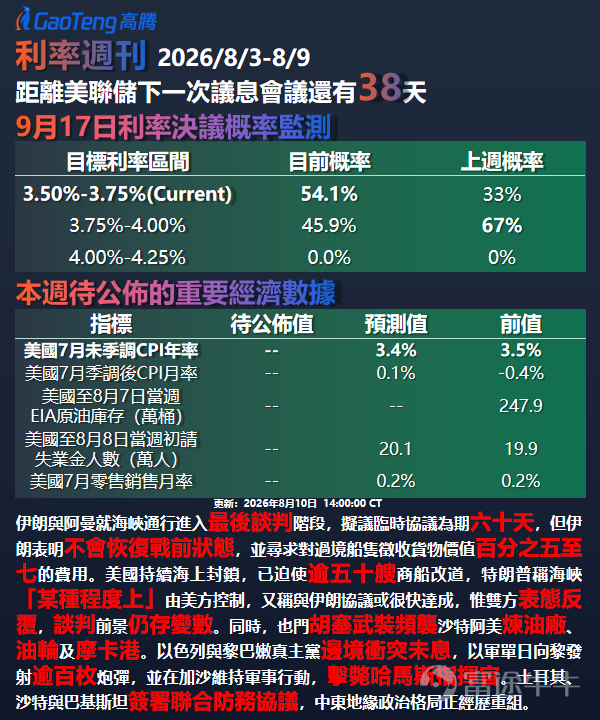
CME FedWatch(As ofAugust 9) indicates that rates will be held steady3.50%-3.75%Probability is54.1%,interest rate hiketo3.75%-4.00%Probability is45.9%。
compared to a week ago (July 31),interest rate hikeprobability had previously reached as high as67.0%—in just seven trading days,interest rate hikeexpectations have receded from an overwhelming consensus to less than 50%.
The drivers areNon-farmThe surprising weakness in nonfarm payrolls and significant downward revisions to May-June employment data led to a notable decline in short-end yields.
▌ Weak nonfarm payrolls reverse rate hike expectations
JulyNon-farmUnexpected job losses and substantial downward revisions to May-June data have completely shaken market expectations for Septemberinterest rate hikethereby strengthening franchisees’ confidence to continue.
Interest rate futures indicate an expected cumulative cut ofinterest rate hikeonly28 basis points, lower than theNon-farm32 basis pointsprior to the release。
previously reinforced by three dissenting voteshawkishconsensus quickly unraveled in the face of signs of a weakening labor market.
▌ The first stress test for the passive tightening strategy
Wallerrelying on spontaneous tightening via long-end yieldsfinancial conditions'spassive strategy,last weekfaces direct challenges from incoming data.
Walleracknowledged communication missteps since taking office—failing to sufficiently reinforce the key message on price stability, and causing market confusion with long-term reform plans.
whenPassive tighteningfacing weakening employment data,the Federal Reserveis caught in a dilemma:interest rate hiketightening further exacerbates downside economic risks, while notinterest rate hikedoing socredibility on inflationwould be further damaged.
Non-farmThe weakness triggered a broad decline in U.S. Treasury yields, with short-end yields falling more than long-end yields, implying the market is not only delayinginterest rate hikerate hike expectations, but alsointerest rate cutmaking room for subsequent moves.
Mitsubishi UFJAnalysts even forecastthe Federal ReserveThe next move could come as early asrate cuts in 2027, reflectinginterest rate hikeExpectations of the end of the cycle are being priced in more rapidly.
Bank of AmericaCEOMoynihanput forth an aggressive forecast, predictingthe Federal Reservethree consecutive rate cuts starting in Septemberinterest rate hike—reflecting market expectationsextreme divergence。
However, interest rate futures are priced in direct contradiction to this, suggesting a rare divergence between institutional forecasts and market trading.
▌ Fed Developments: Wash Miscommunication and Escalating Trump Intervention
WallerApprovedMiscommunicationwhile at the same time,Trumppublicly statedinterest rate hikethe issue was left toWallerbe handled with appropriate discretion.
More critically, the White House sent a letter demandingFed Governor Cookrespond within three weeks to allegations of mortgage fraud, a move widely seen as interference inthe Federal ReserveA direct challenge to independence.
There are reports thatWalleris considering reducing the frequency of its annual interest rate meetings; if implemented, this reform would further compressPreliminary Guidance.
▌ Focus of the Hawk-Dove Debate
Hawks:Fed Governor Cookclearly stated that ifinflationremains elevated, they would supportinterest rate hike;Kansas City Fed President Schmidbelieves a tighter monetary policy is needed to restore price stability;Richmond Fed President Barkinsaid headwinds necessitate tightening. The trio's remarks remain hawkish, but their marginal impact on markets has clearly weakened compared toNon-farmdata.
dovish:New York Fed President Williamsexpects a decline in the second half of the year,inflationimplyingdovishflexibility.MUFGForecastFed rate cuts in 2027, the market has already started pricing ininterest rate hikeEnd.
Centrists:San Francisco Fed President DalySupportHold position and take no action, noting that tech investment is a newinflationrisk.Wasserman Schultz's passive strategyis wavering between weakening data and internal hawkish voices,credibilityThe deficit continues to widen.
▌ Yield Curve: Early signs of a shift from bear steepener to bull flattener
Last week, the yield curve moved uniformly lower, with short-end yields falling more than long-end yields— $U.S. 1-Year Treasury Bills Yield (US12M.BD)$ downward4.0 basis pointsto4.005%, $U.S. 3-Year Treasury Notes Yield (US3Y.BD)$ down9.7 basis pointsto4.264%, $U.S. 5-Year Treasury Notes Yield (US5Y.BD)$ down 9.8 basis points to4.355%, $U.S. 10-Year Treasury Notes Yield (US10Y.BD)$ down8.9 basis pointsto4.650%, $U.S. 30-Year Treasury Bonds Yield (US30Y.BD)$ down7.3 basis pointsto5.203%。
The curve has been shifting since last weekbear steepeningShift in directionbull flattenertaking shape, reflecting the market pricing inNon-farmweakening asinterest rate hikethe end drawing near, rather than deteriorating growth expectations.
Key yield spreadsnarrowing imply front-running of the end of the tightening cycle.
▌ Historical perspective
August 2023SimilarNon-farmWeakening triggeredthe Federal Reservea pauseinterest rate hikeafter which U.S. Treasury yields declined by about50 basis points,Goldrising more than 10%.
Current overlayHormuzCrisis and energy supply risks show historical parallels in direction, but with greater variables.
▌ Scenario Analysis
Scenario 1 (SeptemberHold position and take no action):interest rate hikeExpect further retreat; short-end yields catch down, curvebull flattenerdeepens,Gold safe-haven premiumpersists.
Scenario 2 (Septemberinterest rate hike): long-end catches up, curve returns tobear steepening,Goldand pressuring equities.
Currently leaning toward Scenario One, butWallerCommunication style has made the path more variable than in previous cycles.
▌ Market Sentiment Snapshot
Non-farmUpsets andHormuzcrises coexist, leaving the marketinflationtorn between stickiness and recession concerns. Treasury yields fell across the board,Goldsurged,the yenstrengthened—classicRisk-off tradesThe risk-off mode is fully unfolding, with capital accelerating its withdrawal from risky assets.
▌ Other Major Central Bank Developments
People's Bank of China: Held its second-half work conference, maintaining a moderately accommodative stance. For the consecutive21st monthto increase his stake inGoldto76.08 million ounces, the Political Bureau proposed using a combination of tools including RRR cuts,interest rate cutleaving room for further monetary easing within the year.
Bank of Japan: June meeting minutes showed members unanimously agreed to continueinterest rate hikeAppropriate.Fitchexpects Octoberinterest rate hike. A new round of foreign exchange market intervention could costUSD 87 billion,US-Japan interest rate differentialExpectations for narrowing have strengthened.
Bank of England: Traders are no longer betting on a25-basis-point rate hike within the year, market pricing reversed, reflecting the growing expectation that the global tightening cycle has peaked.
▌ Market Reaction: Extreme divergence with gold surging and crude oil plunging
GoldSurging sharply7.39%to4,401.3 USD, WTI plunged11.20%to77.08 USD, $Brent Last Day Financial Futures (DEC6) (BZmain.US)$ decline5.78%to78.72 USD。
Hormuzcrisis boostedsafe-haven demandsupportGold, but crude oil was weighed down by fears of a global recession, leading to a complete divergence between the two.
U.S. Treasury yields declined across the board,real interest ratesthe pullback provided additional support.GoldWTI crude fell far more than Brent, reflecting unique pricing pressures from oversupply in U.S. shale oil.
Gold, and the concurrent rally in U.S. Treasuries points to a classicrisk-off trade.model.
▌ Closing Remarks
This week’s core focus is onNon-farma surprising reversal.interest rate hikeexpectations,Waller's passive tighteningstrategy faces its firstdata test.。
Investors should closely monitorMid-AugustJuly data to be released soonCPIandPCE—ifinflationdecline in tandem, the probability of a Septemberinterest rate hikerate hike will drop below 30%, confirming the curve trend;bull flattenertrend is confirmed;
ifinflationremains sticky,hawkishdivergence heats up again, and the market returns to a tug-of-war pattern, trading sideways.
$GaoTeng WeInvest Money Market Fund (HK0000478930.MF)$ $GaoTeng WeValue USD Money Market Fund (HK0000584752.MF)$ $GaoTeng WeFund-GaoTeng Asian Income Fund (HK0000447943.MF)$ $USD (USDindex.FX)$ $USD/JPY (USDJPY.FX)$ $Nasdaq Composite Index (.IXIC.US)$ $Dow Jones Industrial Average (.DJI.US)$ $S&P 500 Index (.SPX.US)$ $Hang Seng Index (800000.HK)$ $Hang Seng TECH Index (800700.HK)$ $CBOE Volatility S&P 500 Index (.VIX.US)$
Risk Disclaimer: The above content only represents the author's view. It does not represent any position or investment advice of Futu. Futu makes no representation or warranty.Read more


Comments
to post a comment
7
1