The Fed raises interest rates for the first time in three years! How will the market react?

Bidding Farewell to the 'Dual Mandate': How Should Macro Data Be Interpreted in the Warsh Era?
At 2:00 p.m. ET on July 29, the Federal Reserve voted 9–3to keep the federal funds rate unchanged in the range of 3.50%–3.75%.Following the release of the statement, $S&P 500 Index (.SPX.US)$$Nasdaq Composite Index (.IXIC.US)$$Dow Jones Industrial Average (.DJI.US)$ the three major indices briefly turned positive—the market initially interpreted the 'no change' decision as a mildly dovish signal.
However, the rebound was extremely short-lived. At 2:30 p.m., following the press conference launched by newly appointed Fed Chair Warsh, market sentiment abruptly soured, and equities quickly accelerated their decline—long-end bond markets reacted first.The yield curve for 30-year U.S. Treasuries steepened significantly, reaching its highest level since 2007. The S&P 500 dropped more than 2% in a single day; the Dow Jones Industrial Average fell 1,153 points, marking its steepest one-day decline in over a year; and the Nasdaq 100 entered a technical correction zone.

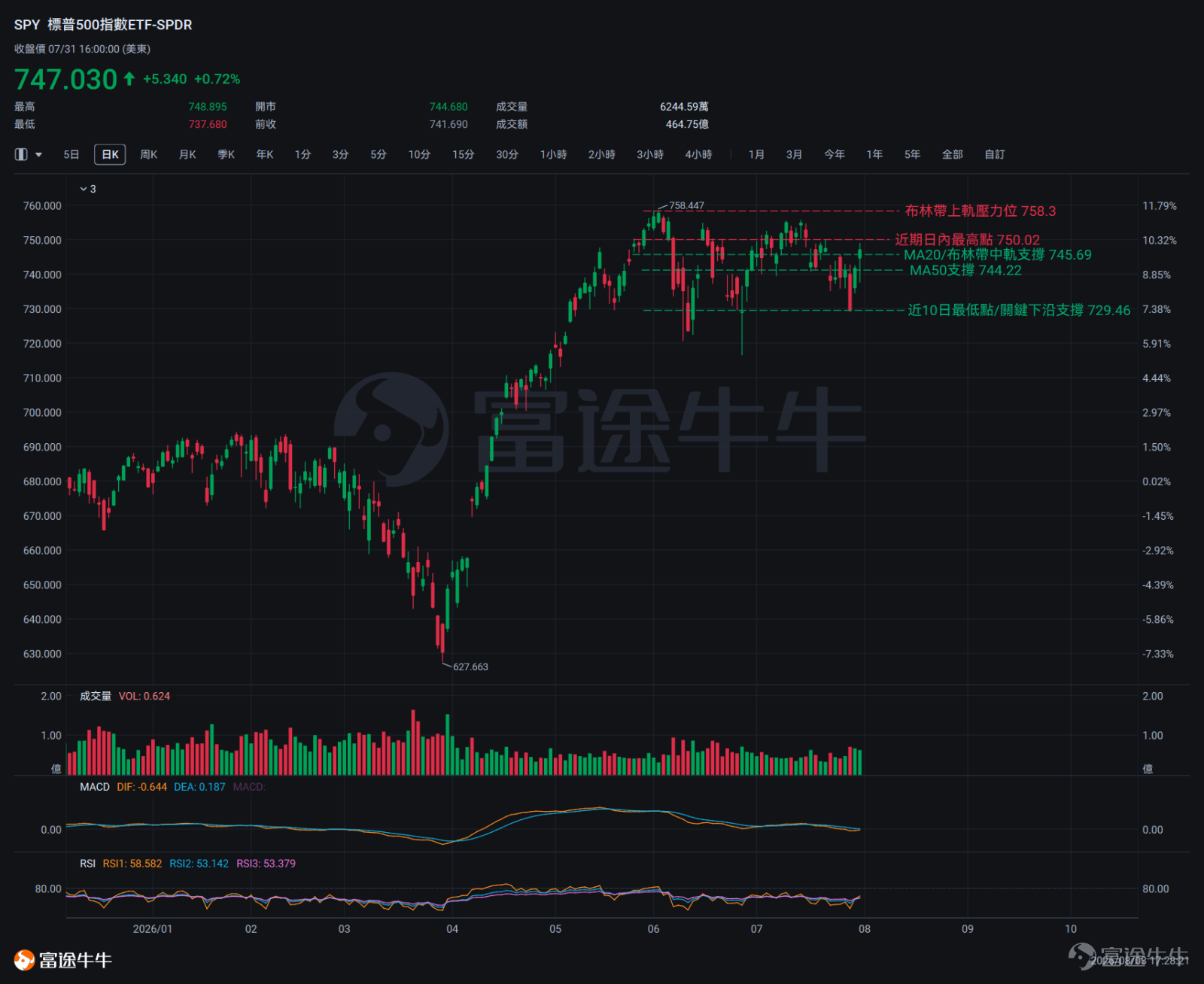
As of July 31, $SPDR S&P 500 ETF (SPY.US)$ the closing price stood at $747.03, above both the 20-day moving average (MA20) at $745.69 and the 50-day moving average (MA50) at $744.22. Although the short-term moving averages are in a bullish alignment,the structure remains relatively flat, with limited support depth—if the share price falls below $744, the bullish alignment risks unraveling.The MACD currently remains in abearish crossover state,with both lines trading below the zero line and the histogram persistently negative,indicating that momentum has yet to receive effective confirmation.
In terms of support levels,$745.69 (20-day moving average and middle Bollinger Band) and $744.22 (50-day moving average, the key medium-term support/resistance level) form the core dual support zone,a breakdown below this zone warrants caution regarding accelerated downside risk.Secondary support lies in the $738–$739 range (the three-day closing price consolidation zone from July 23 to 27),a break below which would bring prices back to the lower boundary of the recent trading range,raising the possibility of another test of the $729.46 low.
On the upside,$750.02 (recent intraday high, top of the upper shadow on July 22) serves as the immediate resistance target; only after a sustained breakout above this level should attention shift to the upper Bollinger Band at $758.30.

Meanwhile, $Invesco QQQ Trust (QQQ.US)$ Friday’s closing price of $687.99 sits below both the 20-day MA ($701.02) and the 50-day MA ($714.75), confirming a bearish alignment, with both short- and medium-term moving averages exerting downward pressure from above.Bearish momentum continues to build, indicating strong downward pressure.Bollinger Bands are currently in an expansion phase, with the stock price trading between the middle band ($701.02) and the lower band ($666.24).
On the support side,$683.55 (the close of the bullish reversal candle on July 30, the first sign of stabilization recently) serves as the most critical current support reference;a break below this level would invalidate the stabilization signal.Secondary support levels are sequentially at $675.49 (July 28 closing price within a high-volume consolidation zone) and $661.14 (the intraday low on July 29, the absolute low over the past 10 days). The Bollinger lower band at $666.24 also provides dynamic support; if $661.14 is breached, further downside potential should be monitored.
On the resistance side,$695.77 (the intraday high on July 31, where the recent rebound stalled) represents the immediate near-term resistance; only a decisive breakout above this level would shift focus to the 20-day moving average (MA20) at $701.02.The MA20 is currently the key resistance point in the prevailing downtrend; if the stock price firmly stabilizes above the MA20,attention would then turn to the directional follow-through toward the 50-day moving average (MA50) at $714.75.
Steve Sosnick, Chief Strategist at Interactive Brokers, succinctly captured the market's current reaction logic to Warsh’s remarks: "The issue isn’t what Warsh said—it’s what he didn’t say. The market now needs to assess whether those hawkish comments represent genuine policy signals or are merely rhetorical."
This article was written just before the release of the non-farm payroll data on August 7 and the CPI data on August 12,We’ll walk you through the key information Warsh deliberately omitted in his latest remarks and how it could impact the near-term trajectory of US equities.
1. Two Missing Words: The Dual Mandate
Comparing the official statements from Warsh’s two press conferences reveals a precise and intentional difference.
In his first press conference on June 17, Warsh still explicitly stated that policy would be 'guided by the Federal Reserve’s dual mandate'—clearly listing both maximum employment and price stability as objectives.
Federal Reserve official press release document dated July 29:

H.R.5396, the Price Stability Act of 2026, passes:

Although the phrase 'dual mandate' still appears in the Fed’s officially published statement, during the July 29 press conference, Warsh’s wording shifted to: 'The Committee will deliver price stability'—Any reference to employment-related objectives completely disappeared.
If this were an isolated incident, it might be dismissed as a mere oversight in phrasing. However, three institutional signals are converging in the same direction: the House Financial Services Committee passed H.R.5396, the Price Stability Act of 2026, by a vote of 30–21, explicitly proposing to narrow the Fed’s mandate to a single inflation target; on July 9, Warsh announced the formation of five external task forces covering inflation frameworks, balance sheet policy, communication strategies, data quality, and productivity and employment, systematically reviewing the current policy framework; and Warsh himself stated outright: 'I do not accept the policy trade-off of tolerating higher inflation for the sake of employment.'
Three signals converge, pointing in the same direction. This is not a wording oversight—it’s a signal.
2. The ‘Fed Put’—the employment put option—is失效

To understand the significance of this signal, one must first grasp what it affects.
For the past 40 years, the Federal Reserve’s dual mandate has provided an implicit policy floor for the stock market, commonly referred to by investors as the ‘employment put option’:Whenever employment data weakened, the Fed was obligated to cut rates to support markets—and historically, rate-cutting cycles have almost always coincided with systematic rallies in risk assets.
Warsh’s shift in stance means the initial link in this transmission chain is being severed. Weaker employment data no longer automatically triggers expectations of rate cuts; and without those expectations, the core trading logic that ‘bad news is good news’ faces fundamental invalidation.
Markets have already begun recalibrating. In May this year, nonfarm payroll data came in far stronger than expected, yet the Nasdaq fell 4% that day—under the old framework, robust employment would have been bullish for equities; under the new framework, it signals persistent inflationary pressures and pushes rate cuts further out of reach.The market logic on nonfarm payroll days has quietly reversed.
3. U.S.–Iran Conflict: The Supply-Side Inflation Dilemma
If the aforementioned framework shift represents a gradual evolution, the escalation of U.S.–Iran tensions introduces a structural accelerator into the entire situation.
The fundamental dilemma of supply-side inflation is that it cannot be effectively addressed by monetary policy alone.Oil supply disruptions caused by war have driven up energy prices, transmitting across the entire price spectrum, yet demand-side pressures are not overheated—in this scenario, tightening monetary policy suppresses growth rather than tackling the root cause of inflation.The Federal Reserve now faces a simultaneous deterioration of persistent inflation and mounting pressure on growth—the precursor conditions to stagflation.
In this environment, cutting interest rates would be interpreted as a concession to both inflation and political pressures,undermining the Fed’s hard-won credibility anchor;while refraining from rate cuts allows growth pressures to accumulate,with the effective operational space for policy tools further compressed by war-related factors.
IV. Surge in 30-year Treasury yields

The rise in long-end rates has delivered another dimension of pressure on equity valuations.
The current S&P 500 price-to-earnings ratio stands at approximately 25x, implying an earnings yield of about 4%; as of the time of writing,The yield on the 30-year US Treasury bond has risen to 5.228%.The equity risk premium (ERP) has thus turned negative—The expected return on holding high-volatility stocks is now lower than that of holding risk-free Treasuries. Historically, this situation is highly unusual and typically accompanied by significant valuation compression pressure.
Notably, Warsh explicitly stated at the press conference that he 'welcomes' rising market yields, calling it a positive signal that 'the market is learning to price based on actual data.'This implies that the Federal Reserve will not only shift its approach toward 'rising long-end rates,' but may even view it as a market-clearing mechanism to eliminate excessive expectations of monetary easing.
Summarizing the above logic, the Fed’s current policy predicament can be described as 'dual lock-in:'
On the motivation front:Under a single-mandate inflation framework,The data threshold required for rate cuts has risen substantially, and political willingness may be insufficient.
On the capacity front:Structural sources of supply-side inflation cannot be eliminated solely through interest rate cuts; premature easing while inflation expectations remain unanchoredcould instead trigger an expectations spiral and further undermine the Fed's credibility.
This means thatThe foundational logic underpinning U.S. equity markets over the past 40 years—'economic weakness → Fed intervention → buy stocks'—is undergoing a systemic rewrite of its institutional premises. This is not a cyclical pause, but a structural repricing.
V. Capital Rotation and Sector Divergence
The aforementioned shifts in the macro environment affect different sectors through distinctly divergent channels.
Among them,Highly valued, long-duration growth tech stocks are most sensitive to interest rates,and lack policy buffers in an environment where the employment 'safety net' has vanished and rates remain elevated; the bond-proxy characteristics of REITs and utilitieshave significantly diminished appeal amid soaring 30-year Treasury yields;small-cap stocks, with 50–60% of their debt structured at floating rates, facecontinuously accumulating refinancing cost pressures; the capital structure stress confronting highly leveraged firms is likewise substantial and should not be underestimated.
On the other hand,The defense industry sector could directly benefit from the certainty of orders driven by wartime consumption; the energy sector has revenue support in an environment where war pushes oil prices higher; large banks may benefit from continued net interest margin expansion in a high-rate environment; commodities and consumer staples offer inflation-hedging characteristics.
6. Key Upcoming Observation Points
Given the current situation’s evolution, investors shouldclosely monitor the following validation points and market reactions:
August 7 (Nonfarm Payrolls data): Observe whether the market has already shifted its interpretation framework—whether strong employment data continues to trigger equity sell-offs (new framework) or is still interpreted as bullish (old framework).
August 12 (CPI data): Under a single-mandate framework, CPI has become the most direct trigger variable for monetary policy, potentially surpassing Nonfarm Payrolls in importance.
Latest developments in U.S.-Iran military tensions (continuously monitored): Whether Iran initiates a blockade of the Strait of Hormuz is the key trigger signal determining if supply-side inflation will escalate further.
Warsh's reaction to employment data (long-term observation)This is the only reliable test to verify whether the policy framework shift is genuine. If future employment data sharply deteriorates and Warsh still refuses to cut rates citing employment concerns, the framework shift can be considered substantively confirmed. However, if Warsh turns 'dovish' as soon as employment data worsens, the signal sent on July 29 is more likely just a cyclical hardline stance rather than an institutional restructuring.
The answer will be revealed by incoming data.
Risk Disclaimer: The above content only represents the author's view. It does not represent any position or investment advice of Futu. Futu makes no representation or warranty.Read more


Comments (2)
to post a comment
27
31