The Fed raises interest rates for the first time in three years! How will the market react?

【Must-read for beginners】Why do tech stocks and Hong Kong equities move whenever the Fed holds a meeting? Learn in 3 minutes how interest rates impact the stocks you're holding!
Have you noticed a pattern? Every few weeks, news pops up about 'Fed rate decisions' or 'FOMC meetings,' and suddenly your tech stocks start swinging wildly in your portfolio—and even Hong Kong stocks follow suit...
What exactly does this 'Fed meeting' have to do with the stocks you hold? Let’s clarify it completely for you in 3 minutes.
📅 Why is this week especially important?
At approximately 2:00 a.m. Beijing time on July 30 (tomorrow), the Federal Reserve will announce the results of its July FOMC meeting.
But the mood this time is very different from previous occasions—the market has dubbed it"the most unpredictable Fed meeting in recent years":
– Base case expectation: Hold rates steady
– Tail risk: The OIS market indicates the probability of a surprise rate hike at this meeting has risen to approximately 38%—such significant pricing divergence just one week ahead of the meeting is an extremely rare occurrence since September 2024.
– Sources of uncertainty: Macro data are showing unusual contradictions—one side sees Middle East geopolitical tensions pushing oil prices higher and persistent inflationary pressures, while the other observes unexpectedly soft June core CPI and core PCE readings, with these opposing forces fiercely offsetting each other.
In simple terms:Even Wall Street's top traders can't be certain right now what the Fed will do.
But as a new investor, rather than guessing whether rates will go up or not, what you really need to understand is—How exactly do interest rate changes affect the assets in your portfolio?
🎓 The 'Transmission Chain' of Interest Rate Changes—from the Fed to Your Stocks
First Layer: Interest Rates → Borrowing Costs
The Federal Reserve’s adjustment of the 'federal funds rate' essentially serves as the global anchor for pricing capital.
– interest rate hike = Borrowing becomes more expensive 💸
– Interest rate cut = Borrowing becomes cheaper 💰
This change ripples through the system like dominoes, progressively influencing corporate and investor behavior.
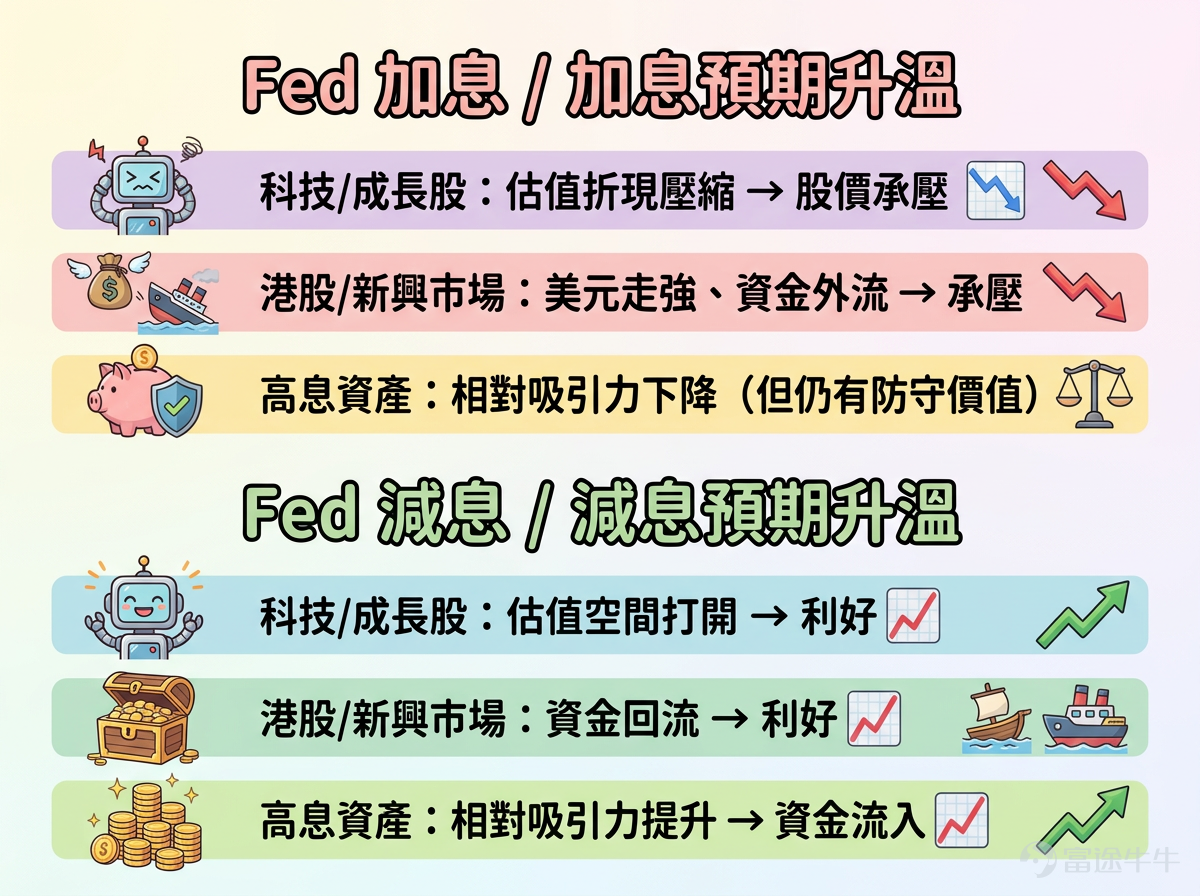
Second Layer: Borrowing Costs → Tech/Growth Stocks (most directly impacted ⚡)
Why are tech stocks most sensitive to interest rates?
Because the valuations of tech companies—especially high-growth, yet-to-be-profitable ones—are largely based on 'profits they will earn many years in the future.'
There's a concept in finance called DCF (Discounted Cash Flow):
📐 Simply put: $100 in future profit must be discounted back to its present value using a 'discount rate.' And the core component of this discount rate is—interest rates.
– Higher interest rates → higher discount rate → future profits become worth less in today's terms → company valuation compresses → Stock price drops
– Lower interest rates → lower discount rate → future profits become worth more in today's terms → valuation expands → stock price rises
This explains why, whenever the market hears rumors of 'interest rate hikes,' $NASDAQ (NASDAQ.US)$ and $Hang Seng TECH Index (800700.HK)$ it is often the first to be hit.
Third layer: Borrowing costs → Hong Kong and emerging markets (capital flow effect 🌊)
As an offshore market, Hong Kong stocks are especially sensitive to U.S. dollar interest rates:
– U.S. rate hikes / sustained high interest rates → Higher returns on U.S. dollar assets (e.g., U.S. Treasuries) attract international capital flows back to the U.S. → Hong Kong stocks face outflow pressure → Hong Kong stocks come under pressure
– U.S. rate cuts → Lower returns on U.S. dollar assets prompt investors to seek higher-yielding opportunities → capital flows into Hong Kong and other emerging markets → Hong Kong stocks benefit
This is one of the deeper reasons why A-shares have performed relatively steadily this year (dominated by domestic capital and less affected by U.S. dollar interest rate transmission), while the Hang Seng Tech Index has underperformed over the same period.
Layer 4: Interest Rates → High-Yield Assets / Dividend Stocks (Seesaw Effect ⚖️)
Many people buy high-dividend stocks, REITs, or high-yield ETFs for 'stable income.' However, changes in interest rates directly affect the attractiveness of these assets:
– During rate hikes: Interest rates on 'risk-free assets' like bank deposits and government bonds rise accordingly. When you can earn a 5% return without taking any risk, a high-dividend stock offering a 6% yield—but subject to share price volatility—becomes relatively less attractive.
– During rate cuts: As risk-free rates decline, the relative appeal of high-dividend stocks re-emerges, drawing capital back in.
🗺️ One chart to summarize: The full picture of interest rate transmission

💡 So, how should beginners position themselves ahead of tomorrow’s FOMC meeting?
The most important point: Don’t try to bet based on guessing the outcome.
As analyzed above, even the market itself is assigning a roughly '50-50' probability—under such conditions, betting on direction is no different from gambling at a casino.
What beginners should focus on instead is:
1. Learning 'response mechanisms' rather than 'predicting outcomes': You don’t need to know whether the Fed will raise rates, but you do need to understand how your holdings—tech stocks, Hong Kong stocks, or high-dividend stocks—will each react if a hike actually happens. This article has already laid that groundwork for you today.
2. Diversify allocations and manage position sizing: Don’t put your entire net worth into a single asset class highly sensitive to interest rates.
3. Use the economic calendar wisely and prepare in advance: In addition to tomorrow’s FOMC decision, this week also features the release of U.S. GDP and PCE data—all of which will influence market expectations for the future interest rate path.
📲 Want real-time insights on how the FOMC outcome impacts your portfolio?
In the face of market uncertainty, knowledge is always your best weapon. Instead of anxiously staring at price charts, spend just three minutes understanding the underlying logic—When you understand 'why it's falling,' you won't be easily scared off by market volatility.
Open the Futubull app:
– 📆 "Market Calendar": One-tap access to all key economic events this week (FOMC, GDP, PCE data release times)

– 🎓 "Futu Academy": More beginner-friendly investment education content on interest rates, valuation, and asset allocation

– 🤖 "AI Q&A": Instantly ask questions like 'How do rate hikes affect tech stocks?' and get intelligent answers. You can also chooseExpert Mode—It not only provides market insights, stock selection, diagnostics, and portfolio analysis, but can also write code, build indicators, and execute strategies—turning your investment ideas from 'inspiration' to 'validation' in a seamless, no-code experience.


Risk and Disclaimer: Futubull is an all-in-one financial investment trading platform, with brokerage services provided by Futu Securities International (Hong Kong) Limited. This content is for investor education purposes only and does not constitute an offer, solicitation, recommendation, opinion, or any guarantee regarding any securities, financial products, or instruments. Investing involves risks; fund prices may rise or fall.
Risk Disclaimer: The above content only represents the author's view. It does not represent any position or investment advice of Futu. Futu makes no representation or warranty.Read more


Comment (1)
to post a comment
22
24