
Wallsh speech incoming: What's next for US stocks, Bitcoin, and gold?

$100 Options Mini Recap | Did Nokia’s earnings turn from bullish to bearish? Oil prices break out—bulls rejoice!
Fellow investors, the market presented two starkly different scenarios this week—one was the Finnish telecom giant $Nokia Oyj (NOK.US)$ , whose share price unexpectedly dropped after its earnings announcement; the other was crude oil suddenly surging, $United States Oil Fund LP (USO.US)$ rallying sharply for several consecutive days.
In this episode, we’ll break down these two trades: How did puts betting against Nokia harvest profits right after earnings? And how did calls riding the crude oil rally multiply fivefold in just a few days? More importantly, each case reveals a practical options insight—if you understand them, next time a similar opportunity arises, you’ll know whether to jump in and when to exit.
Enough talk—let’s dive straight into this week’s recap.
Nokia: Solid earnings—so why did the stock still drop?
For many, the name Nokia evokes nostalgia—the phones that could crack walnuts, Snake, and the legendary 'never turns off' reputation.However, in the capital markets, this Finnish company has long transformed into a leading global communications equipment supplier, and its optical networking business has recently hitched a ride on the AI boom.
Interestingly,Nokia's earnings report isn't actually bad.Nokia’s Q2 profit beat expectations, with sales from its AI and cloud businesses doubling, prompting the company to raise its full-year profit guidance. By the numbers, this was a 'broadly better-than-expected' report.
But what about the stock price? Following the earnings release, NOK shares plunged—closing at $9.73 on Wednesday, down more than 5% for the day.
Stronger-than-expected results but a falling share price—this isn’t a bug; it’s how markets really work.
First, market sentiment was weak overall on the day of the earnings release, with broader indices underperforming. In a risk-off environment, positive news tends to have diminished impact. Second, the communications equipment sector faces headwinds from a slowing 5G investment cycle: after years of aggressive network buildouts, global telecom operators are now cutting back on capital expenditures. The market remains skeptical about Nokia’s growth prospects in the coming quarters—strong performance this quarter doesn’t guarantee strength next quarter.
Stock prices reflect expectations, not just current earnings figures. When concerns about the future persist, even a 'better-than-expected' report can lead to a sell-off.
What’s happening with options?

(The design image shown on screen is for illustrative purposes only and does not constitute any investment advice or guarantee. Market conditions change frequently; the displayed option prices do not reflect real-time data. Options shown are filtered based on an initial price below $3 per contract.)
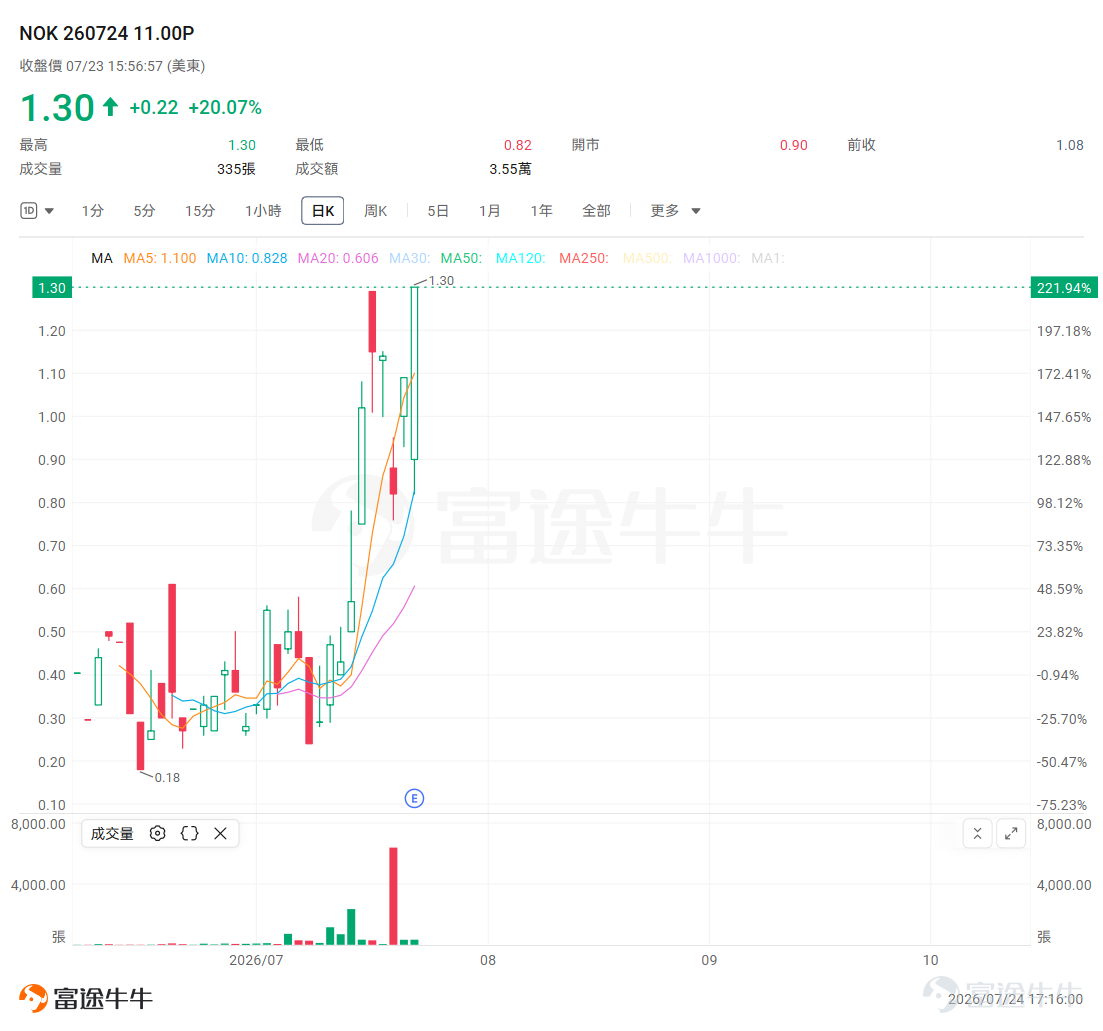
Let’s take a look at this NOK put contract—NOK 260724 11.00P, which is a put option expiring today, July 24, with a strike price of $11.
The fate of this contract is clearly visible on the chart:
Before the earnings announcement, the price of this put option hovered steadily between $0.30 and $0.50. Think about it—just $30 to $50 per contract, less than the cost of a decent dinner.
Lowest point: The chart shows it once dipped to around $0.18—at that point, buying one contract would have cost only $18, a true 'bargain-bin' price.
Breakout moment: After the earnings release, the stock price plunged, and this put option took off. It climbed steadily from its early-July low, peaking around $1.30 in early July (around July 7).
Closing price: As of July 23, it was quoted at $1.30, up 20.07% for the day.
Additionally, note that this contract has a strike price of $11, while NOK’s current stock price is $9.73, meaningThis put option is already in the money.——It has real intrinsic value—not just 'air' propped up by time and volatility.
The most counterintuitive aspect of earnings trades is this: whether the results themselves are good or bad is often not the sole factor driving the stock price.
Many beginners think: ‘Earnings beat expectations—so the stock must go up!’ They buy calls the day before earnings, only to watch their calls expire worthless the next day while reading headlines like ‘Profits Double!’
Here are a few realities you need to accept:
Market conditions matter more than individual company earnings—If the broader market or sector is down on earnings day, your stock will likely get dragged down too.
Forward guidance matters more than current-quarter results—Wall Street cares about the future, not the past. Even if this quarter’s results are strong but next quarter’s guidance is weak, the stock will still drop.
Expectation gaps are what really matter—If the market has already priced in good news, then 'good' is no longer a surprise. Only results that exceed even the most optimistic expectations can truly drive the stock price upward.
This NOK putessentially reflects not 'Nokia's poor performance,' but rather 'even if earnings aren't bad, the stock price might still not hold up under current market conditions.'
Of course, such a judgment requires a comprehensive grasp of market sentiment, sector trends, and capital preferences—it’s not something you can win by random bets. Options have never been a 'sure-win' game, butusing lower cost to chase greater potential—that’s precisely where their appeal lies.
USO: Oil prices surge—call buyers double their gains
If Nokia exemplifies 'expectation-driven trading,' then USO’s recent move is pure trend-following momentum.。
USO is the United States Oil Fund, which tracks WTI crude oil futures prices. In other words, buying USO is equivalent to indirectly buying crude oil—the fund rises when oil prices rise and falls when they drop, making the logic very straightforward.
This week, international oil prices staged a sharp rally.Why is oil rising? The crude oil market has always been a barometer of geopolitical tensions.
Ongoing tensions in the Middle East and the continuing fallout from the Russia-Ukraine conflict mean that any news suggesting a potential supply disruption excites bullish traders.More importantly, Trump has recently resumed making frequent public statements, and the resulting policy uncertainty has fueled speculation about future supply dynamics.
Geopolitical events act like a 'switch' for oil prices: usually quiet, but once triggered by news, volatility hits quickly and sharply.This is also why crude-related options have frequently posted astonishing gains this year—volatility itself is the lifeblood of options.

(The design image shown on screen is for illustrative purposes only and does not constitute investment advice or guarantee; market conditions change rapidly, and the option prices depicted do not reflect real-time data. Options displayed were selected based on an initial price below $3 per contract.)
Let’s take a look at this one:USO 260729 140.00C—a call option expiring on July 29 with a strike price of $140.
This contract's price action is a textbook example of trend-following:
Starting Point: Around July 17, the price of this call option was only about $0.86—$86 per contract, roughly the cost of two Starbucks drinks.
Accumulation Phase: From July 17 to 21, the contract price slowly climbed within the $1.50–$2.00 range, as oil prices continued consolidating.
Breakout Moment: On July 22, USO’s underlying stock broke out, and this call option surged along with it—jumping from around $2 directly into the $4–$5 range.
Peak Moment: On July 23, it hit an intraday high of $6.80!
Closing price: As of the July 23 market close, it settled at $5.20, marking a single-day gain of 176.11%.
All of this unfolded in less than a week.
This case illustrates the most alluring aspect of options:In a strong trending market, options can appreciate far more than the underlying stock.
USO’s underlying stock rose from around $123 to $139—a 16% gain. But this call option with a $140 strike price surged from $0.86 to $5.20, an increase of over 500%.
As the underlying stock price approaches the strike price, this option shifts from 'likely expiring worthless' to 'having a chance to become in-the-money,' causing its sensitivity to the stock’s price movements to spike sharply. For every $1 increase in the underlying stock, the option might rise by several cents or even $1—and since its base price is only a few cents, the percentage gain becomes extremely exaggerated.
But a crucial reminder here:Oil price moves driven by geopolitical events tend to be fast and fleeting.
Today, prices might jump 5% on news of 'escalating conflict,' only to reverse tomorrow on reports of 'ceasefire negotiations.' A single tweet from Trump, a statement from OPEC, or an action by an oil-producing nation could instantly flip oil prices.Volatility cuts both ways—it can multiply your gains or wipe you out entirely.
This contract expires on July 29, leaving only a few trading days remaining. If oil prices pull back over the next few days and USO drops to $138 or $137, this call option’s price could plummet just as dramatically.Time value is like the last few grains of sand in an hourglass—slipping away before your eyes.
So, when trading near-month options during geopolitically driven market moves, you profit from 'amplified volatility,' but you also need discipline—Take profits when they’re good; don’t wait until the wind shifts before thinking about exiting.
In summary: one drop, one rally—two strategies, same principle.
This week’s two cases perfectly illustrate the two sides of the same coin in the options world:
NOK put: Betting that 'even strong earnings won’t save the stock price' in a weak market environment, risking $30 to potentially gain $130—and patiently earned a 7x return;
USO call: Riding a geopolitically driven breakout trend, risking $86 to potentially gain $520—and achieved a 6x return in less than a week.
One is 'expectation-based speculation,' the other is 'trend-driven'; one is short, the other is long.But at their core, both are doing the same thing: using limited capital to capture asymmetric return opportunities at moments of relatively high conviction.
Buying puts on earnings day bets on the market principle that 'even positive news can’t prop up a stock when the overall environment is poor'; buying calls after a trend breakout bets on the technical logic that 'breakouts often lead to continuation.' Neither is blind guessing—they’re informed, evidence-based trades.
Of course, your judgment might be wrong. If Nokia’s stock had strong market support or its sector surged that day, that put would expire worthless; if oil prices broke out but immediately pulled back due to a piece of 'de-escalation' news causing a false breakout, that call would quickly lose value.The high reward potential of options never comes for free—the flip side is the extreme risk of losing your entire investment if you’re wrong.
$100 in, $1,000 out—options truly offer the possibility of leveraging small capital for big opportunities. But this possibility hinges on three things: picking the right direction, timing it correctly, and managing position size properly. Understand first, then act. Get your timing right, and opportunities will never be in short supply.
See you in our next recap~
Not familiar with options basics? Study up before jumping in.
If, while reading this recap, you’re still fuzzy on concepts like 'What is a long call?' or 'How do I read strike prices?', don’t rush into placing orders—take some time first to solidify your fundamentals. We’ve compiled practical beginner resources below; consider bookmarking them:
Finally, we’ve got a little perk for our fellow investors—feel free to claim it!Options Starter Pack
*This promotion is exclusively available to invited Hong Kong users. Click to learn more.Detailed terms and conditions of the promotion >>

Disclaimer
This content does not constitute an offer, solicitation, recommendation, opinion, or any guarantee regarding any securities, financial products, or instruments. The risk of loss in trading options can be substantial. In certain circumstances, your losses may exceed the initial margin deposit. Even if you place contingent orders, such as 'stop-loss' or 'limit' orders, there is no assurance that losses will be avoided. Market conditions may prevent these orders from being executed. You may be required to deposit additional margin on short notice. If you fail to meet the required margin within the specified time, your open positions may be liquidated. Nevertheless, you remain liable for any deficit balance in your account resulting from such events. Therefore, you should thoroughly research and understand options before trading, and carefully consider whether such trading is suitable for you based on your financial condition and investment objectives. If you trade options, you should familiarize yourself with the procedures for exercising options and handling expiration, as well as your rights and obligations upon exercise or expiration.
Risk Disclaimer: The above content only represents the author's view. It does not represent any position or investment advice of Futu. Futu makes no representation or warranty.Read more


Comments (3)
to post a comment
17
22