
Wallsh speech incoming: What's next for US stocks, Bitcoin, and gold?

Unexpected CPI cooldown + Waller's 'zero tolerance'—who should investors trust in the new earnings season?
On July 14 (Eastern Time), several macro developments unfolded nearly simultaneously: June CPI came in cooler than expected, easing bets on further rate hikes; Fed Chair Kevin Warsh, in his congressional debut, reiterated a 'zero tolerance' stance toward persistently high inflation; the five largest Wall Street banks reported strong Q2 earnings on the same day, officially kicking off the U.S. earnings season; and more troublingly, renewed U.S.-Iran hostilities pushed oil prices higher.
A favorable inflation print collides with costlier policy resolve. Looking only at the market's immediate reaction, it’s easy to jump to the simplistic conclusion of 'data-friendly, risk appetite recovering.'
But when these threads are layered together, investors actually need to grapple with four harder questions:Is the one-month drop in inflation a turning point or an illusion? Could the resurgence in oil prices erase the recent disinflation progress? Will the Warsh-led Fed prioritize incoming data or policy resolve? And amid macro volatility, how will tech stocks perform this earnings season?
1. CPI Surprisingly Cools: Rate Hike Bets Retreat, but Geopolitical Risks Loom
Data from the U.S. Bureau of Labor Statistics showed that June CPI declined 0.4% month-over-month—the steepest drop since April 2020—and annual CPI eased to 3.5% from May’s 4.2%. Core CPI was flat at 0.0% month-over-month and rose 2.6% year-over-year, both below market expectations.
The primary driver behind this inflation cooldown is falling energy prices. Meanwhile, core inflation also cooled, indicating that the improvement isn’t solely due to energy-related factors. Sticky components like shelter and services are also showing signs of marginal easing.
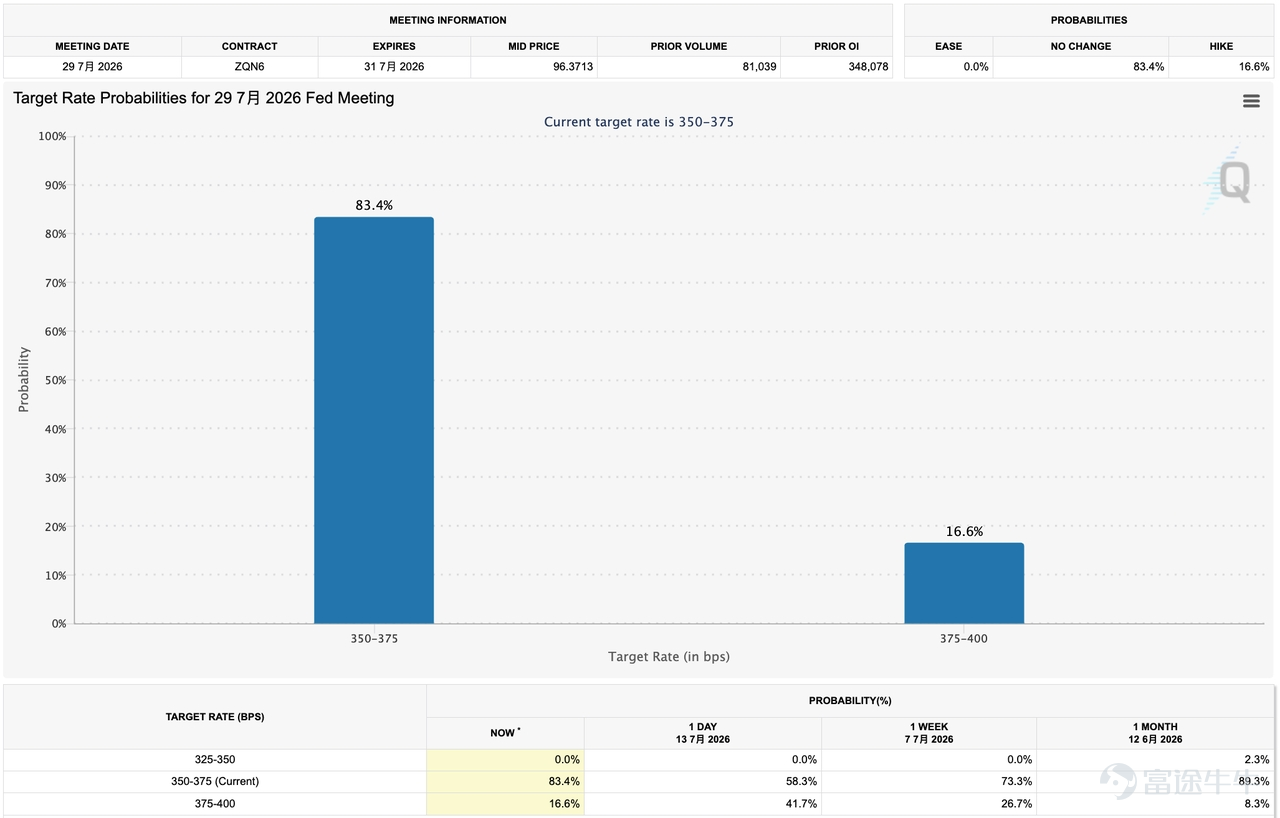
Following the data release,according to CME FedWatch, the probability of a 25-basis-point rate hike at the July 29 FOMC meeting dropped from approximately 42% the previous day to around 16%, and the likelihood of a September rate hike also declined notably; Treasury yields fell, and U.S. equity index futures rose simultaneously.

However, this 'rosy CPI' figure emerged against a backdrop of eased geopolitical tensions—it benefited from lower energy prices. Yet over the past week, with the U.S.-Iran memorandum of understanding collapsing and hostilities reigniting, oil prices, after retreating to pre-conflict levels, now face renewed upside risks.

For U.S. equities, higher oil prices would lift inflation expectations, constrain hopes for monetary easing, and pressure valuations of growth stocks. Thus, markets may exhibit an apparently contradictory pattern—indices breathing a sigh of relief due to diminished rate hike expectations, yet becoming more selective toward high-valuation tech names in terms of style preference.
The latest CPI decline has reduced the near-term likelihood of a rate hike but has not eliminated uncertainty around monetary policy for the year; a market trading window has opened, but a rate-cutting cycle has not yet begun in tandem.
Investors should pay closer attention to the stability of the inflation narrative,If oil prices rise only in a temporary spike, they are more likely to be treated as a one-off shock; however, if disruptions related to the Strait of Hormuz persist and gasoline prices remain stubbornly elevated, the representativeness of June’s CPI sample will quickly deteriorate.
II. Waller’s Congressional Debut: 'Zero Tolerance' for Persistently High Inflation, with AI Specifically Highlighted
On the same day, Waller delivered his first semiannual monetary policy testimony to Congress since taking office.He explicitly stated that the Committee has 'no tolerance' for persistently elevated inflation and remains firmly committed to restoring price stability.
In response to the unexpectedly cooler CPI data, he emphasized that it represents just one month’s data point and bluntly remarked, 'Some might say, "Mission accomplished," but that’s not my view.' He directly affirmed that if pressured externally, he would 'continue doing my job.'
Nick Timiraos, dubbed the 'new Fed whisperer,' noted that Waller deliberately avoided offering any hints about the future rate path, aiming to prevent markets from interpreting a single data point as an imminent policy pivot. Bloomberg assessed his overall tone as hawkish, indicating the Fed is unwilling to signal easing until it is confident inflation is sustainably returning to target.
More forward-looking was his commentary on AI.Waller said the timeline for AI-driven productivity gains remains uncertain, but the demand it creates for capital, labor, and infrastructure 'is already happening,' and the Fed is 'closely monitoring its impact on inflation and employment.'This indicates that AI is both a profit story and has been added by Waller to the inflation watchlist.
Two key observation windows are also coming up tonight:The U.S. June PPI will be released at 20:30 Beijing time, followed by Waller’s testimony before the Senate Banking Committee again at 22:00 Beijing time. The former will test whether the cooling inflation trend is also reflected on the upstream production side, while the latter will focus on whether he offers any new remarks under lawmakers’ questioning.
III. Earnings Season: The Big Five Banks Report First, but Tech Is the Real Final Exam
On one hand, there’s better-than-expected cooling inflation data; on the other, a hawkish Fed Chair.The tug-of-war between improving macroeconomic data and policy stance will continue unfolding over the next few weeks, and the upcoming earnings season may well be the true litmus test.
The Q2 earnings season has already kicked off, with Wall Street’s Big Five banks ( $JPMorgan (JPM.US)$ 、 $Bank of America (BAC.US)$ 、 $Citigroup (C.US)$ 、 $Wells Fargo & Co (WFC.US)$ And, $Goldman Sachs (GS.US)$ ) all reporting results before market open on July 14. Public data shows that the combined net profit of these five top investment banks exceeded $49 billion in Q2, marking significant year-over-year growth, driven primarily by rebounds in investment banking and trading businesses.
Goldman Sachs expects S&P 500 companies to post a 22% year-over-year surge in Q2 earnings, with AI infrastructure-related stocks contributing nearly 60% of this growth, $Micron Technology (MU.US)$ and $NVIDIA (NVDA.US)$ with two companies alone accounting for over 40%. Market expectations for strong earnings have already been priced in, making it critical whether tech stocks can deliver results that justify their current valuations—a key focus for investors.
Among all variables, AI capital expenditure is the biggest uncertainty.Over the past two years, the 'AI narrative' has been the core engine driving up U.S. equity valuations, with tech giants announcing capital expenditure budgets often reaching tens of billions of dollars, attracting strong market interest. However, the situation is changing.Investment banks such as Morgan Stanley recently warned that as AI investment commitments continue to escalate, market focus is shifting from 'burning cash' to 'generating profits.'
If Q2 earnings reports show tech giants becoming more cautious about AI spending, the market may reassess the sustainability of the entire AI investment narrative. Conversely, if spending remains elevated without translating into revenue growth, earnings pressure could similarly weigh on stock prices—making this the central theme of the earnings season.
4. U.S. Equity Index ETF Options Strategies
Amid a complex environment shaped by geopolitical risks, policy shifts, and earnings reports, the following section uses $Invesco QQQ Trust (QQQ.US)$ as an example to discuss index options strategies.
Options data shows that QQQ's put/call ratio exceeds 1, with an open interest put/call ratio of 1.42, indicating relatively high overall hedging demand in the market. Its implied volatility sits in a moderately high range, with a relatively high volatility percentile. Given the high cost of options premiums during this event-dense window, structured options strategies offer better value than simple directional trades.


1. Bull Call Spread
This strategy suits investors who are optimistic that market sentiment will continue improving as CPI cools down and believe geopolitical risks won’t escalate into a systemic crisis, yet are unwilling to bear the high costs of buying outright call options in a high-volatility environment.
Construct a bull call spread: buy a call option with a lower strike price and simultaneously sell a call option with a higher strike price. This strategy allows limited-cost exposure to a rebound, with both upside and downside risks capped—suited for investors expecting a sideways recovery rather than a sharp one-sided rally.

(Using QQQ as an example to illustrate the options strategy; the on-screen visuals are for demonstration purposes only and do not constitute any investment advice or guarantee. Market conditions change frequently, and displayed prices may not reflect actual market values.)
2. Protective Put
Suitable for investors holding $Invesco QQQ Trust (QQQ.US)$ physical positions in QQQ or tech stocks who are reluctant to liquidate but concerned about short-term drawdowns triggered by earnings volatility, oil price swings, or central bank policy announcements.
The approach involves holding the underlying asset while simultaneously buying a near-the-money or slightly out-of-the-money near-term put option. If a pullback occurs during the earnings window or if oil prices and rate-decision events drive up volatility, the put’s appreciation can offset losses in the underlying position. The cost is akin to purchasing 'insurance' for the position—ideal for investors unwilling to sell but wary of short-term volatility. However, note that implied volatility (IV) is currently elevated, making standalone puts relatively expensive.

(Using QQQ as an example to illustrate the options strategy; the on-screen visuals are for demonstration purposes only and do not constitute any investment advice or guarantee. Market conditions change frequently, and displayed prices may not reflect actual market values.)
3. Collar Strategy
Investors seeking to lock in gains and mitigate downside risk during periods of heightened event risk—while avoiding high hedging costs—may consider a collar strategy.
This involves buying a put while simultaneously selling an out-of-the-money call, using the call premium to offset the cost of the put. When implied volatility (IV) is elevated, a collar often better fulfills the goal of 'reducing insurance costs' compared to buying a put outright. The trade-off is a modest sacrifice of upside potential in exchange for low-cost downside protection.

(Using QQQ as an example to illustrate the options strategy; the on-screen visuals are for demonstration purposes only and do not constitute any investment advice or guarantee. Market conditions change frequently, and displayed prices may not reflect actual market values.)
Investors may also consider hedging using index futures.To $SPDR S&P 500 ETF (SPY.US)$ For exposure, consider $E-mini S&P 500 Futures (SEP6) (ESmain.US)$ ($50 per point) or $Micro E-mini S&P 500 Index Futures (SEP6) (MESmain.US)$ ; tech stocks / $Invesco QQQ Trust (QQQ.US)$ positions can correspond to $E-mini NASDAQ 100 Futures (SEP6) (NQmain.US)$ And, $Micro E-mini Nasdaq-100 Index Futures (SEP6) (MNQmain.US)$ ; when mid- and small-cap holdings are significant, monitor $E-mini Russell 2000 Index Futures (SEP6) (RTYmain.US)$ . Compared to options, futures do not suffer from time decay, but require close attention to margin requirements and overnight price gaps, and investors must ensure the hedge instrument matches their portfolio exposure.
Summary
Cooling CPI data has reduced near-term urgency for further rate hikes, yet renewed tensions between the U.S. and Iran remind investors that disinflation progress remains fragile. Waller refused to declare 'mission accomplished' and emphasized the Federal Reserve’s independence. The big five banks kicked off earnings season on a strong note with robust trading results, but the capital expenditure plans and return guidance from tech giants will ultimately determine how much further tech stocks can rally.
For investors, what truly matters isn’t any single piece of positive or negative news. In the short term, one can capitalize on sentiment rebounds driven by inflation data; in the medium term, focus should shift to the Fed’s policy resolve; and for long-term investing, fundamentals—corporate earnings—must remain the anchor.
 Fellow investors, with a new earnings season upon us, what do you think about the performance of U.S. stocks?
Finally, we have a small gift for our fellow investors—feel free to claim it!Options Starter Pack
*This promotion is exclusively available to invited HK users. Click to learn more.Detailed terms and conditions of the promotion >>
Market conditions are complex and ever-changing,Options StrategiesToo many choices and unsure how to decide? Futubull helps you build yourSelect Strategy, making investing simple and efficient from now on!

Options Risk Warning:An option is a contract that grants the holder the right—but not the obligation—to buy or sell an underlying asset at a fixed price on or before a specified date. The price of an option is influenced by various factors, including the current price of the underlying asset, the strike price, time to expiration, and implied volatility. Implied volatility reflects the market's expectation of future price fluctuations over the life of the option; it is derived by reverse-engineering the option’s price using the Black-Scholes pricing model and is commonly viewed as an indicator of market sentiment. When investors anticipate greater volatility, they may be willing to pay higher premiums for options to hedge their risk, leading to higher implied volatility. Traders and investors use implied volatility to assess the attractiveness of option prices, identify potential mispricings, and manage risk exposure.
Disclaimer:This content does not constitute an offer, solicitation, recommendation, opinion, or any guarantee regarding any securities, financial products, or instruments. The risk of loss from trading options can be substantial. In certain circumstances, your losses may exceed the initial margin deposit. Even if you place contingent orders, such as 'stop-loss' or 'limit' orders, these may not necessarily prevent losses. Market conditions may render such orders unexecutable. You may be required to deposit additional margin on short notice. If you fail to meet the required margin within the stipulated time, your open positions may be liquidated. Nevertheless, you remain liable for any resulting deficit in your account. Therefore, prior to trading options, you should thoroughly research and understand options, and carefully consider whether such trading is suitable for you based on your financial situation and investment objectives. If you trade options, you should become familiar with the procedures for exercising options and handling expiration, as well as your rights and obligations upon exercise or expiration. Options trading involves a high degree of risk and is not suitable for all investors. Investors should carefully read"Characteristics and Risks of Standardized Options"。
Risk Disclaimer: The above content only represents the author's view. It does not represent any position or investment advice of Futu. Futu makes no representation or warranty.Read more


Comments (4)
to post a comment
17
19