
Oil prices breaking above $100 fuel expectations of rate hikes! Will the Fed act next week?

Global Weekly Insights | US consumer resilience stands out, but structural divergence persists; China’s industrial production shows marginal recovery
United States: FOMC meeting turns unexpectedly hawkish, rate hike expectations intensify; consumer resilience evident amid ongoing structural divergence
Last week, the U.S. macro focus centered on the first FOMC meeting under new Federal Reserve Chair Volcker, which delivered a surprisingly hawkish signal overall. As expected, rates were held steady, but the policy statement removed language suggesting a dovish bias, streamlined its content framework, and reformed forward guidance mechanisms—shifting the policy emphasis further toward anchoring inflation expectations and downplaying the weight of employment objectives.The dot plot significantly raised rate projections this time, with nearly half of FOMC participants supporting at least one rate hike this year, alongside upward revisions to core PCE inflation forecasts for both 2024 and 2025.This underscores the Fed’s core assessment of persistently sticky inflation. In his press conference, Volcker emphasized institutional reforms at the Fed, covering multiple dimensions such as communication practices, data frameworks, and the inflation-targeting regime. The Fed abandoned excessive forward guidance and offered no reassuring signals to markets, prompting traders to further front-load rate-hike expectations. The implied probability of a rate hike by October surged sharply, driving U.S. Treasury yields and the dollar index higher while pressuring equities and gold lower.On the economic data front, U.S. retail sales in May significantly exceeded expectations, reflecting robust nominal consumer resilience.Higher gasoline prices and a rebound in motor vehicle sales broadly lifted spending across all retail categories, with core control group consumption data notably strong—providing solid support to the economy. However, K-shaped divergence in consumption persisted: low-income households faced significant pressure from elevated fuel costs, declining savings rates, and stagnant real wages, raising doubts about the sustainability of consumer spending.
China: May’s retail sales turned negative year-over-year, signaling weak domestic demand, while industrial output showed marginal improvement, with clear structural divergence across retail formats.
Key domestic economic indicators for May were released collectively, revealing a pattern of weakening domestic demand alongside recovering production. Consumer activity remained subdued, with May’s retail sales posting their first year-over-year decline in three years—a record monthly drop—primarily dragged down by a sharp fall in auto sales. Excluding autos, retail sales still registered positive growth.Consumption showed pronounced structural divergence: staple categories such as food, groceries, pharmaceuticals, and apparel maintained solid growth, whereas discretionary spending remained relatively weak.Offline experiential formats—including warehouse membership stores and shopping malls—posted strong growth, significantly outpacing online retail. This reflects current market advantages in high-quality supply and consumer preference for in-person experiences. Meanwhile, hard-discount supermarkets and supply-chain integration have emerged as key trends shaping the retail sector amid an economic downturn.Production-side indicators improved noticeably, with May’s year-over-year growth in industrial value-added (for firms above designated size) ticking up modestly, and most sectors recording positive growth.High-end manufacturing sectors such as electronic equipment, specialized equipment, and automobile manufacturing continued to experience strong demand. Output of products like new-energy vehicles and electricity generation rose steadily, while industrial export delivery value maintained double-digit growth, reflecting effective support for industry from both industrial upgrading and external demand. Only certain property-related and traditional raw materials sectors faced downward pressure.
In the equity market,
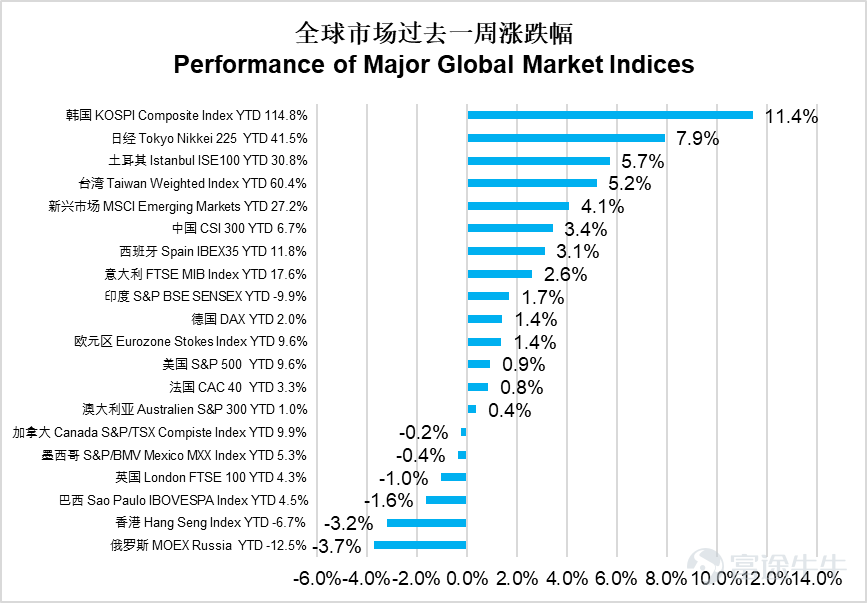
Last week, global markets exhibited extreme regional divergence, with Asia-Pacific markets collectively rallying sharply, while European, U.S., and some emerging markets broadly came under pressure.The Asia-Pacific region led global performance, with South Korea's KOSPI surging 11.4% for the week—the highest gain—followed by the Nikkei 225 rising 7.9%. Taiwan’s Taiex and Turkey’s ISE 100 climbed 5.2% and 5.7%, respectively. The MSCI Emerging Markets Index and CSI 300 also posted significant gains. European markets edged higher overall, with Spain’s IBEX 35 and Italy’s FTSE MIB leading the advance, while Germany’s DAX, the Eurozone STOXX, and France’s CAC 40 all strengthened steadily.In contrast, markets in Russia, Hong Kong, Brazil, and the UK saw notable corrections, with Russia’s MOEX plunging 3.7% and the Hang Seng Index retreating 3.2%.Brazil’s Ibovespa and the UK’s FTSE 100 also weakened in tandem, resulting in a market landscape characterized by strong outperformance in the Asia-Pacific region and pressure on European, U.S., and commodity-linked emerging markets.

Source: Wind
U.S. equity markets closed slightly higher for the week, $S&P 500 Index (.SPX.US)$with the index rising 0.9% for the week, as sector rotation featured pronounced strength in growth stocks and a sharp pullback in value and energy sectors.The information technology sector stood out, gaining 3.1% for the week, while the industrials sector rose 2.6%. Communication services, consumer discretionary, utilities, and financials also posted modest gains. The energy sector came under severe pressure, plummeting 6.6%. Real estate, healthcare, and consumer staples all declined notably, falling 3.4%, 3.0%, and 2.9%, respectively, while materials saw a slight pullback. Overall, the market displayed a clear divergence, with tech-driven growth sectors leading gains while defensive sectors such as energy, consumer staples, and real estate broadly weakened.

Source: Wind
Hong Kong equities underwent a significant correction overall, with the Hang Seng Index falling 3.2% for the week, and sector performance was starkly divergent, with most sectors broadly declining,except for the industrials sector, which bucked the trend and rose. The energy sector led the market lower, plunging 9.1% for the week, while property and construction, consumer staples, and consumer discretionary ranked among the worst performers, retreating 6.5%, 6.0%, and 4.9%, respectively.Most sectors—including utilities, telecommunications, technology, materials, healthcare, and financials—faced varying degrees of pressure.Only the industrial sector stood out, surging 5.5% for the week and bucking the broader downtrend. The market overall exhibited extreme divergence, with cyclical, consumer, and real estate sectors all correcting, while only industrials broke out to the upside.

Source: Wind
Bond Market
Global bond markets rebounded modestly over the past week. The Global Aggregate Index fell 0.28%, while the U.S. Aggregate Index rose 0.15%. U.S. investment-grade corporate bonds gained 0.15%, and U.S. high-yield corporate bonds advanced 0.09%. The Emerging Markets USD Bond Aggregate Index climbed 0.32%, and the China USD Credit Bond Index rose 0.12%.

On the rates front, the U.S. Treasury yield curve flattened: the 2-year Treasury yield rose 10 basis points to 4.18%, while the 10-year Treasury yield declined 3 basis points to 4.45%.

Market outlook
· Easing geopolitical tensions have alleviated inflationary pressures, while the Federal Reserve’s unexpectedly hawkish shift has tightened liquidity conditions.
This week, the core tension in overseas markets shifted from prior 'geopolitical shocks' to a tug-of-war between 'inflation relief driven by easing geopolitical risks' and 'liquidity tightening triggered by the Fed’s surprise hawkish pivot.' The memorandum of understanding between the U.S. and Iran and expectations of resumed shipping through the Strait of Hormuz led to a rapid unwinding of oil’s geopolitical risk premium, pushing both Brent and WTI crude prices below $80—their lowest levels in three months.This development should normally ease inflation concerns and support risk assets—and indeed, it fueled a strong rebound in Asia-Pacific markets like Japan and South Korea that had previously been hit hard.However, at the June FOMC meeting—marking new Fed Chair Walsh’s debut—the central bank dampened market enthusiasm by removing dovish language and signaling potential 'preemptive rate hikes' this year via its dot plot. This partially offset the positive impact of lower oil prices on inflation expectations with renewed concerns over tighter liquidity due to a hawkish policy shift.This dynamic explains why U.S. equities posted modest weekly gains despite significant internal sector divergence.
It is worth noting that current market pricing of rate hike expectations may carry a risk of 'excessive linear extrapolation.' The hawkish dot plot guidance is highly contingent on upcoming data trends. Chair Walsh’s refusal to offer forward guidance or reaffirm a 'Fed Put' has instead amplified the market’s tendency to self-reinforce tight monetary expectations based solely on the dot plot. Fed funds futures have already fully priced in a rate hike by October, with the probability of a September hike rising to approximately 80%.However, factors supporting the current phase of strength in the U.S. economy—including one-off tariff rebates and temporary service-sector hiring demand driven by the World Cup—are expected to weaken after August–September.If maritime traffic through the strait resumes smoothly and the disinflationary pressure from oil prices continues to ease, market expectations for rate hikes could be revised downward, potentially leading to an improvement in macro liquidity conditions once again.
Key economic data and events this week
China will release its June Loan Prime Rate (LPR) data on Monday;
The U.S. will release the final reading of first-quarter GDP and the May Personal Consumption Expenditures (PCE) price index on Thursday.
Disclaimer: The issuer of this report is E Fund Asset Management (Hong Kong) Co., Ltd. This report does not constitute an invitation or recommendation to invest in fund units. Fund unit subscriptions can only be made using application forms accompanied by the fund prospectus. Investment involves risks; fund prices may rise or fall, and past performance is not indicative of future results. Before investing, investors should carefully read the fund prospectus (including the 'Risk Factors' section) to understand the investment risks related to the fund. This report may only be distributed in certain jurisdictions. In any jurisdiction where distributing such information or making any invitation or recommendation is prohibited, or where distributing this report or making an invitation or recommendation to any person would be illegal, this report does not constitute such distribution or invitation or recommendation. This document has been exempted from prior review and approval by the Hong Kong Securities and Futures Commission, and has not been reviewed by the SFC. SFC approval does not imply promotion or endorsement of the plan, nor does it guarantee its commercial merits or performance, nor does it indicate suitability for all investors, or endorsement of suitability for any particular investor or category of investors. All rights reserved © 2026. E Fund Asset Management (Hong Kong) Co., Ltd.
Risk Disclaimer: The above content only represents the author's view. It does not represent any position or investment advice of Futu. Futu makes no representation or warranty.Read more
Comments
to post a comment
1