
Oil prices breaking above $100 fuel expectations of rate hikes! Will the Fed act next week?

Options Sir on Macro | Waller's hawkish debut stuns markets, major progress in US-Iran talks—how to position for an era of high volatility?
This week, the U.S. stock market witnessed two major events powerful enough to reshape its future trajectory: on one hand, newly appointed Federal Reserve Chair Kevin Warsh made his debut, sending hawkish signals that rattled markets; on the other, U.S.-Iran negotiations achieved a historic breakthrough, sharply reducing geopolitical risk.
These opposing forces pulled against each other, generating exceptionally high market volatility. For investors, understanding the underlying logic is essential to identifying appropriate strategies in the options and futures markets.
I. Warsh’s First FOMC Meeting: Rates Held Steady, Communication Framework Completely Overhauled
In the early hours of June 18, the Federal Reserve held its third FOMC meeting of 2026—the first chaired by new Fed Chair Kevin Warsh, marking a historically significant moment. As widely expected, the Fed left the target range for the federal funds rate unchanged at 3.50% to 3.75%.
However, the most impactful element of this meeting was not the rate decision itself, but rather the comprehensive overhaul of the Fed’s communication framework under Warsh—combined with upward revisions to inflation and interest rate projections—creating a confluence of hawkish signals that heightened policy uncertainty.
– Forward guidance fully scrapped; policy statement drastically streamlined to 130 words as the Fed shifts from 'path management' to 'statement of facts'
Under Warsh’s leadership, the policy statement was sharply condensed to 130 words and entirely eliminated traditional forward guidance—a clear reduction compared to the Powell era. The statement now only includes the interest rate decision, arrangements regarding ample reserves, current assessments of the economy, employment, and inflation, and a reaffirmation of the commitment to price stability. Warsh explicitly stated that markets should move away from relying on the Fed to provide a policy path and instead price assets based on incoming economic data.
– The dot plot turned unexpectedly hawkish, with half of officials betting on a rate hike within the year, rapidly fueling rate hike expectations.
While abandoning clear forward guidance, the dot plot also sent a strongly hawkish signal. A total of 18 committee members submitted rate projections (Chair Warsh himself declined to submit a dot plot forecast, leaving out a critical vote). Of these, nine projected at least one rate hike in 2026: three forecast one hike, five forecast two hikes, one forecast three hikes, and one expected a rate cut.
The median projection for the 2026 policy rate was sharply revised upward from 3.4% in March to 3.8%. Warsh’s abstention from submitting his own dot plot has left markets struggling with ambiguous interpretation. This combination—eliminating forward guidance while simultaneously signaling higher rates via the dot plot—plunged markets into an immediate information vacuum.
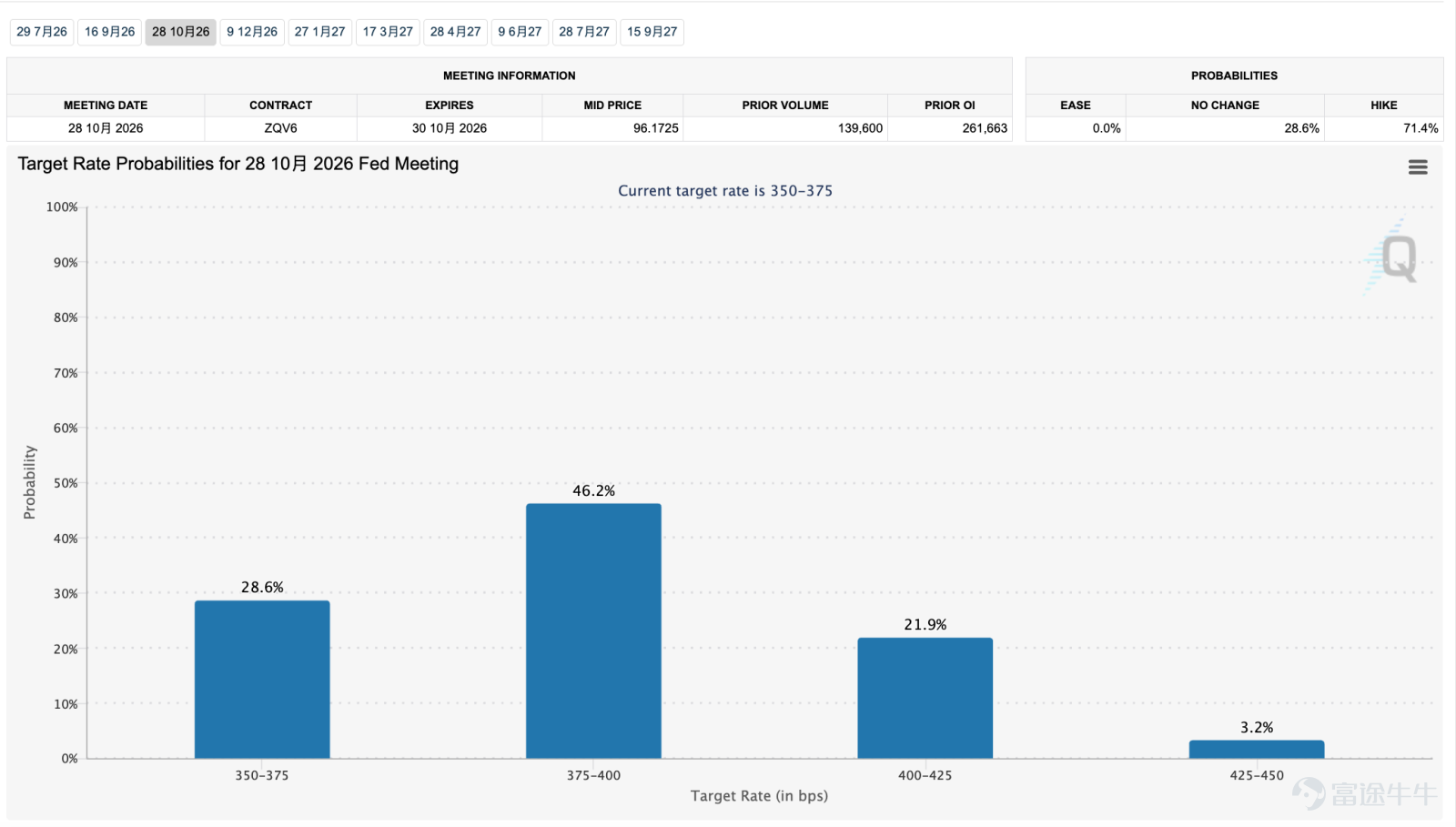
According to the CME Group FedWatch Tool, market-implied probability of a rate hike in October has now risen above 70%.

– Inflation forecasts were significantly revised upward, yet the Fed remains unwavering in its commitment to the 2% inflation target.
Impacted by Middle East conflicts driving up oil prices and supply chain disruptions, the Fed raised its 2026 PCE inflation forecast from 2.7% to 3.6%, and core PCE from 2.7% to 3.3%, acknowledging that energy supply shocks are temporarily pushing up prices. The 2027 inflation forecast saw a modest upward revision, though the overall trajectory still points to a gradual decline over time—indicating the Fed views current inflation pressures as transitory, with no significant shift yet in its assessment of the long-run inflation trend.
Waller has repeatedly emphasized that the Fed will not reassess its inflation framework until the 2% inflation target is achieved, and this hawkish stance has further reinforced market pricing for tighter policy.Waller stressed 'strict independence' and data-driven decision-making, alleviating concerns about political interference but exacerbating near-term uncertainty.
Additionally, Waller announced the formation of five working groups to study Fed communications, balance sheet policy, data sources, productivity and employment, and the inflation framework—signaling that reforms to the policy framework have entered a research and preparatory phase.
Amid multiple tightening signals combined with a major shift in communication mechanisms, markets are caught in a dual fog of 'missing policy signals plus volatile inflation data.' The previous trading day saw all three major U.S. equity indices close lower, reflecting investor anxiety over the policy path ahead.

II. A Turnaround: U.S.-Iran Talks Make Significant Progress, Boosting U.S. Stock Futures
Just as markets were gripped by hawkish sentiment, news of geopolitical easing emerged early on June 18.The U.S. and Iran have remotely signed a memorandum of understanding, a development that significantly eases market concerns about disruptions to Middle Eastern energy supplies, providing support to U.S. stock futures. Falling energy prices have also raised hopes for relief from inflationary pressures.

For now, although markets have increased their assessment of rate hike risks following the Fed meeting, Waller may still face political pressure from the White House when it comes to actual policy implementation.
Any rate hikes this year will still require stronger supporting data on inflation. Going forward, whether the Fed intensifies tightening will hinge on three key variables:Whether higher energy prices spill over into core and services inflation; whether market-based inflation expectations continue to rise persistently; and whether overall financial conditions can remain accommodative.
In the near term, a hawkish dot plot combined with a relatively tough stance on inflation could weigh on valuations of high-multiple risk assets, as rising real rates would exert downward pressure on technology and growth-oriented sectors.However, capital investment in AI and the productivity gains it drives remain core pillars underpinning U.S. economic resilience.Following the pullback, investors should closely monitor earnings delivery from leading tech companies.
As geopolitical tensions ease, if crude oil prices and inflation readings subsequently decline, market focus may shift back to the AI theme.
Looking ahead, under the new Fed communication framework following Waller’s appointment, the market’s volatility baseline could systematically rise.Significant progress in U.S.-Iran negotiations has alleviated energy-driven inflationary pressures, but it is not yet sufficient to reverse the Fed’s current tight policy stance. Under Waller’s revised communication framework, policy decisions are highly dependent on high-frequency data such as monthly CPI and nonfarm payrolls. Even if oil prices decline, persistent core inflation stickiness means rate hike risks cannot be fully ruled out.
III. How to trade options in a high-volatility market?
(Illustrating options strategies using the QQQ ETF as an example; not investment advice)
With Waller’s debut and developments in U.S.-Iran talks, the market has entered a classic high-volatility phase. Implied volatility (IV) has risen due to the FOMC event. $Invesco QQQ Trust (QQQ.US)$ Options IV percentile has reached a historically elevated level of 94%, while the put/call open interest ratio has climbed and remains above 1.5, indicating heightened institutional hedging demand.


1. Collar Strategy: Low-cost hedging for long-term tech stock positions
Leading US tech stocks and AI growth equities exhibit high volatility. The Nasdaq has declined significantly more than other major indices in this correction. Investors holding core tech stock positions can use a collar strategy to cap downside risk while reducing hedging costs.
For investors who remain bullish on the long-term fundamentals of the AI sector but worry about near-term valuation pullbacks driven by Federal Reserve rate hike expectations—and are unwilling to reduce positions and realize paper gains—they may consider maintaining their underlying holdings in individual stocks or tech ETFs, buying slightly out-of-the-money puts as downside protection, and simultaneously selling out-of-the-money calls to collect premiums that offset the cost of the puts.

(The design images displayed on screen are for illustrative purposes only and do not constitute any investment advice or guarantee; market conditions change frequently, and the prices shown do not reflect actual market values.)
2. Put Spread: A short-term hedging tool for broad market indices
If investors anticipate a market pullback due to hawkish remarks from Federal Reserve officials and wish to hedge against systemic downside risk from potential rate hikes, they may consider implementing a put spread strategy. Buying standalone put options entails relatively high premium costs; a put spread helps compress hedging expenses.
Buy a slightly out-of-the-money put option while simultaneously selling a deeper out-of-the-money put with a lower strike price. In a sharp market decline, gains from the long put minus losses from the short put lock in a defined profit. If the market rises, the maximum loss is limited to the net premium paid at initiation, offering controlled risk.

(The design images displayed on screen are for illustrative purposes only and do not constitute any investment advice or guarantee; market conditions change frequently, and the prices shown do not reflect actual market values.)
3. Cash-Secured Put
The recent FOMC meeting has pushed up implied volatility for short-dated options, but once the market digests the news, short-term volatility faces downward pressure. Investors without existing positions who believe easing US-Iran tensions could offset the hawkish risks posed by Waller may consider selling short-dated, out-of-the-money options expiring soon. The core rationale is that near-term options experience time decay much faster than longer-dated ones as expiration approaches, allowing sellers to collect substantial premiums.
If the index rebounds or trades sideways, investors can capture the premium to enhance capital efficiency. If the index pulls back toward the strike price, they also gain an opportunity to establish long-term exposure to US equity indices at a more deliberate cost basis.

(The design images displayed on screen are for illustrative purposes only and do not constitute any investment advice or guarantee; market conditions change frequently, and the prices shown do not reflect actual market values.)
4. Index ETF Futures Strategies: Intraday Hedging and Calendar Spread Arbitrage
Investors may also consider trading U.S. equity index futures to hedge risk, as the 24-hour trading feature of futures is well-suited for hedging around major events.
Intraday Hedging:If institutional and retail investors hold a basket of U.S. equities and cannot quickly reduce positions to avoid policy-driven volatility, they can use stock index futures for intraday hedging against systemic downside risk. This involves selling a corresponding amount of index futures based on their portfolio exposure and closing the position intraday once the negative catalyst materializes. Alternatively, when U.S.-Iran negotiations deliver significant positive news, investors could buy index futures to capture a rebound and close the position once intraday unrealized gains are achieved. Intraday closing eliminates overnight exposure, helping avoid shocks from unexpected overnight developments, though it demands higher execution skill.
Calendar Spread Arbitrage:In the event of sudden negative news, near-month contracts tend to be more sensitive and typically decline more sharply than longer-dated contracts, creating an opportunity to short the near-month while going long the far-month to profit from the widening spread. However, caution is warranted against misjudgment risk—for instance, if rising rate-hike expectations cause the far-month contract to underperform even more severely.
Fifth, Summary
Waller is tearing up the old 'Federal Reserve' playbook. Faced with this shift in the policy framework, investors may need to stop obsessing over guessing the Fed’s next move and instead adapt to this new data-dependent norm.
 Fellow investors, Waller’s debut sent a hawkish shockwave through the market, yet on the same day, U.S.-Iran negotiations achieved a historic breakthrough—what’s your outlook for U.S. equity indices going forward?
Finally, Option Sir brings a small perk for fellow investors, welcome to claim it.Options Beginner Pack
*This event is exclusive to invited HK users. Click to learn more.Detailed event rules>>
Market conditions are complex and volatile,Options StrategyOverwhelmed by choices? Futubull helps you build a portfolio in three steps.Options Strategymaking investing simple and efficient!

Option Risk Warning:An option is a contract that grants the holder the right—but not the obligation—to buy or sell an underlying asset at a predetermined price on or before a specified date. Option prices are influenced by multiple factors, including the current price of the underlying asset, the strike price, time to expiration, and implied volatility. Implied volatility reflects the market’s expectation of future price fluctuations over the life of the option and is derived by reverse-engineering the Black-Scholes pricing model. It is commonly used as a gauge of market sentiment. When investors anticipate greater volatility, they may be willing to pay higher premiums for options to hedge risk, leading to elevated implied volatility. Traders and investors use implied volatility to assess the relative attractiveness of option prices, identify potential mispricings, and manage risk exposure.
Disclaimer:This content does not constitute any offer, solicitation, recommendation, opinion, or guarantee of any securities, financial products, or tools. The risk of loss in trading options can be substantial. In some cases, losses may exceed the initial margin deposited. Even if you set contingent orders such as 'stop-loss' or 'limit' orders, these may not prevent losses. Market conditions may make such orders unexecutable. You may be required to deposit additional margin within a short period. If you fail to provide the required amount within the specified time, your open positions may be liquidated. However, you will still be responsible for any shortfall in your account. Therefore, before trading, you should study and understand options and carefully consider whether such trading is suitable for you based on your financial situation and investment objectives. If you trade options, you should be familiar with the procedures for exercising options and the rights and obligations upon exercise and expiration. Options trading carries extremely high risks and is not suitable for all investors. Investors should carefully readCharacteristics and Risks of Standardized Options。
Risk Disclaimer: The above content only represents the author's view. It does not represent any position or investment advice of Futu. Futu makes no representation or warranty.Read more


Comments (3)
to post a comment
58
62