
Oil prices breaking above $100 fuel expectations of rate hikes! Will the Fed act next week?

The Federal Reserve's monetary policy stance has turned clearly hawkish, with expectations of higher discount rates prompting a repricing of risk assets.
1. The FOMC kept the federal funds rate unchanged but adopted a more hawkish tone.
The Federal Reserve’s FOMC met on June 16–17, 2026 (the first meeting chaired by new Chair Kevin Warsh), maintaining the target range for the federal funds rate at 3.50%–3.75%, in line with broad market expectations. However, the key message conveyed was a hawkish pivot, signaling an accelerated tightening of market liquidity. See the author’s earlier note: 'Euro-Japan tightening convergence may trigger repricing of risk assets; narrowing U.S.-Japan yield spreads in 2027 could lead to a material contraction in carry trade volumes.'
So far this year, the Fed has repeatedly held rates steady. In 2025, the Fed cut rates by 25 basis points at three consecutive meetings—in September, October, and December. Since January of this year, however, it has maintained rates unchanged across four consecutive meetings.
The Federal Reserve chose to hold rates steady due to: 1) Economic assessment: solid economic growth (despite uncertainty from Middle East conflicts), strong productivity and capital investment, stable employment, and little change in the unemployment rate. 2) Inflation remains above the 2% target, driven by supply-side shocks such as energy prices. The Fed’s primary objective remains achieving price stability. While the economy is resilient, inflationary pressures are persistent (not transitory), making near-term rate cuts unnecessary—and even leaving the door open for potential hikes. Price stability and fighting inflation (influenced by factors like energy prices and geopolitical risks) take precedence over stimulating growth.
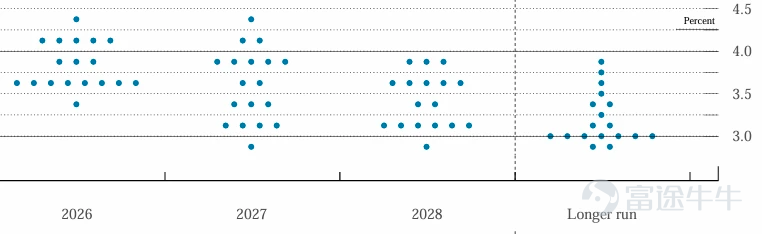
II. Dot Plot (Summary of Economic Projections, SEP) Shows a Markedly More Hawkish Shift (vs. March Update)
The median projection for the federal funds rate at the end of 2026 rose to approximately 3.8% (from 3.4% previously), suggesting a possible shift this year from one rate cut to a potential hike. Median projections for 2027 and 2028 were also revised upward. GDP growth forecasts were downgraded, while core PCE inflation for 2026 was raised to 3.3% (from 2.7% previously), remaining above target through 2028.
Historically, the Fed’s dot plot reflects FOMC members’ individual projections over time for the appropriate level of the federal funds rate. Each dot represents one FOMC participant’s forecast for the target rate in a given year, serving as a collective policy signal to guide market expectations about future interest rate direction.

Source: Summary of Economic Projections, June 17, 2026
III. Markets Should Pay Attention to Chair Warsh’s Communication Style and Approach
Warsh’s communication style centers on 'talk less, do more,' emphasizing brevity, data dependence, and policy flexibility—contrasting sharply with the Powell era’s more detailed forward guidance and transparent communication.
Warsh’s statements are streamlined and pragmatic. The latest statement is notably shorter and more concise, removing dovish-leaning forward guidance and instead highlighting data dependence and a focus on core assessments rather than detailed path forecasts—consistent with Warsh’s long-standing views. Accordingly, the Fed is expected to reduce forward guidance and enhance policy flexibility going forward.
De-emphasizing the Dot Plot (SEP/Dot Plot): Warsh himself does not submit rate projections and has publicly criticized the tool for locking in decisions and amplifying errors (such as past misjudgments on inflation). He has established a communications review task force that may reform or diminish the role of this instrument.
Reducing forward guidance and over-explanation: Warsh believes excessive communication causes markets to become overly reliant on Fed rhetoric, thereby constraining policy flexibility. He prefers holding press conferences only during significant developments rather than providing detailed commentary after every meeting.
Task force review: – Announced the formation of five task forces, including one on communications review, which are to deliver recommendations by year-end covering statements, minutes, transcripts, etc., aiming to enhance decision-making resilience.
IV. Warsh’s communication style enhances the Fed’s flexibility and credibility over the long term
– Enhancing flexibility and credibility: Avoiding excessive commentary reduces the risk of self-inflicted errors and prevents policy from being constrained by its own forward guidance, making decisions more data-driven. Previous over-communication has eroded the Fed’s independence; reforms could restore institutional resilience.
– Focusing on substance: Concise communication compels markets to focus on the Fed’s actions rather than its words, potentially improving policy implementation efficiency and credibility over time (earning trust through outcomes rather than promises).
– Adapting to the environment: In the current context of inflationary pressures and geopolitical uncertainty, flexible communication better supports the fight against inflation rather than locking in a pre-set path toward easing.
Overall assessment: Warsh’s approach marks a shift toward independence plus flexibility. While it may reduce communication transparency in the short term, it aims to improve the quality of policy transparency and decision-making clarity. The effectiveness of these reforms will depend on the conclusions of the task forces by year-end and subsequent implementation.
Markets now need to adapt to a data-dependent framework rather than relying on quarterly forecasts.
V. Risk assets require repricing
Higher-for-longer rate expectations typically exert downward pressure through the following channels: lifting real yields and the U.S. dollar, increasing the opportunity cost of holding non-yielding assets (such as equities and gold), while a stronger dollar weighs on dollar-denominated commodities.
– Gold prices are expected to decline noticeably going forward (having fallen to multi-month lows around the meeting due to a stronger dollar and higher yields). Although geopolitical risks offer some support, hawkish signals dominate, diminishing gold’s appeal as a beneficiary of low-rate environments. Similarly, other commodities and high-beta assets face pressure. See the author’s earlier note: The long-term gold cycle may have already peaked, and Laopu Gold’s customer base has started to contract.
– Higher discount rates: reduce the present value of future cash flows, negatively impacting high-valuation growth and technology stocks. U.S. equities broadly declined after the meeting (S&P 500 dropped more than 1%, wiping out significant market value; Nasdaq performed even worse). Overall market volatility may rise, with short-term risk appetite dampened.
– Bond yields could rise further, particularly in the short end. Over the longer term, if inflation eases or growth slows, there remains room for policy adjustments, but current pricing reflects a higher-for-longer interest rate path.
Risk Disclosure: The above content is for personal sharing purposes only and does not constitute any investment advice. Please assume all risks yourself.
Risk Disclaimer: The above content only represents the author's view. It does not represent any position or investment advice of Futu. Futu makes no representation or warranty.Read more

Comments
to post a comment
2