English
Back
Open Account
The Federal Reserve launches reforms! How to position for the Worshe era?
Futubull Options Sir
joined discussion · ·

Options Sir on Macro | FOMC Preview: Cutting Through the Fog of Waller, Will Markets Stay Risk-On?

Over the past period, we have experienced a sharp pullback driven by stronger-than-expected nonfarm payroll data, a soft landing amid inflation data shocks, and the landmark U.S.-Iran deal finalized over the weekend.Yet none of this may be as significant as the debut of newly appointed Fed Chair Kevin Warsh.
Deafening Silence Announced in Advance: The Referee Who No Longer 'Spoils the Plot'
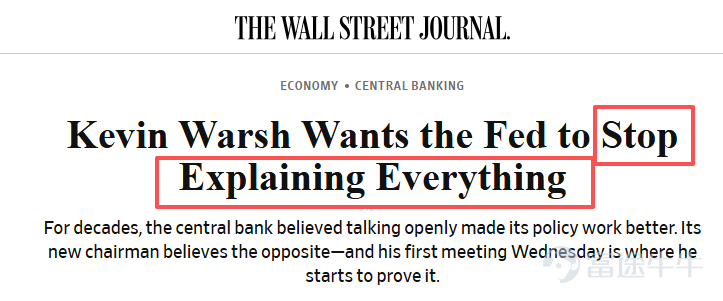
If you follow the Federal Reserve closely, you’ve surely noticed something highly unusual:Since Kevin Warsh was officially sworn in on May 22, he hasn’t uttered a single word in public.
During the Powell era, Fed officials were eager to speak nearly every day, afraid the market might misinterpret even the slightest hint of their intentions. But the month since Warsh took office has been nothing short of an 'information vacuum' in Federal Reserve history.
This goes far beyond mere caution from a new appointee—it is adeafening silence announced in advance
Over the past period, we have experienced a sharp pullback driven by stronger-than-expected nonfarm payroll data, a soft landing amid inflation data shocks, and the landmark U.S.-Iran deal finalized over the weekend.Yet none of this may be as significant as the debut of newly appointed Fed Chair Kevin Warsh. Deafening Silence Announced in Advance: The Referee Who No Longer 'Spoils the Plot' If you follow the Federal Reserve closely, you’ve surely noticed something highly unusual:Since Kevin Warsh was officially sworn in on May 22, he hasn’t uttered a single word in public. During the Powell era, Fed officials were eager to speak nearly every day, afraid the market might misinterpret even the slightest hint of their intentions. But the month since Warsh took office has been nothing short of an 'information vacuum' in Federal Reserve history. This goes far beyond mere caution from a new appointee—it is adeafening silence announced in advance。 Based on Warsh’s prior testimony and published writings, there is one thing he deeply despises:forward guidanceIn his view, the Federal Reserve has been talking too much to the market—like revealing the entire plot before the movie even starts. This not only makes the market complacent, always expecting the Fed to act as a backstop, but also ends up constraining the Fed itself: having spoken so definitively, it becomes very difficult to pivot when new data emerges. The direct consequence of this mindset is the enormous uncertainty surrounding this week's FOMC meeting.Currently, interest rate markets remain firmly convinced that the Fed will hold rates steady at this meeting (with a probability...
Based on Warsh’s prior testimony and published writings, there is one thing he deeply despises:forward guidanceIn his view, the Federal Reserve has been talking too much to the market—like revealing the entire plot before the movie even starts. This not only makes the market complacent, always expecting the Fed to act as a backstop, but also ends up constraining the Fed itself: having spoken so definitively, it becomes very difficult to pivot when new data emerges.
The direct consequence of this mindset is the enormous uncertainty surrounding this week's FOMC meeting.Currently, interest rate markets remain convinced that the Fed will hold rates steady at this meeting (with a probability exceeding 96%), but the real risk lies not in whether rates will be hiked, but in whether the 'dot plot' will be scrapped altogether.
Over the past period, we have experienced a sharp pullback driven by stronger-than-expected nonfarm payroll data, a soft landing amid inflation data shocks, and the landmark U.S.-Iran deal finalized over the weekend.Yet none of this may be as significant as the debut of newly appointed Fed Chair Kevin Warsh. Deafening Silence Announced in Advance: The Referee Who No Longer 'Spoils the Plot' If you follow the Federal Reserve closely, you’ve surely noticed something highly unusual:Since Kevin Warsh was officially sworn in on May 22, he hasn’t uttered a single word in public. During the Powell era, Fed officials were eager to speak nearly every day, afraid the market might misinterpret even the slightest hint of their intentions. But the month since Warsh took office has been nothing short of an 'information vacuum' in Federal Reserve history. This goes far beyond mere caution from a new appointee—it is adeafening silence announced in advance。 Based on Warsh’s prior testimony and published writings, there is one thing he deeply despises:forward guidanceIn his view, the Federal Reserve has been talking too much to the market—like revealing the entire plot before the movie even starts. This not only makes the market complacent, always expecting the Fed to act as a backstop, but also ends up constraining the Fed itself: having spoken so definitively, it becomes very difficult to pivot when new data emerges. The direct consequence of this mindset is the enormous uncertainty surrounding this week's FOMC meeting.Currently, interest rate markets remain firmly convinced that the Fed will hold rates steady at this meeting (with a probability...
Source: CME FedWatch.
For years, the dot plot has served as investors’ primary compass for deciphering the Fed’s projected interest rate path.If Waller deems it a form of 'excessive forward guidance,' and chooses to eliminate or indefinitely postpone its release during his debut meeting, markets would instantly lose their sense of direction.Without forward guidance as a 'shock absorber,' short-term speculative flows could become chaotic, potentially driving asset price volatility sharply higher once again.
Waller’s silence is, in essence, forcing the market to learn how to price assets amid uncertainty on its own. He doesn’t want to be the market’s 'nanny'; he wants to be the authoritative 'referee' who commands respect without raising his voice. In the short term, this may cause some pain; but in the long run, it is a necessary step toward restoring rational pricing in the market.
The U.S.-Iran Deal and Inflation’s 'Hidden Door'
While markets are still jittery over Waller’s 'black-box operations,' macroeconomic news has delivered a major positive surprise:This Friday (June 19), the U.S. and Iran will formally sign a peace agreement.
This means the largest geopolitical cloud hanging over the global economy is beginning to dissipate. For months, fears of a blockade at the Strait of Hormuz pushed oil prices higher, leaving everyone anxious that a repeat of the 1970s-style stagflation might be imminent.Now, with the agreement about to be signed, the oil price anchor is quickly retreating from elevated levels, significantly easing market concerns about runaway inflation.
Over the past period, we have experienced a sharp pullback driven by stronger-than-expected nonfarm payroll data, a soft landing amid inflation data shocks, and the landmark U.S.-Iran deal finalized over the weekend.Yet none of this may be as significant as the debut of newly appointed Fed Chair Kevin Warsh. Deafening Silence Announced in Advance: The Referee Who No Longer 'Spoils the Plot' If you follow the Federal Reserve closely, you’ve surely noticed something highly unusual:Since Kevin Warsh was officially sworn in on May 22, he hasn’t uttered a single word in public. During the Powell era, Fed officials were eager to speak nearly every day, afraid the market might misinterpret even the slightest hint of their intentions. But the month since Warsh took office has been nothing short of an 'information vacuum' in Federal Reserve history. This goes far beyond mere caution from a new appointee—it is adeafening silence announced in advance。 Based on Warsh’s prior testimony and published writings, there is one thing he deeply despises:forward guidanceIn his view, the Federal Reserve has been talking too much to the market—like revealing the entire plot before the movie even starts. This not only makes the market complacent, always expecting the Fed to act as a backstop, but also ends up constraining the Fed itself: having spoken so definitively, it becomes very difficult to pivot when new data emerges. The direct consequence of this mindset is the enormous uncertainty surrounding this week's FOMC meeting.Currently, interest rate markets remain firmly convinced that the Fed will hold rates steady at this meeting (with a probability...
Last week’s data confirmed this trend. May’s CPI and PPI figures showed that core inflation wasn’t as alarming as many feared, and energy price increases remained confined to 'first-order transmission' (e.g., higher gasoline prices) without triggering the dreaded 'second-order transmission' into services and wages (i.e., broad-based price surges across the economy).
More importantly,Waller actually holds a 'hidden key' that could lower the bar for rate cuts—the Trimmed-Mean PCE.
The core PCE we typically watch excludes food and energy,but if the price of a specific item—such as used cars during the pandemic—skyrockets, core PCE can still be distorted.
The 'trimmed-mean PCE' favored by Waller first discards the items with the largest price increases and the steepest declines, focusing only on how much prices have risen in the broad middle segment. If you look at the traditional core PCE, it remains near a stubbornly high level of around 4%, which feels bleak.But if you look at the trimmed-mean PCE, the current reading is only about 2.3%.
The implementation of the U.S.-Iran agreement effectively pulls the teeth out of the inflationary tiger; meanwhile, the logic behind the trimmed-mean PCE serves as Waller’s hidden green light for rate cuts up his sleeve.The Federal Reserve now has unprecedented room to maneuver— with the inflation alarm lifted, it no longer needs to rush into hiking rates and now has a credible theoretical pathway to cut rates whenever appropriate.
The worst may be over—is it time to go Risk On?
By combining these two threads, we can clearly see the full picture of this FOMC meeting and the market's trajectory.
Scenario one (the most probable): Waller adopts a balanced stance.With inflation already tamed by the U.S.-Iran deal, Waller has no reason to strike hard in his debut. He is most likely to adopt a ‘hawkish in words, dovish in action’ approach—using rhetoric that underscores his commitment to fighting inflation to satisfy his ‘hawkish persona,’ while taking no actual steps to hike rates or reveal overly aggressive balance-sheet runoff details. Regarding the dot plot, even if he chooses to downplay it, he won’t abruptly scrap it but will instead gradually phase it out.
Scenario two (a low-probability black swan): Waller takes an extremely hardline stance.He could directly announce the elimination of the dot plot or unveil a balance-sheet runoff plan that significantly exceeds market expectations. This would trigger sharp short-term market turmoil and a spike in volatility.
But let’s not forget another dimension of the market:microstructure. Over the past two weeks, U.S. equities—particularly tech stocks—have undergone a significant pullback due to stronger-than-expected nonfarm payroll data and panic surrounding the FOMC,and market long positioning has already eased considerably.
Over the past period, we have experienced a sharp pullback driven by stronger-than-expected nonfarm payroll data, a soft landing amid inflation data shocks, and the landmark U.S.-Iran deal finalized over the weekend.Yet none of this may be as significant as the debut of newly appointed Fed Chair Kevin Warsh. Deafening Silence Announced in Advance: The Referee Who No Longer 'Spoils the Plot' If you follow the Federal Reserve closely, you’ve surely noticed something highly unusual:Since Kevin Warsh was officially sworn in on May 22, he hasn’t uttered a single word in public. During the Powell era, Fed officials were eager to speak nearly every day, afraid the market might misinterpret even the slightest hint of their intentions. But the month since Warsh took office has been nothing short of an 'information vacuum' in Federal Reserve history. This goes far beyond mere caution from a new appointee—it is adeafening silence announced in advance。 Based on Warsh’s prior testimony and published writings, there is one thing he deeply despises:forward guidanceIn his view, the Federal Reserve has been talking too much to the market—like revealing the entire plot before the movie even starts. This not only makes the market complacent, always expecting the Fed to act as a backstop, but also ends up constraining the Fed itself: having spoken so definitively, it becomes very difficult to pivot when new data emerges. The direct consequence of this mindset is the enormous uncertainty surrounding this week's FOMC meeting.Currently, interest rate markets remain firmly convinced that the Fed will hold rates steady at this meeting (with a probability...
What does this mean? It means the bar for 'bad news being fully priced in' is now very low.As long as Waller does not deliver a devastating shock during his press conference early Thursday morning, and given the tangible easing of geopolitical tensions in the Middle East, the macroeconomic uncertainty will truly be resolved.
We are now in the phase where macro risks are being realized: the U.S.-Iran deal has put a floor under inflation, and Waller’s backdoor has kept the path open for rate cuts. As long as his debut doesn’t trigger a meltdown, this marks the starting line for a new rally. (Of course, it’s also possible that the market rallies too aggressively over the next few days, causing crowded positioning to briefly ease only to surge again—a replay of the recent nonfarm payroll-induced crash can’t be ruled out.)
Options Strategy
The overarching macro narrative points toward 'resolution of uncertainty + renewed risk-on sentiment.' How should we position with options in the current environment?
(1) Call spreads: a moderate offensive strategy
You’re confident that once macro uncertainty clears, markets will re-enter a risk-on mode and you want to capture the upside—but you feel outright buying calls is too expensive right now (as implied volatility may be elevated ahead of macro events), and fear that if the rally falls short, a naked call could expire worthless. In this case, consider constructing a bull call spread: buy one at-the-money or slightly out-of-the-money call, and simultaneously sell a more deeply out-of-the-money call.
Over the past period, we have experienced a sharp pullback driven by stronger-than-expected nonfarm payroll data, a soft landing amid inflation data shocks, and the landmark U.S.-Iran deal finalized over the weekend.Yet none of this may be as significant as the debut of newly appointed Fed Chair Kevin Warsh. Deafening Silence Announced in Advance: The Referee Who No Longer 'Spoils the Plot' If you follow the Federal Reserve closely, you’ve surely noticed something highly unusual:Since Kevin Warsh was officially sworn in on May 22, he hasn’t uttered a single word in public. During the Powell era, Fed officials were eager to speak nearly every day, afraid the market might misinterpret even the slightest hint of their intentions. But the month since Warsh took office has been nothing short of an 'information vacuum' in Federal Reserve history. This goes far beyond mere caution from a new appointee—it is adeafening silence announced in advance。 Based on Warsh’s prior testimony and published writings, there is one thing he deeply despises:forward guidanceIn his view, the Federal Reserve has been talking too much to the market—like revealing the entire plot before the movie even starts. This not only makes the market complacent, always expecting the Fed to act as a backstop, but also ends up constraining the Fed itself: having spoken so definitively, it becomes very difficult to pivot when new data emerges. The direct consequence of this mindset is the enormous uncertainty surrounding this week's FOMC meeting.Currently, interest rate markets remain firmly convinced that the Fed will hold rates steady at this meeting (with a probability...
(The design images displayed on the screen are for demonstration purposes only and do not constitute any investment advice or guarantee; market movements are frequent, and the illustrated option prices do not represent actual conditions)
By selling a call option with a higher strike price, you collect a premium that significantly offsets the cost of buying the call. This reduces your net outlay and lowers your breakeven point, but it also caps your maximum potential profit.
(2) Strategic Deployment: Sell a Cash-Secured Put
You are optimistic about a risk-on market rally following the anticipated U.S.-Iran deal, believe recent pullbacks have alleviated crowded positioning, and want to buy core assets on dips—but feel current levels still aren’t sufficiently safe. In this case, you could sell a put option expiring in 1–2 months, with a strike price 5%–10% below your target entry level. At the same time, ensure your account holds enough cash to cover the full exercise value (i.e., strike price multiplied by contract size), making it cash-secured.
Over the past period, we have experienced a sharp pullback driven by stronger-than-expected nonfarm payroll data, a soft landing amid inflation data shocks, and the landmark U.S.-Iran deal finalized over the weekend.Yet none of this may be as significant as the debut of newly appointed Fed Chair Kevin Warsh. Deafening Silence Announced in Advance: The Referee Who No Longer 'Spoils the Plot' If you follow the Federal Reserve closely, you’ve surely noticed something highly unusual:Since Kevin Warsh was officially sworn in on May 22, he hasn’t uttered a single word in public. During the Powell era, Fed officials were eager to speak nearly every day, afraid the market might misinterpret even the slightest hint of their intentions. But the month since Warsh took office has been nothing short of an 'information vacuum' in Federal Reserve history. This goes far beyond mere caution from a new appointee—it is adeafening silence announced in advance。 Based on Warsh’s prior testimony and published writings, there is one thing he deeply despises:forward guidanceIn his view, the Federal Reserve has been talking too much to the market—like revealing the entire plot before the movie even starts. This not only makes the market complacent, always expecting the Fed to act as a backstop, but also ends up constraining the Fed itself: having spoken so definitively, it becomes very difficult to pivot when new data emerges. The direct consequence of this mindset is the enormous uncertainty surrounding this week's FOMC meeting.Currently, interest rate markets remain firmly convinced that the Fed will hold rates steady at this meeting (with a probability...
(The design images displayed on the screen are for demonstration purposes only and do not constitute any investment advice or guarantee; market movements are frequent, and the illustrated option prices do not represent actual conditions)
(3) Hedge Against Black Swans: Armor Your Portfolio
If you’re already heavily invested in U.S. equities—particularly AI-related tech stocks that have rallied sharply—and remain bullish on their long-term fundamentals but are deeply concerned that Waller’s ‘new sheriff in town’ stance might trigger an unexpected crash and erase your gains,
consider buying slightly out-of-the-money put options on a broad-market ETF that expire on the day of the Fed meeting’s conclusion (this Thursday). If Waller indeed announces unexpectedly hawkish measures, your put will quickly gain value, offsetting steep losses in your underlying holdings; if the meeting passes smoothly, you only lose the known ‘insurance premium,’ while still fully capturing any upside from your equity positions.
Over the past period, we have experienced a sharp pullback driven by stronger-than-expected nonfarm payroll data, a soft landing amid inflation data shocks, and the landmark U.S.-Iran deal finalized over the weekend.Yet none of this may be as significant as the debut of newly appointed Fed Chair Kevin Warsh. Deafening Silence Announced in Advance: The Referee Who No Longer 'Spoils the Plot' If you follow the Federal Reserve closely, you’ve surely noticed something highly unusual:Since Kevin Warsh was officially sworn in on May 22, he hasn’t uttered a single word in public. During the Powell era, Fed officials were eager to speak nearly every day, afraid the market might misinterpret even the slightest hint of their intentions. But the month since Warsh took office has been nothing short of an 'information vacuum' in Federal Reserve history. This goes far beyond mere caution from a new appointee—it is adeafening silence announced in advance。 Based on Warsh’s prior testimony and published writings, there is one thing he deeply despises:forward guidanceIn his view, the Federal Reserve has been talking too much to the market—like revealing the entire plot before the movie even starts. This not only makes the market complacent, always expecting the Fed to act as a backstop, but also ends up constraining the Fed itself: having spoken so definitively, it becomes very difficult to pivot when new data emerges. The direct consequence of this mindset is the enormous uncertainty surrounding this week's FOMC meeting.Currently, interest rate markets remain firmly convinced that the Fed will hold rates steady at this meeting (with a probability...
(The design images displayed on the screen are for demonstration purposes only and do not constitute any investment advice or guarantee; market movements are frequent, and the illustrated option prices do not represent actual conditions)
Finally, here's a small perk for fellow Futubull investors, welcome to claim it.Options Beginner Pack
*This event is exclusive to invited HK users. Click to learn more.Detailed event rules>>
Market conditions are complex and volatile,Options StrategyOverwhelmed by choices? Futubull helps you build a portfolio in three steps.Options Strategymaking investing simple and efficient!
Over the past period, we have experienced a sharp pullback driven by stronger-than-expected nonfarm payroll data, a soft landing amid inflation data shocks, and the landmark U.S.-Iran deal finalized over the weekend.Yet none of this may be as significant as the debut of newly appointed Fed Chair Kevin Warsh. Deafening Silence Announced in Advance: The Referee Who No Longer 'Spoils the Plot' If you follow the Federal Reserve closely, you’ve surely noticed something highly unusual:Since Kevin Warsh was officially sworn in on May 22, he hasn’t uttered a single word in public. During the Powell era, Fed officials were eager to speak nearly every day, afraid the market might misinterpret even the slightest hint of their intentions. But the month since Warsh took office has been nothing short of an 'information vacuum' in Federal Reserve history. This goes far beyond mere caution from a new appointee—it is adeafening silence announced in advance。 Based on Warsh’s prior testimony and published writings, there is one thing he deeply despises:forward guidanceIn his view, the Federal Reserve has been talking too much to the market—like revealing the entire plot before the movie even starts. This not only makes the market complacent, always expecting the Fed to act as a backstop, but also ends up constraining the Fed itself: having spoken so definitively, it becomes very difficult to pivot when new data emerges. The direct consequence of this mindset is the enormous uncertainty surrounding this week's FOMC meeting.Currently, interest rate markets remain firmly convinced that the Fed will hold rates steady at this meeting (with a probability...
Option Risk Warning:An option is a contract that grants the holder the right—but not the obligation—to buy or sell an underlying asset at a predetermined price on or before a specified date. Option prices are influenced by multiple factors, including the current price of the underlying asset, the strike price, time to expiration, and implied volatility. Implied volatility reflects the market’s expectation of future price fluctuations over the life of the option and is derived by reverse-engineering the Black-Scholes pricing model. It is commonly used as a gauge of market sentiment. When investors anticipate greater volatility, they may be willing to pay higher premiums for options to hedge risk, leading to elevated implied volatility. Traders and investors use implied volatility to assess the relative attractiveness of option prices, identify potential mispricings, and manage risk exposure.
Disclaimer:This content does not constitute any offer, solicitation, recommendation, opinion, or guarantee of any securities, financial products, or tools. The risk of loss in trading options can be substantial. In some cases, losses may exceed the initial margin deposited. Even if you set contingent orders such as 'stop-loss' or 'limit' orders, these may not prevent losses. Market conditions may make such orders unexecutable. You may be required to deposit additional margin within a short period. If you fail to provide the required amount within the specified time, your open positions may be liquidated. However, you will still be responsible for any shortfall in your account. Therefore, before trading, you should study and understand options and carefully consider whether such trading is suitable for you based on your financial situation and investment objectives. If you trade options, you should be familiar with the procedures for exercising options and the rights and obligations upon exercise and expiration. Options trading carries extremely high risks and is not suitable for all investors. Investors should carefully readCharacteristics and Risks of Standardized Options
Risk Disclaimer: The above content only represents the author's view. It does not represent any position or investment advice of Futu. Futu makes no representation or warranty.Read more
Thumbs Up
198
Respect
3
Heart
19
Emm
4
Sob
2
Lol
4
1.1M Views
Report
Comments (180)
Write a Comment...
180
230
141