
SpaceX IPO countdown begins! The largest IPO in history is coming—century opportunity or valuation bubble?
On June 12, $SpaceX (SPCX.US)$ it is expected to officially debut on U.S. stock markets with a $1.8 trillion valuation and a $75 billion fundraising target, aiming to become the largest IPO in human history.
Currently, SpaceX has already received oversubscription of 3x to 4x, with subscription demand reaching as high as $250 billion. Index providers including Nasdaq, FTSE Russell, and Hang Seng Index have all initiated fast-track inclusion processes, with passive fund buying demand expected to reach $30 billion. Meanwhile, SpaceX also faces skepticism over its lofty valuation, with Morningstar assigning a fair value estimate less than half of the IPO target. Is this IPO a feast or a gamble?
This article compiles key information about SpaceX’s listing, comprehensively breaking down the opportunities and risks behind this trillion-dollar IPO—from core businesses and financial metrics to pricing details and index impacts.
Decoding the three core engines: rockets, Starlink, and space-based computing power
According to the prospectus, SpaceX operates three main businesses: space infrastructure (launch services + satellite internet), satellite internet (Starlink), and AI (xAI). Among these, Starlink is the primary cash cow, generating $11.4 billion in revenue in 2025 with an EBITDA margin of 63% and surpassing 10.3 million subscribers. However, xAI carries significant uncertainty, reporting a $6.4 billion loss in 2025, and accounting for 76% of the $7.7 billion in capital expenditures in Q1 2026.
Looking ahead, Morgan Stanley forecasts SpaceX’s revenue will reach $3.4 trillion by 2040, while Goldman Sachs expects revenue to exceed $470 billion by 2030, with AI-related revenue contributing $322 billion. However, SpaceX’s 2025 revenue stands at only $18.7 billion, accompanied by a $4.9 billion loss.
On the eve of its IPO, Musk also disclosed for the first time detailed plans for orbital AI data centers, positioning them as a core growth engine for the company. Musk stated that SpaceX aims to achieve, by the end of 2027,an annual deployment rate of 1 GWof space-based AI computing capacity, seeking to scale up by orders of magnitude annually, ultimately reaching1 TWof computing capacity. However, he also cautioned investors to 'remain cautious' about this aggressive timeline, while the IPO filing presents a more conservative official outlook, targeting2028Gradually advancing commercialization starting from this point.
In addition, SpaceX has successively signed massive computing power leasing agreements with Anthropic and Google. Anthropic will pay USD 1.25 billion per month, while Google will begin paying USD 920 million per month starting October this year, resulting in an annualized revenue from these two contracts of approximatelyUSD 26 billion, with a combined total contract value exceeding USD 70 billion.
Priced at USD 135 per share, with USD 250 billion in capital rushing to secure shares—the strategic maneuvering behind the IPO pricing
SpaceX plans to issue 555.6 million shares in this IPO at a price ofUSD 135 per share, raising approximately USD 75 billion, implying a valuation of roughly$1.8 trillion. Meanwhile, SpaceX is considering reserving up to 30% of the offering—potentially amounting to USD 22.5 billion—for retail investors, fundamentally disrupting the traditional IPO practice where institutions dominate pricing.
According to Reuters, citing informed sources, SpaceX has already attracted more thanUSD 25 billionInvestor subscription demand has far exceeded the company's planned fundraising target of USD 7.5 billion, positioning it to become the largest initial public offering in history. Sources indicate that SpaceX’s offering is already oversubscribed by three to four times its intended issuance size.
What impacts will follow its listing?
First, several major global index providers have already given the green light for SpaceX to be rapidly included in their indices following its listing.
Nasdaq Global Indexes has confirmed it will apply a 'fast-entry' rule, adding SpaceX to its index as early as 15 trading days after its offering, provided eligibility criteria are met.
Hang Seng Indexes Company announced it will include SpaceX in the Hang Seng Hong Kong-US Tech Index constituent list on the 11th trading day after its listing.
FTSE Russell has further shortened the waiting period to just five trading days.
S&P Global stated it will maintain its existing eligibility requirements for major benchmark indexes such as the S&P 500 and has rejected proposals to accelerate the inclusion of mega-cap companies like SpaceX shortly after listing.
According to estimates by index rebalancing forecasting firm Intropic, because Nasdaq, FTSE Russell, and MSCI all plan to quickly add SpaceX to their indexes, passive investors are expected to hold approximatelyapproximately 30%of SpaceX’s free-float shares just 15 days after its listing. By comparison, under previous, slower inclusion rules, this figure would have been only around 4%.
Secondly, SpaceX's IPO is not only a fundraising bonanza but also a systemic stress test for global equity market liquidity. BNP Paribas estimates that passive funds alone will generate approximately $30 billion in buying demand for SpaceX, while retail investors’ FOMO sentiment could trigger even larger-scale capital rotation. The bank notes that this buying demand will largely be funded by selling other equities, compounding end-of-quarter selling pressure exceeding $100 billion in U.S. stocks—a tail risk that cannot be ignored.
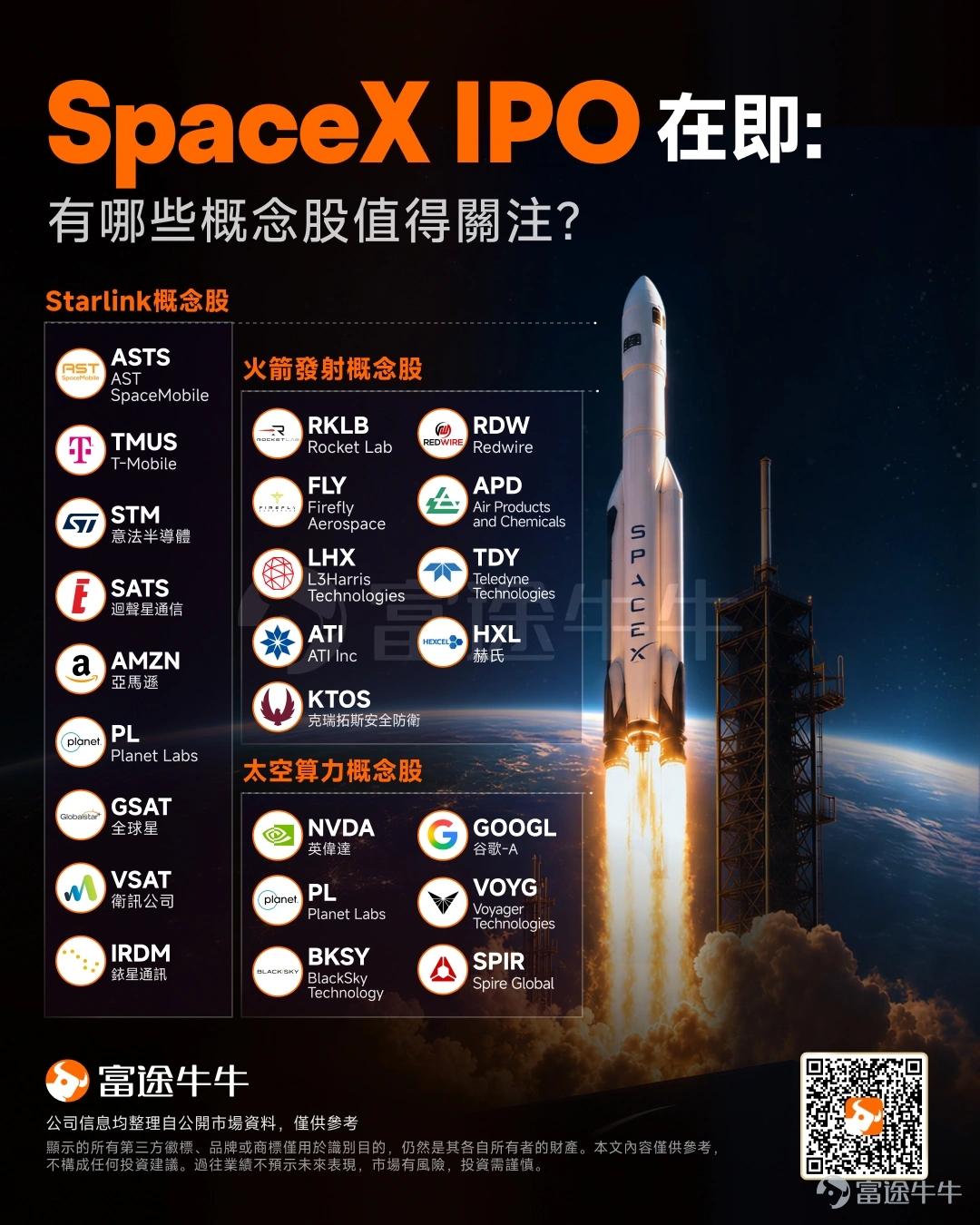
What investment opportunities deserve attention?
Generally speaking, the listing of an industry giant often marks the beginning of sector-wide reshuffling. SpaceX’s move toward what could become the largest IPO in history may deliver a powerful catalyst to space and AI-related themes.

SpaceX's IPO is undoubtedly the most iconic event in global capital markets in 2026, and it is set to continuously reshape market dynamics over the coming months. After SpaceX goes public, will you choose to enter on the first day, or wait for the initial volatility to subside before seizing an opportunity? Could the space economy become the next mega investment theme following AI?
Risk Disclaimer: The above content only represents the author's view. It does not represent any position or investment advice of Futu. Futu makes no representation or warranty.Read more


Comments (23)
to post a comment
54
141