
Waller's debut is imminent—how will Fed policy shift?

Earnings & Options Strategy | 4 Key Focus Areas in Oracle's Earnings Report: Can Its $50 Billion AI Infrastructure Investment Deliver as Promised?
$Oracle (ORCL.US)$Will release its latest earnings after U.S. market hours on June 10.This is not an ordinary earnings report—it is Oracle's first full-quarter financial statement since significantly increasing its AI-related investments. For leading companies closely tied to the AI sector, the significance of their results extends far beyond their own performance—It serves as a critical benchmark for verifying whether the entire AI industry is growing at, or even exceeding, expected rates.
In the previous quarter, Oracle delivered a set of results that pleased Wall Street—revenue reached $17.19 billion, up 22% year-over-year and above market expectations; non-GAAP earnings per share came in at $1.79, surpassing analysts’ forecast of $1.71. The most encouraging figure came from OCI (Cloud Infrastructure), which posted an 84% year-over-year growth rate—far exceeding most expectations. During the earnings call, management raised its total revenue target for fiscal year 2027 to $90 billion, nearly 5% higher than Wall Street’s prior consensus of approximately $86 billion, driving the stock to surge more than 10% intraday the day after the report.

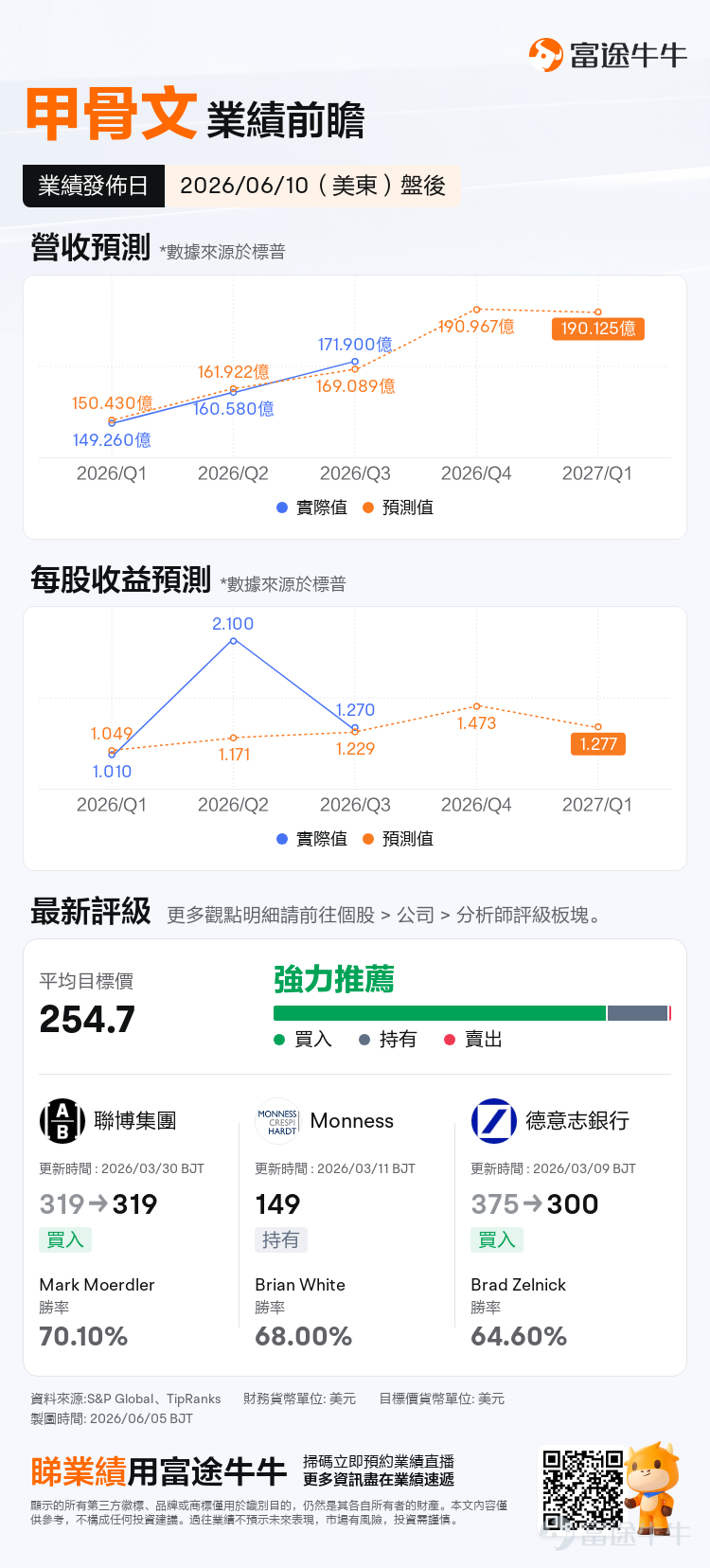
For this earnings release, analysts’ consensus expectations for Oracle are as follows:Total revenue of $19.09 billion, representing approximately 20% year-over-year growth; GAAP earnings per share of $1.47.
Key items the market will be looking to validate in this earnings report include the following:
1. Actual capital expenditures for the full fiscal year 2026;
2. Whether remaining performance obligations (RPO) continue to expand;
3. Whether cloud revenue maintains—or even accelerates—its growth pace;;
4. Capital expenditure plans and business guidance for fiscal year 2027.
Key Focus Areas of This Earnings Report
1) Actual full-year capital expenditures for FY2026
A significant portion of Oracle's planned $50 billion in annual capital expenditures is allocated to rapidly building new data centers globally.Whether construction progress keeps pace with spending directly affects when new data centers come online, when they begin delivering computing power to customers, and when revenue recognition starts. If Q4 capital expenditures fall significantly below $10.8 billion (with $39.2 billion already spent across the first three quarters), it would indicate that construction is lagging behind schedule, pushing back the delivery timeline for remaining contracted services.
Secondly, Oracle’s core rationale for taking on debt is 'borrowing to build infrastructure and repaying the debt with contract revenues.' However, this logic hinges on infrastructure being built effectively and on schedule. If capital expenditures fall short, investors may begin to question whether management has overestimated its execution capabilities.
Finally, Oracle’s full-year free cash flow situation also warrants attention—after accounting for Q4 capital expenditures, will its already deeply negative free cash flow show signs of improvement or continue deteriorating?
2) Remaining Performance Obligation (RPO)
For Oracle, RPO primarily consists of multi-year cloud infrastructure contracts. This metric provides the most direct quantitative reflection of 'long-term AI computing power contracts being locked in.' The market will closely monitor whether this figure continues to expand and whether its conversion into actual revenue accelerates. At the end of Q3, this number reached an astonishing $553 billion, up 325% year-over-year, driven largely by a handful of mega-customers—including OpenAI, Meta, and xAI—signing unprecedented multi-year contracts.
What to Watch in Q4?
First, the absolute amount—i.e., how much was newly signed in Q4.Contract backlog must continue to grow to support the FY2027 revenue target of USD 90 billion—because Remaining Performance Obligations (RPO) serve as a 'reservoir' for future revenue; if the reservoir doesn't expand, subsequent revenue growth will struggle to accelerate.
Second is customer concentration.The market’s biggest current concern is excessive concentration on OpenAI. If Q4 disclosures show that newly added RPO primarily comes from customers other than OpenAI, this concentration risk would be diluted, making the debt narrative more robust.
3) Cloud revenue
The real issue for Q4 is the sustainability of OCI (Oracle Cloud Infrastructure) growth.The 84% growth in Q3 was achieved on a relatively low base (as OCI’s scale was small the prior year). As the base grows larger, growth rates will naturally face mean-reversion pressure. If OCI growth slows to the 60%–70% range in Q4, total cloud revenue growth could fall short of Q3 levels.
4) FY2027 capital expenditure and business guidance
The USD 50 billion capital expenditure planned for fiscal year 2026 is already 'priced in' by the market. However, management has yet to provide an official figure for fiscal year 2027. If capital spending continues to rise beyond expectations, Oracle may be forced to return to the bond market sooner than anticipated.
We also need to hear how the FY2027 revenue target of USD 90 billion will be broken down. This figure was previously mentioned only briefly during earnings calls as a long-term outlook and has never been systematically detailed:
1. How large does OCI need to grow?
2. Which customers will convert from RPO into recognized revenue?
3. When will the new data center come online, and when will it start contributing incremental revenue?
If management further raises guidance this time or provides clarity in its outlook regarding the ramp-up pace of new customers, it would directly serve as a catalyst igniting the next market move; if management continues to offer only vague directional commentary, the market discount will persist.
Options trading strategy reference ahead of earnings
Currently, the options market is exhibiting extreme divergence in sentiment surrounding Oracle's earnings report.

Based on implied volatility data, Oracle's current IV is approximately 79.87%, with an IV rank as high as 92.indicating that Oracle’s options volatility is at an extremely elevated percentile within its historical range over the past year. The market has already fully priced in expectations of 'significant volatility' at current levels, suggesting potentially extreme price swings on earnings day.
In this environment, the primary risk of directly buying call or put options is not necessarily getting the direction wrong,but rather an 'IV crush'—after earnings are released, volatility typically collapses sharply regardless of the outcome, causing option premiums to plummet significantly, which could result in losses even if the directional bet was correct.Therefore,"Let high IV work in your favor" is the core options strategy for this earnings event.
Reference Strategy 1: Cash-Secured Put
Target Investors: Suitable for investors who are confident that Oracle will rise after earnings and are willing to acquire shares at a lower price.
Rationale: Collect elevated implied volatility (IV) premium ahead of earnings. If results beat expectations, the put option will likely expire worthless. If results slightly disappoint but the stock decline is limited, investors can still acquire shares at their desired price.

(The illustrative graphics shown on screen are for demonstration purposes only and do not constitute investment advice or guarantees; market conditions change rapidly, and the displayed option prices do not reflect real-time data.)
Reference Strategy 2: Covered Call
Target Investors: Suitable for investors who already hold Oracle shares and have limited expectations for further significant upside, and who wish to trade a portion of their potential upside for downside 'protection.'
Rationale: Implied volatility (IV) is currently extremely high, meaning the premium received from selling out-of-the-money call options far exceeds typical levels. If the stock price rises modestly or trades sideways after earnings, the full premium is retained. If the stock price exceeds the strike price, the underlying shares are sold at the strike price, with the premium serving as additional compensation—effectively raising the net sale price above the market price alone. The only trade-off is forgoing any gains beyond the strike price.

(The illustrative graphics shown on screen are for demonstration purposes only and do not constitute investment advice or guarantees; market conditions change rapidly, and the displayed option prices do not reflect real-time data.)
Risk control tips
Although short-option strategies generally offer higher win rates, investors must still implement proper risk management:
1. Position sizing is critical. The primary risk of short-option strategies lies in black swan events. It is recommended that margin allocated to any single underlying not exceed 20% of total capital, and investors should avoid selling more options than they can comfortably cover merely to chase premium income.
2. For covered calls, pay attention to rolling positions. When a covered call becomes deeply in-the-money and you remain bullish on the underlying stock, consider buying back the current option to close the position and simultaneously selling a longer-dated call with a higher strike price to avoid having the stock called away at an unfavorable price.
3. For cash-secured puts, beware of left-tail risk. If the stock price plunges sharply due to deteriorating fundamentals, do not mechanically hold the position. Instead, cut losses or roll down the position according to your risk tolerance.
Finally, here's a small perk for fellow Futubull investors, welcome to claim it.Options Beginner Pack
*This event is exclusive to invited HK users. Click to learn more.Detailed event rules>>
Market conditions are complex and volatile,Options StrategyOverwhelmed by choices? Futubull helps you build a portfolio in three steps.Options Strategymaking investing simple and efficient!

Option Risk Warning:An option is a contract that grants the holder the right, but not the obligation, to buy or sell an asset at a fixed price on a specific date or at any time before that date. The price of an option is influenced by various factors, including the current price of the underlying asset, the strike price, time to expiration, and implied volatility. Implied volatility reflects the market’s expectations for the level of volatility in the option over a future period. It is a data point derived inversely from the Black-Scholes option pricing model and is generally regarded as an indicator of market sentiment. When investors anticipate greater volatility, they may be more willing to pay a higher price for options to hedge risks, resulting in higher implied volatility. Traders and investors use implied volatility to assess the attractiveness of option prices, identify potential mispricings, and manage risk exposure.
Disclaimer:This content does not constitute any offer, solicitation, recommendation, opinion, or guarantee of any securities, financial products, or tools. The risk of loss in trading options can be substantial. In some cases, losses may exceed the initial margin deposited. Even if you set contingent orders such as 'stop-loss' or 'limit' orders, these may not prevent losses. Market conditions may make such orders unexecutable. You may be required to deposit additional margin within a short period. If you fail to provide the required amount within the specified time, your open positions may be liquidated. However, you will still be responsible for any shortfall in your account. Therefore, before trading, you should study and understand options and carefully consider whether such trading is suitable for you based on your financial situation and investment objectives. If you trade options, you should be familiar with the procedures for exercising options and the rights and obligations upon exercise and expiration. Options trading carries extremely high risks and is not suitable for all investors. Investors should carefully readCharacteristics and Risks of Standardized Options。
Risk Disclaimer: The above content only represents the author's view. It does not represent any position or investment advice of Futu. Futu makes no representation or warranty.Read more


Comments (3)
to post a comment
33
85