
Cerebras surged over 68% in its debut. Do you have confidence in its future performance?

Option Sir Breaks Down Hot Topics | POET Soars Overnight: Has the AI Optical Interconnect Small-Cap Finally Reached the Order Validation Stage?
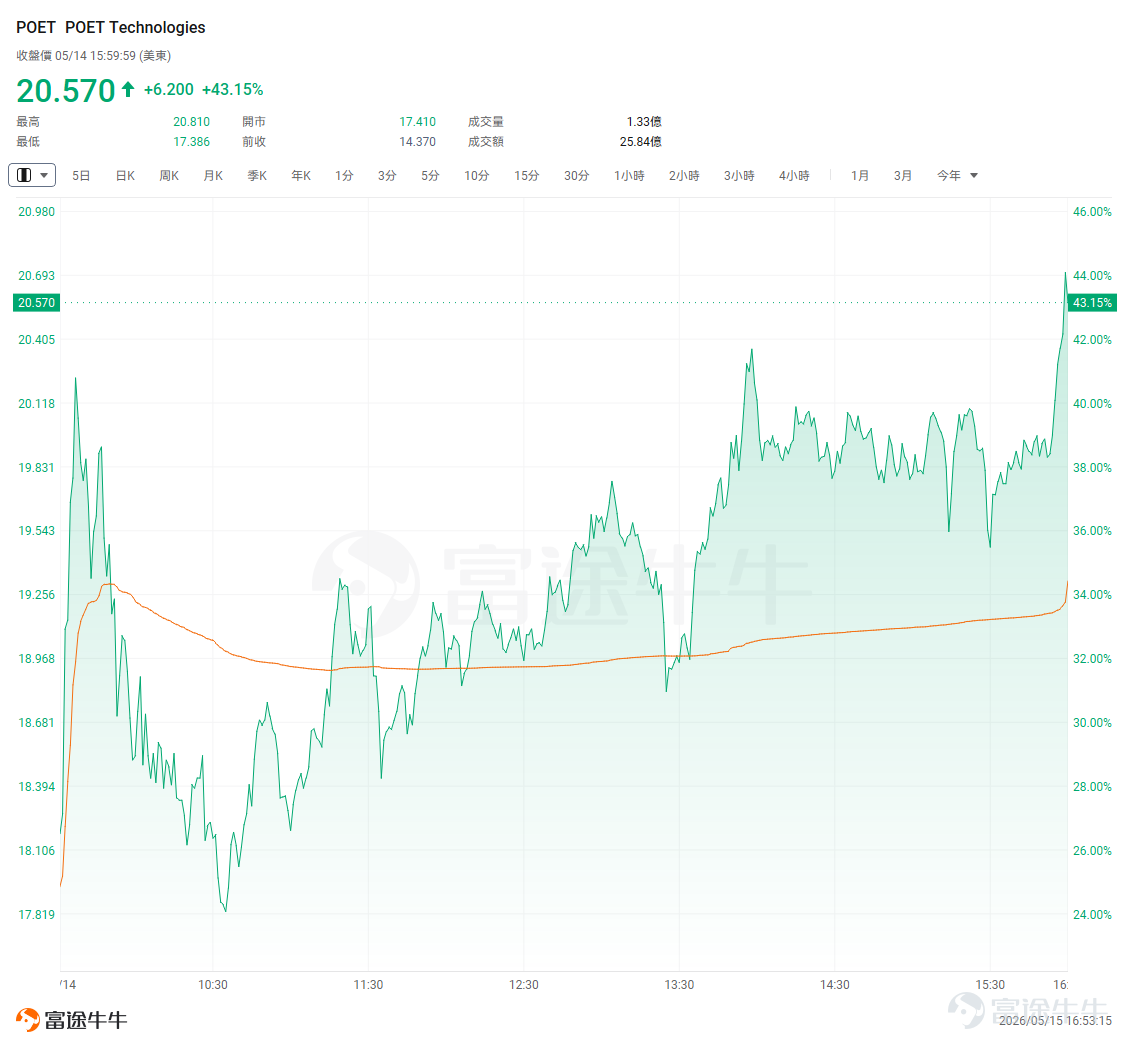
$POET Technologies (POET.US)$ Yesterday, it surged significantly, closing at $20.57, with a single-day increase of 43.15%. During trading, it hit a high of $25.57, and trading volume expanded notably. The latest market capitalization is approximately $1.257 billion. For many investors, this company might not be familiar.POET is still an early-stage commercial company. How should we interpret its rise? Is it sentiment-driven speculation or the arrival of a turning point in performance?

1. What exactly is POET as a company?
POET Technologies primarily focuses on high-speed optical engines, light source products, and custom optical modules, targeting markets such as AI systems and hyperscale data centers. The company's core technology platform is the POET Optical Interposer, which essentially integrates photonic and electronic devices at the chip level and attempts to use wafer-level semiconductor manufacturing methods to address cost, power consumption, size, and mass production efficiency issues faced by traditional optical modules.
To put it simply, if GPUs and HBM solve the problem of 'computing faster,' optical interconnects solve the issue of 'data transmitting faster and more energy-efficiently.' The larger the AI training and inference clusters, the greater the pressure for data flow between chips, servers, and data center networks. Traditional copper interconnects and conventional optical module assembly methods encounter bottlenecks in terms of power consumption, distance, density, and manufacturing efficiency.
POET’s current focus includes 800G, 1.6T, and higher optical engines and optical modules, as well as light source products used for communication between AI servers and between chips. The company positions these products as next-generation solutions to address bandwidth and latency issues in AI systems.
Therefore, POET is not a traditional optical module assembly company. What it aims to do is build a more fundamental photonic integration platform, transforming the optical interconnect manufacturing process with semiconductor methods. This is also why the market is willing to give it higher upside potential.
Why the sudden surge? The Lumilens order was the direct catalyst.
The direct catalyst for this stock price surge came from POET's collaboration with Lumilens.。
POET and Lumilens announced a supply agreement and joint development partnership, under which the two companies will advance wafer-level photonic integration solutions for next-generation AI optical networks based on the Electrical-Optical Interposer (EOI) platform. Lumilens has placed an initial $50 million EOI optical engine order with POET, marking the first phase of a larger supply relationship that could exceed $500 million in cumulative purchases over the next five years.
A notable detail about this order is that POET granted Lumilens up to 22,921,400 warrants, exercisable at $8.25 per share, with 2,292,100 shares immediately exercisable, while the remainder will vest progressively based on future purchase payments by Lumilens.
This order holds significant importance for POET, as the company previously had very low revenue levels.In Q1 2026, POET’s revenue was only $503,400, compared to $341,200 in the previous quarter; net loss for Q1 was $12.34 million, versus a net loss of $42.7 million in Q4. In other words, POET has yet to reach a stable revenue growth phase, and the market has been primarily focused on its technological roadmap and customer potential.
The emergence of the first order worth 50 million US dollars has changed the market's way of observing it. Both parties have indeed made a long-term interest binding, giving POET Technologies its first clear commercial order anchor. POET Technologies' technical platform is starting to gain commercial validation.The biggest question the market had about POET Technologies was whether its technical path could truly enter the customer supply chain. The Lumilens order at least shows that POET Technologies’ EOI optical engine is moving from samples and co-development towards a measurable procurement arrangement.For a company with quarterly revenue still in the hundreds of thousands of dollars, a 50-million-dollar order is enough to change the market’s expectations for future revenue growth.
However, it should be clarified that the 50-million-dollar order will not immediately turn entirely into revenue.The company announcement explicitly mentioned that order fulfillment and revenue recognition depend on the successful development of modules, final certification approval, and whether manufacturing capacity can scale up smoothly. Engineering samples are expected to be released by the end of 2026, with mass production ramp-up anticipated to align with the deployment schedule of hyperscale customers in 2027.
Three, is this short-term speculation or the arrival of an inflection point in performance?
POET Technologies' upside potential comes from three levels:
First, the revenue base is extremely low.Any order reaching the tens of millions entering revenue recognition will bring an extremely exaggerated year-on-year growth rate.
Second, the industry position is attractive enough.The AI computing power industry chain has expanded from GPUs to HBM, servers, electricity, and liquid cooling. Looking further ahead, optical interconnects are an indispensable part of the equation. The market is now willing to search for the 'next bottleneck.' POET Technologies fits perfectly into this narrative.
Third, the technological route exhibits platform-level attributes.POET Technologies emphasizes wafer-level integration, alignment-free manufacturing, high density, low power consumption, and scalable production. If these advantages can be validated in customer mass production, its value will exceed that of a single product order. Company announcements also mentioned that the EOI platform aims to replace the largest cost, yield, and throughput constraints in traditional optical engine production.
However, the current valuation has started to demand that the company deliver on orders. POET Technologies' story has shifted from 'whether it has the technology' to 'whether it can deliver,' which is key to whether its valuation can stabilize going forward. The market is already pricing in significant revenue growth by 2027.
If the initial order for Lumilens proceeds smoothly and leads analysts to revise upward their 2027 revenue forecasts, the stock price could see further revaluation. However, if subsequent new orders, customer certifications, or capacity progress are lacking, volatility following a sharp one-day rise will significantly increase.For instance, after Marvell acquired Celestial AI, it canceled a previous purchase order issued to POET Technologies due to the latter’s breach of confidentiality obligations regarding the disclosure of the purchase order and shipment information, causing POET Technologies’ stock to plummet by 47.25% in a single day.
POET Technologies currently exhibits high-risk characteristics with short-term technical overbought conditions, extremely optimistic sentiment in the options market, but extremely high implied volatility.The stock price has significantly deviated from all major moving averages, creating substantial short-term profit-taking pressure and accumulating downside risks. During the sharp rise on May 14, although there was a net inflow of $92.6764 million, institutional fund flows showed divergence, with intraday data revealing a net outflow of very large orders totaling $1.8154 million. Sentiment in the options market leans optimistic, with a Put/Call Ratio of 0.55 and extremely high implied volatility (IV), currently at 189.78%, reaching historical highs.
1. If you already hold POET Technologies shares and do not want to sell but are concerned about a pullback, consider protecting your unrealized gains.
Operationally, you can retain the shares while buying puts below and selling calls above, using the premium received from selling calls to partially offset the cost of buying puts. The core function of this strategy is to lock in some of the profits already earned. POET Technologies saw extreme intraday volatility yesterday, and the current share price has deviated too much from short-term moving averages. Once market sentiment retreats, the pullback may not be mild. The trade-off of the collar strategy is sacrificing some potential for further upside, but under these levels of gains and turnover, controlling downside risk takes priority over amplifying profits.
(The figure below illustrates the simulated profit and loss scenario of this strategy on the expiration date. The design image displayed on the screen is for demonstration purposes only and does not constitute any investment advice or guarantee; market conditions fluctuate frequently, and the prices shown do not represent actual values.)

2. If you believe there is short-term overheating and want to speculate on a pullback
For traders focused on the short term, if they determine that POET Technologies has surged too quickly in the short run and might experience a technical pullback, they can use a call option spread strategy. This is equivalent to betting on a retreat from the current high levels without bearing the high premium costs associated with simply buying Put options.
This strategy is more suitable for short-term trading one to two weeks after an event. The rationale isn't based on pessimism about the company's long-term outlook but rather on trading the 'technical correction after a sharp rise.' For a high-volatility small-cap stock like POET Technologies, once upward momentum falters, the speed of retracement could be rapid; however, due to the high cost of short selling or buying Puts, it is essential to manage potential losses through spreads.
(The figure below illustrates the simulated profit and loss scenario of this strategy on the expiration date. The design image displayed on the screen is for demonstration purposes only and does not constitute any investment advice or guarantee; market conditions fluctuate frequently, and the prices shown do not represent actual values.)

Finally, Option Sir brings a small perk for fellow investors, welcome to claim it.Options Beginner Pack
*This event is exclusive to invited HK users. Click to learn more.Detailed event rules>>
Market conditions are complex and volatile,Options StrategyOverwhelmed by choices? Futubull helps you build a portfolio in three steps.Options Strategymaking investing simple and efficient!

Option Risk Warning:An option is a contract that grants the holder the right, but not the obligation, to buy or sell an asset at a fixed price on a specific date or at any time before that date. The price of an option is influenced by various factors, including the current price of the underlying asset, the strike price, time to expiration, and implied volatility. Implied volatility reflects the market’s expectations for the level of volatility in the option over a future period. It is a data point derived inversely from the Black-Scholes option pricing model and is generally regarded as an indicator of market sentiment. When investors anticipate greater volatility, they may be more willing to pay a higher price for options to hedge risks, resulting in higher implied volatility. Traders and investors use implied volatility to assess the attractiveness of option prices, identify potential mispricings, and manage risk exposure.
Disclaimer:This content does not constitute any offer, solicitation, recommendation, opinion, or guarantee of any securities, financial products, or tools. The risk of loss in trading options can be substantial. In some cases, losses may exceed the initial margin deposited. Even if you set contingent orders such as 'stop-loss' or 'limit' orders, these may not prevent losses. Market conditions may make such orders unexecutable. You may be required to deposit additional margin within a short period. If you fail to provide the required amount within the specified time, your open positions may be liquidated. However, you will still be responsible for any shortfall in your account. Therefore, before trading, you should study and understand options and carefully consider whether such trading is suitable for you based on your financial situation and investment objectives. If you trade options, you should be familiar with the procedures for exercising options and the rights and obligations upon exercise and expiration. Options trading carries extremely high risks and is not suitable for all investors. Investors should carefully readCharacteristics and Risks of Standardized Options。
Risk Disclaimer: The above content only represents the author's view. It does not represent any position or investment advice of Futu. Futu makes no representation or warranty.Read more


Comment (1)
to post a comment
24
48