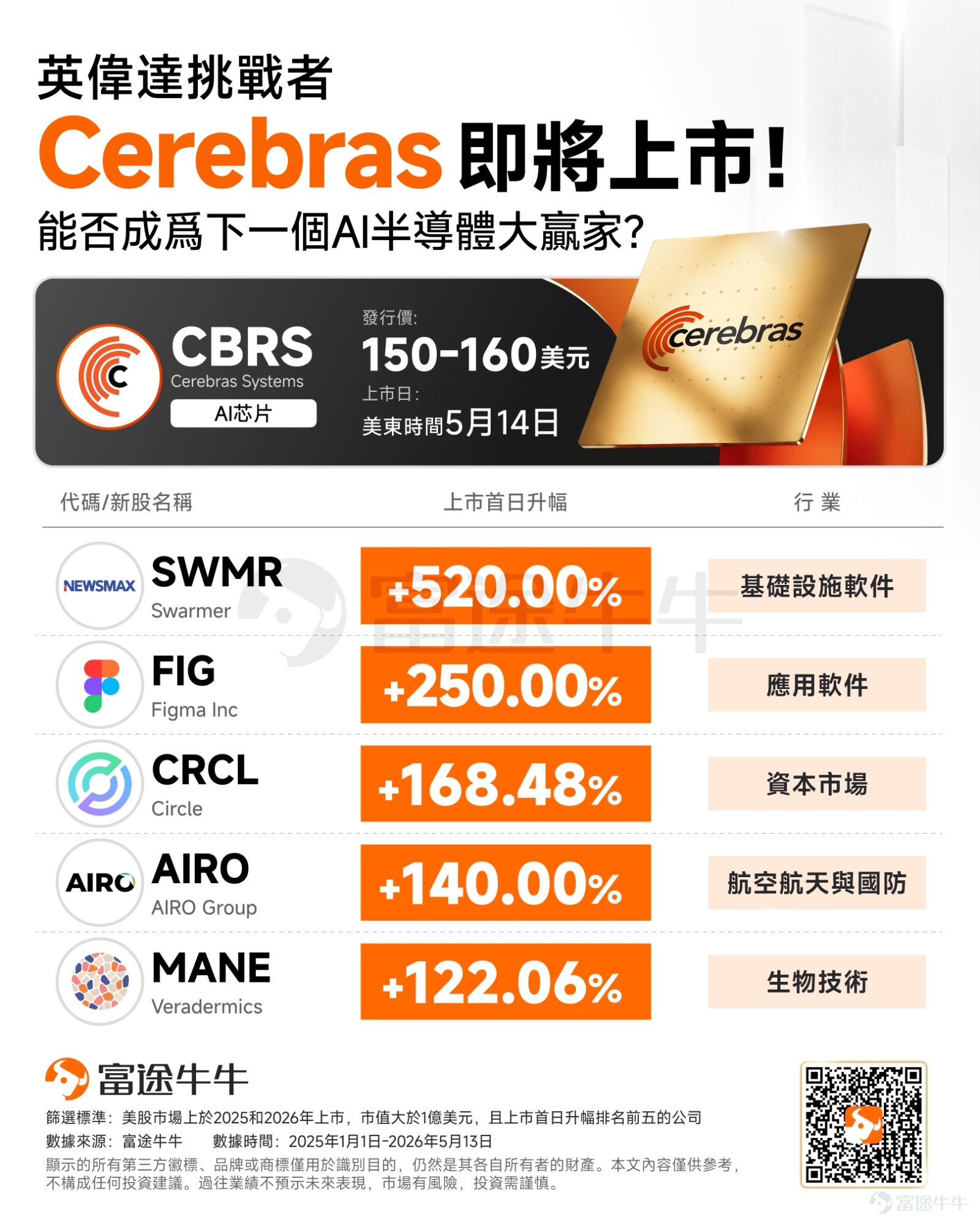
Cerebras surged over 68% in its debut. Do you have confidence in its future performance?

Cerebras is about to go public! Can the only wafer-scale AI chip shake NVIDIA's dominant position?
Cerebras, the AI chip company hailed as the 'NVIDIA challenger,' will list on Nasdaq under the ticker symbol CBRS on Thursday, May 14, Eastern Time. Due to high subscription demand, it has already achieved over 20 times oversubscription, with subscription interest exceeding $10 billion.
The company announced on May 11 that it had raised its price range from $115–$125 per share to $150–$160 and increased the number of shares offered to 30 million, aiming to raise up to $4.8 billion. This will become the largest IPO globally so far this year.

--
--
--
What makes this company so passionately pursued by the market? Let’s first understand Cerebras' technological edge and business logic.
What does Cerebras do? What are its technical advantages?
Cerebras Systems is an AI chip company that breaks through the physical limitations of traditional chips. Over the past few years, the main focus in AI hardware has been on 'large model training.' However, as AI models move toward practical applications, the demand for inference is growing, and the market for low-latency, real-time response 'inference' is exploding.
Cerebras happens to be riding this wave of 'inference fever.' Its core approach is wafer-scale chips, which can be understood as:Turning an entire wafer into one giant chip. The key advantage lies in integrating tens of thousands of computing cores and memory units directly onto a single wafer.This solution often proves more direct and efficient than piecing together GPU clusters when handling high-throughput, low-latency inference tasks.
Core Technology — Wafer Scale Engine (WSE)
Traditional GPUs or CPUs are limited by lithography machine sizes, with a standard 300mm wafer typically cut into dozens to hundreds of individual chips. In contrast, Cerebras’ flagship product, the WSE-3, covers an area of 46,225 square millimeters, approximately 57 times larger than NVIDIA's B200 GPU. It integrates 4 trillion transistors and 900,000 AI computing cores.
Since wafer-scale chips are so powerful, why don't other chip companies make them?
As is well known, the larger the chip, the lower the yield. Under traditional designs, a single fatal defect on an entire wafer would render the whole wafer scrap, resulting in extremely high costs. Cerebras' solution is the 'redundant cores and fully dynamic routing' technology: The WSE-3 contains 900,000 cores, and when a defect is detected, Cerebras' underlying microarchitecture can automatically bypass the defective cores and maintain the chip’s overall computational power by utilizing nearby cores. This allows them to utilize entire wafers with higher yields, which is a hardcore patent that other chip giants have yet been unable to replicate at low cost.

The real technological barrier: memory. In AI inference, data transfer speed is far more important than raw computing power.In traditional architectures, frequent shuttling of model parameters between external memory and computing cores leads to transmission delays and bandwidth limitations. The WSE-3 integrates memory directly onto the chip, with an SRAM capacity of 44GB and memory bandwidth reaching 21PB per second. By comparison, NVIDIA's H100 on-chip memory bandwidth is roughly one six-thousandth of this figure. According to Cerebras, when running Meta’s flagship model Llama 4 Maverick, which has 400 billion parameters,the WSE-3’s inference speed is more than twice that of NVIDIA DGX B200 Blackwell systems.
Moreover, what Cerebras offers is not just the chip,but an all-in-one integrated package spanning hardware, system, and cloud services:Each CS-3 includes one WSE-3 chip, a liquid cooling system, power management, and accompanying software. With a maximum power consumption of about 23 kilowatts, it can be deployed directly into a data center like a server.
Cerebras also provides the cloud service Cerebras Inference, which claims to offer inference speeds 15 times faster than traditional GPUs while significantly reducing costs. In other words, Cerebras is not only a chip company but also a systems integrator, data center operator, and inference cloud service provider. This vertically integrated model in the wafer-scale ultra-large chip field currently has no equivalent in the industry.
Why is this company so strongly favored by the market?
"Non-NVIDIA Alternatives":Current global AI computing power infrastructure spending continues to expand aggressively. Amid NVIDIA’s dominance and insufficient production capacity, cloud service providers and large enterprises are urgently seeking a "second supplier" to achieve diversification. Cerebras, as the most architecturally differentiated pure AI chip provider, has naturally become a scarce outlet for capital markets to chase.
From "Massive Losses" to "Turning a Profit":The biggest skepticism the market has about startup chip companies is often whether they can make money. Through its latest SEC filing, Cerebras delivered an extremely impressive financial report:
- Revenue surge: Full-year 2025 revenue reached $510 million, a substantial year-on-year increase of 76%.
- Turning profitable: From a loss of $485 million in 2024 to achieving a net profit of $237.8 million in 2025.
Optimistic order visibility:Cerebras currently holds remaining performance obligations (backlog orders) amounting to $24.6 billion. Given its current annual revenue of approximately $500 million, these orders ensure high growth for the company is locked in for several years, providing business stability that is extremely rare among startups.
1、Boosted by a long-term contract with OpenAI:
The two parties signed a long-term supply contract extending until 2028, with OpenAI committing to purchase up to 750 megawatts (MW) of low-latency inference computing clusters, with the total contract value exceeding $20 billion.
OpenAI is not only a client but also directly provided Cerebras with a $1 billion operating capital loan and holds a significant stake in the company, indicating deeply intertwined interests. OpenAI plans to leverage its ultra-low latency features to support the commercial rollout of next-generation real-time voice and agent technologies.
2、 AWS Collaboration
In March 2026, Amazon AWS signed a legally binding term sheet with Cerebras. The two parties will launch the first 'decoupled reasoning solution,' where AWS's self-developed Trainium chips handle Prefill and integrate the Cerebras CS-3 system into the Amazon Bedrock platform via the EFA network. This marks Cerebras's first successful entry into the infrastructure supply chain of the world’s largest cloud giant.
3、CoreWeave: 300MW Large-Scale Data Center Computing Power Order
Cerebras has partnered with AI cloud giant CoreWeave and Canadian telecom BCE to build Canada's largest dedicated AI data center. In this 300MW campus, 160MW of power will be exclusively allocated to deploy Cerebras's wafer-scale systems as the core reasoning and training compute infrastructure, complementing and synergizing with CoreWeave’s NVIDIA GPU compute clusters.
What risks does this company currently face?
First is customer concentration:Although Cerebras is actively pivoting toward the U.S. domestic market, 86% of its 2025 revenue still heavily relies on two major AI companies in the UAE. Any geopolitical shifts or order reductions could significantly impact the company.
Single-order risk:Of its claimed $24.6 billion order pool, over $20 billion comes from a single customer, OpenAI. The prospectus mentions that Cerebras must meet specified data center delivery milestones and minimum capacity thresholds; failure to deliver could allow OpenAI to terminate part or all of the agreement.
Exclusive manufacturing and supply chain bottlenecks:Although the WSE chip features a high level of redundant cores and defect tolerance technology, its massive single-die physical structure ties production closely to Taiwan Semiconductor's advanced process capacity. Despite the company’s redundancy core technology, as global advanced process capacity continues to tighten, any fluctuations in Taiwan Semiconductor’s wafer yield will also impact Cerebras.
NVIDIA’s counterattack:NVIDIA won’t stand idly by; the Blackwell B200 series has already entered the market by the end of 2025. The next-generation GPU, codenamed Vera Rubin, is expected to enter mass production in the second half of 2026. The Rubin architecture will use HBM4 memory, providing bandwidth of up to 22TB/s, with inference performance projected to improve 2.5 times over Blackwell, rapidly narrowing Cerebras’ current technical advantage in low-latency inference.
Short-term valuation surge:In just three months since its second attempt at an IPO, Cerebras' market value skyrocketed from $23 billion to approximately $48.8 billion to $50 billion at listing, thanks to strong endorsements and subscription enthusiasm from OpenAI.
What are the noteworthy investment opportunities and related stocks?
For investors, apart from monitoring the company’s IPO, they can also focus on key companies within the relevant supply chain and strategic partners:
– $Taiwan Semiconductor (TSM.US)$:As the sole contract manufacturer, Cerebras uses TSMC’s N5 custom process and special stitching techniques. Although TSMC may introduce SoW-X technology to compete by 2027, each giant Cerebras chip brings significant revenue opportunities for TSMC in the short term.
– $ASE Technology (ASX.US)$:Wafer-level chips present extreme challenges in backend packaging and testing. ASE Group handles complex InFO_SoW advanced packaging, playing a crucial role in making Cerebras hardware commercially viable.
– $Amazon (AMZN.US)$:By integrating CS-3, AWS has strengthened its bargaining power in the AI inference market. This marks an important entry point for the company to expand its "non-GPU" ecosystem.
– Other large enterprises: $Qualcomm (QCOM.US)$ 、 $Intel (INTC.US)$ These major enterprises have adopted defensive strategies by investing in Cerebras. If Cerebras enters a growth phase, investors may receive corresponding returns on their investment.
Summary
The core significance of Cerebras' IPO is not about disrupting NVIDIA but validating the commercial viability of "non-HBM inference chips." Constrained by physical production capacity limits, Cerebras will not be able to challenge the mainstream position of "GPUs + HBM + optical interconnects" within the next five years. Therefore, this does not pose a substantial negative impact on HBM, optical communications, or Taiwan Semiconductor’s advanced packaging supply chain; instead, it becomes a new profit growth point for Taiwan Semiconductor's advanced process capacity. The future AI computing power market is expected to enter a "dual-track coexistence" era, and the IPO is merely the beginning of Cerebras’ commercialization test.
Risk Disclaimer: The above content only represents the author's view. It does not represent any position or investment advice of Futu. Futu makes no representation or warranty.Read more


Comments (13)
to post a comment
100
459