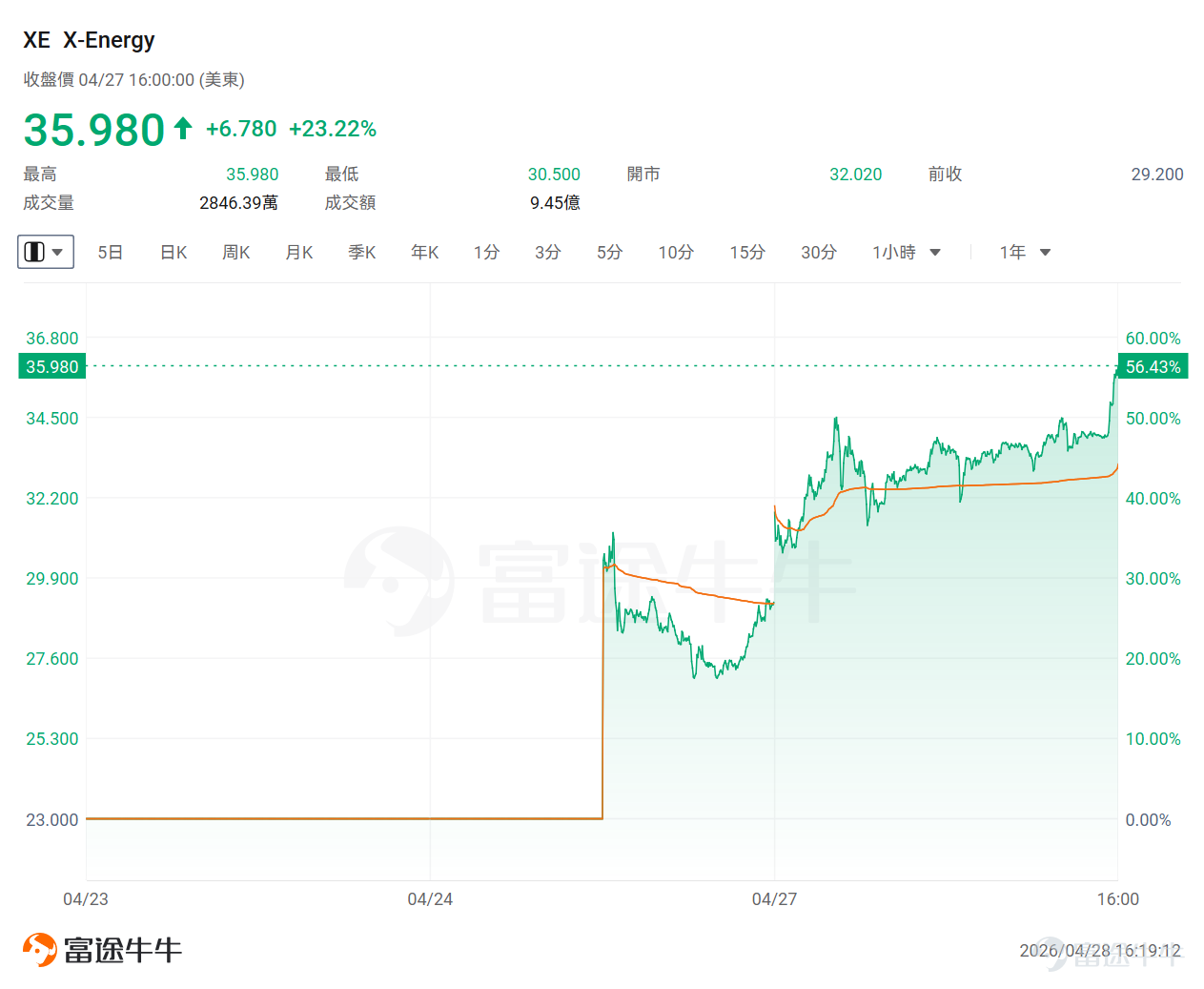

Surging over 50% in two days after listing! X-Energy, the new star in nuclear power, was heavily bought by 'Wooden Sister' – what opportunities in this industry are worth capturing?
Recently, the stunning debut of small modular nuclear reactor developer $X-Energy (XE.US)$ on Nasdaq—surging over 50% in two days—not only allowed early investors like Amazon, hedge fund giant Citadel, and asset management firm Ares Management to reap huge profits,but also sent a strong market signal: the 'Renaissance 2.0' era of the nuclear energy industry has truly arrived.
![Recently, the small modular nuclear reactor developer $X-Energy (XE.US)$ made a stunning debut on Nasdaq, with cumulative gains of over 50% in two days, not only allowing early investors like Amazon, hedge fund giant Citadel, and asset management firm Ares Management to make hefty profits,but also sending a strong market signal: the 'Renaissance 2.0' era for the nuclear energy industry has truly arrived. Notably, On XE's first day of listing, 'Wooden Sister' scooped up more than 4 million shares.Besides, as early as last year,[Share Link: 'Backed by Huang Renzhong and heavily bet on by Trump! Is AI’s final destination nuclear power? Here’s a list of golden opportunities in the industrial chain.']Multiple articles mentioned that Huang Renzhong believes energy will become the next global bottleneck for artificial intelligence,predicting that small modular reactors will be widely used to power AI systems within the next decade. And in March this year,TerraPower, backed by Bill Gates, received the first nuclear power construction permit in the U.S. in nearly a decade,Its sodium-cooled fast reactor breaks the four-decade monopoly of light water reactors and has signed a contract with Meta to build up to eight reactors,This also signifies that advanced nuclear power dedicated to providing carbon-free electricity for AI data centers has officially begun its commercialization wave. By now, many fellow investors may be wondering why nuclear power is becoming increasingly important and which companies in the industry chain are worth capturing. We will explain these to fellow investors one by one going forward. Why is nuclear power becoming increasingly important? 2...](https://nnqimage.futunn.com/sns_client_feed/900080/20260428/web-1777370666547-vR2PCFsg6P.png/big?area=1&is_public=true&imageMogr2/ignore-error/1/format/webp)
Notably, On XE's first day of listing, Cathie Wood snapped up more than 4 million shares.Besides, as early as last year,Huang Renxun's support and Trump’s big bet! Is nuclear power the ultimate solution for AI? Here’s a list of promising companies in the industry to watch.Multiple articles have also mentioned that Huang Renxun believes energy will become the next global bottleneck for artificial intelligence,predicting that in the next decade, small modular nuclear reactors will be widely used to power AI systems.
And in March this year,TerraPower, backed by Bill Gates, received the first nuclear construction permit in the US in nearly a decade,Its sodium-cooled fast reactor breaks the four-decade monopoly of light water reactors and it has signed a contract with Meta to build up to eight reactors,This signifies that advanced nuclear power, providing carbon-free electricity specifically for AI data centers, is officially breaking ground in its commercialization wave.
By now, many fellow investors are probably curious: why is nuclear power becoming increasingly important? Which companies in the supply chain are worth capturing? We'll explain these one by one for our fellow investors.
Why is nuclear power becoming increasingly important?
At the beginning of 2026, the Trump administration set an ambitious goal to increase the total installed nuclear power capacity in the United Statesfrom the current approximately 100 gigawatts (GW) to 400 gigawatts by 2050.
Barclays' latest research report indicates that nuclear energy is transitioning from policy consensus to the substantive construction phase. The market will increasingly reward companies that can demonstrate actual delivery capabilities — whether in the operation and expansion of existing units or credible pathways for advanced reactors from permitting to commencement.
Since 2026, three drivers — energy security, decarbonization, and AI computing power demand — have continued to strengthen. Global nuclear ecosystem stocks have risen 19% year-to-date, with uranium mining and processing sectors surging as much as 30%, significantly outperforming the 6% gain of global benchmark indices.
![Recently, the small modular nuclear reactor developer $X-Energy (XE.US)$ made a stunning debut on Nasdaq, with cumulative gains of over 50% in two days, not only allowing early investors like Amazon, hedge fund giant Citadel, and asset management firm Ares Management to make hefty profits,but also sending a strong market signal: the 'Renaissance 2.0' era for the nuclear energy industry has truly arrived. Notably, On XE's first day of listing, 'Wooden Sister' scooped up more than 4 million shares.Besides, as early as last year,[Share Link: 'Backed by Huang Renzhong and heavily bet on by Trump! Is AI’s final destination nuclear power? Here’s a list of golden opportunities in the industrial chain.']Multiple articles mentioned that Huang Renzhong believes energy will become the next global bottleneck for artificial intelligence,predicting that small modular reactors will be widely used to power AI systems within the next decade. And in March this year,TerraPower, backed by Bill Gates, received the first nuclear power construction permit in the U.S. in nearly a decade,Its sodium-cooled fast reactor breaks the four-decade monopoly of light water reactors and has signed a contract with Meta to build up to eight reactors,This also signifies that advanced nuclear power dedicated to providing carbon-free electricity for AI data centers has officially begun its commercialization wave. By now, many fellow investors may be wondering why nuclear power is becoming increasingly important and which companies in the industry chain are worth capturing. We will explain these to fellow investors one by one going forward. Why is nuclear power becoming increasingly important? 2...](https://nnqimage.futunn.com/sns_client_feed/900080/20260428/web-1777370666264-ZyJUeZEUp4.png/big?area=1&is_public=true&imageMogr2/ignore-error/1/format/webp)
In fact, the escalation of the Middle East situation has become an important catalyst for accelerating this round of nuclear energy policies.The specific progress is as follows:
1. In 2026, global nuclear energy policies have shifted from principled support to the implementation of specific industrial policies, with substantial progress seen in North America, Europe, and Asia.
In the United States, the Trump administration views nuclear energy as a geostrategic tool to win the global AI competition, launching a series of aggressive industrial policies. The U.S. Department of Energy (DOE) allocated approximately $900 million each to Centrus, Orano, and General Matter to expand domestic uranium enrichment capacity, covering both high-assay low-enriched uranium (HALEU) required for advanced reactors and low-enriched uranium (LEU) needed for traditional light-water reactors. The NRC issued a construction permit for TerraPower's 345-megawatt Natrium project in Kemmerer and accepted Holtec's phased construction permit application for the SMR-300 at Palisades.
In Asia, Tokyo Electric Power's Unit 6 of the Kashiwazaki-Kariwa Nuclear Power Plant resumed commercial operations; in Europe, Sweden and Switzerland both advanced legislative processes to repeal nuclear power bans.
2. Hyperscale tech companies have begun providing revenue guarantees for nuclear energy construction.
The most significant business development in 2026 is Meta's modular nuclear procurement. In January this year, Meta announced agreements with Vistra, TerraPower, and Oklo, potentially supporting up to 6.6GW of new and existing clean energy capacity. Combined with the previously signed power purchase agreement with Constellation for the Clinton Clean Energy Center, Meta has established a diversified nuclear procurement system covering operational units, power upgrades, and advanced reactor pipelines.
Additionally, previously signed agreements have started to translate into actual construction actions. The Hermes 2 project, a collaboration between Kairos Power and Google, broke ground in Oak Ridge in April. This is the first fourth-generation commercial-scale reactor in the U.S. to receive a construction permit and will supply up to 50MW of clean electricity to the Tennessee Valley Authority (TVA) grid. Last week, TerraPower also announced the official commencement of its flagship Natrium project Kemmerer Unit 1, less than two months after receiving the construction permit from the NRC.
Which companies in the industry chain are worth capturing?
As early as the end of 2024,An article titled 'Tech Giants Scramble to Deploy! Could 2025 Be the Year Nuclear Stocks Break Out, Becoming the Next Battleground for AI?' highlighted investment opportunities related to the nuclear power industry, stating that AI data centers would become the new 'electricity hogs.' The proportion of electricity consumed by data centers is expected to increase further, and nuclear power could become the next battleground for AI.
From an upstream and downstream perspective of the industry chain, the SMR nuclear power industry chain encompasses all aspects from upstream uranium mining, midstream R&D and construction, to downstream operations and waste management.
![Recently, the small modular nuclear reactor developer $X-Energy (XE.US)$ made a stunning debut on Nasdaq, with cumulative gains of over 50% in two days, not only allowing early investors like Amazon, hedge fund giant Citadel, and asset management firm Ares Management to make hefty profits,but also sending a strong market signal: the 'Renaissance 2.0' era for the nuclear energy industry has truly arrived. Notably, On XE's first day of listing, 'Wooden Sister' scooped up more than 4 million shares.Besides, as early as last year,[Share Link: 'Backed by Huang Renzhong and heavily bet on by Trump! Is AI’s final destination nuclear power? Here’s a list of golden opportunities in the industrial chain.']Multiple articles mentioned that Huang Renzhong believes energy will become the next global bottleneck for artificial intelligence,predicting that small modular reactors will be widely used to power AI systems within the next decade. And in March this year,TerraPower, backed by Bill Gates, received the first nuclear power construction permit in the U.S. in nearly a decade,Its sodium-cooled fast reactor breaks the four-decade monopoly of light water reactors and has signed a contract with Meta to build up to eight reactors,This also signifies that advanced nuclear power dedicated to providing carbon-free electricity for AI data centers has officially begun its commercialization wave. By now, many fellow investors may be wondering why nuclear power is becoming increasingly important and which companies in the industry chain are worth capturing. We will explain these to fellow investors one by one going forward. Why is nuclear power becoming increasingly important? 2...](https://nnqimage.futunn.com/sns_client_feed/900080/20260428/web-1777371343894-5jegHJdqWa.png/big?area=1&is_public=true&imageMogr2/ignore-error/1/format/webp)
Upstream: Raw Materials and Processing
The upstream industry chain mainly involves the supply of basic raw materials, key equipment, and nuclear fuel required for nuclear energy development, primarily including uranium mining and uranium enrichment.
Specifically, uranium mining includes $Cameco (CCJ.US)$ 、$Uranium Energy (UEC.US)$ 、$Energy Fuels (UUUU.US)$ 、$Denison Mines (DNN.US)$ 、$NexGen Energy (NXE.US)$ ; Nuclear fuel processing$Centrus Energy (LEU.US)$ 。
Midstream: Design, R&D, and Construction
The midstream includes design, R&D, and construction. Among these,
$X-Energy (XE.US)$ is a highly anticipated US advanced Small Modular Reactor (SMR) developer and nuclear fuel manufacturer,Amazon is its most important strategic partner and largest shareholder,with a stake of approximately 24.9%.This company's standout advantage lies in having substantial commercial orders,—its clients include Amazon, Dow Inc, and UK energy provider Centrica, all of which have reached power supply agreements.
$NuScale Power (SMR.US)$It is the first listed SMR nuclear power vendor; the company’s core product is the SMR power module,HSBC states that it holds the only SMR design currently licensed by the NRC, giving it a first-mover advantage.The company adopts a light-asset model, primarily offering technology licensing and services, but may require additional fundraising as projects progress.
$Oklo Inc (OKLO.US)$The company focuses on the development of Small Modular Reactors (SMRs) and has previously received investment from 'ChatGPT's father' Altman. HSBC believes that OKLO’s business is deeply tied to data center power demand, with commercial electricity sales expected around 2030.
$NANO Nuclear Energy (NNE.US)$ specializes in developing small modular reactors, with its main business covering four areas related to SMRs, spanning manufacturing, fuel, transportation, and other segments, aiming to build a diversified vertically integrated industrial chain;
$BWX Technologies (BWXT.US)$ focuses on nuclear reactor component manufacturing and nuclear energy technology. The biggest difference between BWXT and SMR/OKLO is that BWXT is a large equipment supplier and technical service provider, primarily offering nuclear reactor components, nuclear fuel, and defense-related nuclear technologies to government and commercial sectors, with clients including the US government (e.g., providing nuclear reactors for naval submarines).
Downstream: Operations, Sales, and Waste Management
The downstream primarily involves nuclear power plant operations and energy supply, with participants including $Constellation Energy (CEG.US)$ 、 $Vistra Energy (VST.US)$ 、 $American Electric Power (AEP.US)$ 、 $Southern (SO.US)$ 、 $Exelon (EXC.US)$ 、 $Duke Energy (DUK.US)$ 、 $Entergy (ETR.US)$ 、 $Public Service Enterprise Group (PEG.US)$Wait.
In addition, electrical equipment includes $GE Vernova (GEV.US)$ 、 $Eaton (ETN.US)$ 、 $Honeywell (HON.US)$ 、 $Emerson Electric (EMR.US)$ 、 $Graham (GHM.US)$Wait.
Summary
Overall, the global nuclear energy industry has transitioned from the previous phase of 'policy discussions and concept speculation' to a new stage of 'real orders and capacity construction.' The explosive growth of large AI models is driving massive computational power demands, which are evolving into an intense competition for electricity resources. Nuclear power — particularly SMRs (Small Modular Reactors), known for their flexibility, stability, and zero-carbon emissions — has become the ultimate solution for tech giants to address the 'electricity crunch.'
For investors, this represents a long-term opportunity spanning the entire industrial chain. However, as institutions have noted, as the market enters the actual construction phase, capital will become more 'selective,' rewarding companies that demonstrate real delivery capabilities, high commercial order conversion rates, and can successfully navigate policy approvals.In this gold rush of 'Nuclear Renaissance 2.0,' fellow investors need to closely track key project milestones and cooperation updates of core targets, capturing this wave of dual-driven benefits from AI and energy security!
Risk Disclaimer: The above content only represents the author's view. It does not represent any position or investment advice of Futu. Futu makes no representation or warranty.Read more


Comments (6)
to post a comment
39
129