
AI agents ignite CPU demand! Who are the big winners?

Option Sir Breaks Down Hot Topics | CPU Trio: Intel Awaits Earnings Report, AMD & ARM Hit New Highs, How to Choose?
In overnight US stock trading, the semiconductor sector once again took center stage, with both memory and CPUs sharing the spotlight. The market trend showed a clear divergence: $Advanced Micro Devices (AMD.US)$ signed a 1.2 GW fuel cell power contract with $Arm Holdings (ARM.US)$AMD surged over 6%, while ARM skyrocketed more than 12%, both hitting new all-time highs.;On the other hand, the long-time leader $Intel (INTC.US)$, amid mixed market sentiment towards its earnings report scheduled to be released after the market closes today (April 23), ended lower against the market trend.
Behind this rise and fall is the market's vote on the shift in computing paradigms and the reshaping of competitive dynamics in the AI era. The CPU, once considered a 'supporting actor' during the GPU-led AI training boom, is regaining capital's favor due to its irreplaceability in AI inference, especially in emerging agent workloads.
However, these three companies possess different strengths and are pursuing varied paths, all competing on the same recovering track, leaving fellow investors potentially conflicted.Today, we will revisit the new narrative around the CPU industry, compare the medium- to long-term logic of AMD, Intel, and ARM, and explore short-term trading opportunities surrounding key events such as Intel's earnings report.
CPU: From 'Supporting Actor' to 'Key Player'
Over the past few years, the structure of computing expenditure in data centers has undergone a dramatic transformation. With the explosive demand for large model training,AI accelerators with extremely powerful parallel computing capabilities, such as GPUs, have consumed the vast majority of growth share.The proportion of AI accelerators in data center computing expenditure surged from 26% in 2021 to 87% in 2025, while the share of CPUs shrank from 74% to 13%.
However, the wave of AI is entering a new phase: moving from AI training to large-scale AI applications and inference. This brings a glimmer of structural recovery for CPUs.

Data source: SemiAnalysis
AI inference, especially in complex agent interactions and multi-step task processing, has workload characteristics that are completely different from training. It involves not only simple matrix operations but also a significant amount ofsequence processing, low-latency responses, task scheduling, memory management, and logical control.。
For instance, during the 'decoding' phase of conversational AI, generating each new token requires referencing the entire preceding context, which is a highly sequential, control-intensive process. GPUs excel at parallel computing, whereas CPUs act as the traffic coordinator for the entire system's collaborative operation.In agent-based scenarios, CPUs are required to frequently coordinate and transfer data between computing nodes, memory, and storage, making their core role increasingly prominent.
Another positive factor for the industry comes from the supply chain.To meet the surging demand for AI accelerators (GPUs, ASICs), global advanced process capacity (such as Taiwan Semiconductor's CoWoS packaging) continues to tilt toward this field, which has, to some extent, squeezed CPU production resources, similar to what we've observed in the memory industry.
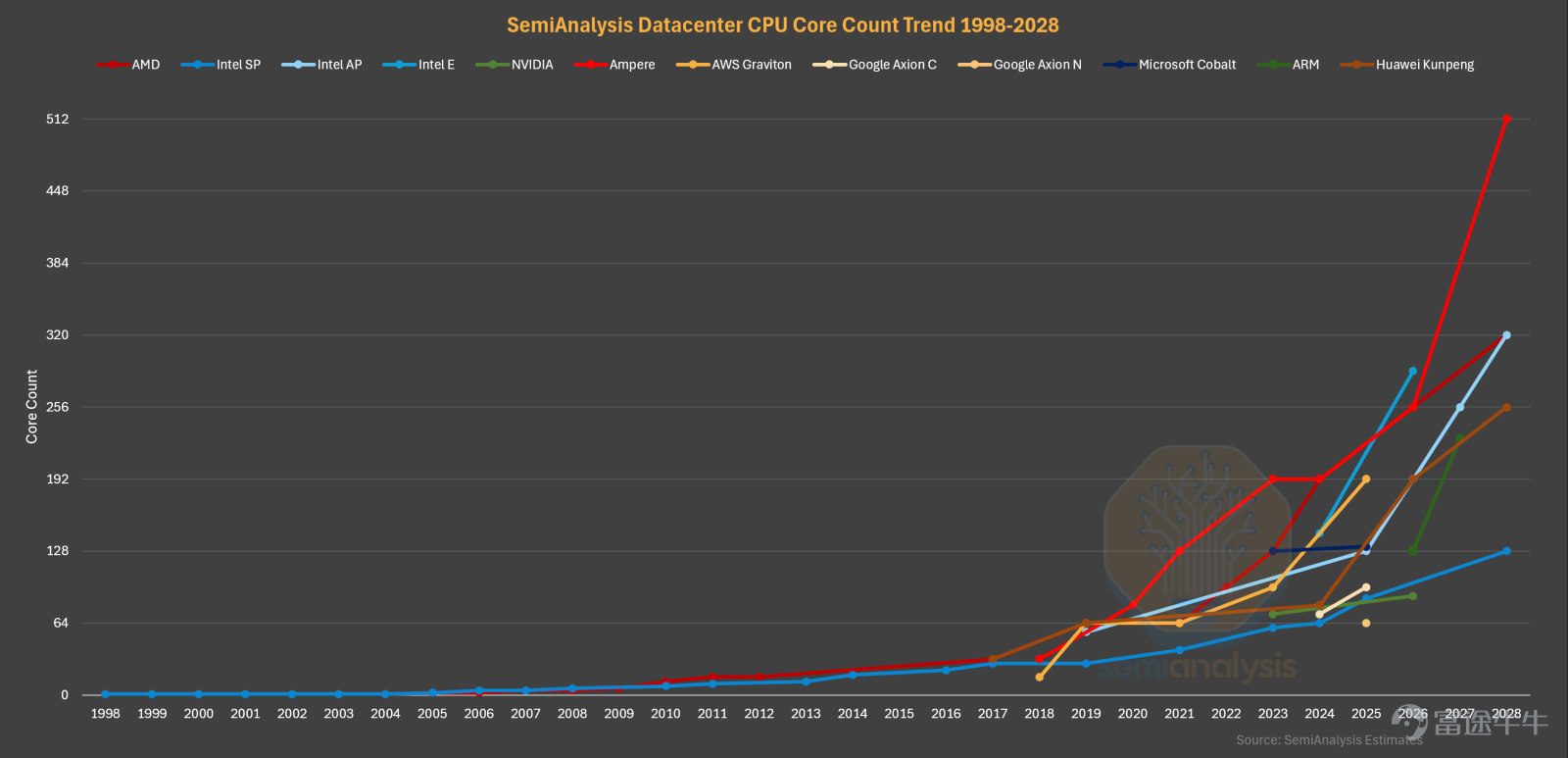
A 'steep' increase in demand has collided with rigid constraints on the supply side, triggering a price hike across the entire industry chain. The expectation of price increases has shifted from 'rumors' to become 'trading signals.' The first wave of price hikes began in March this year, while the second wave is expected to materialize in the second and third quarters of this year. Multiple institutions believe that the shortage of CPUs mayextend through 2026 and continue into 2027.As long as the capital expenditure cycle for global AI infrastructure persists and bottlenecks in advanced process technology and advanced packaging capacity remain unresolved, the logic of 'rising volume and price' in the CPU industry will continue to be supported.
Three Titans Compete: Business Model Divergence and Long-Term Logic
The industry's wave is becoming clear, but not every channel will navigate smoothly as the tide rises.Intel, AMD, and ARM—these three key players have distinct business models and clear strategic paths. The core of medium- to long-term allocation lies in identifying which company can build deeper competitive moats and occupy a more advantageous position within the AI-driven industrial trend.
(The chart above shows historical market share changes, while the one below illustrates future market share projections. Differences in metrics exist; focus primarily on trends.)


Intel: The Challenged 'Defender'
In the server CPU market, Intel is facing strong competition from AMD and encroachment by the ARM camp, leading to a visible trend of gradual market share erosion.The success or failure of its next-generation products (such as Diamond Rapids using the 18A process) will be crucial.
Intel is a representative of the integrated device manufacturing model, designing and manufacturing chips. It has faced difficulties in recent years due to lagging process technology. The current core strategy is to 'revive through manufacturing,' regaining technological competitiveness via its advanced processes while providing foundry services externally.
Its story is two-fold: on one hand, revitalizing its own CPU product competitiveness (e.g., Panther Lake, Xeon) with advanced processes; on the other hand, attracting external customers to generate revenue and validation for its foundry business. However, this is a high-stakes gamble involving significant capital expenditure and complex execution. Its valuation already partially reflects expectations of this transformation, and subsequent focus will be on the progress of customer order fulfillment.
Today (April 23), Elon Musk announced plans to use Intel's 14A process to produce chips for his Terafab project.This makes$Tesla (TSLA.US)$a major first customer for Intel's 14A technology, prompting Intel’s pre-market rise.
AMD: A model of execution, driving product iteration
Based on $Taiwan Semiconductor (TSM.US)$Advanced process technology,AMD’s CPU roadmap (e.g., the current Turin, upcoming Venice) continues to match or even surpass Intel in performance and energy efficiency, securing a 'time advantage.'At $Amazon (AMZN.US)$AWS,$Microsoft (MSFT.US)$Azure,$Alphabet-A (GOOGL.US)$ Among the instances of leading public cloud service providers like Alibaba Cloud, AMD’s penetration rate continues to rise, making it the preferred choice for many high-performance computing and general-purpose computing workloads.
AMD does not rely solely on CPUs. Its Instinct series GPUs, in conjunction with its CPUs, provide a comprehensive computing power platform, better meeting customers' needs for integrated AI infrastructure.AMD’s products fully meet cloud providers’ demands for high-performance and energy-efficient computing, enabling it to gain market share, raise prices, and reinvest profits into next-generation R&D, forming a virtuous cycle. It has been the most dynamic CPU company in recent years. The company now needs to prove that it can maintain product leadership amid increasingly fierce competition while converting the success of its AI GPUs into a more robust ecosystem binding.
ARM: A unique licensing ecosystem, just beginning its chip journey
ARM benefits from its golden business model as a 'tool provider',It licenses its Arm architecture to companies such as Apple, Qualcomm, and Amazon, collecting one-time license fees and ongoing chip royalties.This is a high-margin (consistently over 97%), asset-light 'tax' model, deeply benefiting from the expansion of the entire computing ecosystem (especially mobile and emerging data centers).
The company recently embarked on a major strategic transformation, announcing plans to develop its own CPUs in-house, aiming to enter the more lucrative commercial market. However, this means it will directly compete with AMD, Intel, and even its largest customers (such as cloud providers that develop their own chips using ARM architecture).ARM currently only has the backing of SoftBank and $Meta Platforms (META.US)$lacks support from other hyperscale customers. However, the company still has the potential to secure a foothold in the future.Bank of America expects the company to capture approximately 25% of the server CPU market share by 2030.
To summarize, if you are seeking growth and certainty, AMD is currently the most logical choice with strong execution capabilities, making it suitable for investors willing to pay a premium for high growth; Intel is better suited for investors with higher risk tolerance who are betting on the success of its manufacturing strategy, but this requires enduring high volatility and uncertainty; ARM offers exposure to the broad growth in computing demand and has an excellent business model, though its chip business is still in development.
Trading Perspective: Earnings Report Dynamics, All-Time High Strategy, and Options Approach
Tonight’s Intel earnings report was analyzed by Options Sir in Tuesday's 'Earnings Options Guide.' If you want to review the key highlights of this earnings report, you can click to revisit it.
Compared to the past two days, Intel's implied volatility (IV) continues to expand, with the IV percentile now reaching the 98% mark.The Intel options strategy outlined in the article for a high IV environment remains applicable.

For AMD and ARM, following yesterday’s significant rise, both have seen their implied volatility reach elevated levels. Notably, ARM’s IV percentile has already hit 100%, placing it at an extremely high position.AMD will release its earnings report after the market close on May 5, while ARM will do so on May 6, which is not far away.
Below are reference options strategies for these two stocks:
(1) Bull Call Spread
Suitable for investors who are optimistic about the continued rise in stock prices but consider the cost of directly buying call options too high amid current high volatility, and expect a moderate increase (not an unlimited surge). It allows expressing a mildly bullish view at a lower cost while avoiding some risks associated with time value and volatility decay.

(The design images displayed on screen are for illustrative purposes only and do not constitute any investment advice or guarantees; market conditions fluctuate frequently, and the option prices shown do not represent real-world values.)
Simultaneously buy a call option with a lower strike price and sell a call option with the same expiration date but a higher strike price. The premium collected from selling the higher-priced option partially offsets the cost of buying the lower-priced option, thereby reducing the initial investment and breakeven point.
(2) Covered Call
Investors who currently hold AMD or ARM stocks and believe that after reaching new highs, the stock may enter a period of consolidation rather than experiencing a short-term surge. They aim to generate additional cash income in a high-volatility environment. This strategy leverages the currently high option premiums to enhance returns or hedge against minor downside risks, though it caps potential profits if the stock rises significantly.
While holding the underlying stock (e.g., 100 shares of AMD or ARM), sell a corresponding number of out-of-the-money call options (typically with a strike price above the current stock price). The premium received from selling the options serves as additional income on top of stock ownership. If the stock price remains below the strike price at expiration, the options expire worthless, and the premium becomes extra profit. If the stock price surges beyond the strike price, the stock must be sold at the strike price, forgoing some upside gains but locking in profits up to “the strike price plus the premium.”
The story of the three CPU giants is a symphony of the old king defending, the new contender rising, and the ecosystem ruler expanding its territory. The industry's recovery provides a common backdrop, but each company plays a distinct melody. As for the short term, Intel’s earnings stage is set for tonight, and volatility is expected. Whether participating in this game through options strategies or observing quietly to adjust long-term positions, understanding the vastly different “scripts” of these three companies is the first step toward making informed decisions.
Finally, here's a small perk for fellow Futubull investors, welcome to claim it.Options Beginner Pack
*This event is exclusive to invited HK users. Click to learn more.Detailed event rules>>
Risk Disclosure: This content does not constitute a research report and is for reference only. It should not be used as the basis for any investment decision. The information involved in this article is not a comprehensive description of the mentioned securities, markets, or developments. Although the source of the information is considered reliable, no guarantee is provided regarding its accuracy or completeness. Additionally, no assurance is given regarding the accuracy of any statements, opinions, or forecasts provided herein.
Risk Disclaimer: The above content only represents the author's view. It does not represent any position or investment advice of Futu. Futu makes no representation or warranty.Read more


Comments (3)
to post a comment
65
161