
Tesla's Q1 performance was strong, is it time to take a position?

Decoding IV Premium | Analysis of Time-Limited Options Strategies Ahead of Intel and Tesla Earnings
The Q1 earnings season has officially entered the intensive disclosure phase. Following the smooth hearing of Kevin Warsh, the newly appointed Federal Reserve Chairman, and the ceasefire between the US and Iran entering the negotiation stage, recent macro uncertainties that have troubled the market have significantly decreased.Market attention is beginning to shift towards corporate earnings themselves.
This column will provide an in-depth analysis of the volatility of popular stocks set to release earnings during the week and share appropriate options trading strategies.This issue focuses on two highly watched technology stocks — $Tesla (TSLA.US)$ and $Intel (INTC.US)$ which will disclose their financial reports successively within 48 hours—one testing whether AI-related businesses are proceeding effectively, and the other examining the progress of semiconductor strategic restructuring.
This Week’s Popular Earnings Calendar
[Post-market on 04-22] Tesla (TSLA)
Traditional business pressures have already been priced in (Q1 deliveries of 358,000 units were below expectations, and energy storage deployment of 8.8 GWh was only 60% of expectations). The key focus for Tesla's performance this time lies in whether the AI narrative can support its valuation: the pace of FSD/Robotaxi implementation, updates on the Optimus mass production timeline, and management’s explanation of the $20 billion capital expenditure—especially whether they can provide a clear timeline for when Robotaxis will start generating returns.More details > >
[Post-market on 04-23] Intel (INTC)
What truly impacts Intel's stock price this earnings season is management’s tone: whether demand for data center AI-related CPUs can continue, whether non-GAAP gross margins will exceed the guidance of 34.5%, whether there are more specific customer and yield progress updates for 18A and Foundry, and how detailed the Q2 performance guidance will be.More details > >
Analysis of Popular Stock IVs
Dual-dimensional validation of IV percentile and IV rank serves as the core basis for determining whether seller strategies have a structural advantage – both dimensions must simultaneously indicate high levels to confirm a true rent-collection window.

Reference data date: April 22
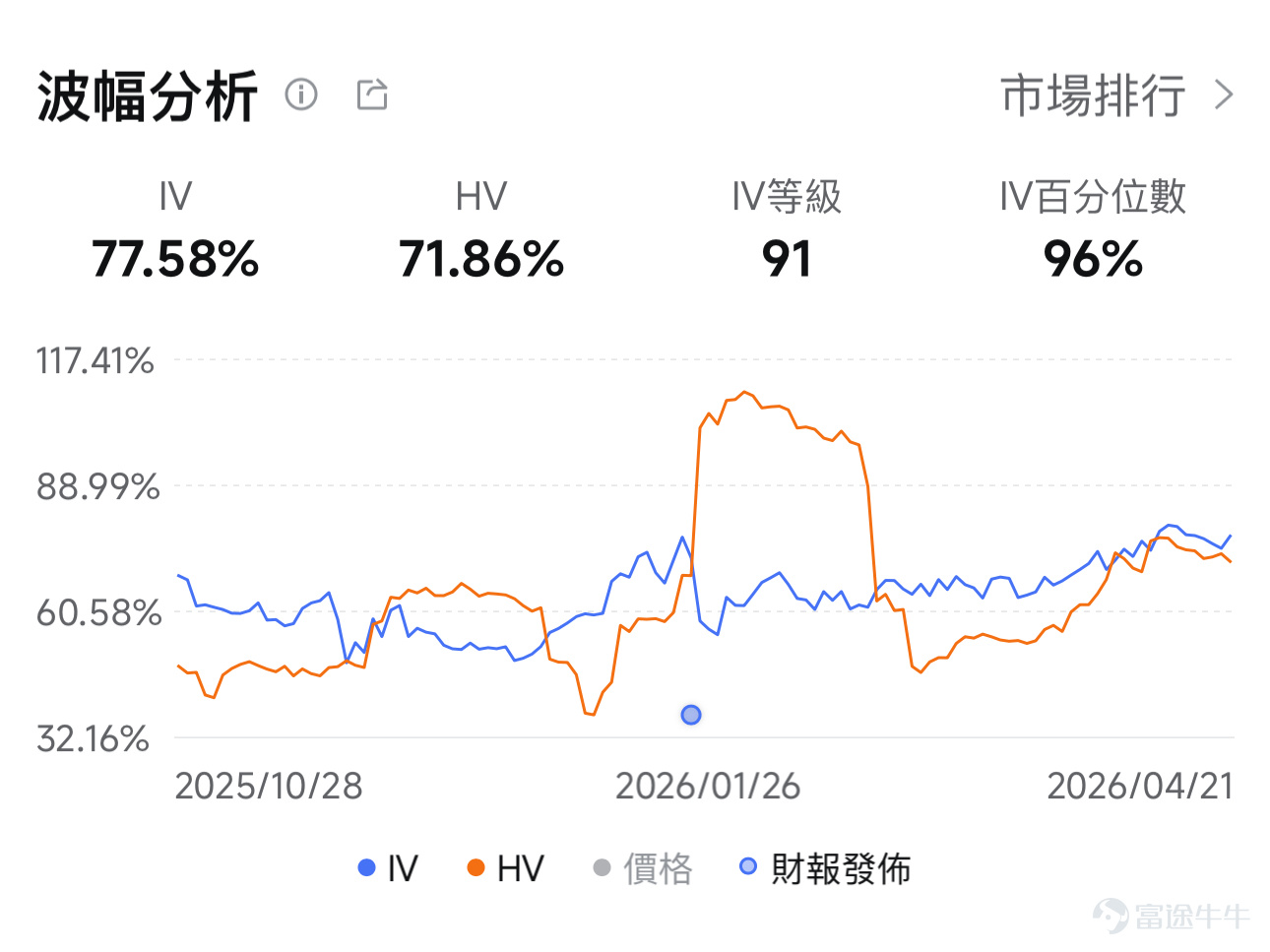
Intel (INTC):An IV percentile of 96% means that Intel options were cheaper than they are now on 96% of trading days over the past year.IV level at 91, HV 71.9% is in a historically high range, confirming a dual premium peak — the market is paying a significant premium for earnings uncertainty, which is the core logic behind sellers collecting premiums. The IV/HV ratio of 1.08x indicates that the premium is not overly excessive, but combined with the 96% IV percentile background,Structurally, this clearly favors the seller.

Reference data date: April 22
Tesla (TSLA):An IV of 51.6% may not seem high, but it is an exception for Tesla — its historical IV range is extremely wide, with peaks exceeding 100%. The current percentile is only 33%, meaning Tesla options were more expensive 67% of the time. Both IV and HV are tracking closely, so the premium collected from selling options largely compensates for the historical volatility costs already incurred rather than exploiting irrational fear in the market. More importantly,In a low IV environment, any sudden catalyst (better-than-expected earnings, progress in Robotaxi) could push IV from 50% back to over 70%. Even if the directional bet is correct, losses on the Vega side may outweigh the gains from Theta.
Limited-time high IV premium option strategy
Tesla (TSLA)
When IV is at a relatively low absolute level, using the Sell Put strategy for opening positions at lower prices is not suitable.Pre-earnings conservative operations require Sell Put strike prices to be ≥12% OTM (current price is $386.42, the safe strike price ceiling is approximately $340). However, even if the selected strike price meets the requirement, the current IV environment (level 14, 33rd percentile) offers extremely limited premium income.The risk-reward ratio is difficult to justify — betting on historically unpredictable earnings with low premiums is not how 'smart money' operates.However, investors holding a base position in Tesla, who are optimistic about Tesla's long-term performance but wish to hedge against short-term fluctuations driven by earnings, may consider implementing a Covered Call strategy based on their individual circumstances. This allows them to lock in upside gains in exchange for premium income as a buffer. The true value of the Covered Call strategy lies in 'you are already willing to sell the underlying shares at the strike price of the call option.'— Otherwise, the cost of capping upside potential will become very apparent in the event of a strong earnings report.
Covered Call strategy reference:
![The Q1 earnings season has officially entered the intensive disclosure phase. Following the smooth hearing of Kevin Warsh, the newly appointed Federal Reserve Chairman, and the ceasefire between the US and Iran entering the negotiation stage, recent macro uncertainties that have troubled the market have significantly decreased.Market attention is beginning to shift towards corporate earnings themselves. This column will provide an in-depth analysis of the volatility of popular stocks set to release earnings during the week and share appropriate options trading strategies.This issue focuses on two highly watched technology stocks — $Tesla (TSLA.US)$ and $Intel (INTC.US)$ which will disclose their financial reports successively within 48 hours—one testing whether AI-related businesses are proceeding effectively, and the other examining the progress of semiconductor strategic restructuring. This Week’s Popular Earnings Calendar [Post-market on 04-22] Tesla (TSLA) Traditional business pressures have already been priced in (Q1 deliveries of 358,000 units were below expectations, and energy storage deployment of 8.8 GWh was only 60% of expectations). The key focus for Tesla's performance this time lies in whether the AI narrative can support its valuation: the pace of FSD/Robotaxi implementation, updates on the Optimus mass production timeline, and management’s explanation of the $20 billion capital expenditure—especially whether they can provide a clear timeline for when Robotaxis will start generating returns.[Share Link: More details > >] [Post-market on 04-23] Intel (INTC) The true impact on Intel's stock price this earnings season lies in management's tone: data indicates...](https://nnqimage.futunn.com/sns_client_feed/999908/20260422/web-1776836212804-LLGamX7g2o.jpeg/big?area=2&is_public=true&imageMogr2/ignore-error/1/format/webp)
Reference strike price: $420 (anchored above the upper Bollinger Band at $405.11, leaving ample buffer room)
Reference expiration date: 2026-05-15
Reference premium: approximately $785 per contract, equivalent to reducing the holding cost by $7.85 per share (actual prices can be checked within the Futubull app: Individual Stock—Option Chain).
Earnings scenario analysis across all conditions:
![The Q1 earnings season has officially entered the intensive disclosure phase. Following the smooth hearing of Kevin Warsh, the newly appointed Federal Reserve Chairman, and the ceasefire between the US and Iran entering the negotiation stage, recent macro uncertainties that have troubled the market have significantly decreased.Market attention is beginning to shift towards corporate earnings themselves. This column will provide an in-depth analysis of the volatility of popular stocks set to release earnings during the week and share appropriate options trading strategies.This issue focuses on two highly watched technology stocks — $Tesla (TSLA.US)$ and $Intel (INTC.US)$ which will disclose their financial reports successively within 48 hours—one testing whether AI-related businesses are proceeding effectively, and the other examining the progress of semiconductor strategic restructuring. This Week’s Popular Earnings Calendar [Post-market on 04-22] Tesla (TSLA) Traditional business pressures have already been priced in (Q1 deliveries of 358,000 units were below expectations, and energy storage deployment of 8.8 GWh was only 60% of expectations). The key focus for Tesla's performance this time lies in whether the AI narrative can support its valuation: the pace of FSD/Robotaxi implementation, updates on the Optimus mass production timeline, and management’s explanation of the $20 billion capital expenditure—especially whether they can provide a clear timeline for when Robotaxis will start generating returns.[Share Link: More details > >] [Post-market on 04-23] Intel (INTC) The true impact on Intel's stock price this earnings season lies in management's tone: data indicates...](https://nnqimage.futunn.com/sns_client_feed/999908/20260422/web-1776842589770-flzKLuP7bG.png/big?area=2&is_public=true&imageMogr2/ignore-error/1/format/webp)
Intel (INTC)
IV percentile at 89%, rank 84, currently one of the most expensive periods for option pricing over the past year. A seller strategy here offers clear structural advantages: the premiums you collect include a real risk premium, which naturally reverts after an IV crush.
Covered Call strategy reference:
![The Q1 earnings season has officially entered the intensive disclosure phase. Following the smooth hearing of Kevin Warsh, the newly appointed Federal Reserve Chairman, and the ceasefire between the US and Iran entering the negotiation stage, recent macro uncertainties that have troubled the market have significantly decreased.Market attention is beginning to shift towards corporate earnings themselves. This column will provide an in-depth analysis of the volatility of popular stocks set to release earnings during the week and share appropriate options trading strategies.This issue focuses on two highly watched technology stocks — $Tesla (TSLA.US)$ and $Intel (INTC.US)$ which will disclose their financial reports successively within 48 hours—one testing whether AI-related businesses are proceeding effectively, and the other examining the progress of semiconductor strategic restructuring. This Week’s Popular Earnings Calendar [Post-market on 04-22] Tesla (TSLA) Traditional business pressures have already been priced in (Q1 deliveries of 358,000 units were below expectations, and energy storage deployment of 8.8 GWh was only 60% of expectations). The key focus for Tesla's performance this time lies in whether the AI narrative can support its valuation: the pace of FSD/Robotaxi implementation, updates on the Optimus mass production timeline, and management’s explanation of the $20 billion capital expenditure—especially whether they can provide a clear timeline for when Robotaxis will start generating returns.[Share Link: More details > >] [Post-market on 04-23] Intel (INTC) The true impact on Intel's stock price this earnings season lies in management's tone: data indicates...](https://nnqimage.futunn.com/sns_client_feed/999908/20260422/web-1776836212828-Dp8Ib48Syd.jpeg/big?area=2&is_public=true&imageMogr2/ignore-error/1/format/webp)
Reference Strike Price: $75 (Approximately +13% above the current price; anchored near the upper Bollinger Band at $74.75)
Reference Expiration Date: 2026-05-01
Reference Premium: Approximately $142 per contract, equivalent to a reduction in holding cost of $1.42 per share (Actual prices can be checked within the Futubull app: Individual Stock—Option Chain)
Sell Put Strategy Reference:
![The Q1 earnings season has officially entered the intensive disclosure phase. Following the smooth hearing of Kevin Warsh, the newly appointed Federal Reserve Chairman, and the ceasefire between the US and Iran entering the negotiation stage, recent macro uncertainties that have troubled the market have significantly decreased.Market attention is beginning to shift towards corporate earnings themselves. This column will provide an in-depth analysis of the volatility of popular stocks set to release earnings during the week and share appropriate options trading strategies.This issue focuses on two highly watched technology stocks — $Tesla (TSLA.US)$ and $Intel (INTC.US)$ which will disclose their financial reports successively within 48 hours—one testing whether AI-related businesses are proceeding effectively, and the other examining the progress of semiconductor strategic restructuring. This Week’s Popular Earnings Calendar [Post-market on 04-22] Tesla (TSLA) Traditional business pressures have already been priced in (Q1 deliveries of 358,000 units were below expectations, and energy storage deployment of 8.8 GWh was only 60% of expectations). The key focus for Tesla's performance this time lies in whether the AI narrative can support its valuation: the pace of FSD/Robotaxi implementation, updates on the Optimus mass production timeline, and management’s explanation of the $20 billion capital expenditure—especially whether they can provide a clear timeline for when Robotaxis will start generating returns.[Share Link: More details > >] [Post-market on 04-23] Intel (INTC) The true impact on Intel's stock price this earnings season lies in management's tone: data indicates...](https://nnqimage.futunn.com/sns_client_feed/999908/20260422/web-1776836212809-6At8pPoyu3.jpeg/big?area=2&is_public=true&imageMogr2/ignore-error/1/format/webp)
Reference Strike Price: $56 (Approximately -18% below the current price, providing sufficient buffer; anchored near MA20 at $55.59)
Reference Expiration Date: 2026-05-08
Reference Premium: Approximately $111 per contract, equivalent to a reduction in holding cost of $1.11 per share (Actual prices can be checked within the Futubull app: Individual Stock—Option Chain)
Earnings scenario analysis across all conditions:
![The Q1 earnings season has officially entered the intensive disclosure phase. Following the smooth hearing of Kevin Warsh, the newly appointed Federal Reserve Chairman, and the ceasefire between the US and Iran entering the negotiation stage, recent macro uncertainties that have troubled the market have significantly decreased.Market attention is beginning to shift towards corporate earnings themselves. This column will provide an in-depth analysis of the volatility of popular stocks set to release earnings during the week and share appropriate options trading strategies.This issue focuses on two highly watched technology stocks — $Tesla (TSLA.US)$ and $Intel (INTC.US)$ which will disclose their financial reports successively within 48 hours—one testing whether AI-related businesses are proceeding effectively, and the other examining the progress of semiconductor strategic restructuring. This Week’s Popular Earnings Calendar [Post-market on 04-22] Tesla (TSLA) Traditional business pressures have already been priced in (Q1 deliveries of 358,000 units were below expectations, and energy storage deployment of 8.8 GWh was only 60% of expectations). The key focus for Tesla's performance this time lies in whether the AI narrative can support its valuation: the pace of FSD/Robotaxi implementation, updates on the Optimus mass production timeline, and management’s explanation of the $20 billion capital expenditure—especially whether they can provide a clear timeline for when Robotaxis will start generating returns.[Share Link: More details > >] [Post-market on 04-23] Intel (INTC) The true impact on Intel's stock price this earnings season lies in management's tone: data indicates...](https://nnqimage.futunn.com/sns_client_feed/999908/20260422/web-1776842357812-k5U3eAYD0z.png/big?area=2&is_public=true&imageMogr2/ignore-error/1/format/webp)
 Finally, here's a small perk for fellow investors. Welcome, fellow investors, to claim your benefit.Options Beginner Pack
*This event is exclusive to invited HK users. Click to learn more.Detailed event rules>>
Risk Warning
An option is a contract that gives the holder the right, but not the obligation, to buy or sell an asset at a fixed price at any time on or before a specific date. The price of an option is influenced by various factors, including the current price of the underlying asset, the strike price, the time to expiration, and implied volatility. Implied volatility reflects the market's expectation of the option’s volatility over a certain period in the future. It is derived inversely from the Black-Scholes (BS) pricing model and is generally considered an indicator of market sentiment. When investors expect greater volatility, they may be more willing to pay higher prices for options to help hedge risks, leading to higher implied volatility. Traders and investors use implied volatility to evaluate.Option priceattractiveness, identify potential mispricings, and manage risk exposure.
Disclaimer
This content is for reference only and should not be considered as an offer, solicitation, invitation, or advice to buy or sell any investment product or make any investment decision. It should also not be interpreted as professional advice. Options contracts are derivative products and may not be suitable for all investors. You should carefully consider your own investment experience, investment objectives, financial resources, and other relevant conditions before deciding whether to participate in such transactions. The risk of loss in trading options contracts can be substantial. In some cases, losses may exceed the initial margin deposited. Even if you have set contingent orders, such as 'stop-loss' or 'limit' orders, they may not prevent losses. Market conditions may render such orders unexecutable. You may be required to deposit additional margin within a short period. If you fail to provide the required amount within the specified time, your open positions may be liquidated. However, you will still be responsible for any shortfall in your account resulting from such liquidation. Therefore, before trading, you should study and understand index options and carefully consider whether such trading is suitable for you based on your financial situation and investment objectives. If you trade options, you should be familiar with the procedures for exercising options and the rights and obligations upon expiration.
Risk Disclaimer: The above content only represents the author's view. It does not represent any position or investment advice of Futu. Futu makes no representation or warranty.Read more

Comments
to post a comment
24
18