
Strong rebound in March non-farm payroll! Will there still be a rate cut this year?

Option Sir's Macro View | Trump's speech failed to reassure the market; rebound enters verification phase, non-farm payroll data and market holidays may amplify volatility
1. Reversal of Market Expectations: From De-escalation to Escalation
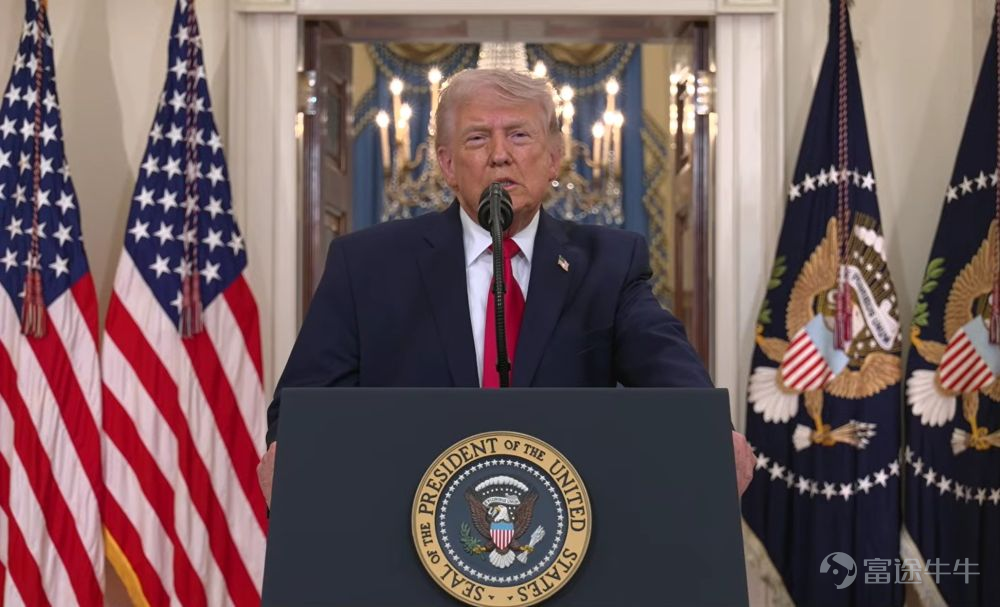
At 4 a.m. Beijing time on April 2, the global market was holding its breath awaiting President Trump's televised address regarding the Iran conflict. Prior to this, the market had experienced two consecutive days of violent rebounds, with investors widely betting that Trump would use this opportunity to signal de-escalation or even announce the winding down of the war. However, what the market eventually received was not a clear resolution but new uncertainty.
Figure 1: President Trump Delivers a National Television Address from the White House, but No Cooling Signal—As Market Expected—Emerges

In his speech, although Trump claimed a 'quick, decisive, and overwhelming victory' in the Iran conflict, the core content left the market deeply disappointed. He explicitly stated, 'In the next two to three weeks, we will deliver an extremely powerful blow,' and issued an ultimatum: 'If there is no agreement, we will launch fierce strikes against every power plant in Iran.'Moreover, regarding the market’s most pressing concern—the reopening of the Strait of Hormuz—Trump provided no timeline or solutions throughout his speech.
This statement directly shattered the optimistic expectations that had been built over the past two days based on the "TACO" (Trump Always Chickens Out) rule. Following the announcement, the market instantly turned: Brent crude oil surged above $105 per barrel at one point during the session, with intraday gains expanding to 4%, reigniting concerns about an energy crisis. The Asia-Pacific markets came under broad pressure. $S&P 500 Index (.SPX.US)$ Prices fell in response.
On the surface, Trump still claimed in his speech that the war was "nearing completion," which didn't seem like a complete rejection of de-escalation prospects; however, what truly disappointed the market wasn't the lack of dovish language but rather the absence of a clear endgame mechanism.For the capital markets, "how much longer will the conflict last" is not the only issue—more crucial questions include "when will oil shipments resume," "when will energy supplies return to normal," and "is the White House willing to set a cap on economic costs?" This speech offered no clear answers.
This also means that the uncertainty surrounding the Middle East situation has not only failed to dissipate but has further intensified due to new military threats.
II. The previous two-day rebound: The failure and illusion of the TACO rule
Before Trump’s speech, US stocks had just experienced a two-day rebound. On March 31, the S&P 500 surged 2.91% in a single day, while the Nasdaq skyrocketed 3.83%. The core logic behind this rally was the market's belief in Trump's "TACO" rule.
Over the past month, the market has distilled a set of "TACO trading principles" based on oil prices.Simply put, since gasoline prices are directly tied to voter satisfaction and Trump's support rate in the midterm elections, whenever crude oil approaches $100 per barrel, pushing domestic US gasoline prices near the politically sensitive threshold of $4 per gallon, Trump can't help but send out signals of easing tensions, thereby driving market rebounds.
Figure 2: Oil price fluctuations have become the core baton of market sentiment over the past month

It was precisely based on this pattern that when oil prices broke through $100 on Monday, the market quickly bet that Trump would compromise again, triggering a rebound in trading on Tuesday and Wednesday. However, a subtle change occurred this time. Before Trump's speech, Brent crude had already fallen below $98, indicating that Trump’s “political pressure” had eased somewhat. After oil prices fell below the red line, Trump’s stance hardened again, causing the TACO rule to fail once more at this cycle’s peak, leaving investors who chased the rally trapped once again.
This also suggests that the rebound over the previous two days was likely just another instance of 'sentiment repair' based on the TACO rule rather than a fundamental reversal. With Trump's stance hardening again, the sustainability of this rebound is facing a severe test.
Third, Friday's non-farm payroll data overlaps with a market holiday, with the real risk being 'deferred pricing'
Aside from geopolitical black swan events, the market will also face an extremely unusual macro risk this week:The March non-farm payroll report coincides with Good Friday。This rare timing mismatch could bring significant uncertainty to investors holding positions over the weekend.
According to the schedule, the US March non-farm payroll report will be released as usual at 20:30 Beijing time on April 3 (Friday). However, since it is Good Friday,US stocks, European markets, and COMEX precious metals futures will be closed for the entire dayThe data was released as usual, but the market remains closed. What does this imply?
1. Liquidity black holeThe uncertainty of direction, coupled with the delay in pricing, will significantly amplify the risk of holding positions over the weekend. After the data release, investors will not be able to trade immediately. All long and short sentiments and position adjustments must be accumulated and released all at once when the market opens on Monday. This is highly likely to result in a large gap at Monday's opening, and intraday volatility will also be extremely magnified.
2. Pricing mismatchDuring the Friday market closure, although some foreign exchange and government bond markets remain open, liquidity is far from sufficient. Any non-farm payroll data exceeding expectations could trigger sharp asset price fluctuations in a low-liquidity environment.
3. Time lag of cross-border capitalSince some Asian markets will open as usual on Friday (Hong Kong Stock Exchange closed on April 3, April 6, and April 7), while European and American markets are closed, this may lead to some funds reacting earlier in the Asian markets, potentially causing fluctuations in Asian assets.
Currently, Market expectations for the non-farm payroll data are: approximately 56,000 new jobs added in March, with the unemployment rate remaining at 4.5%.Considering that February’s non-farm payroll data unexpectedly dropped by 92,000, any positive growth figure could be interpreted by the market as a sign that the economy remains strong, thereby dampening expectations for interest rate cuts. Conversely, if the data again falls short of expectations and the unemployment rate rises sharply, it may trigger market fears of stagflation or even recession.

Against the backdrop of current heightened geopolitical tensions and extremely fragile market sentiment, this situation of 'data being released but unable to trade' will greatly increase investor hesitation. Many institutions, in order to avoid the uncertainty risks over the weekend, are likely to begin reducing positions for risk aversion in the late session on Thursday (today).
Four, Future Scenario Analysis: Asset Allocation Under Three Pathways
Facing the current complex situation, we cannot simply adopt a bullish or bearish view, but need to conduct scenario analysis based on how the situation evolves.The rebound has not been completely disproven, but it has regressed from being a 'possible trend starting point' to an 'event-driven recovery that needs revalidation.' There are three main possible paths for the future US-Iran conflict:
Scenario One: Substantial de-escalation, conflict downgraded
In this scenario, the US and Iran reach a temporary agreement within a two-week window. Iran uses the suspension of uranium enrichment activities as leverage to secure partial sanctions relief from the US, along with a commitment to reopen the Strait of Hormuz. This is the most optimistic scenario and was the primary trading logic behind the earlier rebound. If this situation arises, consider adding positions in equity assets on dips.
Asset Performance:
– Oil prices drop significantly, with Brent crude potentially falling quickly below $90.
– Inflation concerns ease, expectations for Fed rate cuts rekindle, and US Treasury yields decline.
– US stocks see a corrective rebound, led by previously oversold tech stocks.
Scenario Two: Fighting and negotiating, high volatility
This is currently the most likely scenario. Both sides are in contact, but core differences remain vast. The US leverages the expiration of the April 6 pause on energy facility strikes, along with increased troop deployment as a deterrent, attempting maximum pressure; Iran counters by blocking the strait and attacking Middle Eastern facilities. Both parties fight while negotiating, leading to repeated back-and-forth tensions. Under this scenario, markets will enter a period of high volatility. It is not advisable to chase highs or blindly short. Traders may adopt swing trading strategies or hedge using appropriate tools.
Asset Performance:
– Oil prices fluctuate at high levels between $100-$105, with extremely high volatility; any minor development could trigger sharp price swings.
– High oil prices drive up inflation expectations, boosting expectations for Fed interest rate hikes and strengthening the US dollar.
– The overall stock market is under pressure, with significant sector divergence. Energy, chemical, and military sectors benefit, while technology growth stocks are pressured.
– Gold remains in high-level volatility, offering both inflation-hedging and safe-haven attributes.
Scenario Three: Strategic Deception, Full Escalation
This represents the most pessimistic tail risk. The peace negotiation signals released by the US are merely smokescreens, aiming to buy time to complete military deployments, with the ultimate goal of seizing Kharg Island and completely destroying Iran’s nuclear capabilities. Upon any signs of this scenario, equity positions should be immediately reduced, while increasing allocations in gold, cash, and energy resource assets.
Asset Performance:
– A full escalation of conflict could drive oil prices to surge to $120 or even $150, echoing the oil crises of the 1970s.
– The world falls into severe stagflation, forcing the Federal Reserve to raise interest rates and the dollar index spikes.
– Global stock markets undergo a deep correction, with widespread declines except for a handful of resource stocks.
– Gold, as the ultimate safe-haven asset, experiences a sharp rise in price.
V. What should be done at this stage?
Based on the above analysis,For investors with a higher risk appetite in the short term,the uncertainty of chasing the rebound at this moment remains relatively high. The most crucial support for this rally is no longer stable, and the combination of Friday's non-farm payroll data release and market closure will further delay risks until Monday.
For conservative investors who already hold significant positions in US equities,a more reasonable approach would be 'defense first, then wait for clarity.' It is not advisable to continue increasing the proportion of high-volatility growth stocks, especially those sectors that bounced back quickly over the past two days due to improved risk sentiment. Holding onto core positions is fine, but one must accept the reality that, until oil prices retreat and geopolitical tensions ease, the market is unlikely to experience a strong upward trend.Below, we outline several trading strategies that investors can refer to under different scenarios:
(1) If you believe this rebound is likely to be short-lived and the market still faces downward pressure later,
you may consider implementing $Invesco QQQ Trust (QQQ.US)$ a 1-2 week bear put spread on high-beta tech stocks, buying at-the-money or slightly out-of-the-money puts while selling puts with lower strike prices.
The rationale is that although the market might see a rebound due to easing news, as long as oil prices, interest rates, and risk-off sentiment do not materially retreat, the upside potential for indices will remain constrained. In other words, the current environment resembles volatile tugs-of-war rather than a smooth new uptrend. By using a bear put spread, expectations are narrowed to 'a pullback is sufficient,' without fantasizing about a one-sided crash. This approach ensures costs are more controllable and better suited to the current news-driven market state. The profit and loss at expiration for this strategy can be referenced in the figure below.
(The design images displayed on screen are for illustrative purposes only and do not constitute any investment advice or guarantees; market conditions fluctuate frequently, and the option prices shown do not represent real-world values.)

(2) If you already hold a substantial long position in tech stocks but don't want to directly cut your position or are optimistic about a subsequent rebound,
If investors are optimistic about $NVIDIA (NVDA.US)$$Tesla (TSLA.US)$ technology stocks in the long term, a more suitable approach would be to apply a Collar strategy to their existing holdings, which involves buying protective Puts below while selling Calls above, using the premium from the Call to partially offset the cost of the Put.
The logic behind this strategy is that the biggest uncertainty in the market comes from the risk of price gaps caused by fluctuating news. Especially before geopolitical conditions become clear, markets can easily rebound during the day but then get pushed back down by new information at night. If investors sell the underlying stock now, they might give up their positions at the worst possible time; however, doing nothing exposes the portfolio fully to potential volatility over weekends and during data release windows.
The benefit of the Collar strategy is that it does not involve betting on direction but instead locks in downside risk while retaining some upside participation.For investors who already have profits or significant positions, this is a better alternative than simply holding on in the current environment. The profit and loss at expiration for this strategy can be referenced in the figure below.
(The design images displayed on screen are for illustrative purposes only and do not constitute any investment advice or guarantees; market conditions fluctuate frequently, and the option prices shown do not represent real-world values.)

(3) High-risk strategies at this stage
At this point, engaging in naked Put selling or naked Strangle selling The probability of success for structures with significant tail risk exposure may be relatively low. The reason is that the current market is a typical headline-driven market. If news fluctuates repeatedly, prices can easily gap directly, and for most retail investors, sell-side strategies may lead to small gains but big risks.
6. Risk Warning
1. geopolitical risks: The situation in the Middle East is highly volatile, and any sudden military conflict could trigger sharp market fluctuations.
2. Risk of policy overcorrection: If oil prices remain persistently high, the Fed may be forced to pivot back to a hawkish stance, thereby pressuring global asset valuations.
Finally, here's a small perk for fellow investors—welcome to claim it!Options Beginner Pack
This event is exclusively for invited HK users, click to learn moreDetailed event rules >>
Futu's simulated trading challenge is now open for registration! Zero cost, zero risk, and you could win stock cash vouchers!For more details, click here

Disclaimer
This content does not constitute any offer, solicitation, recommendation, opinion, or guarantee of any securities, financial products, or tools. The risk of loss in buying and selling options can be substantial. In some cases, your losses may exceed the initial margin amount deposited. Even if you set contingent orders, such as 'stop-loss' or 'limit' orders, these may not necessarily prevent losses. Market conditions may make these orders unexecutable. You might be required to deposit additional margin within a short period. If you fail to provide the required amount within the specified time, your open positions may be liquidated. However, you will still be responsible for any account deficit arising from this. Therefore, before trading, you should study and understand options and carefully consider whether such trading suits you based on your financial situation and investment objectives. If you trade options, you should be familiar with the procedures upon exercising options and at expiration, as well as your rights and obligations when exercising options and at expiration.
Risk Disclaimer: The above content only represents the author's view. It does not represent any position or investment advice of Futu. Futu makes no representation or warranty.Read more


Comments (7)
to post a comment
76
112