Following the failed launch of the ASTS satellite, where do space-related stocks go from here?

Countdown to the IPO of the century! SpaceX is reportedly going public as early as June. Who will benefit?
SpaceX is accelerating the process for what could be the largest IPO in U.S. history.
On March 25, according to The Information, a tech media outlet, a directly informed source revealed that this rocket and communications company under Musk plans as early asthis week or next weekto file its IPO prospectus with regulators,with the goal of completing the listing by June this year.
The report stated that advisors involved in the preparation work expectthe company’s fundraising size may exceed $75 billion,higher than the previous external estimate of $50 billion.
Notably, sources familiar with the matter indicated that in a typical IPO, retail investors usually receive only about 10% of the allocation.However, the proportion of SpaceX's offering targeting individual investors is expected to increase significantly this time, potentially exceeding 20%, though the exact percentage has yet to be finalized.In addition,SpaceX is not expected to adopt the standard six-month lock-up period for insiders commonly seen in the IPO market.
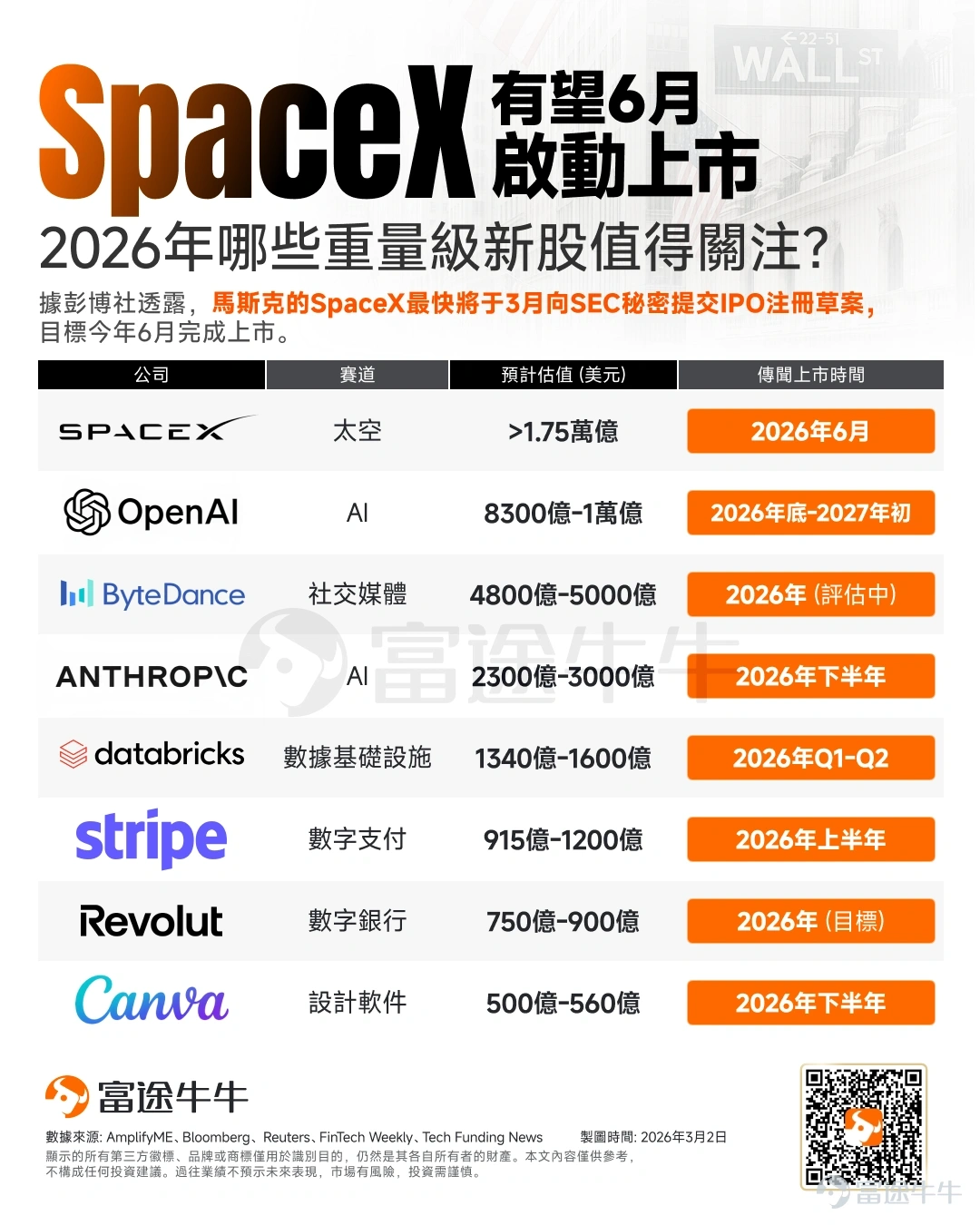
Previously《2026 IPO 'Super Year' on the horizon: SpaceX rumored to confidentially file for an IPO as early as March. Which related stocks could benefit?》As previously highlighted, several leading companies across various sectors have been actively preparing for public listings this year. From space technology exploring the boundaries of the universe, to AI large models reshaping human productivity, to long-established giants in fintech and social platforms, every company on this anticipated list holds absolute pricing power and dominance within their respective fields.
![SpaceX is accelerating the process for what could be the largest IPO in U.S. history. On March 25, according to The Information, a tech media outlet, a directly informed source revealed that this rocket and communications company under Musk plans as early asthis week or next weekto file its IPO prospectus with regulators,with the goal of completing the listing by June this year. The report stated that advisors involved in the preparation work expectthe company’s fundraising size may exceed $75 billion,higher than the previous external estimate of $50 billion. Notably, sources familiar with the matter indicated that in a typical IPO, retail investors usually receive only about 10% of the allocation.However, the proportion of SpaceX's offering targeting individual investors is expected to increase significantly this time, potentially exceeding 20%, though the exact percentage has yet to be finalized.In addition,SpaceX is not expected to adopt the standard six-month lock-up period for insiders commonly seen in the IPO market. Previously[Share Link: 《][Share Link: 2026 IPO 'Super Year' on the horizon: SpaceX rumored to confidentially file for an IPO as early as March. Which related stocks could benefit?][Share Link: 》]As previously highlighted, several leading companies across various sectors have been actively preparing for public listings this year. From space technology exploring the boundaries of the universe, to AI large models reshaping human productivity, to long-established giants in fintech and social platforms, every company on this anticipated list holds absolute pricing power and dominance within their respective fields. Many investors might wonder...](https://nnqimage.futunn.com/sns_client_feed/900080/20260325/web-1774407203187-JGqiwu6yYv.webp/big?area=1&is_public=true&imageMogr2/ignore-error/1/format/webp)
So it’s believed that many investors would like to know,which concept stocks are worth watching as SpaceX applies for its IPO with great urgency?
Previously'Will Musk Build Another Trillion-Dollar Empire? SpaceX Listing Rumors Spark Market Excitement—Here Are Some Related Stocks Worth Watching!'It was previously noted that SpaceX’s largest long-term investors include Peter Thiel's Founders Fund, 137 Ventures, and Valor Equity Partners, among other venture capital firms. Fidelity Investments and Google are also key investors.
![SpaceX is accelerating the process for what could be the largest IPO in U.S. history. On March 25, according to The Information, a tech media outlet, a directly informed source revealed that this rocket and communications company under Musk plans as early asthis week or next weekto file its IPO prospectus with regulators,with the goal of completing the listing by June this year. The report stated that advisors involved in the preparation work expectthe company’s fundraising size may exceed $75 billion,higher than the previous external estimate of $50 billion. Notably, sources familiar with the matter indicated that in a typical IPO, retail investors usually receive only about 10% of the allocation.However, the proportion of SpaceX's offering targeting individual investors is expected to increase significantly this time, potentially exceeding 20%, though the exact percentage has yet to be finalized.In addition,SpaceX is not expected to adopt the standard six-month lock-up period for insiders commonly seen in the IPO market. Previously[Share Link: 《][Share Link: 2026 IPO 'Super Year' on the horizon: SpaceX rumored to confidentially file for an IPO as early as March. Which related stocks could benefit?][Share Link: 》]As previously highlighted, several leading companies across various sectors have been actively preparing for public listings this year. From space technology exploring the boundaries of the universe, to AI large models reshaping human productivity, to long-established giants in fintech and social platforms, every company on this anticipated list holds absolute pricing power and dominance within their respective fields. Many investors might wonder...](https://nnqimage.futunn.com/sns_client_feed/900080/20260403/web-1775182509202-y1ba8BMQXs.jpeg/big?area=1&is_public=true&imageMogr2/ignore-error/1/format/webp)
--
--
--
1. Musk’s 'Holding Empire'
$Tesla (TSLA.US)$SpaceX and Tesla are the 'twin stars' of Musk's business empire.In a previous interview, Musk hinted at the launch of a new initiative called 'Galaxy Mind,' aimed at integratingSpaceX, Tesla, and xAIthe core capabilities of these three major companies,to deploy AI satellites powered by solar energy into deep space.Specifically, the realization of this blueprint relies on clear division of labor and collaboration among the three companies:
SpaceX: Provide mature rocket launch and spacecraft manufacturing capabilities, responsible for deploying AI satellites into deep-space orbits.
Tesla: Leverage its expertise in solar and battery technology to provide efficient, long-lasting energy solutions for the satellites.
xAI: Develop cutting-edge artificial intelligence models capable of running on a large scale aboard satellites.
2. Core Competitors
As SpaceX’s valuation rises, its competitors may benefit from increased 'industry buzz.' However, in the medium to long term, the scarcity of these companies might diminish. If SpaceX goes public, funds could be pulled out from $Rocket Lab (RKLB.US)$ and $AST SpaceMobile (ASTS.US)$ and redirected towards SpaceX.
$Rocket Lab (RKLB.US)$:Recognized by the market as a 'mini SpaceX' and referred to by investors as 'Little Rocket', it is currently one of only two private aerospace companies globally that can achieveregular, high-frequency successful launches; not only has it established itself with the highly reliable small rocket Electron, but it has also successfully transformed into an end-to-end service provider integrating satellite manufacturing, software, and launch through its 'Space Systems' business, making it the only space leader in the US stock market thathas delivered solid performance and possesses the rare quality of being a 'SpaceX alternative'. Its under-development medium reusable rocketNeutronis considered a key trump card in potentially breaking SpaceX's Falcon 9 monopoly in the future.
$AST SpaceMobile (ASTS.US)$:It is regarded by the market as the 'AT&T of space'.orThe frontrunner in the 'smartphone-to-satellite direct connection' space, its core vision is to build the world’s firstspace-based cellular broadband network, using massive low-orbit satellites as 'space base stations,' allowing ordinary smartphones on the groundto connect directly to satellite signals without hardware modifications or purchasing specialized equipment(such as dish antennas); despite fierce competition from SpaceX's Starlink, it has become a highly explosive (and also highly volatile) pure-play in the US stock market for betting on the trillion-dollar communication revolution of 'eliminating signal dead zones,' thanks to its deep partnerships and patent moats with AT&T, Verizon, Vodafone, and Google .
$Firefly Aerospace (FLY.US)$:It is currently a dark horse with strong potential in the commercial aerospace sector, second only to the leading duo (SpaceX/Rocket Lab), standing out with its successful orbital light rocket launches Alpha in the US Department of Defense’s 'Rapid Response Launch (Tactical Space)' missions; unlike single launch providers, it owns a high-barrier 'Earth-Moon ecosystem chain', with its Blue Ghost lunar lander holding large commercial payload contracts from NASA; this company is addressing market gaps by collaborating with defense giant Northrop Grumman to develop medium-lift rockets (MLV).。
3. Partners
SpaceX's IPO is a 'shot in the arm' for its partners, meaning more cash on hand and stronger execution capabilities.
$EchoStar (ECHO.US)$:In September 2025, SpaceX acquired EchoStar Communications’ AWS-4 and H-Band spectrum licenses for satellite and mobile communications. The payment structure of this deal was unique, involving up to $8.5 billion in cash and $8.5 billion worth of SpaceX stock. At that time, with SpaceX valued at approximately $400 billion, this equity stake represented around 2% of SpaceX’s total shares. Additionally, SpaceX agreed to assume EchoStar Communications' debt interest of approximately $2 billion through November 2027.
$Planet Labs PBC (PL.US)$:The relationship between Planet Labs and SpaceX can be described in one sentence: 'A long-term and deep passenger-driver relationship.' Planet Labs owns the world's largest fleet of Earth observation satellites (hundreds), which have shorter lifespans (about 3-5 years) and require frequent replenishment and updates. Planet Labs is one of SpaceX's most loyal commercial launch customers, with its business continuity heavily reliant on the timely launches of SpaceX rockets.
$Amazon (AMZN.US)$:The partnership between Amazon and SpaceX represents a dramatic commercial twist. As the parent company of Blue Origin, Amazon has long been considered a major competitor to SpaceX in the commercial space sector. However, due to delays in the development of Blue Origin's New Glenn rocket, Amazon had to adjust its strategy and, in 2025, commissioned SpaceX to launch 24 Kuiper satellites.
4. Starlink-related Business
$T-Mobile US (TMUS.US)$: Starlink's 'top ally' in commercialization and a pioneer in implementation,T-Mobile is SpaceX's most important telecom partner for its 'Direct to Cell' satellite business. The two parties signed a historic agreement named 'Coverage Above and Beyond,' with the key breakthrough being 'no need to change phones'—using T-Mobile’s existing 5G spectrum to turn Starlink satellites into 'space base stations.' This not only helps T-Mobile solve the problem of terrestrial signal dead zones but also opens up a vast consumer market for SpaceX, serving as a critical monetization pathway for Starlink services transitioning from 'niche broadband' to 'mass-market telecom.'
$Qualcomm (QCOM.US)$: 'The underlying technology enabler' bridging space and ground communications If T-Mobile provides the 'road' (spectrum and users), Qualcomm provides the 'engine' (chips). As the global leader in communication chips, Qualcomm is working closely with SpaceX to optimize the 5G NTN (Non-Terrestrial Network) standard. SpaceX needs Qualcomm's mobile modem and RF front-end technology support to ensure that future smartphones can efficiently and with low power consumption 'understand' satellite signals. Qualcomm is the key hardware driver enabling satellite communication standardization and making satellite functionality a 'standard feature' in smartphones.
$flyExclusive (FLYX.US)$:The company previously announced it has signed an authorized dealer agreement with Starlink, officially becoming a certified dealer and installation service provider for its high-speed, low-latency aviation internet system.
5. Investment Companies
$Alphabet-A (GOOGL.US)$& $Bank of America (BAC.US)$$ : Googleis one of the most important early strategic shareholders of SpaceX (holding approximately 7%), with both parties deeply tied in cloud and edge computing.Bank of Americahad participated in SpaceX's financing.
If SpaceX goes public:For Google, this represents a massive 'asset revaluation'—the $900 million investment made years ago could multiply several times over, directly enhancing the investment income on its financial statements. For Bank of America (BAC), it means earning substantial IPO underwriting fees while recouping debt risks. These two belong to the ‘effortless winners’ as vested interests.
$Destiny Tech100 (DXYZ.US)$ & $Entrepreneur Private-Public Crossover ETF (XOVR.US)$ & $Fundrise Innovation Fund (VCX.US)$: These three fundsare currently the 'premium channels' for individual investors to buy SpaceX in the secondary market. Their business model is 'hoarding scarce private equities and marking them up to sell to individual investors'.
If SpaceX goes public:This would be a devastating 'valuation-crushing' blow to them. Although the stock price may soar due to pre-IPO hype, once SpaceX officially lists, investors will be able to purchase shares directly, and no one will be willing to pay the current premium of over 100% charged by DXYZ. At that time, DXYZ’s share price will experience a sharp correction (dropping from the premium back to net asset value), losing its scarcity.
Summary
The year 2026 is expected to become a historic milestone in the annals of the capital market. From SpaceX’s ambitious deep-space exploration to the general artificial intelligence revolution led by OpenAI and Anthropic, we may witness tech giants making a historic leap from 'underlying infrastructure' to 'ultimate commercial realization.'
Risk Disclaimer: The above content only represents the author's view. It does not represent any position or investment advice of Futu. Futu makes no representation or warranty.Read more


Comments (37)
to post a comment
289
1126