
The United States and Iran are sticking to their respective positions—can peace talks proceed smooth

Weekly Options Strategy 0323 | When the Iran storm meets the Fed's hawkish pivot, who is 'swimming naked'? A survival guide to options in times of high volatility
This article is from the "Weekly Options Strategy" column, which brings fellow investors a review of last week's market, the hot topics of the week, and an analysis of potential options trading opportunities. Welcome!Click hereJoin the learning session, and you will receive notifications when new updates to the column are available.
Dear fellow investors, happy Monday~
Last week, tensions in the Middle East escalated, and major central banks released hawkish signals during the 'super central bank week,' leading to a rise in tight monetary policy trading globally. This caused US Treasury yields to soar and put pressure on risk asset prices. Traditional safe-haven assets like gold and silver also showed signs of malfunction.
Entering this week, risks first intensified in the Asia-Pacific market, with large-scale sell-offs occurring in Hong Kong stocks, A-shares, and the Japanese and Korean markets. As risks have suddenly risen, how should we respond? Let’s dive into this week’s [Options Weekly Strategy].
The situation in Iran remains volatile, with market sentiment low. How should we respond?
Since tensions erupted in Iran, the conflict has entered its fourth week, showing no signs of easing but rather continuously escalating. The most critical development over the weekend was Trump issuing a 48-hour ultimatum to Iran, demanding the full restoration of passage through the Strait of Hormuz, or the U.S. will strike Iran’s power facilities. Iran's response also escalated, explicitly threatening that if the U.S. acts, it will retaliate against the energy and freshwater infrastructure of Gulf nations and could potentially shut down the Strait of Hormuz entirely.
Last Friday, all three major U.S. stock indexes fell. $S&P 500 Index (.SPX.US)$Dow Jones dropped 1.51%, $Nasdaq Composite Index (.IXIC.US)$S&P 500 fell 2.01%, $Dow Jones Industrial Average (.DJI.US)$Nasdaq declined 0.96%; technology stocks came under significant pressure, and currently, the S&P 500 has broken below its 200-day moving average (the dividing line between bull and bear markets).It is now near the second support level.
Since the outbreak of the U.S.-Israel-Iran conflict, U.S. stocks have shown relative resilience compared to global equity markets. One reason is that equity markets often lag behind bonds in reacting to interest rate cut expectations; another is the belief that Trump would once again resort to “TACO.”
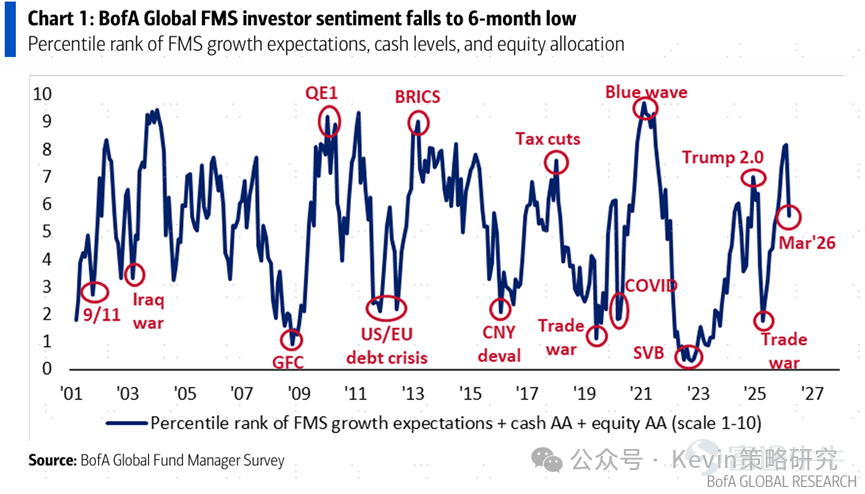
However, in the past week, trading saw a 'compensatory correction,' with Trump’s TACO facing noticeable diminishing marginal utility, as neither diplomatic negotiations nor substantive talks have truly commenced. According to Bank of America Merrill Lynch's March global and Asian fund manager survey (as of March 17), global investor sentiment hit a six-month low, with cash levels rising from 3.4% in February to 4.3% in March, marking the largest monthly increase since March 2020. Markets have started pricing in a higher oil price baseline and are no longer expecting the Federal Reserve to cut rates—a stark contrast to earlier expectations for rate cuts.To achieve this, it is equivalent to expecting the conflict to persist into the third and fourth quarters with oil prices remaining above $100.
![This article is from the "Weekly Options Strategy" column, which brings fellow investors a review of last week's market, the hot topics of the week, and an analysis of potential options trading opportunities. Welcome![Share Link: Click here]Join the learning session, and you will receive notifications when new updates to the column are available. Dear fellow investors, happy Monday~ Last week, tensions in the Middle East escalated, and major central banks released hawkish signals during the 'super central bank week,' leading to a rise in tight monetary policy trading globally. This caused US Treasury yields to soar and put pressure on risk asset prices. Traditional safe-haven assets like gold and silver also showed signs of malfunction. This week, risks first fermented in the Asia-Pacific market, with large-scale sell-offs occurring in Hong Kong stocks, A-shares, and the Japanese and Korean markets. With risks suddenly escalating, how should we respond? Let's delve into this week's [Weekly Options Strategy]. The situation in Iran has been volatile, and market sentiment remains low. How to respond? Since the escalation of the situation in Iran, the conflict has now entered its fourth week, showing no signs of easing but instead continuing to escalate. The key development over the weekend was Trump issuing a 48-hour ultimatum to Iran, demanding the full restoration of passage through the Strait of Hormuz, or the US will strike Iran’s power facilities. Iran’s response has also escalated, explicitly threatening that if the US acts, it will retaliate against the energy and water infrastructure of Gulf nations and may completely shut down the Strait of Hormuz. Last Friday, all three major US stock indexes fell, with $S&P 500 Index (.SPX.US)$a 1.51% drop, $Nasdaq Composite Index (.IXIC.US)$a 2.01% drop, ...](https://nnqimage.futunn.com/sns_client_feed/999908/20260323/web-1774261317631-PCUrcejnFR.png/big?area=2&is_public=true&imageMogr2/ignore-error/1/format/webp)
Opportunity Analysis
The market will most likely enter a phasecharacterized by 'some rebounds, weak trends, and high volatility',where short-term trading is prone to highly volatile fluctuations, and medium-term recovery will be harder to achieve smoothly. Unless there is substantial easing of passage through the Strait of Hormuz and unless oil prices retreat from their elevated levels, the equity market will struggle to recover smoothly. Of course, rebounds will occur during this period, potentially sharp ones, as any news about negotiations, escorts, reserve releases, or rerouting can trigger short-covering;
but even if the market rebounds, it will more likely be a quick fix driven by news rather than a clean new upward trend. Unless oil prices and yields fall in tandem, such rebounds are more like trading-driven corrections rather than the start of a new mid-term uptrend.
Options strategy
Recently, $Invesco QQQ Trust (QQQ.US)$ After experiencing a significant pullback, current prices are nearing short-term support levels, and numerous technical indicators are signaling oversold conditions, providing a technical basis for a rebound. However, the persistent net outflow of major funds suggests that downward pressure has not fully abated, and any rebound may face selling pressure, with sustainability yet to be observed.Short-term traders looking to participate in rebound opportunities should strictly set stop-losses to guard against the risk of further downside if the rebound fails.
On March 20, the implied volatility (IV) was 29.00%, withan IV percentile as high as 91%,which typically reflects full pricing of market panic or uncertainty, increasing the likelihood of volatility retreating from extreme highs. On the same day, the put-call ratio (PCR) stood at 0.86, below 1 and lower than in previous days, indicating a slight improvement in market sentiment.
(1) If you believe that the short-term market weakness may persist and want to express a bearish view
(The profit and loss at the expiration of this strategy can be referenced in the figure below. The design image displayed on the screen is for demonstration purposes only and does not constitute any investment advice or guarantee; market conditions fluctuate frequently, and the option prices shown in the figure do not represent real situations.)
If you judge that high oil prices will continue to delay rate cuts and suppress the valuation of the technology sector, a more prudent approach is not to directly buy deep out-of-the-money Puts, but to use a Bear Put Spread with 30 to 45 days until expiration: for example, buying a Put while selling a more out-of-the-money Put. The advantage of this is that, in the current environment where volatility has clearly increased, it reduces the time value decay and the risk of implied volatility pullback faced by simply buying Puts.
![This article is from the "Weekly Options Strategy" column, which brings fellow investors a review of last week's market, the hot topics of the week, and an analysis of potential options trading opportunities. Welcome![Share Link: Click here]Join the learning session, and you will receive notifications when new updates to the column are available. Dear fellow investors, happy Monday~ Last week, tensions in the Middle East escalated, and major central banks released hawkish signals during the 'super central bank week,' leading to a rise in tight monetary policy trading globally. This caused US Treasury yields to soar and put pressure on risk asset prices. Traditional safe-haven assets like gold and silver also showed signs of malfunction. This week, risks first fermented in the Asia-Pacific market, with large-scale sell-offs occurring in Hong Kong stocks, A-shares, and the Japanese and Korean markets. With risks suddenly escalating, how should we respond? Let's delve into this week's [Weekly Options Strategy]. The situation in Iran has been volatile, and market sentiment remains low. How to respond? Since the escalation of the situation in Iran, the conflict has now entered its fourth week, showing no signs of easing but instead continuing to escalate. The key development over the weekend was Trump issuing a 48-hour ultimatum to Iran, demanding the full restoration of passage through the Strait of Hormuz, or the US will strike Iran’s power facilities. Iran’s response has also escalated, explicitly threatening that if the US acts, it will retaliate against the energy and water infrastructure of Gulf nations and may completely shut down the Strait of Hormuz. Last Friday, all three major US stock indexes fell, with $S&P 500 Index (.SPX.US)$a 1.51% drop, $Nasdaq Composite Index (.IXIC.US)$a 2.01% drop, ...](https://nnqimage.futunn.com/sns_client_feed/999908/20260323/web-1774261317447-2VrUTKaSz9.png/big?area=2&is_public=true&imageMogr2/ignore-error/1/format/webp)
(2)If you remain bullish on tech-heavy QQQ and believe there might be a short-term rebound but wish to hedge against potential losses
(The profit and loss at the expiration of this strategy can be referenced in the figure below. The design image displayed on the screen is for demonstration purposes only and does not constitute any investment advice or guarantee; market conditions fluctuate frequently, and the option prices shown in the figure do not represent real situations.)
You can consider a Protective Collar Strategy, which involves buying a Put while simultaneously selling a Call at a higher strike price to form a Collar, further reducing the cost of insurance.
The 10-year US Treasury yield rising above 4.4% directly pressures the valuation of high-valuation tech stocks, indicating that high-beta assets are still under pressure. The Collar Strategy sacrifices some potential gains in exchange for limited losses during periods of extreme volatility.
![This article is from the "Weekly Options Strategy" column, which brings fellow investors a review of last week's market, the hot topics of the week, and an analysis of potential options trading opportunities. Welcome![Share Link: Click here]Join the learning session, and you will receive notifications when new updates to the column are available. Dear fellow investors, happy Monday~ Last week, tensions in the Middle East escalated, and major central banks released hawkish signals during the 'super central bank week,' leading to a rise in tight monetary policy trading globally. This caused US Treasury yields to soar and put pressure on risk asset prices. Traditional safe-haven assets like gold and silver also showed signs of malfunction. This week, risks first fermented in the Asia-Pacific market, with large-scale sell-offs occurring in Hong Kong stocks, A-shares, and the Japanese and Korean markets. With risks suddenly escalating, how should we respond? Let's delve into this week's [Weekly Options Strategy]. The situation in Iran has been volatile, and market sentiment remains low. How to respond? Since the escalation of the situation in Iran, the conflict has now entered its fourth week, showing no signs of easing but instead continuing to escalate. The key development over the weekend was Trump issuing a 48-hour ultimatum to Iran, demanding the full restoration of passage through the Strait of Hormuz, or the US will strike Iran’s power facilities. Iran’s response has also escalated, explicitly threatening that if the US acts, it will retaliate against the energy and water infrastructure of Gulf nations and may completely shut down the Strait of Hormuz. Last Friday, all three major US stock indexes fell, with $S&P 500 Index (.SPX.US)$a 1.51% drop, $Nasdaq Composite Index (.IXIC.US)$a 2.01% drop, ...](https://nnqimage.futunn.com/sns_client_feed/999908/20260323/web-1774261317479-EUR5mbrdOh.jpeg/big?area=2&is_public=true&imageMogr2/ignore-error/1/format/webp)
Navigating through the crude oil fog, has Trump's Taco lost its effectiveness?
The global energy market’s attention once again focuses on the narrow waters of the Persian Gulf — the Strait of Hormuz. Since the joint military strikes by the US and Israel against Iran, this 'world oil valve,' which carries about 20% of global oil transportation, has become the epicenter of geopolitical games and price fluctuations.
Shipping through the Strait of Hormuz has nearly come to a halt,Any news regarding negotiations, military actions, or facility attacks often triggers sharp oil price fluctuations of more than 5% in a single day. Market sentiment is fragile, with trading driven by headline news.
![This article is from the "Weekly Options Strategy" column, which brings fellow investors a review of last week's market, the hot topics of the week, and an analysis of potential options trading opportunities. Welcome![Share Link: Click here]Join the learning session, and you will receive notifications when new updates to the column are available. Dear fellow investors, happy Monday~ Last week, tensions in the Middle East escalated, and major central banks released hawkish signals during the 'super central bank week,' leading to a rise in tight monetary policy trading globally. This caused US Treasury yields to soar and put pressure on risk asset prices. Traditional safe-haven assets like gold and silver also showed signs of malfunction. This week, risks first fermented in the Asia-Pacific market, with large-scale sell-offs occurring in Hong Kong stocks, A-shares, and the Japanese and Korean markets. With risks suddenly escalating, how should we respond? Let's delve into this week's [Weekly Options Strategy]. The situation in Iran has been volatile, and market sentiment remains low. How to respond? Since the escalation of the situation in Iran, the conflict has now entered its fourth week, showing no signs of easing but instead continuing to escalate. The key development over the weekend was Trump issuing a 48-hour ultimatum to Iran, demanding the full restoration of passage through the Strait of Hormuz, or the US will strike Iran’s power facilities. Iran’s response has also escalated, explicitly threatening that if the US acts, it will retaliate against the energy and water infrastructure of Gulf nations and may completely shut down the Strait of Hormuz. Last Friday, all three major US stock indexes fell, with $S&P 500 Index (.SPX.US)$a 1.51% drop, $Nasdaq Composite Index (.IXIC.US)$a 2.01% drop, ...](https://nnqimage.futunn.com/sns_client_feed/999908/20260323/web-1774261317480-WcxI8rQ7Xu.png/big?area=2&is_public=true&imageMogr2/ignore-error/1/format/webp)
Trump's policies continue to swing between military pressure and tactical de-escalation, aiming to create favorable conditions for negotiations or to force Iran to make concessions, but this has also significantly increased the risk of miscalculation and unintended escalation.
Opportunity Analysis
The crude oil market is currently caught in a fierce tug-of-war between 'short-term geopolitical maneuvering' and 'long-term structural reshaping.' The consensus is that the central level of oil prices has systematically shifted higher, but the short-term trajectory is highly uncertain with extreme volatility. The conflict has escalated from blockading straits to directly targeting oil and gas production facilities (such as Iran’s South Pars gas field). This touches on Iran’s basic livelihood and could trigger retaliatory attacks on neighboring countries' facilities, potentially leading to supply disruptions at the source. The risks far exceed the current transportation disruptions.
In the short term (over the next few weeks), the core of market trading will be geopolitical maneuvering and the timeline for a ceasefire.All eyes are focused on one specific question: When will the Strait of Hormuz reopen (or partially reopen)? In response, the market has developed three mainstream scenario analyses:
The first scenario is a 'rapid de-escalation' (probability now reduced), where Trump seeks to cool tensions ahead of midterm elections. However, the current situation has grown far more complex than the earlier surprise strike on Venezuela at the beginning of the year.
The second scenario is 'prolonged confrontation' (probability rising), with the strait maintaining low flow traffic, while the insurance issues for tankers remain unresolved.
The third scenario is an 'extreme escalation' (tail risk), where key energy facilities are attacked, triggering a full-scale crisis. Due to the rapidly changing situation, short-term forecasts by institutions are highly uncertain. Morgan Stanley predicts that the average crude oil price in the second quarter could reach $110 per barrel.
In the long term (the second half of 2026 and beyond), the underlying logic of the market will shift towards permanent damage to supply capacity and a geopolitical risk premium.
By then, the focus will shift from the geopolitical events themselves to more fundamental questions: How much of the Middle East's crude oil production capacity can be restored? How will the world rebuild depleted inventories? A strong consensus has formed in the market: the central level of oil prices will permanently rise. The pre-war 'comfort zone' of $65-$70 is gone, and the new price floor will be much higher.
Options strategy
In an environment of high divergence and volatility in oil price forecasts, the options market tracking WTI crude oil prices has become a key battleground for capital. Last week, the Bull Bull Classroom provided a detailed breakdown of why crude oil ETFs fail to continuously track oil prices and how to deploy strategies based on term structure characteristics. Interested fellow investors can revisit it.$United States Oil Fund LP (USO.US)$"Hormuz, Term Structure, and USO: How to Navigate the Energy Storm"
As of last Friday, the implied volatility (IV) of USO options was as high as 91.14%, with the IV percentile reaching 96%, theoretically favoring option sellers.Since the outbreak of the U.S.-Iran conflict, the open interest in USO options has surged significantly, with a relatively concentrated put position. The put/call ratio has remained consistently above 1,indicating hedging or bearish demand in the market.
![This article is from the "Weekly Options Strategy" column, which brings fellow investors a review of last week's market, the hot topics of the week, and an analysis of potential options trading opportunities. Welcome![Share Link: Click here]Join the learning session, and you will receive notifications when new updates to the column are available. Dear fellow investors, happy Monday~ Last week, tensions in the Middle East escalated, and major central banks released hawkish signals during the 'super central bank week,' leading to a rise in tight monetary policy trading globally. This caused US Treasury yields to soar and put pressure on risk asset prices. Traditional safe-haven assets like gold and silver also showed signs of malfunction. This week, risks first fermented in the Asia-Pacific market, with large-scale sell-offs occurring in Hong Kong stocks, A-shares, and the Japanese and Korean markets. With risks suddenly escalating, how should we respond? Let's delve into this week's [Weekly Options Strategy]. The situation in Iran has been volatile, and market sentiment remains low. How to respond? Since the escalation of the situation in Iran, the conflict has now entered its fourth week, showing no signs of easing but instead continuing to escalate. The key development over the weekend was Trump issuing a 48-hour ultimatum to Iran, demanding the full restoration of passage through the Strait of Hormuz, or the US will strike Iran’s power facilities. Iran’s response has also escalated, explicitly threatening that if the US acts, it will retaliate against the energy and water infrastructure of Gulf nations and may completely shut down the Strait of Hormuz. Last Friday, all three major US stock indexes fell, with $S&P 500 Index (.SPX.US)$a 1.51% drop, $Nasdaq Composite Index (.IXIC.US)$a 2.01% drop, ...](https://nnqimage.futunn.com/sns_client_feed/999908/20260323/web-1774261317520-XKXsW4L7Dt.png/big?area=2&is_public=true&imageMogr2/ignore-error/1/format/webp)
The recent U.S.-Iran conflict causing disruptions in shipping through the Strait of Hormuz is the core factor driving up oil prices. Market expectations suggest that the shipping disruptions may last for several weeks, but there is also uncertainty regarding the potential easing of tensions.
Given the characteristics of 'high volatility plus event-driven' dynamics, simply buying directional options (whether calls or puts) faces challenges such as high premiums and time value decay. Managing risks, leveraging volatility premiums, and preparing contingency plans for various scenarios might be more important and rational choices.
(1) Enhancing returns while staying calm: Covered Call strategy
The covered call is a classic income-generating strategy suitable for investors who already hold the underlying asset, remain confident in its long-term prospects, but hold neutral views on short-term gains. In volatile or mildly bullish markets, it can continuously enhance portfolio returns; by leveraging a high-volatility environment, it allows for collecting excess premium income.
For example, if you already hold 100 shares of USO stock, you can sell one corresponding call option at your target price. If the price of USO equals or exceeds the strike price of the sold call at expiration, you will need to sell at the strike price, capping your maximum profit; if it is below the strike price, you can pocket the entire premium from selling the call, but in the event of a sharp decline in crude oil prices, the premium may not be enough to offset the losses.
![This article is from the "Weekly Options Strategy" column, which brings fellow investors a review of last week's market, the hot topics of the week, and an analysis of potential options trading opportunities. Welcome![Share Link: Click here]Join the learning session, and you will receive notifications when new updates to the column are available. Dear fellow investors, happy Monday~ Last week, tensions in the Middle East escalated, and major central banks released hawkish signals during the 'super central bank week,' leading to a rise in tight monetary policy trading globally. This caused US Treasury yields to soar and put pressure on risk asset prices. Traditional safe-haven assets like gold and silver also showed signs of malfunction. This week, risks first fermented in the Asia-Pacific market, with large-scale sell-offs occurring in Hong Kong stocks, A-shares, and the Japanese and Korean markets. With risks suddenly escalating, how should we respond? Let's delve into this week's [Weekly Options Strategy]. The situation in Iran has been volatile, and market sentiment remains low. How to respond? Since the escalation of the situation in Iran, the conflict has now entered its fourth week, showing no signs of easing but instead continuing to escalate. The key development over the weekend was Trump issuing a 48-hour ultimatum to Iran, demanding the full restoration of passage through the Strait of Hormuz, or the US will strike Iran’s power facilities. Iran’s response has also escalated, explicitly threatening that if the US acts, it will retaliate against the energy and water infrastructure of Gulf nations and may completely shut down the Strait of Hormuz. Last Friday, all three major US stock indexes fell, with $S&P 500 Index (.SPX.US)$a 1.51% drop, $Nasdaq Composite Index (.IXIC.US)$a 2.01% drop, ...](https://nnqimage.futunn.com/sns_client_feed/999908/20260323/web-1774261319621-of1KOako0p.png/big?area=2&is_public=true&imageMogr2/ignore-error/1/format/webp)
(The design images displayed on screen are for illustrative purposes only and do not constitute any investment advice or guarantees; market conditions fluctuate frequently, and the option prices shown do not represent real-world values.)
(2) Moderately bullish: Bull Call Spread
In the current environment where implied volatility (IV) has sharply risen and become expensive, if you believe that USO will continue to rise, the cost of simply buying a call option is too high. The Bull Call Spread might be a better choice.
This strategy uses the income from selling a higher-priced call to partially subsidize the cost of buying a lower-priced call, thereby establishing a bullish position at a lower net cost. Selling the higher-priced call also actively gives up the unlimited profit potential if the underlying price moves above that strike price, in exchange for defined risk and reward.
![This article is from the "Weekly Options Strategy" column, which brings fellow investors a review of last week's market, the hot topics of the week, and an analysis of potential options trading opportunities. Welcome![Share Link: Click here]Join the learning session, and you will receive notifications when new updates to the column are available. Dear fellow investors, happy Monday~ Last week, tensions in the Middle East escalated, and major central banks released hawkish signals during the 'super central bank week,' leading to a rise in tight monetary policy trading globally. This caused US Treasury yields to soar and put pressure on risk asset prices. Traditional safe-haven assets like gold and silver also showed signs of malfunction. This week, risks first fermented in the Asia-Pacific market, with large-scale sell-offs occurring in Hong Kong stocks, A-shares, and the Japanese and Korean markets. With risks suddenly escalating, how should we respond? Let's delve into this week's [Weekly Options Strategy]. The situation in Iran has been volatile, and market sentiment remains low. How to respond? Since the escalation of the situation in Iran, the conflict has now entered its fourth week, showing no signs of easing but instead continuing to escalate. The key development over the weekend was Trump issuing a 48-hour ultimatum to Iran, demanding the full restoration of passage through the Strait of Hormuz, or the US will strike Iran’s power facilities. Iran’s response has also escalated, explicitly threatening that if the US acts, it will retaliate against the energy and water infrastructure of Gulf nations and may completely shut down the Strait of Hormuz. Last Friday, all three major US stock indexes fell, with $S&P 500 Index (.SPX.US)$a 1.51% drop, $Nasdaq Composite Index (.IXIC.US)$a 2.01% drop, ...](https://nnqimage.futunn.com/sns_client_feed/999908/20260323/web-1774261317310-63glo8sGDc.png/big?area=2&is_public=true&imageMogr2/ignore-error/1/format/webp)
(The design images displayed on screen are for illustrative purposes only and do not constitute any investment advice or guarantees; market conditions fluctuate frequently, and the option prices shown do not represent real-world values.)
Gold plunges—has the precious metals bull market come to an end?
On Monday, spot gold fell to $4,100 per ounce, wiping out all year-to-date gains. Meanwhile, the Middle East conflict has persisted for four weeks, with risks of further escalation between the US and Iran.The consecutive rise in oil prices has not only heightened inflation risks but also significantly dampened short-term expectations for central bank rate cuts. The market now prices in over a 30% probability of a Fed rate hike within the year.As a result, gold has recorded eight consecutive trading days of declines, marking its largest weekly drop since 1983.
![This article is from the "Weekly Options Strategy" column, which brings fellow investors a review of last week's market, the hot topics of the week, and an analysis of potential options trading opportunities. Welcome![Share Link: Click here]Join the learning session, and you will receive notifications when new updates to the column are available. Dear fellow investors, happy Monday~ Last week, tensions in the Middle East escalated, and major central banks released hawkish signals during the 'super central bank week,' leading to a rise in tight monetary policy trading globally. This caused US Treasury yields to soar and put pressure on risk asset prices. Traditional safe-haven assets like gold and silver also showed signs of malfunction. This week, risks first fermented in the Asia-Pacific market, with large-scale sell-offs occurring in Hong Kong stocks, A-shares, and the Japanese and Korean markets. With risks suddenly escalating, how should we respond? Let's delve into this week's [Weekly Options Strategy]. The situation in Iran has been volatile, and market sentiment remains low. How to respond? Since the escalation of the situation in Iran, the conflict has now entered its fourth week, showing no signs of easing but instead continuing to escalate. The key development over the weekend was Trump issuing a 48-hour ultimatum to Iran, demanding the full restoration of passage through the Strait of Hormuz, or the US will strike Iran’s power facilities. Iran’s response has also escalated, explicitly threatening that if the US acts, it will retaliate against the energy and water infrastructure of Gulf nations and may completely shut down the Strait of Hormuz. Last Friday, all three major US stock indexes fell, with $S&P 500 Index (.SPX.US)$a 1.51% drop, $Nasdaq Composite Index (.IXIC.US)$a 2.01% drop, ...](https://nnqimage.futunn.com/sns_client_feed/999908/20260323/web-1774261317378-3KnABUuBX9.png/big?area=2&is_public=true&imageMogr2/ignore-error/1/format/webp)
As the situation evolves, market expectations for the Middle East conflict have shifted towards a “prolonged standoff.” According to Polymarket prediction data, the probability of a ceasefire within March has dropped to 12%, with a higher likelihood of prolonging into April or May. Against this backdrop,the main trading theme is transitioning from short-term emotional impacts to deeper secondary effects—namely, negative feedback caused by tightening liquidity and the pressure of high energy costs on inflation and supply chains.This is the fundamental reason for the sudden increase in volatility of core assets such as gold, US Treasuries, and global equities last week.
![This article is from the "Weekly Options Strategy" column, which brings fellow investors a review of last week's market, the hot topics of the week, and an analysis of potential options trading opportunities. Welcome![Share Link: Click here]Join the learning session, and you will receive notifications when new updates to the column are available. Dear fellow investors, happy Monday~ Last week, tensions in the Middle East escalated, and major central banks released hawkish signals during the 'super central bank week,' leading to a rise in tight monetary policy trading globally. This caused US Treasury yields to soar and put pressure on risk asset prices. Traditional safe-haven assets like gold and silver also showed signs of malfunction. This week, risks first fermented in the Asia-Pacific market, with large-scale sell-offs occurring in Hong Kong stocks, A-shares, and the Japanese and Korean markets. With risks suddenly escalating, how should we respond? Let's delve into this week's [Weekly Options Strategy]. The situation in Iran has been volatile, and market sentiment remains low. How to respond? Since the escalation of the situation in Iran, the conflict has now entered its fourth week, showing no signs of easing but instead continuing to escalate. The key development over the weekend was Trump issuing a 48-hour ultimatum to Iran, demanding the full restoration of passage through the Strait of Hormuz, or the US will strike Iran’s power facilities. Iran’s response has also escalated, explicitly threatening that if the US acts, it will retaliate against the energy and water infrastructure of Gulf nations and may completely shut down the Strait of Hormuz. Last Friday, all three major US stock indexes fell, with $S&P 500 Index (.SPX.US)$a 1.51% drop, $Nasdaq Composite Index (.IXIC.US)$a 2.01% drop, ...](https://nnqimage.futunn.com/sns_client_feed/999908/20260323/web-1774261317347-CpJJwxImrG.png/big?area=2&is_public=true&imageMogr2/ignore-error/1/format/webp)
Opportunity Analysis
The recent sharp pullback in gold prices is mainly attributed to the liquidity shock triggered by the rebound in inflation and heightened expectations of interest rate hikes. However, once geopolitical tensions ease, signs of economic recession emerge, and markets pivot back to rate cut expectations, gold will likely regain upward momentum.Currently, gold prices have partially priced in the expectation of rate hikes within the year. Technically, gold experienced a heavy sell-off last week, with the RSI indicator plummeting from a high of 90 at the end of January to 29, entering oversold territory.
In fact, the Fed's policy path has not fundamentally changed. The latest FOMC dot plot shows that the 19 policymakers still broadly anticipate one rate cut this year. The strong perception of a 'hawkish' stance stems more from Powell’s tone-setting remarks: he emphasized the inflation risks posed by Middle East conflicts, downplayed concerns about a deteriorating job market, and repeatedly stressed future uncertainties. This has nudged market sentiment toward a 'tightening policy' bias.
For gold, the movement in real interest rates will be the key variable.If the conflict drags on and inflation expectations continue to rise, making the Fed’s rate hike path increasingly clear, downward pressure on gold may persist. On the other hand, if there are signs of easing geopolitical tensions, whether suppressed safe-haven demand can be re-released remains the biggest market suspense.Investors should closely watch the following macro data in the near term, as it will provide some guidance on the upcoming interest rate path:US initial jobless claims for the week ending March 21 (8:30 AM EST on March 26), and the US Core PCE Price Index for February (8:30 AM EST on March 28).
Options strategy
If investors believe that gold may have reached a阶段性 top and faces the risk of further回调, but still wish to hold their long现货 positions without closing them prematurely, they can adopt a collar strategy for defensive positioning.
ActionA typical investment strategy is to buy out-of-the-money (OTM) put options as downside protection while simultaneously selling OTM call options to offset the cost of the protection. Given this combination of buying and selling options tends to be neutral, it is particularly suitable for precious metals currently experiencing high波动. Even if implied volatility (IV) contracts later, the strategy not only provides effective protection against现货 price declines but also prevents additional losses from IV drops when单纯 purchasing options.
AdvantageThe premium collected from selling call options significantly offsets or even fully covers the cost of buying put options (creating a zero-cost collar). This avoids the risk faced by pure option buyers when IV falls (crushes). Without closing the现货 position, the strategy establishes a clear 'stop-loss底线,' greatly enhancing the safety buffer against risks.
RiskThe biggest trade-off is sacrificing potential upside gains if the underlying asset experiences a significant price increase (capped profits). If prices surge above the strike price of the call option, the call will be assigned, forcing the investor to sell the现货 at the strike price to realize profits. Additionally, although maximum losses are strictly capped by the Put, the investor must still absorb any回撤 between the current market price and the Put's strike price.
(2) For investors anticipating a rebound in precious metals: Bull Call Spread Strategy
If investors believe that gold may have bottomed out in the short-to-medium term and is poised for a反弹, they can use a bullish call spread strategy for试探性布局. A more cautious approach involves extending the expiration period within an affordable premium range and selecting in-the-money call options.
Operation: Buy calls with lower strike prices while selling the same number of calls with higher strike prices.
Advantages: By selling options to offset部分 of the premium costs, this strategy mitigates the risk of IV回落 (crush), and though it limits the maximum profit potential, it significantly lowers the breakeven point.
The biggest riskThe maximum loss is the net premium paid. However, since the premium from selling one leg generates income, investors benefit from greater safety margins compared to single-leg purchases and avoid being affected by收敛波动率.
(The design images displayed on screen are for illustrative purposes only and do not constitute any investment advice or guarantees; market conditions fluctuate frequently, and the option prices shown do not represent real-world values.)
![This article is from the "Weekly Options Strategy" column, which brings fellow investors a review of last week's market, the hot topics of the week, and an analysis of potential options trading opportunities. Welcome![Share Link: Click here]Join the learning session, and you will receive notifications when new updates to the column are available. Dear fellow investors, happy Monday~ Last week, tensions in the Middle East escalated, and major central banks released hawkish signals during the 'super central bank week,' leading to a rise in tight monetary policy trading globally. This caused US Treasury yields to soar and put pressure on risk asset prices. Traditional safe-haven assets like gold and silver also showed signs of malfunction. This week, risks first fermented in the Asia-Pacific market, with large-scale sell-offs occurring in Hong Kong stocks, A-shares, and the Japanese and Korean markets. With risks suddenly escalating, how should we respond? Let's delve into this week's [Weekly Options Strategy]. The situation in Iran has been volatile, and market sentiment remains low. How to respond? Since the escalation of the situation in Iran, the conflict has now entered its fourth week, showing no signs of easing but instead continuing to escalate. The key development over the weekend was Trump issuing a 48-hour ultimatum to Iran, demanding the full restoration of passage through the Strait of Hormuz, or the US will strike Iran’s power facilities. Iran’s response has also escalated, explicitly threatening that if the US acts, it will retaliate against the energy and water infrastructure of Gulf nations and may completely shut down the Strait of Hormuz. Last Friday, all three major US stock indexes fell, with $S&P 500 Index (.SPX.US)$a 1.51% drop, $Nasdaq Composite Index (.IXIC.US)$a 2.01% drop, ...](https://nnqimage.futunn.com/sns_client_feed/999908/20260323/web-1774261317481-IzWBc4cyPS.png/big?area=2&is_public=true&imageMogr2/ignore-error/1/format/webp)
Futu Securities Analyst Xu Anyu
CE: BWS681
(The author is a licensed securities professional, and neither the author nor associated persons hold financial interests in the recommended stock issuer.)
Finally, here's a small perk for fellow investors—welcome to claim it!Options Beginner Pack
This event is exclusively for invited HK users, click to learn moreDetailed event rules >>
Futu's simulated trading challenge is now open for registration! Zero cost, zero risk, and you could win stock cash vouchers!For more details, click here
![This article is from the "Weekly Options Strategy" column, which brings fellow investors a review of last week's market, the hot topics of the week, and an analysis of potential options trading opportunities. Welcome![Share Link: Click here]Join the learning session, and you will receive notifications when new updates to the column are available. Dear fellow investors, happy Monday~ Last week, tensions in the Middle East escalated, and major central banks released hawkish signals during the 'super central bank week,' leading to a rise in tight monetary policy trading globally. This caused US Treasury yields to soar and put pressure on risk asset prices. Traditional safe-haven assets like gold and silver also showed signs of malfunction. This week, risks first fermented in the Asia-Pacific market, with large-scale sell-offs occurring in Hong Kong stocks, A-shares, and the Japanese and Korean markets. With risks suddenly escalating, how should we respond? Let's delve into this week's [Weekly Options Strategy]. The situation in Iran has been volatile, and market sentiment remains low. How to respond? Since the escalation of the situation in Iran, the conflict has now entered its fourth week, showing no signs of easing but instead continuing to escalate. The key development over the weekend was Trump issuing a 48-hour ultimatum to Iran, demanding the full restoration of passage through the Strait of Hormuz, or the US will strike Iran’s power facilities. Iran’s response has also escalated, explicitly threatening that if the US acts, it will retaliate against the energy and water infrastructure of Gulf nations and may completely shut down the Strait of Hormuz. Last Friday, all three major US stock indexes fell, with $S&P 500 Index (.SPX.US)$a 1.51% drop, $Nasdaq Composite Index (.IXIC.US)$a 2.01% drop, ...](https://nnqimage.futunn.com/sns_client_feed/999908/20260323/web-1774261317440-Cfh9R2KOmS.webp/big?area=2&is_public=true&imageMogr2/ignore-error/1/format/webp)
Disclaimer
This content does not constitute any offer, solicitation, recommendation, opinion, or guarantee of any securities, financial products, or tools. The risk of loss in buying and selling options can be substantial. In some cases, your losses may exceed the initial margin amount deposited. Even if you set contingent orders, such as 'stop-loss' or 'limit' orders, these may not necessarily prevent losses. Market conditions may make these orders unexecutable. You might be required to deposit additional margin within a short period. If you fail to provide the required amount within the specified time, your open positions may be liquidated. However, you will still be responsible for any account deficit arising from this. Therefore, before trading, you should study and understand options and carefully consider whether such trading suits you based on your financial situation and investment objectives. If you trade options, you should be familiar with the procedures upon exercising options and at expiration, as well as your rights and obligations when exercising options and at expiration.
Risk Disclaimer: The above content only represents the author's view. It does not represent any position or investment advice of Futu. Futu makes no representation or warranty.Read more

Comments
to post a comment
36
12