
BTC surpasses $75,000! Has the upward channel been fully opened?

After the Middle East conflict, crypto assets outperformed gold. Has the investment logic of crypto changed?
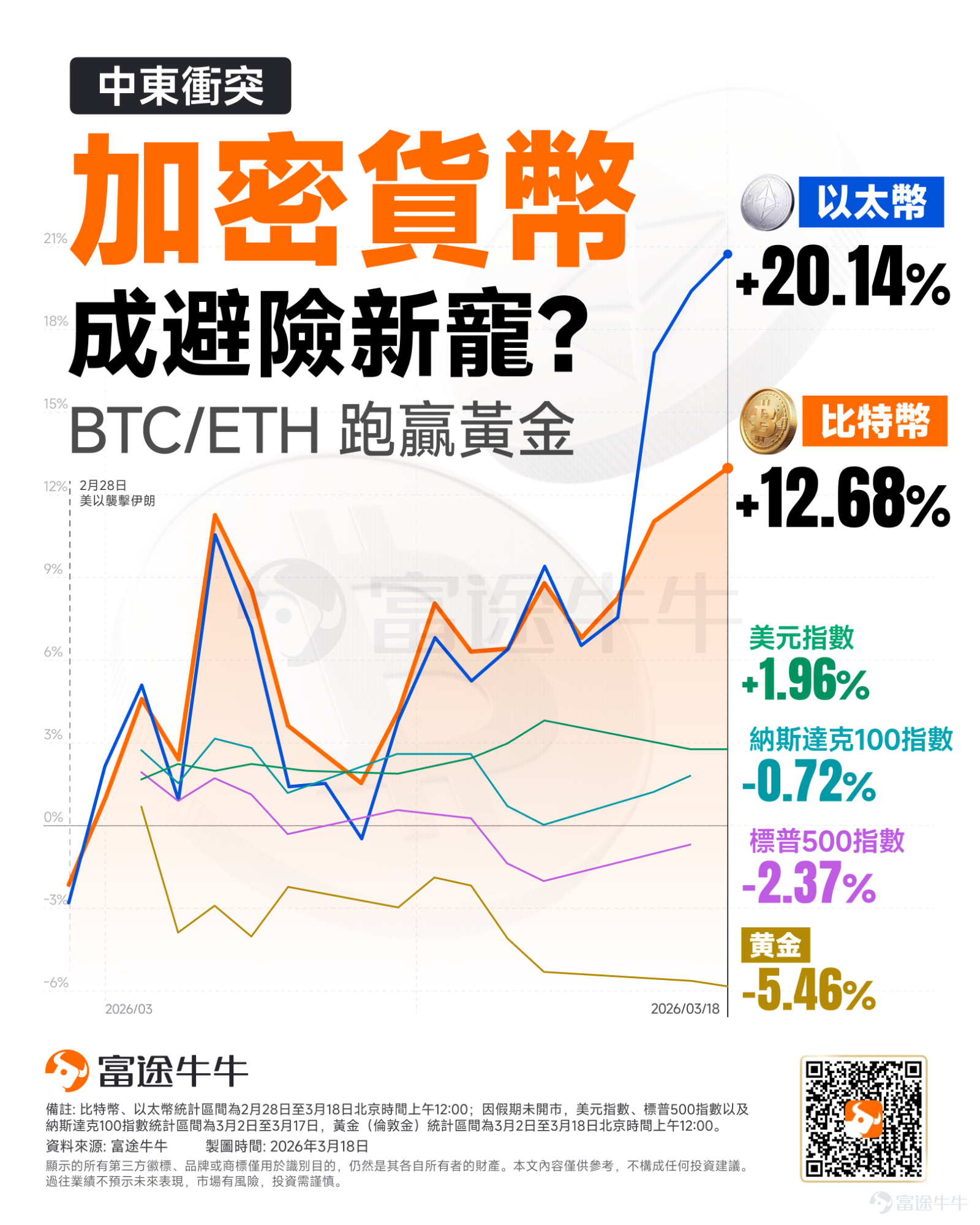
Since the Middle East conflict in 2026, market trends have shown a different pattern from the initial sell-off narrative. From February 28 to March 18, crypto assets $Ethereum (ETH.CC)$ surged more than 20%, $Bitcoin (BTC.CC)$ while the US stock market showed weakness, $S&P 500 Index (.SPX.US)$ with Nasdaq down 2.37% and the Nasdaq 100 Index retreating 0.72%; traditional safe-haven asset gold also experienced a trend decline, falling over 5%, with only crude oil rallying due to direct energy supply shocks.
The market couldn't help but notice that crypto assets actually outperformed all major macro asset classes except oil during the geopolitical conflict. Does this mean that Bitcoin and other crypto assets are becoming new inflation hedges or safe-haven favorites?

Crypto asset prices completed a full release of risks in the earlier period.
The military action occurred on Saturday when all major global financial markets were closed except for the crypto market. Bitcoin became the only major liquid asset that could immediately reflect the geopolitical shock, but it did not exhibit strong characteristics of a safe-haven asset; Bitcoin plummeted over 7% at first instance, and Ethereum and other crypto assets simultaneously saw significant declines, bearing concentrated global macro risk release pressure in the short term.
Looking further back along the timeline, cryptocurrencies experienced a deep correction early in 2026, pre-digesting negative factors from the macro fundamentals, which helped alleviate the short-term selling pressure following this conflict.

The performance of Bitcoin and Ethereum on February 28
After the panic, there will be no further major declines. Institutions are accumulating positions, and ETFs are seeing inflows of funds
In addition to the release of prior risk, the key factors supporting cryptocurrency outperformance during the conflict include continued institutional accumulation since the beginning of the year and recent ETF fund inflows
Relevant data indicates that from the start of the conflict on February 28 until March 12, the world's largest gold ETF $SPDR Gold ETF (GLD.US)$ experienced an outflow of about 2.7% of its assets under management, while Blackrock’s spot Bitcoin ETF $iShares Bitcoin Trust (IBIT.US)$ recorded an inflow of approximately 1.5% over the same period
Public market tracking data shows that crypto ETFs have recorded net inflows for multiple consecutive days recently. Since March 2026, the total cumulative net inflow into spot Bitcoin ETFs has reached approximately $2.1 billion, with a noticeable improvement in the reversal trend. At the same time, spot Ethereum ETFs also recorded $160 million in net inflows, indicating that institutions are increasingly diversifying their allocation into crypto assets

Moreover, amid this year’s extremely panicked continuous sell-off, the holdings in the crypto asset market have been flowing into the hands of institutions, with the average cost basis for Bitcoin maintained at around $70,000The ongoing participation of institutional buying has built solid support for Bitcoin prices, while long-term holders' reluctance to sell has reduced the selling pressure in the circulating supply of the crypto market
The essence of encryption remains unchanged: it is still constrained by expectations of US dollar liquidity and has fallen as a result
Cryptographic assets have shown phased strong performance amid the backdrop of Middle Eastern conflicts, but they still share fundamental similarities with gold in terms of macro pricing logic. The monetary policy stance of the Federal Reserve remains the core macro variable determining the pricing of major asset classes.
The hawkish monetary policy tone from the Federal Reserve last night reflects extreme caution regarding the initiation of a new rate-cutting cycle. Sticky domestic inflation data in the US has forced the market to reassess the interest rate path.The market currently expects the Federal Reserve to cut rates only once this year. During periods when hawkish expectations significantly rise, cryptographic assets and gold experience year-over-year declines.

The performance of Bitcoin, Ethereum, and gold on March 18 and 19
Cryptographic assets are non-interest-bearing assets, just as gold is. Tightening dollar liquidity systemically suppresses the valuation expansion space for global risk assets and non-interest-bearing assets. Investors holding non-interest-bearing assets cannot receive regular interest returns, and elevated benchmark interest rates increase the opportunity cost of holding cryptographic assets and gold.The high level of risk-free yields has prompted some capital to flow back into dollar cash assets. Overall, cryptographic assets have not yet completely departed from the analysis framework of traditional macroeconomic variables.
Cryptographic assets still carry risk attributes but also serve as a source of enhanced portfolio allocation.
Characteristics such as 24/7 uninterrupted trading, relatively small market capitalization, and high sensitivity to marginal capital flows make cryptographic assets quickly liquidated during weekend geopolitical conflicts, serving as an emergency liquidity source for global financial markets. Prior risk release provided opportunities for recent capital inflows, supporting outperformance compared to other major asset classes after the conflict occurred.
Although the high volatility and risk attributes of Bitcoin have not fundamentally changed, its role as part of strategic allocation in an investment portfolio can still help enhance overall returns.
Historical backtesting data (from January 1, 2018, to March 13, 2026) reveals that moderately including a 3%-5% Bitcoin allocation in an S&P 500 benchmark portfolio can optimize risk-adjusted returns without significantly increasing risk.
Specifically, the cumulative return of a pure S&P 500 portfolio was 149.57%, with a Sharpe ratio of 1.49 and a maximum drawdown of 31.81%. After adding 3% Bitcoin, the Sharpe ratio improved, with the maximum drawdown only slightly increasing to 31.94%. With a 5% allocation, the Sharpe ratio reached a peak of 1.88, with a maximum drawdown of approximately 32.04%.At the same time, the portfolio's rate of return kept increasing, with crypto assets serving as a supplementary tool in the investment mix to help capture high growth potential.
Of course, to conclude, past performance does not indicate future results.

Risk Disclaimer: The above content only represents the author's view. It does not represent any position or investment advice of Futu. Futu makes no representation or warranty.Read more

Comments (4)
to post a comment
15
27