
[Opportunity Express] The storage supercycle remains intact, with earnings reports upcoming: How to view Micron amidst geopolitical volatility?
Since the beginning of the year, the memory chip market has undoubtedly been one of the most prominent themes in the global capital markets, especially in the US stock market. The core driver of this rally is not the traditional consumer electronics cycle, but a structural 'super cycle' ignited by AI's comprehensive iteration from training to inference.
However, just as market sentiment was running high, the sudden escalation of geopolitical conflicts in Iran cast a shadow over this hot theme, triggering short-term market pullbacks and wait-and-see behavior.
The Opportunity Express once broke down for everyonethe logic behind the storage star SanDisk, within itsShorted by CitronAt the same time, an interpretation was promptly released. Fellow investors who are interested can review it~
In this issue, we will share the latest developments in the storage sector and introduce one of the three storage giants — $Micron Technology (MU.US)$ 。
Super cycle: This time 'it really is different,' with limited impact from Middle East conflicts
The engine of this 'super cycle' is AI, which has fundamentally reshaped the supply and demand dynamics of the storage industry.
On the demand side, AI servers require 8 to 10 times more storage than traditional servers, with demand highly concentrated on high-end products like high-bandwidth memory (HBM) and enterprise SSDs. Global cloud service providers are making intensive capital expenditures to support large-scale model training and inference.
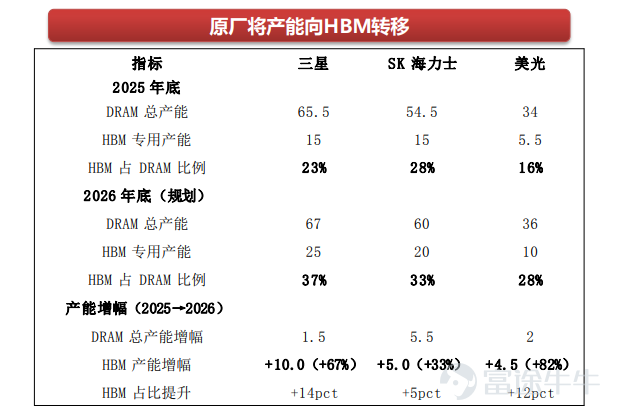
On the supply side,The three major manufacturers are prioritizing limited advanced production capacity for higher-margin HBM, causing serious pressure on general-purpose DRAM (such as DDR4) and some NAND capacity used for consumer electronics (like smartphones and PCs). This structural shift in capacity is a deliberate 'capacity management' strategy. Additionally, there are rigid constraints on capacity expansion: wafer fab construction takes 1.5-2 years, while HBM cleanroom construction requires 8-12 months, meaning short-term supply cannot be quickly ramped up.
![Since the beginning of the year, the memory chip market has undoubtedly been one of the most prominent themes in the global capital markets, especially within the US stock market. The core driver behind this rally is not the traditional consumer electronics cycle but a structural 'supercycle' ignited by AI's comprehensive iteration from training to inference. However, just as market sentiment was running high, the sudden escalation of geopolitical conflict involving Iran cast a shadow over this hot theme, triggering a short-term pullback and wait-and-see sentiment in the market. The Opportunity Express previously broke down[Share Link: the rationale for storage star SanDisk], and when it[Share Link: was shorted by Citron], we promptly provided an analysis. Fellow investors who are interested can review it~ In this issue, we will share the latest developments in the storage sector and introduce one of the three storage giants - $Micron Technology (MU.US)$ 。 Super Cycle: This Time 'It Really Is Different,' Limited Impact from Middle East Conflicts The engine of this 'super cycle' is AI, which has fundamentally reshaped the supply and demand landscape of the storage industry. On the demand side, AI servers require 8 to 10 times more storage than traditional servers, with a high concentration of demand for high-end products such as High Bandwidth Memory (HBM) and enterprise SSDs. Global cloud service providers are making intensive capital expenditures to support large model training and inference. On the supply side,The three major manufacturers are prioritizing limited advanced production capacity for higher-margin HBM, leading to a shortage of general-purpose DRAM used in consumer electronics such as smartphones and PCs...](https://nnqimage.futunn.com/sns_client_feed/900080/20260311/web-1773223754800-lnAzYSMpcx.png/big?area=1&is_public=true&imageMogr2/ignore-error/1/format/webp)
The storage industry has experienced several cycles in the past, but none have been as intense as this one.The overwhelming demand from AI is drawing away capacity, with increases far exceeding previous cycle peaks, and the industry has fully entered 'uncharted territory'.
![Since the beginning of the year, the memory chip market has undoubtedly been one of the most prominent themes in the global capital markets, especially within the US stock market. The core driver behind this rally is not the traditional consumer electronics cycle but a structural 'supercycle' ignited by AI's comprehensive iteration from training to inference. However, just as market sentiment was running high, the sudden escalation of geopolitical conflict involving Iran cast a shadow over this hot theme, triggering a short-term pullback and wait-and-see sentiment in the market. The Opportunity Express previously broke down[Share Link: the rationale for storage star SanDisk], and when it[Share Link: was shorted by Citron], we promptly provided an analysis. Fellow investors who are interested can review it~ In this issue, we will share the latest developments in the storage sector and introduce one of the three storage giants - $Micron Technology (MU.US)$ 。 Super Cycle: This Time 'It Really Is Different,' Limited Impact from Middle East Conflicts The engine of this 'super cycle' is AI, which has fundamentally reshaped the supply and demand landscape of the storage industry. On the demand side, AI servers require 8 to 10 times more storage than traditional servers, with a high concentration of demand for high-end products such as High Bandwidth Memory (HBM) and enterprise SSDs. Global cloud service providers are making intensive capital expenditures to support large model training and inference. On the supply side,The three major manufacturers are prioritizing limited advanced production capacity for higher-margin HBM, leading to a shortage of general-purpose DRAM used in consumer electronics such as smartphones and PCs...](https://nnqimage.futunn.com/sns_client_feed/900080/20260311/web-1773223754714-ACiaeeiWdy.png/big?area=1&is_public=true&imageMogr2/ignore-error/1/format/webp)
The recent escalation of the Iran conflict and the halt in shipping through the Strait of Hormuz have triggered widespread market concerns over the global supply chain.In particular, South Korea’s two storage giants, Samsung and Hynix, experienced significant volatility following the outbreak of the conflict.
However, according to industry chain research, the direct impact of this geopolitical crisis on the storage industry is currently minimal. The storage industry chain exhibits a high degree of 'intra-Asia circulation':
A large number of memory chips are produced in Asia, with abundant material inventories and a high level of localization; semiconductor equipment is mostly transported by air, bypassing the Strait of Hormuz; chip distribution also centers around Asia, such as HBM being manufactured in South Korea and then shipped to Taiwan for packaging.The current strong demand and price increases in the industry have not been substantially disrupted.
However, if the conflict becomes prolonged, there are some potential concerns: first, it may disrupt the supply of key raw materials from the Middle East, such as helium (about 30% of global production comes from Qatar and must pass through the Strait of Hormuz); second, it could hinder tech giants' plans to build AI data centers in the Middle East, potentially suppressing future chip demand.
Micron: One of the three storage giants, crossing cycles toward an explosive growth phase
Micron, Samsung $CSOP Samsung Electronics Daily Max (2x) Leveraged Product (07747.HK)$, Hynix $CSOP SK Hynix Daily Max (2x) Leveraged Product (07709.HK)$are collectively known as the world's three largest storage companies, with Micron being the sole storage giant in North America.The company is mainly engaged in integrated solutions for the research, manufacturing, sales, and service of memory products such as DRAM and NAND.
![Since the beginning of the year, the memory chip market has undoubtedly been one of the most prominent themes in the global capital markets, especially within the US stock market. The core driver behind this rally is not the traditional consumer electronics cycle but a structural 'supercycle' ignited by AI's comprehensive iteration from training to inference. However, just as market sentiment was running high, the sudden escalation of geopolitical conflict involving Iran cast a shadow over this hot theme, triggering a short-term pullback and wait-and-see sentiment in the market. The Opportunity Express previously broke down[Share Link: the rationale for storage star SanDisk], and when it[Share Link: was shorted by Citron], we promptly provided an analysis. Fellow investors who are interested can review it~ In this issue, we will share the latest developments in the storage sector and introduce one of the three storage giants - $Micron Technology (MU.US)$ 。 Super Cycle: This Time 'It Really Is Different,' Limited Impact from Middle East Conflicts The engine of this 'super cycle' is AI, which has fundamentally reshaped the supply and demand landscape of the storage industry. On the demand side, AI servers require 8 to 10 times more storage than traditional servers, with a high concentration of demand for high-end products such as High Bandwidth Memory (HBM) and enterprise SSDs. Global cloud service providers are making intensive capital expenditures to support large model training and inference. On the supply side,The three major manufacturers are prioritizing limited advanced production capacity for higher-margin HBM, leading to a shortage of general-purpose DRAM used in consumer electronics such as smartphones and PCs...](https://nnqimage.futunn.com/sns_client_feed/900080/20260311/web-1773223755537-3xjHqGZHFC.png/big?area=1&is_public=true&imageMogr2/ignore-error/1/format/webp)
Data source: TrendForce.
Micron's performance exhibits typical cyclical fluctuations. Previously, its business was primarily driven by demand from consumer electronics and cloud computing. Changes in demand from end markets such as smartphones, tablets, PCs, and traditional data centers directly impacted the company’s results.
As smartphone penetration gradually approached its peak, the company’s business subsequently entered a cyclical downturn. However, during the pandemic, demand for remote work and online entertainment drove growth.Micron experienced a two-year growth cycle in the fiscal years 2021–2022. In fiscal year 2023, due to a peak in consumer electronics shipments earlier that exhausted downstream demand, coupled with excess industry inventory, the company’s performance significantly declined, resulting in substantial losses.
Starting in 2023, the growth drivers of the memory industry gradually shifted towards AI models and applications. After Micron’s performance bottomed out in fiscal year 2023, it is expected to experience a strong rebound in the fiscal years 2024–2025.
Micron's net profit and growth rate (in billions of US dollars)
![Since the beginning of the year, the memory chip market has undoubtedly been one of the most prominent themes in the global capital markets, especially within the US stock market. The core driver behind this rally is not the traditional consumer electronics cycle but a structural 'supercycle' ignited by AI's comprehensive iteration from training to inference. However, just as market sentiment was running high, the sudden escalation of geopolitical conflict involving Iran cast a shadow over this hot theme, triggering a short-term pullback and wait-and-see sentiment in the market. The Opportunity Express previously broke down[Share Link: the rationale for storage star SanDisk], and when it[Share Link: was shorted by Citron], we promptly provided an analysis. Fellow investors who are interested can review it~ In this issue, we will share the latest developments in the storage sector and introduce one of the three storage giants - $Micron Technology (MU.US)$ 。 Super Cycle: This Time 'It Really Is Different,' Limited Impact from Middle East Conflicts The engine of this 'super cycle' is AI, which has fundamentally reshaped the supply and demand landscape of the storage industry. On the demand side, AI servers require 8 to 10 times more storage than traditional servers, with a high concentration of demand for high-end products such as High Bandwidth Memory (HBM) and enterprise SSDs. Global cloud service providers are making intensive capital expenditures to support large model training and inference. On the supply side,The three major manufacturers are prioritizing limited advanced production capacity for higher-margin HBM, leading to a shortage of general-purpose DRAM used in consumer electronics such as smartphones and PCs...](https://nnqimage.futunn.com/sns_client_feed/900080/20260311/web-1773223754737-O0uNBZ4z5w.png/big?area=1&is_public=true&imageMogr2/ignore-error/1/format/webp)
Data source: Company announcements
DRAM (of which HBM is one type) and NAND (the company’s main business) are the two largest product lines.$SanDisk (SNDK.US)$In fiscal year 2025, DRAM and NAND Flash accounted for 76.5% and 22.8% of the company’s total revenue, respectively. In the first quarter of fiscal year 2026, DRAM accounted for 79.3% of the company’s total revenue, while NAND Flash made up 20%.This reflects a further shift in production capacity towards high-end areas such as HBM.
In December 2025, the company officially announced that it would cease retail channel sales after February 2026, shifting focus to producing high value-added HBM and enterprise-level SSDs.Resources will be concentrated on serving larger, more strategically significant clients (such as cloud service providers Hyperscalers and OEM giants), to establish the company's core position in the AI supply chain.
With the earnings report approaching, will it ignite another round of market excitement?
Micron’s previous earnings report (Q1 of fiscal year 2026, corresponding to the end of November 2025) was released in December 2025. The company achieved revenue of $13.64 billion, representing a year-over-year increase of 56.7%. Gross margin rose to 56%, while Non-GAAP net profit reached $5.48 billion, growing by 169% year over year, with a net profit margin of 40.2%.
This significantly better-than-expected earnings report injected a strong boost into the then-fluctuating memory sector. Micron surged more than 10% immediately afterward, and other memory companies also saw successive gains, making it the undeniable main storyline at the beginning of 2026.
![Since the beginning of the year, the memory chip market has undoubtedly been one of the most prominent themes in the global capital markets, especially within the US stock market. The core driver behind this rally is not the traditional consumer electronics cycle but a structural 'supercycle' ignited by AI's comprehensive iteration from training to inference. However, just as market sentiment was running high, the sudden escalation of geopolitical conflict involving Iran cast a shadow over this hot theme, triggering a short-term pullback and wait-and-see sentiment in the market. The Opportunity Express previously broke down[Share Link: the rationale for storage star SanDisk], and when it[Share Link: was shorted by Citron], we promptly provided an analysis. Fellow investors who are interested can review it~ In this issue, we will share the latest developments in the storage sector and introduce one of the three storage giants - $Micron Technology (MU.US)$ 。 Super Cycle: This Time 'It Really Is Different,' Limited Impact from Middle East Conflicts The engine of this 'super cycle' is AI, which has fundamentally reshaped the supply and demand landscape of the storage industry. On the demand side, AI servers require 8 to 10 times more storage than traditional servers, with a high concentration of demand for high-end products such as High Bandwidth Memory (HBM) and enterprise SSDs. Global cloud service providers are making intensive capital expenditures to support large model training and inference. On the supply side,The three major manufacturers are prioritizing limited advanced production capacity for higher-margin HBM, leading to a shortage of general-purpose DRAM used in consumer electronics such as smartphones and PCs...](https://nnqimage.futunn.com/sns_client_feed/900080/20260311/web-1773223755076-Pe42wbZO6K.png/big?area=1&is_public=true&imageMogr2/ignore-error/1/format/webp)
The results for the second quarter of fiscal year 2026 will be announced after market close next week (March 18).This earnings report is not only a test of the company’s own performance but also a crucial window for the market to observe the strength and sustainability of the AI-driven 'memory supercycle.' Geopolitical uncertainties have added risks to the narrative of high growth. If the results continue to impress the market, they could dispel the gloom currently hanging over the memory industry.
Ahead of this earnings release, the market holds high expectations for Micron’s performance this quarter. Wall Street consensus expects revenue of approximately $19.15 billion, representing a projected year-over-year growth of 137.8% from about $8.05 billion, surpassing the midpoint of the guidance given in the previous quarter and nearing the upper limit of its forecast range.
Key highlights will revolve around validating the narrative of 'structural shortages.' Investors can assess the strength and sustainability of the current cycle through three main themes:
(1) Progress and certainty regarding HBM business.The key lies in confirming whether the full-year HBM capacity for 2026 is still sold out and whether it can meet approximately 50%-67% of the mid-term demand from key clients like NVIDIA and AMD. At the same time, close attention should be paid to the mass production progress, yield performance, and next-generation AI platform certification status of HBM4. Whether management reaffirms or revises its forecast that the total addressable market (TAM) for HBM will reach USD 1 trillion by 2028 will also define the long-term market potential.
(2) Examine the AI-driven full-stack demand and profitability strength.Aside from HBM, it is necessary to verify whether demand for enterprise SSDs and server DRAM (such as DDR5) is strengthening simultaneously to confirm the breadth of demand expansion. Regarding profitability, this quarter’s gross margin guidance has already reached a historical high of 68%, and the market will closely monitor whether actual results can surpass the upper limit of the guidance and management's outlook for the second-half gross margin trend, which will help assess whether profitability is nearing a cyclical peak.
(3) Analyze capital expenditures and the long-term supply-demand dynamics. The company has raised its FY2026 capital expenditure plan to approximately USD 20 billion. The specific allocation (e.g., the new HBM plant in Hiroshima, Japan, advanced DRAM capacity in the U.S.) will directly affect industry supply in the coming years. Additionally, management previously projected that supply tightness would persist until 2027; whether this earnings report extends or shortens that expectation will become a critical factor in determining the length of the 'super cycle.'
This earnings report sits at the collision point between 'extreme expectations' and 'multiple uncertainties.'Earnings are highly likely to show explosive growth, with the core focus on whether guidance can once again deliver an 'astonishing' outcome—especially regarding revenue and gross margin forecasts for Q3 and the full year of FY2026.
Any clear signals about smooth progress on HBM4, robust AI full-stack demand, or supply tightness extending to 2027 will reinforce its narrative as a core AI supplier. Conversely, if there are mentions of slowing price increases, geopolitical costs eroding profits, or weak traditional demand (e.g., PCs/smartphones), it may prompt the market to reassess the sustainability of high valuations.
Technical Analysis & Options Strategies
The company’s stock price is currently in a consolidation phase characterized by strong upward momentum followed by high-level fluctuations.。From December 2025 post-earnings to the historical high in late January 2026, the company’s stock price exhibited a remarkable upward trend with significant gains. However, it subsequently entered a wide-ranging fluctuation phase, failing to establish new highs effectively, and the latest closing price is near the lower-middle part of the fluctuation range.
The MA 60 line forms a strong support for the medium to long term. Following two rounds of adjustments in November and December last year, as well as the recent Iran-related shock, rebounds have occurred near this level each time.
![Since the beginning of the year, the memory chip market has undoubtedly been one of the most prominent themes in the global capital markets, especially within the US stock market. The core driver behind this rally is not the traditional consumer electronics cycle but a structural 'supercycle' ignited by AI's comprehensive iteration from training to inference. However, just as market sentiment was running high, the sudden escalation of geopolitical conflict involving Iran cast a shadow over this hot theme, triggering a short-term pullback and wait-and-see sentiment in the market. The Opportunity Express previously broke down[Share Link: the rationale for storage star SanDisk], and when it[Share Link: was shorted by Citron], we promptly provided an analysis. Fellow investors who are interested can review it~ In this issue, we will share the latest developments in the storage sector and introduce one of the three storage giants - $Micron Technology (MU.US)$ 。 Super Cycle: This Time 'It Really Is Different,' Limited Impact from Middle East Conflicts The engine of this 'super cycle' is AI, which has fundamentally reshaped the supply and demand landscape of the storage industry. On the demand side, AI servers require 8 to 10 times more storage than traditional servers, with a high concentration of demand for high-end products such as High Bandwidth Memory (HBM) and enterprise SSDs. Global cloud service providers are making intensive capital expenditures to support large model training and inference. On the supply side,The three major manufacturers are prioritizing limited advanced production capacity for higher-margin HBM, leading to a shortage of general-purpose DRAM used in consumer electronics such as smartphones and PCs...](https://nnqimage.futunn.com/sns_client_feed/900080/20260311/web-1773223755208-OyO13gW4ol.png/big?area=1&is_public=true&imageMogr2/ignore-error/1/format/webp)
Data from the options market shows that implied volatility (IV) is at an extremely high historical level, indicating that the market expects the earnings report to trigger significant stock price fluctuations, already pricing in a wide-range oscillation of ±12.69% post-results.
![Since the beginning of the year, the memory chip market has undoubtedly been one of the most prominent themes in the global capital markets, especially within the US stock market. The core driver behind this rally is not the traditional consumer electronics cycle but a structural 'supercycle' ignited by AI's comprehensive iteration from training to inference. However, just as market sentiment was running high, the sudden escalation of geopolitical conflict involving Iran cast a shadow over this hot theme, triggering a short-term pullback and wait-and-see sentiment in the market. The Opportunity Express previously broke down[Share Link: the rationale for storage star SanDisk], and when it[Share Link: was shorted by Citron], we promptly provided an analysis. Fellow investors who are interested can review it~ In this issue, we will share the latest developments in the storage sector and introduce one of the three storage giants - $Micron Technology (MU.US)$ 。 Super Cycle: This Time 'It Really Is Different,' Limited Impact from Middle East Conflicts The engine of this 'super cycle' is AI, which has fundamentally reshaped the supply and demand landscape of the storage industry. On the demand side, AI servers require 8 to 10 times more storage than traditional servers, with a high concentration of demand for high-end products such as High Bandwidth Memory (HBM) and enterprise SSDs. Global cloud service providers are making intensive capital expenditures to support large model training and inference. On the supply side,The three major manufacturers are prioritizing limited advanced production capacity for higher-margin HBM, leading to a shortage of general-purpose DRAM used in consumer electronics such as smartphones and PCs...](https://nnqimage.futunn.com/sns_client_feed/900080/20260311/web-1773223754759-2O9V0bboiz.png/big?area=1&is_public=true&imageMogr2/ignore-error/1/format/webp)
The current IV percentile is at 93%, which is at an extremely high historical level. This means that option prices are very expensive, making the direct cost of purchasing options (especially short-term options) quite high. Moreover, IV typically plunges after earnings, eroding the profits of option buyers.
Strategy One: Bull Call Spread
Suitable for investors who believe that the earnings report may bring positive catalysts, potentially driving the stock price higher, but wish to control costs and reduce the impact of a volatility drop.
Buy one call option with a lower strike price while simultaneously selling another call option with the same expiration date but a higher strike price. The maximum profit equals the difference between the two strike prices minus the net premium paid; the maximum loss is limited to the initial net premium paid when constructing the strategy. By selling the option, part of the purchase cost is offset, making it particularly suitable for scenarios where the direction is correct, but profitability is challenging due to excessively high IV in highly volatile stocks.
![Since the beginning of the year, the memory chip market has undoubtedly been one of the most prominent themes in the global capital markets, especially within the US stock market. The core driver behind this rally is not the traditional consumer electronics cycle but a structural 'supercycle' ignited by AI's comprehensive iteration from training to inference. However, just as market sentiment was running high, the sudden escalation of geopolitical conflict involving Iran cast a shadow over this hot theme, triggering a short-term pullback and wait-and-see sentiment in the market. The Opportunity Express previously broke down[Share Link: the rationale for storage star SanDisk], and when it[Share Link: was shorted by Citron], we promptly provided an analysis. Fellow investors who are interested can review it~ In this issue, we will share the latest developments in the storage sector and introduce one of the three storage giants - $Micron Technology (MU.US)$ 。 Super Cycle: This Time 'It Really Is Different,' Limited Impact from Middle East Conflicts The engine of this 'super cycle' is AI, which has fundamentally reshaped the supply and demand landscape of the storage industry. On the demand side, AI servers require 8 to 10 times more storage than traditional servers, with a high concentration of demand for high-end products such as High Bandwidth Memory (HBM) and enterprise SSDs. Global cloud service providers are making intensive capital expenditures to support large model training and inference. On the supply side,The three major manufacturers are prioritizing limited advanced production capacity for higher-margin HBM, leading to a shortage of general-purpose DRAM used in consumer electronics such as smartphones and PCs...](https://nnqimage.futunn.com/sns_client_feed/900080/20260311/web-1773223754759-XIDXfWpkAx.png/big?area=1&is_public=true&imageMogr2/ignore-error/1/format/webp)
(The design images displayed on screen are for illustrative purposes only and do not constitute any investment advice or guarantees; market conditions fluctuate frequently, and the option prices shown do not represent real-world values.)
Strategy Two: Iron Condor
Suitable for investors who believe that the stock price will not experience extreme one-sided fluctuations after the earnings report and is more likely to fluctuate within a specific range. This is a classic short-volatility strategy, expecting volatility to decline (IV Crush) following the earnings event.
Simultaneously sell one out-of-the-money put option and one out-of-the-money call option (constituting a short straddle), while to limit risk, buy one further out-of-the-money put option and one further out-of-the-money call option for protection.
The final position consists of four options: selling a put with a lower strike price K1, buying a put with a higher strike price K2, buying a call with a lower strike price K3, and selling a call with a higher strike price K4, with the strike prices typically evenly spaced.
![Since the beginning of the year, the memory chip market has undoubtedly been one of the most prominent themes in the global capital markets, especially within the US stock market. The core driver behind this rally is not the traditional consumer electronics cycle but a structural 'supercycle' ignited by AI's comprehensive iteration from training to inference. However, just as market sentiment was running high, the sudden escalation of geopolitical conflict involving Iran cast a shadow over this hot theme, triggering a short-term pullback and wait-and-see sentiment in the market. The Opportunity Express previously broke down[Share Link: the rationale for storage star SanDisk], and when it[Share Link: was shorted by Citron], we promptly provided an analysis. Fellow investors who are interested can review it~ In this issue, we will share the latest developments in the storage sector and introduce one of the three storage giants - $Micron Technology (MU.US)$ 。 Super Cycle: This Time 'It Really Is Different,' Limited Impact from Middle East Conflicts The engine of this 'super cycle' is AI, which has fundamentally reshaped the supply and demand landscape of the storage industry. On the demand side, AI servers require 8 to 10 times more storage than traditional servers, with a high concentration of demand for high-end products such as High Bandwidth Memory (HBM) and enterprise SSDs. Global cloud service providers are making intensive capital expenditures to support large model training and inference. On the supply side,The three major manufacturers are prioritizing limited advanced production capacity for higher-margin HBM, leading to a shortage of general-purpose DRAM used in consumer electronics such as smartphones and PCs...](https://nnqimage.futunn.com/sns_client_feed/900080/20260311/web-1773223754676-iywLdM1GPU.png/big?area=1&is_public=true&imageMogr2/ignore-error/1/format/webp)
(The design images displayed on screen are for illustrative purposes only and do not constitute any investment advice or guarantees; market conditions fluctuate frequently, and the option prices shown do not represent real-world values.)
Finally, here's a small perk for fellow investors—welcome to claim it!Options Beginner Pack
This event is exclusively for invited HK users, click to learn moreDetailed event rules >>
Futu's simulated trading challenge is now open for registration! Zero cost, zero risk, and you could win stock cash vouchers!
![Since the beginning of the year, the memory chip market has undoubtedly been one of the most prominent themes in the global capital markets, especially within the US stock market. The core driver behind this rally is not the traditional consumer electronics cycle but a structural 'supercycle' ignited by AI's comprehensive iteration from training to inference. However, just as market sentiment was running high, the sudden escalation of geopolitical conflict involving Iran cast a shadow over this hot theme, triggering a short-term pullback and wait-and-see sentiment in the market. The Opportunity Express previously broke down[Share Link: the rationale for storage star SanDisk], and when it[Share Link: was shorted by Citron], we promptly provided an analysis. Fellow investors who are interested can review it~ In this issue, we will share the latest developments in the storage sector and introduce one of the three storage giants - $Micron Technology (MU.US)$ 。 Super Cycle: This Time 'It Really Is Different,' Limited Impact from Middle East Conflicts The engine of this 'super cycle' is AI, which has fundamentally reshaped the supply and demand landscape of the storage industry. On the demand side, AI servers require 8 to 10 times more storage than traditional servers, with a high concentration of demand for high-end products such as High Bandwidth Memory (HBM) and enterprise SSDs. Global cloud service providers are making intensive capital expenditures to support large model training and inference. On the supply side,The three major manufacturers are prioritizing limited advanced production capacity for higher-margin HBM, leading to a shortage of general-purpose DRAM used in consumer electronics such as smartphones and PCs...](https://nnqimage.futunn.com/sns_client_feed/900080/20260311/web-1773223754747-44hlRObc0k.webp/big?area=1&is_public=true&imageMogr2/ignore-error/1/format/webp)
Disclaimer
This content does not constitute any offer, solicitation, recommendation, opinion, or guarantee of any securities, financial products, or tools. The risk of loss in buying and selling options can be substantial. In some cases, your losses may exceed the initial margin amount deposited. Even if you set contingent orders, such as 'stop-loss' or 'limit' orders, these may not necessarily prevent losses. Market conditions may make these orders unexecutable. You might be required to deposit additional margin within a short period. If you fail to provide the required amount within the specified time, your open positions may be liquidated. However, you will still be responsible for any account deficit arising from this. Therefore, before trading, you should study and understand options and carefully consider whether such trading suits you based on your financial situation and investment objectives. If you trade options, you should be familiar with the procedures upon exercising options and at expiration, as well as your rights and obligations when exercising options and at expiration.
Risk Disclaimer: The above content only represents the author's view. It does not represent any position or investment advice of Futu. Futu makes no representation or warranty.Read more


Comments
to post a comment
60
134