Is the AI trading theme making a comeback? Japanese and South Korean stocks rebound strongly

Pricing power reversal! Memory sector enters a 'once-in-a-lifetime' super cycle. Who is reaping the AI红利?
This year, driven by the explosion of AI demand and supply bottlenecks, memory chips are entering a full-fledged 'seller's market'.
Although recent Middle East conflicts have put pressure on the memory sector, the core logic remains unshaken — strong demand from AI data center construction is driving up prices for both DRAM and NAND significantly.
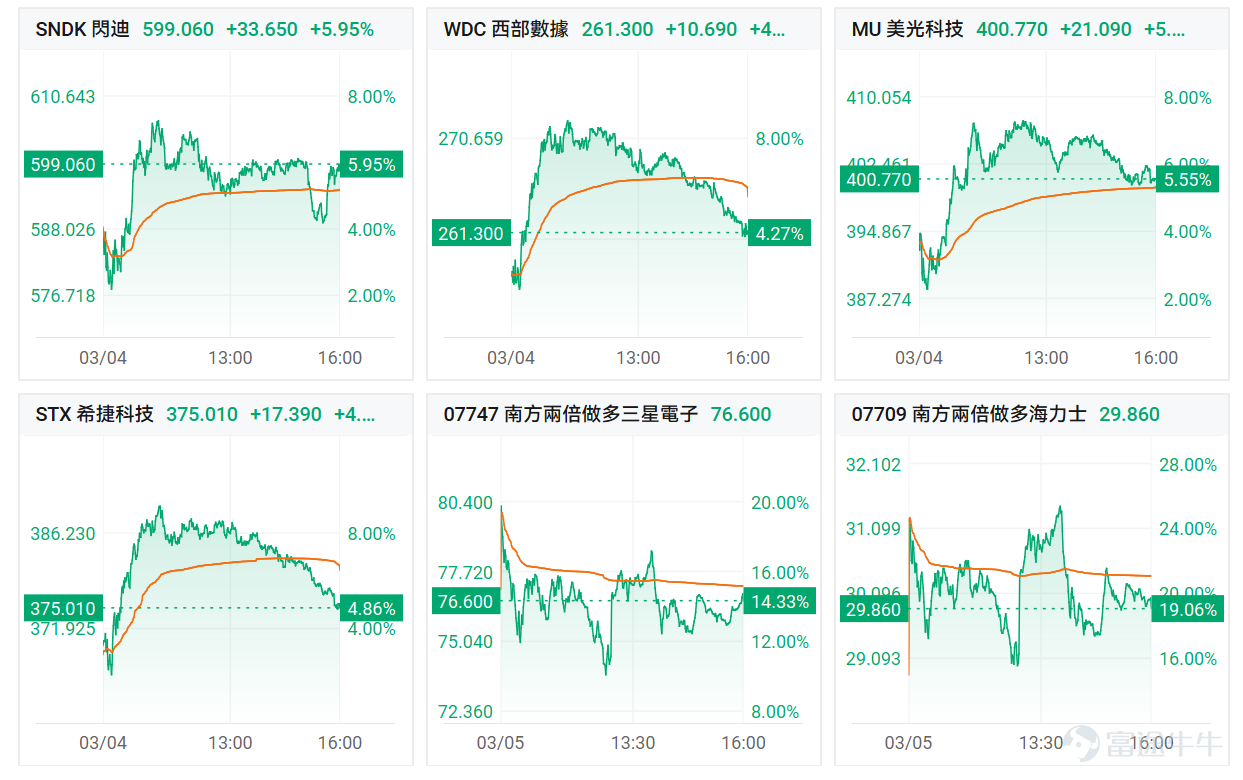
Following the overnight tech stock rebound in the US, two major American memory giants — $Micron Technology (MU.US)$and $SanDisk (SNDK.US)$ — once again became the focus of global investors, surging nearly 6% in a single day on Wednesday! This bullish enthusiasm quickly spilled over to the Asian markets today, with $CSOP Samsung Electronics Daily Max (2x) Leveraged Product (07747.HK)$ and $CSOP SK Hynix Daily Max (2x) Leveraged Product (07709.HK)$ — continuing the momentum with a substantial rebound.

--
--
--
Notably, The latest news shows that Samsung Electronics' Q1 DRAM price increase has been finalized at over 100%, expanding approximately 30 percentage points from the previously negotiated 70% level a month ago. According to Korean media reports, some overseas customers have completed payments, and the supply negotiation cycle has been compressed from annually to quarterly or even monthly. This round of price hikes stems from capacity constraints caused by the surge in AI investments impacting HBM, leading to limited general DRAM supply while demand remains robust.SK Hynix and Micron Technology have followed suit with equal price hikes, establishing a collective price increase among the three major manufacturers, with the upward trend expected to continue into the second quarter.
This article will provide fellow investors with an in-depth analysis of the macro outlook for the storage industry, as well as the specific positioning of key giants in the supply chain.
The storage industry is experiencing a 'once-in-a-lifetime' super cycle.
BNP Paribas recently released a research report stating that DRAM contract prices are expected to surge 90% quarter-over-quarter in the first quarter of 2026. NAND, known for its traditionally stable price curve, is expected to soar by 55%.Moreover, the second quarter will continue the price hike trajectory that began in the second half of 2025.
The latest memory industry survey from TrendForce shows that sustained demand for artificial intelligence and data centers in the first quarter of 2026 will further exacerbate the global memory supply-demand imbalance.Thereby increasing suppliers' pricing power.As a result, TrendForce has significantly raised its price forecasts for DRAM and NAND flash products in the first quarter of 2026:
Traditional DRAM contract prices: Quarter-over-quarter increase adjusted from the previous 55%-60% to 90%-95%.
NAND flash contract prices: Quarter-over-quarter increase expected to be adjusted from 33%-38% to 55%-60%.
Enterprise-grade solid-state drives (eSSD): Expected to increase by 53% to 58% quarter-on-quarter, setting a new record for quarterly price increases.

This highlights a key fact:Storage chips have become the "absolute center" in the AI mega-wave, comparable to NVIDIA's AI chips.,They remain one of the core supply bottlenecks that first experience supply-demand imbalances and pricing power in this wave.
Notably, Pano Cheng, CEO of Phison Electronics, the global leader in storage control chips, recently made a shocking statement during an in-depth interview: with the explosion of the AI wave,The storage industry is entering a once-in-a-lifetime super cycle,Its intensity makes even Taiwan Semiconductor's conventional business model appear "mild."
As a leading company in the NAND flash memory controller chip field, Phison Electronics holds a central position in the industry chain. In the interview, Pano Cheng frankly stated,The current market is not just about shortages; it’s a life-and-death competition from cloud to end devices.
The market's understanding of AI-driven storage demand often remains at the qualitative level of "increased demand," but Pano Cheng presented astonishing quantitative data. He used NVIDIA's upcoming next-generation GPU, Vera Rubin, as an example to demonstrate:
According to the basic algorithm disclosed by NVIDIA, each Vera Rubin GPU requires about 20TB of SSD storage. Assuming they sell 10 million units, that amounts to 200 EB (Exabytes) of capacity.
What does 200 EB mean? Pan Jiancheng provided a comparison:Last year's total global NAND Flash output was only around 1000 to 1100 EB. In other words,just this one NVIDIA model, if 10 million units are shipped, will directly consume 20% of the world’s flash memory production capacity.
Pan Jiancheng added, 'This is only the configuration of the machine itself. Once the machine starts operating, the massive amount of data generated will require additional storage, and those needs aren't even included.'
The direct consequence of this supply-demand imbalance is the unlimited expansion of upstream manufacturers' influence.During the interview, Pan Jiancheng revealed a detail that made the host exclaim, 'Even Taiwan Semiconductor wouldn’t dare to do this.'
One Flash manufacturer now requires buyers to prepay for 3 years of goods.'Not a deposit, but full cash prepayment for 3 years.' Pan Jiancheng remarked that in his decades of working in the electronics industry, 'This is the first time I've ever heard of such a thing.'
Which storage giants deserve special attention?
Whether it is the TPU computing power cluster led by Google or the computing power cluster based on NVIDIA GPUs, neither can function without a vast storage ecosystem. There was once a misconception in the market that 'AI only benefits HBM,' but in reality, during the AI inference stage, enterprise-grade eSSDs are equally irreplaceable.
Previously‘2026 Outlook | Nomura, J.P. Morgan, and other investment banks unanimously predict: The storage industry may see a super cycle by 2026! What investment opportunities should be watched?’A previous article outlined the relevant industry chain:

--
--
--
In this extremely intense seller's market, the following six giants are leveraging their respective redefined competitive advantages to collectively reap the 'super红利' of the computing power era:
1. SK Hynix: The absolute leader in HBM and NVIDIA’s 'soulmate'
Core positioning: The undisputed frontrunner in the AI-era storage race. With its first-mover advantage in HBM (High Bandwidth Memory) technology, unparalleled stacking capabilities, and ultra-high yield rates, $CSOP SK Hynix Daily Max (2x) Leveraged Product (07709.HK)$ It has deeply integrated itself into NVIDIA's supply chain, securing the largest share of the HBM market. It is the most direct and pure beneficiary of the AI computing power boom.
Samsung Electronics: The 'all-around powerhouse' and capacity giant of the storage world
Core positioning: The strongest global storage oligarch in terms of overall capabilities. Although it faced pressure in the HBM3 generation, $CSOP Samsung Electronics Daily Max (2x) Leveraged Product (07747.HK)$ It boasts the largest total DRAM and NAND production capacity globally. At present, Samsung is not only making significant gains in reclaiming lost ground in the HBM market, but it also holds a dominant scale advantage in enterprise-grade high-capacity SSDs (eSSDs) and traditional server DDR5 markets, wielding strong pricing power within the industry.
Micron Technology: The rising star of North American storage
Core positioning: A core supplier in North America with geopolitical advantages. $Micron Technology (MU.US)$ Achieved a technological leap at the HBM3E stage and successfully entered NVIDIA's main supply chain with excellent energy efficiency. As the only storage giant in the U.S., Micron Technology enjoys natural procurement priority and favorable policies when tech giants like Microsoft, Google, and Amazon expand their AI data centers in North America.
4. SanDisk: The Return of the King, Pure-Blood NAND and eSSD Emerge as Dark Horses
Core positioning: A pure-play NAND flash memory target with tremendous potential after spinning off and relisting from Western Digital. $SanDisk (SNDK.US)$ Having shed the valuation burden of its HDD business, it has become one of the few pure-blood giants focusing on NAND and solid-state drives (SSDs). With the surge in demand for enterprise SSDs (especially high-capacity eSSDs) in AI inference applications, SanDisk is experiencing a Davis Double Play with both volume and price increases in its core business, offering significant valuation upside post-independent pricing.
5. Western Digital: Remodeling into a Pure-Play Giant of High-Capacity HDD
Core positioning: One of the two oligopolies in 'nearline storage' after divesting its flash business. Following the spin-off, $Western Digital (WDC.US)$ It has transformed into a highly focused pure-play entity in mechanical hard drives (HDD). Trillion-parameter AI models and vast multimodal datasets (video, images, text) require extremely cost-effective solutions, heavily relying on Western Digital’s high-capacity HDD data lakes. Together with Seagate, it splits the underlying infrastructure benefits of AI data hoarding.
5. Seagate: The 'Invisible Guardian' of AI Warm and Cold Data
Core positioning: The absolute oligarch of high-capacity mechanical hard drives (HDD). Never assume that AI only uses solid-state drives. $Seagate Technology (STX.US)$ By leveraging cutting-edge technologies such as HAMR (Heat-Assisted Magnetic Recording), continuous breakthroughs in single-disk capacity are being achieved. As data centers fully transition to AI architectures, Seagate has not only captured the massive demand for warm and cold data storage from cloud providers but also benefited from a significant HDD procurement wave driven by enterprises establishing private databases.
Overall, according to Citi analysts,The memory chip market is about to enter an extremely intense seller's market, with pricing power completely in the hands of storage giants such as Samsung, SK Hynix, Micron Technology, and SanDisk.
Risk Disclaimer: The above content only represents the author's view. It does not represent any position or investment advice of Futu. Futu makes no representation or warranty.Read more


Comments (8)
to post a comment
73
201