Optical communication stocks lead the rebound; will the AI optical cycle continue?

Mark your calendars for March 16-19! NVIDIA's GTC Conference is coming with great anticipation: Are these three hidden themes set to explode?
As the NVIDIA GTC conference in March 2026 approaches, the global AI computing power market is set to receive new technological guidance.
PreviouslyMark your calendars for March 16-19! The NVIDIA GTC conference is coming soon—will this top event signal a stock price rebound?As previously mentioned, the key highlights of this conference go beyond unveiling specifications for next-generation GPUs like Rubin and future Feynman, with significant focus also being placed on technological breakthroughs and commercial progress in areas such as CPO, power architecture, and liquid cooling infrastructure for computing power.
As GPU single-chip power enters the high-watt era,trends toward CPO (Co-Packaged Optics), 800V high-voltage DC power supply, and full liquid cooling have become increasingly clear.Driven by this unstoppable hardware revolution, what disruptive upgrades will the future computing power infrastructure see?
We have compiled the key sectors and companies that are expected to benefit from this GTC conference. Today, we’ll take fellow investors through a detailed breakdown of the industrial chain changes hidden behind these new technologies.
![As the countdown begins to NVIDIA’s GTC Conference in March 2026, the global AI computing power market is set to receive a new wave of technological guidance. Previously[Share Link: Mark your calendars for March 16-19! NVIDIA’s GTC Conference is approaching. Can this top event herald a stock price rebound?]A previous article mentioned that the core highlights of this conference are not only unveiling the Rubin and future Feynman next-gen GPU specs but also focusing on technical breakthroughs and commercial progress in areas like CPO, power architecture, and liquid cooling infrastructure for computing power. With GPU single-chip power entering the high-watt era,CPO (Co-Packaged Optics), 800V high-voltage DC power supply, and full liquid cooling trends have become increasingly clear.Amidst this unstoppable hardware revolution, what disruptive upgrades will the future computing infrastructure embrace? For fellow investors, I’ve compiled the key sectors and companies potentially benefiting from this GTC conference. Today, let’s delve into the industrial chain transformations hidden behind these new technologies: I. Opportunities in the Optical Communication Industry Chain The explosive growth of AI computing power has placed extreme demands on bandwidth, latency, and power consumption for data transmission. As the 'blood vessels' of the computing power network,Optical communication is accelerating its transition from traditional optical modules to CPO (Co-Packaged Optics) and NPO (Near-Packaged Optics).The upcoming GTC conference will be a critical turning point for the commercial implementation of CPO technology. The core highlights of this conference are focused onScal...](https://nnqimage.futunn.com/sns_client_feed/900080/20260305/web-1772680091052-JoqEscbex4.png/big?area=1&is_public=true&imageMogr2/ignore-error/1/format/webp)
--
--
--
1. Opportunities in the Optical Communication Industry Chain
The explosive growth of AI computing power has placed extreme demands on bandwidth, latency, and energy consumption for data transmission. As the 'blood vessels' of the computing network,Optical communication is rapidly transitioning from traditional optical modules to CPO (Co-Packaged Optics) and NPO (Near-Packaged Optics).The upcoming GTC conference will be a critical turning point for the commercial implementation of CPO technology.
The core highlights of this conference focus on breakthroughs in two major areas:Scale Out (horizontal expansion)and Scale Up (vertical expansion)
From the perspective of the Scale-out domain and CPO switch dimension,The GTC conference will mainly showcase three CPO switches: Quantum 3400, Ethernet 6800, and Ethernet 6810. Their mass production timelines are November-December 2026 and February 2027, respectively, with the Ethernet versions' mass production progress expected to be ahead of schedule.
Market sources indicate that in terms of inventory preparation, Taiwan Semiconductor’s yield rate has significantly improved to around 90%. Upstream suppliers such as CW light sources, Shuffle, and FAU have also validated that CPO inventory preparation is accelerating.
Meanwhile, the Scale-up domain is witnessing new developments.NVIDIA's demonstration of the Rubin Ultra optical-in-cabinet solution at the GTC conference has become a market consensus. The unexpected highlight lies in the fact that, apart from the co-packaging of Switch ASICs and optical engines, network cards may also be co-packaged with optical engines, increasing the number of optical engines per GPU to approximately 5.5 and triggering explosive demand for optical engines.
Most notably, just before the GTC conference, NVIDIA made a bold $4 billion investment, simultaneously acquiring stakes in optical communication giants Coherent and Lumentum, securing supply chain capacity for the next generation of 'AI interconnects.' Barclays views this move as a form of 'supply protection' for CPO.
Barclays also noted that the timing of the deal disclosure was 'not surprising,' as NVIDIA 'is likely to publicly discuss new CPO solutions during the GTC conference.'If the upcoming GTC conference reveals a clearer product roadmap, the implications of the aforementioned 'capacity locking' might lead the market to reassess the pace of CPO advancements.
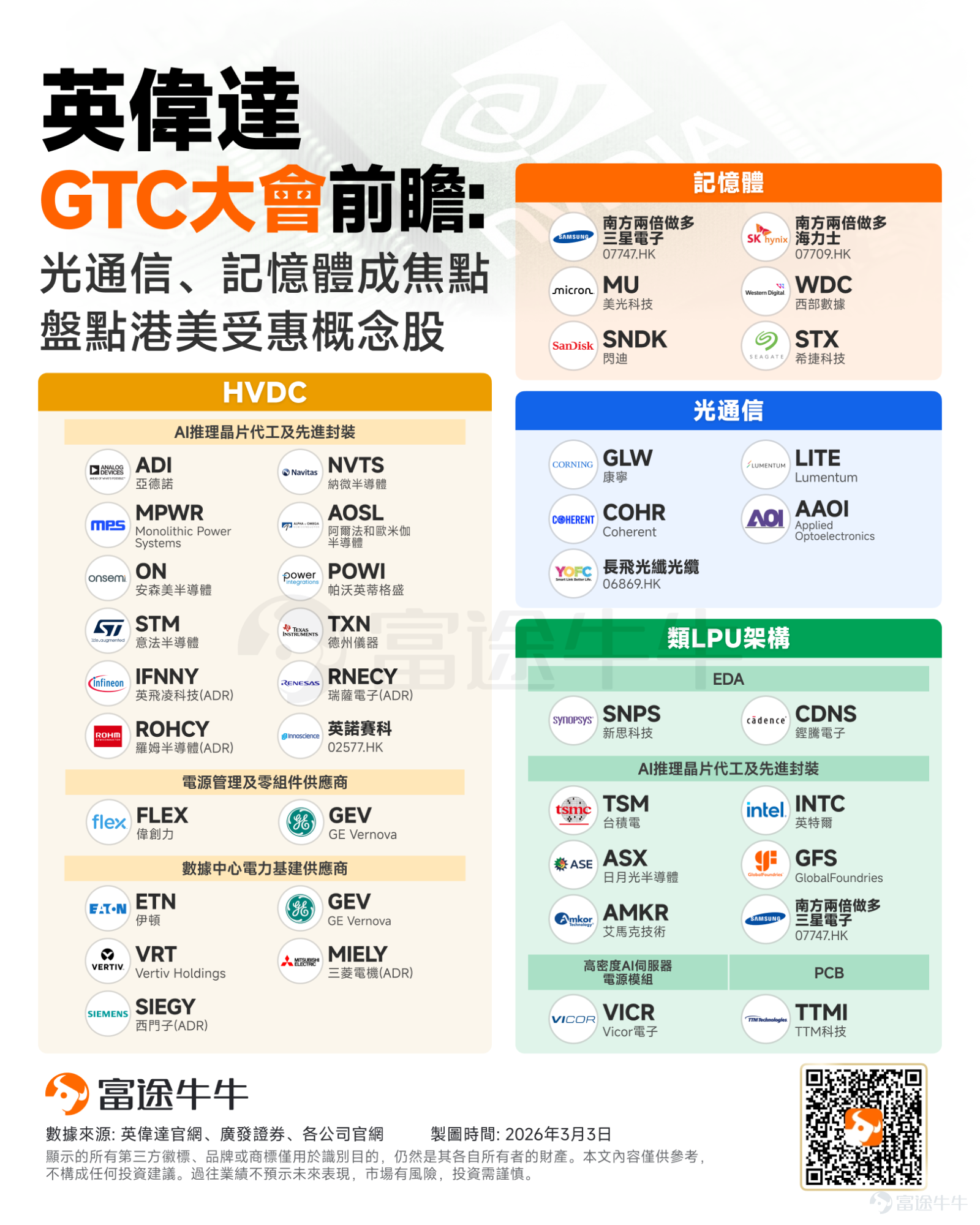
Key companies to watch in the Hong Kong and US optical communication industries: $Corning (GLW.US)$、 $Coherent (COHR.US)$、 $Lumentum (LITE.US)$、 $Applied Optoelectronics (AAOI.US)$、 $YOFC (06869.HK)$。
💡Previously‘2026 Outlook | Don’t Just Focus on NVIDIA! Optical Communication Industry Poised to Become the Strongest Growth Sector by 2026—What Opportunities Should Investors Watch?’A previous article outlined the entire optoelectronics industry chain and related companies. Fellow investors who are interested can click to view.
![As the countdown begins to NVIDIA’s GTC Conference in March 2026, the global AI computing power market is set to receive a new wave of technological guidance. Previously[Share Link: Mark your calendars for March 16-19! NVIDIA’s GTC Conference is approaching. Can this top event herald a stock price rebound?]A previous article mentioned that the core highlights of this conference are not only unveiling the Rubin and future Feynman next-gen GPU specs but also focusing on technical breakthroughs and commercial progress in areas like CPO, power architecture, and liquid cooling infrastructure for computing power. With GPU single-chip power entering the high-watt era,CPO (Co-Packaged Optics), 800V high-voltage DC power supply, and full liquid cooling trends have become increasingly clear.Amidst this unstoppable hardware revolution, what disruptive upgrades will the future computing infrastructure embrace? For fellow investors, I’ve compiled the key sectors and companies potentially benefiting from this GTC conference. Today, let’s delve into the industrial chain transformations hidden behind these new technologies: I. Opportunities in the Optical Communication Industry Chain The explosive growth of AI computing power has placed extreme demands on bandwidth, latency, and power consumption for data transmission. As the 'blood vessels' of the computing power network,Optical communication is accelerating its transition from traditional optical modules to CPO (Co-Packaged Optics) and NPO (Near-Packaged Optics).The upcoming GTC conference will be a critical turning point for the commercial implementation of CPO technology. The core highlights of this conference are focused onScal...](https://nnqimage.futunn.com/sns_client_feed/900080/20260305/web-1772680089888-ttSUGxiDKE.png/big?area=1&is_public=true&imageMogr2/ignore-error/1/format/webp)
--
--
--
2. Opportunities in the industrial chain brought by NVIDIA's LPU
Reports suggest that NVIDIA plans to unveil a new inference chip integrating Groq’s 'Language Processing Unit' (LPU) technology at the GTC Developers Conference, indicating NVIDIA’s accelerated transition into the inference computing space to meet customers’ urgent demand for high-performance, low-cost computing solutions.
The LPU (Language Processing Unit), designed by NVIDIA for AI inference scenarios, focuses on restructuring the inference architecture to address latency, cost, and energy efficiency challenges faced in large model inference:
Architectural Innovation:Elimination of ABF substrates, CoWoS packaging, and backside power delivery,Upgrading PCBs from carrier boards to core interconnect hubs; adopting large-capacity on-chip SRAM to replace HBM, with deterministic execution architecture precisely scheduling computation and communication down to the clock cycle, improving latency and energy efficiency more than tenfold compared to traditional GPUs.
The emergence of the LPU represents not just another chip but a significant upgrade in AI server hardware architecture, bringing definitive incremental demand across multiple segments.
First and foremost, PCBs stand out as the most direct and crucial beneficiary component.LPU’s requirements for signal integrity and transmission loss have reached an extreme.
Secondly, the core of LPU is the integration of large-capacity SRAM.This design philosophy of 'trading area for bandwidth and static memory for low latency' will drive the demand for specialized, high-performance SRAM, bringing new opportunities to related memory chip design companies.
Additionally,The GTC conference may unveil a new memory HBF architecture concept, which benefits NAND, and the market has certain expectations.As more long-term agreements are signed by 2027, the market’s confidence in the performance of memory chips for 2027 and even 2028 will increase, with further upside potential expected in the mid-term.
The collaboration between LPU clusters and GPU clusters,as well as high-speed interconnection between cabinets, places extremely high demands on bandwidth,which will accelerate the implementation and application of advanced optical interconnect technologies such as co-packaged optics.
Finally, LPU does not require complex CoWoS advanced packaging and mainly relies on traditional high-end packaging.High-density computing brings higher cooling demands, significantly upgrading the need for liquid cold plates and thermal conductive materials.
Key companies in the LPU architecture for Hong Kong and US stocks:
AI inference chip foundry and advanced packaging: $Taiwan Semiconductor (TSM.US)$ 、 $Intel (INTC.US)$ 、 $ASE Technology (ASX.US)$ 、 $GlobalFoundries (GFS.US)$ 、 $Amkor Technology (AMKR.US)$ 、 $CSOP Samsung Electronics Daily Max (2x) Leveraged Product (07747.HK)$ 。
III. HVDC Industry Chain Opportunities
At the GTC conference, NVIDIA will showcase new-generation chips such as Rubin and Feynman. Among them, the single-chip power of Rubin reaches 2000 watts, and that of Feynman exceeds 5000 watts. With no significant change in voltage levels, the substantial increase in power leads to a surge in current. For example, if the third-stage power output voltage is 0.8 volts, the current can reach kiloampere levels, posing a great challenge to the third-stage power supply.
To address this, NVIDIA proposed an HVDC (800-volt) solution, mainly targeting the conversion of AC to DC for the primary power supply, increasing the previous 48 volts to 800 volts to reduce current demands; at the same time, for cases where third-stage power directly supplies the GPU, its output voltage is extremely low but the current demand is extremely high. NVIDIA adopted a 0.8-volt design, allowing the current to reach kiloampere levels.
Last year, NVIDIA announced over 20"Electric Power Revolution Corps"partners across three major fields: GaN/SiC power chips and modules, power system component providers, and power system solution providers. This GTC conference will be a continued opportunity to track NVIDIA’s progress.
![As the countdown begins to NVIDIA’s GTC Conference in March 2026, the global AI computing power market is set to receive a new wave of technological guidance. Previously[Share Link: Mark your calendars for March 16-19! NVIDIA’s GTC Conference is approaching. Can this top event herald a stock price rebound?]A previous article mentioned that the core highlights of this conference are not only unveiling the Rubin and future Feynman next-gen GPU specs but also focusing on technical breakthroughs and commercial progress in areas like CPO, power architecture, and liquid cooling infrastructure for computing power. With GPU single-chip power entering the high-watt era,CPO (Co-Packaged Optics), 800V high-voltage DC power supply, and full liquid cooling trends have become increasingly clear.Amidst this unstoppable hardware revolution, what disruptive upgrades will the future computing infrastructure embrace? For fellow investors, I’ve compiled the key sectors and companies potentially benefiting from this GTC conference. Today, let’s delve into the industrial chain transformations hidden behind these new technologies: I. Opportunities in the Optical Communication Industry Chain The explosive growth of AI computing power has placed extreme demands on bandwidth, latency, and power consumption for data transmission. As the 'blood vessels' of the computing power network,Optical communication is accelerating its transition from traditional optical modules to CPO (Co-Packaged Optics) and NPO (Near-Packaged Optics).The upcoming GTC conference will be a critical turning point for the commercial implementation of CPO technology. The core highlights of this conference are focused onScal...](https://nnqimage.futunn.com/sns_client_feed/900080/20260305/web-1772680086264-rkvUIo1OBW.png/big?area=1&is_public=true&imageMogr2/ignore-error/1/format/webp)
--
--
--
Key opportunities in the HVDC industry chain include:
Silicon wafer suppliers: $Analog Devices (ADI.US)$ 、 $Alpha & Omega Semiconductor (AOSL.US)$ 、 $Monolithic Power Systems (MPWR.US)$ 、 $Navitas Semiconductor (NVTS.US)$ 、 $ON Semiconductor (ON.US)$ 、 $Power Integrations (POWI.US)$ 、 $STMicroelectronics (STM.US)$ 、 $Texas Instruments (TXN.US)$ 、 $INNOSCIENCE (02577.HK)$ 、 $INFINEON TECHNOLOG (IFNNY.US)$ 、 $Renesas Electronics (ADR) (RNECY.US)$ 、 $Rohm (ADR) (ROHCY.US)$ , EPC, and Richtek Technology;
Power system component suppliers: $Flex Ltd (FLEX.US)$ 、 $GE Vernova (GEV.US)$ 、 $Shenzhen Megmeet Electrical (002851.SZ)$ , BizLink Group, Delta Electronics, $BYD ELECTRONIC (00285.HK)$ subsidiary Lead Wealth and Lite-On Technology;
Data center power system suppliers: $Eaton (ETN.US)$ 、 $GE Vernova (GEV.US)$ 、 $Vertiv Holdings (VRT.US)$、 $Mitsubishi Electric (ADR) (MIELY.US)$ 、 $SIEMENS AG (SIEGY.US)$ , ABB, Hitachi Energy, Heron Power, Schneider Electric.
Summary
Overall, the 2026 NVIDIA GTC conference has gone beyond announcing the performance of single GPUs (such as Rubin and Feynman) and has evolved into a "hardware specification revolution" aimed at reshaping the global AI computing infrastructure. From breaking transmission bandwidth bottlenecks with CPO optical communication, to cost reduction and efficiency improvements for large model inference through the new LPU architecture, and then moved on to solving the power supply challenges of high-wattage computing beasts with the HVDC high-voltage direct current solution. Each iteration of underlying technology has opened up new growth opportunities across the upstream and downstream industrial chain.
For investors, capital maneuvering in the market often occurs before absolute consensus forms. Rather than seeking perfect certainty and waiting for all technical indicators to fully materialize, it might be better to adopt a probabilistic 'venture capital' mindset – in the early stages when trends are already clear, focus on core supply chain nodes with high success rates (such as optical engines that have already been pre-ordered by giants, indispensable specialty SRAM, and high-voltage power modules).
Every technical detail and mass production timeline released at the GTC conference will serve as the starting gun for market capital to reprice.
Risk Disclaimer: The above content only represents the author's view. It does not represent any position or investment advice of Futu. Futu makes no representation or warranty.Read more


Comment (1)
to post a comment
75
219