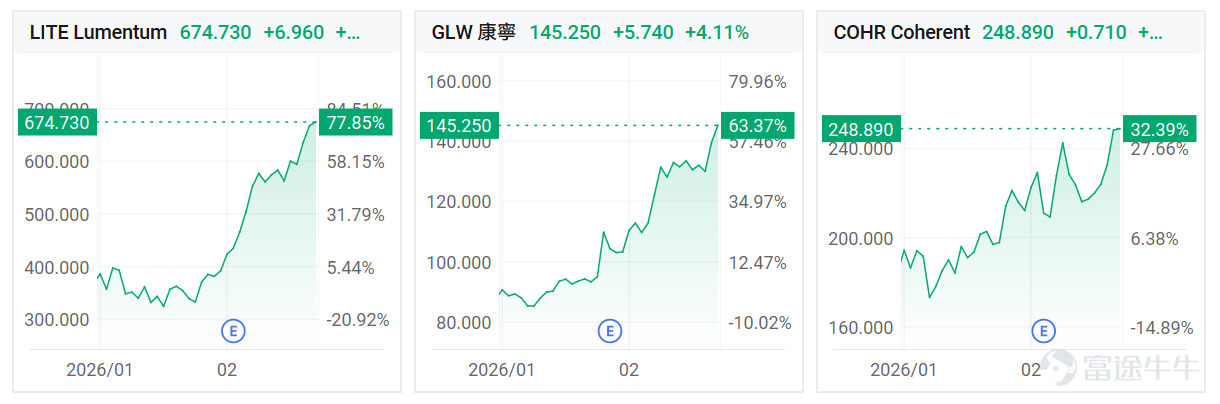
Optical communication stocks lead the rebound; will the AI optical cycle continue?

Focus on March! NVIDIA GTC & OFC, two major tech conferences, are重磅来袭 (approaching with great impact), where are the opportunities in the optical communication sector? Check out this forward-looking strategy guide.
Since the beginning of 2026, the 'hard tech' track in the US stock market has been driven by dual engines: not only has the storage sector continued to soar, but the optical communication industry chain has also entered a major upward phase.
On the trading board, the stock price of leading optical communication giants represented by $Lumentum (LITE.US)$ 、 $Coherent (COHR.US)$ 、 $Corning (GLW.US)$ has repeatedly hit record highs. Their relative gains have significantly outperformed the Philadelphia Semiconductor Index, demonstrating strong explosive power and earnings certainty.

--
--
--
In fact, this is by no means a simple emotional rotation, nor a short-term game of capital switching between high and low sectors. The core logic lies in — the 'bucket effect' of AI infrastructure is undergoing a structural shift.
Over the past two years, market attention has been focused on computing chips such as GPUs. However, with the advent of the era of hundreds of thousands or even millions of GPU clusters, the volume of data interaction between nodes has exploded exponentially. The bottleneck for large model iteration has evolved from pure 'computing power' to 'interconnection bandwidth.' As clusters expand infinitely, without matching ultra-fast networks, even the most expensive GPUs will become inefficient 'isolated computing islands.'
Based on this, optical modules, optical fibers, and similar components are experiencing a historic revaluation. They have completely shed the label of 'peripheral accessories' and risen to become the 'blood vessels and nerves' determining the operational limits of entire computing systems.
This article will focus on introducing the upcoming catalysts in the optical communication industry to fellow investors and highlight which companies are worth watching.
What key events should we watch for next?
First, NVIDIA's GTC and OFC, two top-tier conferences in March, will release crucial industry signals and serve as the focal point of the year.
 NVIDIA GTC Conference
March 16-19, 2026,NVIDIA will host its most important annual AI and computing power conference, GTC 2026, in California, USA. According to a report by GF Securities, the expected highlights of the event include:
1) Emphasis on Rubin once again:With HBM4 technology (which has an advantage over Google's v8AXHBM3e) and superior system design, Rubin is expected to significantly enhance NVIDIA’s product competitiveness, with inference/training performance reaching 5x/3.5x that of GB300.
2) LPUs for inference:OpenAI has released a preview version of its GPT-5.3-Codex-Spark system, which is based on Cerebras architecture and can achieve ultra-fast inference of over 1,000 tokens per second. In response, the firm expects NVIDIA to showcase LPU rack solutions based on SRAM on-chip memory, enabling rapid token generation and extremely low latency.
3) CPO scalability:NVIDIA is expected to launch its second-generation CPO expansion switch, which utilizes Taiwan Semiconductor’s CPO technology. Meanwhile, NVIDIA continues to develop optical-based scaling solutions (potentially showcased at the GTC conference), aiming to improve Kyber system speed, latency, and heat dissipation as copper cable transmission limitations have gradually become apparent.
OFC Conference (Optical Fiber Communication Conference and Exhibition)The 51st Optical Fiber Communication Conference and Exhibition (OFC) will take placefrom March 15 to 19, 2026The event will be held at the Los Angeles Convention Center in California, USA. OFC is the 'Super Bowl of the Year' for the global optical communications industry, where many technology roadmap disputes, product launches, and business collaborations are set. This year’s edition features unprecedented signal density in both its lineup and topics.
At the core of this conference's technical program is the plenary session, featuring speeches by four industry leaders: Julie Sheridan Eng, Chief Technology Officer of Coherent (USA); Alexis Bjorlin, Senior Vice President and General Manager of NVIDIA DGX Cloud Services (USA); and Siegbert Martin, Chief Technology Officer of Tesat-Spacecom (Germany).

In addition, it is expected that $Broadcom (AVGO.US)$ 、 $NVIDIA (NVDA.US)$ 、 $Coherent (COHR.US)$ 、 $Lumentum (LITE.US)$ will showcase new products in the CPO space.
Overall, the OFC 2026 conference will revolve around CPO (Co-Packaged Optics) as its central theme, with a comprehensive focus on key evolutions across the optical communication industry chain: concentrating on the mass production timeline of 3.2T optical modules and the penetration of OCS architecture; closely monitoring capacity expansions for 200G EML/400mw CW lasers as well as breakthroughs in cutting-edge technologies such as micro-ring modulators, thin-film lithium niobate, and silicon photonics heterogeneous bonding; meanwhile, satellite intercommunication will emerge as an important growth area for cross-industry expansion.
Aside from the two conferences mentioned above, recent news from Alibaba Cloud is also worth paying close attention to.
$Alibaba (BABA.US)$ Alibaba Cloud, under the Alibaba Group, has announced the successful activation of the world's first 3.2T NPO (Near-Packaged Optics) module based on OIF standard packaging, marking the engineering implementation phase of full optical scale-up. In the domestic market, both Alibaba and Tencent have started investing in NPO, making this field noteworthy as well.
Which companies are worth watching?
At the beginning of the year,Outlook 2026 | Don’t Just Focus on NVIDIA! By 2026, the Optical Communication Industry May Become the Strongest Growth Area—What Opportunities Should You Watch?It was also noted that with rapid iteration and upgrades of GPUs and ASICs, the marginal effectiveness of computing power is increasingly constrained by the physical limits of network bandwidth.The 'scissors gap' between computing power and transmission capacity is shifting the industry’s focus toward interconnection technologies.
Industry observers note that CPO technology is evolving into two major camps, led respectively by Broadcom and NVIDIA. Broadcom has entered the market with its Tomahawk series of switches, which integrate CPO technology. Meanwhile, NVIDIA is leveraging its Spectrum-X ecosystem and next-generation Quantum Photonics silicon photonics network switches, including the official update of the Quantum-X silicon photonics switch solutions in December 2025, signaling that CPO products are entering a phase of volume production, thereby accelerating the deployment of AI data centers.
In other words, the momentum in optical communications is expected to extend from optical modules to upstream and downstream segments. AI networks are shifting from Scale-out to Scale-up, leading to a clearer competitive landscape within the industry. Relevant companies have been compiled for reference by fellow investors:

--
--
--
Morgan Stanley’s latest report highlights that, driven by increased AI data center rates and investment, the optical communications market size is expected to surge from approximately $30 billion in 2025 to over $65 billion by 2028 under baseline assumptions, reflecting a Compound Annual Growth Rate (CAGR) of about 30%.

Source: Morgan Stanley
As network speeds increase and power consumption bottlenecks become apparent, the next few years will give rise to five major incremental markets:

Based on this, Morgan Stanley has raised its target prices across the board for the four core players in the optical communication sector. Over the past year, the average gains of the four leading companies ( $Corning (GLW.US)$ , $Lumentum (LITE.US)$ , $Ciena (CIEN.US)$ , $Coherent (COHR.US)$ ) have exceeded 300%, with current valuations generally reaching 30-40x the 2028 forecast.
$Corning (GLW.US)$ : The long-term stock most favored by Morgan Stanley, with a target price of $127. The core logic is that the market has yet to factor in the significant potential of 'copper out, optics in' within Scale-up into its valuation (which will mainly explode post-2028), creating an expectation gap that gives it a long-term growth window and excellent margin of safety.
$Lumentum (LITE.US)$ : Morgan Stanley is most cautious about this one, with a target price of $520. LITE currently demonstrates strong execution, but its high valuation implies that its operating profit margin must soar from around 10% in FY25 to over 35% by FY28. Once EML supply eases or silicon photonics accelerates in price reduction, maintaining this level of profitability poses significant risks.
$Coherent (COHR.US)$ & $Ciena (CIEN.US)$ : Both are rated as 'Market Perform,' with target prices of $250 and $280 respectively. Both companies benefit greatly from the AI and DCI wave, but Morgan Stanley believes that the current valuation multiples already reflect these favorable expectations fairly well, leaving limited room for further expansion.
Overall,Morgan Stanley's top pick for the long term is Corning: The market has not fully recognized the long-term earnings elasticity brought by 'copper out, optics in,' resulting in a notable expectation gap. Its growth momentum will extend beyond 2028, creating a long-tail effect. Relatively bearish on Lumentum: The current valuation has already priced in the high gross margin brought by EML premium and the expected increase in CPO. Given the subsequent earnings' high sensitivity to laser pricing, the certainty of maintaining a high level of profitability is questionable.
Summary
Overall, the explosion of optical communications in 2026 is not short-term speculation, but an inevitable trend as AI computing power moves towards 'global interconnection.' The upcoming NVIDIA GTC and OFC conferences in March will be key catalysts for re-evaluating the core technology values of CPO and silicon photonics. Fellow investors can closely monitor related industry developments.
Risk Disclaimer: The above content only represents the author's view. It does not represent any position or investment advice of Futu. Futu makes no representation or warranty.Read more


Comments (24)
to post a comment
180
520