Hong Kong-listed AI 'twin leaders' see active trading! How to position in the AI sector for the Year

Wall Street Pricing Reconfiguration: JPMorgan Names Zhipu and MiniMax as Top Picks! What Other 'Hard Tech' Stocks in the Hong Kong Market Are Worth Watching?
This year, $Z.AI (02513.HK)$ , successively listed $MINIMAX-W (00100.HK)$ , becoming the AI twin stars in the Hong Kong market.
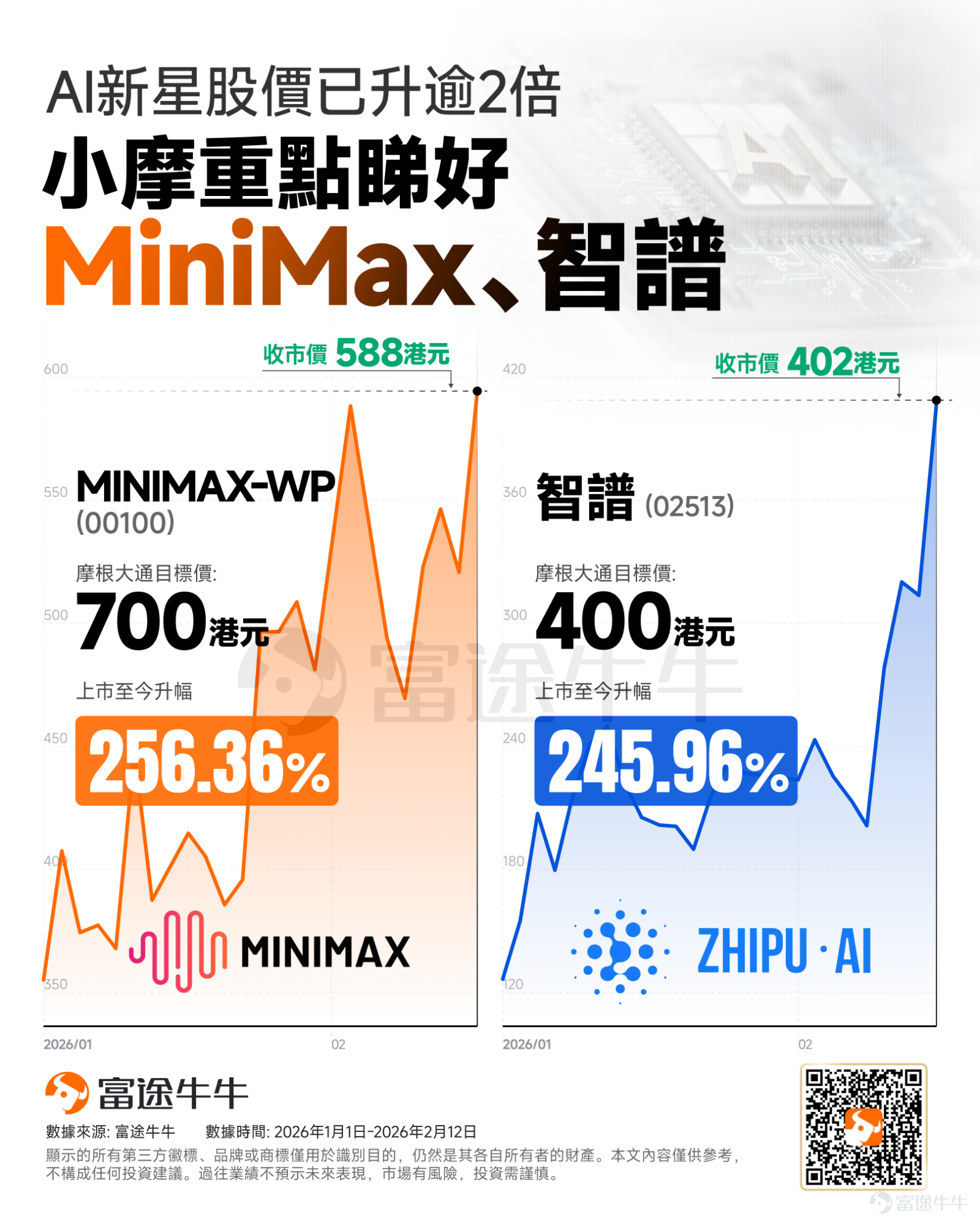
These two companies have performed strongly since their IPOs. As of today, their cumulative stock price increase has exceeded 200%. Today, both launched new models: Zhipu officially launched its new model GLM-5, focused on coding and intelligent agents, and MiniMax also announced the launch of its latest flagship coding model, MiniMax M2.5.

--
--
--
Notably, Wall Street giant JPMorgan recently released a significant research report, covering China’s leading general large language models—Zhipu and MiniMax—for the first time, and directly assigned them an 'Overweight' rating.
This is not just a simple upgrade in outlook but represents a core capital reevaluation by Wall Streetof Chinese AI model developers’ pricing power—this is the first time foreign investors have issueda systematic, strategic 'long' directive.。
Why is this shift so crucial? Which companies in the Hong Kong stock market are worth watching under this new logic? The following will reveal them one by one.
What does JPMorgan think of these two companies?
JPMorgan has directly listed these two companies as 'the top picks for capturing the next wave of global AI value creation'.
Zhipu AI: Target price of 400 HKD
MiniMax: Target price of 700 HKD
This JPMorgan report points out that China’s artificial intelligence industry is transitioning from the 'hundred-model battle' phase to a stage where commercialization capabilities, model innovation strength, and global expansion become the key factors for success.
The bank believes that MiniMax and Zhipu AI have emerged as the two most distinctive independent large language model developers, with their overseas expansion accelerating: over 70% of MiniMax's revenue currently comes from overseas markets, and both companies are rapidly advancing the scaling of their API businesses through the global developer ecosystem. This overseas focus not only diversifies revenue streams and drives gross margin improvement but also highlights their global competitiveness.
More crucially,JPMorgan has provided a timeline for profitability: the two companies are expected to achieve overall profitability by 2029.Details are as follows:
1. Zhipu AI — The API business driven by technological innovation has reached an inflection point, while private deployment services establish a solid long-term foundation.
Zhipu AI has established itself as a deep enterprise solutions provider, focusing on delivering highly customized private deployment and API services to B-end clients. JPMorgan believes the company has reached a critical inflection point: recent releases in the GLM-4.5/4.6/4.7 series indicate a strategic shift toward intelligent systems and production-grade application scenarios (especially in coding and multi-step task execution). This evolution is supported by its business structure: a solid customer base for private deployments in regulated industries in China, combined with opportunities for scaling cloud API services; all while operating under a framework of manageable but non-negligible export control risks.
Zhipu AI’s API business has reached a crucial inflection point.The release of GLM-4.5/4.6/4.7, along with the company’s strategic tilt toward intelligent agent systems, tool-augmented reasoning, and developer-focused infrastructure, demonstrates that its technology roadmap is aligning with global cutting-edge capabilities, particularly in production-grade programming, long-context reasoning, and stability in multi-step execution. As GLM-4.7 gains recognition within the global developer community—especially in high willingness-to-pay and high-intensity usage programming workflows—JPMorgan expects its adoption rate to accelerate significantly.
Private deployment represents a long-term stable demand in the domestic market.Zhipu AI has built a substantial customer base for private deployments in regulated industries domestically, which JPMorgan views as forming a long-term stable demand pool. With continuous iterations of foundational models, this existing private deployment base could evolve into an update-driven, repeat-purchase economic model.
In this context, JPMorgan views Zhipu AI as a technologically driven platform with significant growth potential, facing manageable yet non-negligible regulatory risks.The bank forecasts the company’s revenue CAGR at 127% from 2025 to 2030 and expects it to become profitable by 2029.
2. MiniMax – A full-spectrum AI enterprise with a scalable growth engine
In the field of AI foundational models, MiniMax is a rare company that combines technical strength, multimodal commercialization potential, and global scalability. The company has built solid technological foundations, with its models demonstrating excellent performance in core benchmark tests. At the same time, its full product portfolio lays the groundwork for dual B2B/B2C monetization. Its global expansion (with overseas revenue accounting for 73.1% in the first three quarters of 2025) further enhances its scale-up potential and profitability. JPMorgan's investment thesis is based on the following two points:
Full-spectrum models support dual B2B/B2C commercialization.The company’s simultaneous deployment of text, video, and audio multimodal models enables it to meet increasingly multimodal scenario demands across enterprises and consumer segments, reducing reliance on a single monetization path. MiniMax achieved balanced revenue growth: In the first three quarters of 2025, revenue from the open platform, generative media, and AI companion services each accounted for about one-third. This structure reduces risk and accelerates scale expansion.
Global orientation drives scale and profitability:MiniMax’s early adoption of a global orientation (reflected in customer targeting and infrastructure strategy) gives it rare economic flexibility compared to peers at similar stages of development. Amid high inference costs and fierce domestic competition, entering international markets, diversifying the customer base, and leveraging differentiated pricing environments provide structural advantages. While execution risks remain, JPMorgan believes this global strategy will strengthen MiniMax’s long-term ability to convert technological advancements into substantial economic benefits.
JPMorgan forecasts the company’s revenue CAGR at 138% from 2025 to 2030, with profitability expected to begin in 2029.
Why is this shift in foreign investment so important?
Wall Street never buys into "stories" but prices based on "numbers" and "certainty." Essentially, this represents Wall Street’sThe reconstruction of the valuation system。
This 'buy recommendation' is underpinned by three key pricing anchors:
1. The shift in valuation anchor: From 'user scale' to 'global gold content'
This is the most disruptive logic in this rating. In the past, foreign investors looked at China's internet through the lens of 'population dividend'; now when they look at China's AI, they focus on 'technology spillover capability'.
Data speaks:MiniMax Gundam73.1%The proportion of overseas revenue was a major surprise. This means that Chinese model manufacturers are no longer limited to domestic competition but have the ability to earn dollars in the global market.
Logic reshaping:This structure of 'technology developed in China, monetized globally' directly shatters the valuation ceiling, allowing them to benchmark against global giants and enjoyglobal liquidity premium。
2. Endgame Thinking: Locking in the 'One Domestic, One Overseas' Dual Oligopoly Structure
As the 'Hundred-Model War' nears its end, JPMorgan's report essentially serves as an early verdict from the capital side on the 'Survivors Become Kings' list. These two companies represent the two ultimate forms of survival for large models in China:
智譜:Focused on 'High Compliance + Localization,' deeply cultivating government-enterprise and regulated industries. It is the 'defensive shield' of China’s digital transformation, building a moat with high switching costs.
MiniMax: More oriented toward C-end products and multi-modalities, earning high premiums overseas. It is the 'offensive sword' of China’s AI going global, possessing explosive growth potential.
3. No Pie-in-the-Sky Promises: Providing a Clear 'Profit Timeline'
Tech stocks fear 'endless losses.' JPMorgan explicitly forecastsoverall profitability by 2029and projects a compound annual revenue growth rate over the next five years to be as high as127% and 138%. The emergence of this timeline indicates that the investment logic has shifted from 'dream valuation multiples' to quantifiable metrics.Discounted Cash Flow (DCF) ModelThis is not blind optimism, but a rational pricing based on the inflection point of commercialization.
What other companies in the Hong Kong stock market are worth paying attention to?
PreviouslyThe Hang Seng Index challenges 28,000 points: Who is supporting new highs? These four key AI-related themes in Hong Kong stocks are worth keeping!As previously mentioned, as AI companies go public in droves, it could push Hong Kong stocks towards evolving into a 'hard tech financing hub.' Currently, the number of listed companies strongly correlated with artificial intelligence in Hong Kong exceeds 40, which can be divided into four 'AI battlefronts'—includingAI computing power industry chain、AI software end, including large AI models、AI hardware end, including smartphones, automobiles, and robots、Internet giants. Based on this, NiuNiu has compiled relevant concept stocks for investors' reference:

--
--
--
Specifically:
The first "front" is the AI computing power industry chain.At the beginning of the year, $BIREN TECH (06082.HK)$、 $ILUVATAR COREX (09903.HK)$successively listed on the Hong Kong Stock Exchange, filling the gap in core computing power in the Hong Kong market. Among them, Biren Technology focuses on high-end general-purpose GPUs and large-scale data center computing platforms, becoming a significant representative of domestic general-purpose GPUs in the 'cloud large computing power' direction. TianShu ZhiXin is the first company in China to achieve mass production of general-purpose GPUs.
Additionally,The leader in A-share storage chips, $GIGADEVICE (03986.HK)$going public in Hong Kong also caught up with this wave of enthusiasm, this company is a semiconductor enterprise focusing on chip design business, with products covering Flash, niche DRAM, MCU, analog chips, and sensor chips, applied in multiple terminal fields such as consumer electronics and industrial control.
In addition to these enterprises, there are also companies like $SMIC (00981.HK)$ the leading integrated circuit wafer foundry in the Hong Kong stock market. Additionally, Huahong Semiconductor and companies in the optical communication industry $CIG (06166.HK)$ 、 $YOFC (06869.HK)$ 、 $TIME INTERCON (01729.HK)$ 、 $FIT HON TENG (06088.HK)$ have all benefited from this wave of AI.
Among them, Changfei Fiber Optic Cables has surged more than 60% year-to-date. This company is a global leader in fiber optic preforms, fibers, cables, and integrated solutions providers. With rapid growth in data communication business and breakthroughs in hollow-core fiber technology, Changfei Fiber Optic Cables’ profitability is gradually recovering. Hollow-core fiber uses air as the transmission medium, providing two main advantages: lower latency and reduced loss, making it a key product for future AI data center interconnection. The company’s optical interconnect component businesses, such as MPO, AOC, and high-speed copper cables, developed through its subsidiary Changxin Bochuang, have benefited from the construction of North American AI data centers, and overseas business expansion is proceeding smoothly.
In addition, the Hong Kong stock market also includes $HORIZONROBOT-W (09660.HK)$ 、 $BLACK SESAME (02533.HK)$ 、 $OMNIVISION (00501.HK)$ and similar automotive and specialized chip companies, as well as $SICC (02631.HK)$ 、 $INNOSCIENCE (02577.HK)$ and other semiconductor packaging, testing, and materials companies. Additionally, there are firms focused on computing power infrastructure and communications such as $ZTE (00763.HK)$ 、 $GDS-SW (09698.HK)$ , among others.
The newly listed 'China’s largest manufacturer of PCB-specific production equipment' $HANS CNC (03200.HK)$ , and the global leader in memory interface chips$MONTAGE TECH (06809.HK)$ are also noteworthy.
Dahua CNC is a leading Chinese provider of solutions for PCB dedicated production equipment, primarily engaged in the R&D, manufacturing, and sales of such equipment.
Montage Technology is a globally leading fabless IC design company, focusing on high-performance interconnect chip solutions for cloud computing and artificial intelligence fields.
In addition, as the first AI de-hallucination stock $HAIZHI TECH GP (02706.HK)$as well as the global leader in heat shrink materials and high-speed copper cable supplier $WOER (09981.HK)$Equally worth looking forward to, these two companies are about to go public.
From the底层的晶圆制造 (bottom-level wafer manufacturing) to顶层的芯片设计 (top-level chip design), Hong Kong-listed stocks are accelerating the集结 (gathering) of core AI assets, and a globally competitive closed-loop算力产业链 (computing power industrial chain) has already taken shape.
The second 'frontline' includes the AI software end, which encompasses large AI models.
At the beginning of the year, major model companies $Z.AI (02513.HK)$ 、 $MINIMAX-W (00100.HK)$ successively listed on the Hong Kong Stock Exchange, with their strong upward momentum drawing significant investor attention. Zhipu and MiniMax represent two typical paradigms of AI commercialization in China:
– Zhipu (ToB): Business revolves around institutional clients, adopting the Model-as-a-Service (MaaS) model, with two specific business models: one is helping clients locally customize exclusive AI models, and the other is assisting clients in building AI solutions in the cloud.
– MiniMax (ToC): Core focus is on C-end applications and traffic monetization.Its valuation logic emphasizes Monthly Active Users (MAU). Financial reports show that its native AI product has reached 1.77 million paying users, with approximately 2,500 enterprise institutional clients.
In addition to the much-anticipated new AI players, Hong Kong's software sector also has $MEITU (01357.HK)$、 $MOBVISTA (01860.HK)$ long-standing 'industry veterans' such as {terminology} anchoring the space.Unlike the money-burning model of general large models, these companies have leveraged their long-term accumulation in specific fields to precisely position themselves in vertical AI tracks (such as image design, advertising and marketing), taking the lead in running through the commercial closed loop from 'technology' to 'profit', and are now facing new opportunities for value reassessment.
The third 'frontline' includes AI hardware such as mobile phones, automobiles, and robots, which are also the main carriers for the large-scale implementation of AI technology.
In the Hong Kong stock market, there are consumer electronics companies including $XIAOMI-W (01810.HK)$ 、 $LENOVO GROUP (00992.HK)$ , and it has been reported that Transsion Holdings has submitted its prospectus to the Hong Kong Stock Exchange, planning to list on the Hong Kong Main Board.
In the automotive sector, there are companies such as $BYD COMPANY (01211.HK)$ 、 $XPENG-W (09868.HK)$ and other vehicle manufacturing enterprises. In the robotics field, companies like $UBTECH ROBOTICS (09880.HK)$ 、 $DOBOT (02432.HK)$ are notable.
The fourth 'frontline' is represented by major internet companies.
With the advent of the AI era, $BABA-W (09988.HK)$ 、 $TENCENT (00700.HK)$ 、 $KUAISHOU-W (01024.HK)$ major internet companies have accelerated their AI strategies, achieving breakthroughs in computing power, chips, large models, and applications. For example, Alibaba has clearly outlined its 'Cloud+AI+Chip' strategy; Pingtouge's Zhenwu PPU shipments have reached hundreds of thousands, surpassing Cambricon, making it a top-tier domestic GPU manufacturer. Kuaishou's video generation large model, Kelin AI, surpassed 12 million monthly active users (MAU) in January this year. By 2025, Kelin’s annual revenue is projected to reach $140 million, far exceeding Kuaishou’s initial target of $60 million set at the beginning of 2025.
The fourth 'frontline' is represented by major internet companies.
With the advent of the AI era, $Alibaba-W (09988.HK)$ 、 $Tencent (00700.HK)$ 、 $Kuaishou-W (01024.HK)$ major internet companies have accelerated their AI strategies, achieving breakthroughs in computing power, chips, large models, and applications. For example, Alibaba has clearly outlined its 'Cloud+AI+Chip' strategy; Pingtouge's Zhenwu PPU shipments have reached hundreds of thousands, surpassing Cambricon, making it a top-tier domestic GPU manufacturer. Kuaishou's video generation large model, Kelin AI, surpassed 12 million monthly active users (MAU) in January this year. By 2025, Kelin’s annual revenue is projected to reach $140 million, far exceeding Kuaishou’s initial target of $60 million set at the beginning of 2025.
In addition, beyond the four major AI battlefronts mentioned above,There is another key theme in the Hong Kong stock market worth noting: electric power equipment.
PreviouslyNorth America's Power Shortage Creates New Opportunities! Which Hong Kong-listed Companies Could Benefit?A previous article mentioned that against the backdrop of 'Time-to-Power' becoming the most severe bottleneck in AI infrastructure development,Chinese power solution providers with rapid delivery capabilities and large-scale production advantages are facing a historic opportunity for value reassessment.Niuniu has also compiled relevant investment targets for investors' reference:

--
--
--
In the gas turbine and thermal power equipment sector, investors may focus on $DONGFANG ELEC (01072.HK)$、 $HARBIN ELECTRIC (01133.HK)$、 $SH ELECTRIC (02727.HK)$、 $WEICHAI POWER (02338.HK)$。
Among them, Dongfang Electric, Harbin Electric, and Shanghai Electric are China's three major electrical companies. In the context of a global shortage in gas turbine and thermal power equipment capacity, they have the ability to take on overflow orders. Notably, Shanghai Electric and Dongfang Electric have made breakthroughs in large gas turbine technology. If data center demand from North America or other regions overflows, these companies will be core suppliers.
Additionally, data centers not only require primary power but also a significant amount of backup power (diesel/gas generator sets) to prevent outages (such as transformer explosions leading to blackouts mentioned in the text). Weichai, with its strong export capabilities in engines and power generation equipment, stands to benefit as a potential provider of backup power for data centers.
In the nuclear power sector, attention can be directed to $CGN POWER (01816.HK)$、 $CNNC INT'L (02302.HK)$。
Although these companies’ main assets are in China, the global nuclear renaissance trend is expected to boost the valuation of the entire sector. CGN Power, as an operator, has stable cash flow, while CNNC International is involved in uranium resources. With the global recognition of nuclear power as a 'clean baseload energy,' its long-term strategic value is being reassessed.
Notably, earlier reports indicated that Alibaba and China National Nuclear Corporation, among others, established a nuclear energy company in Xiangshan. This reflects the domestic emphasis and strategic layout on nuclear energy development.
For overseas expansion of power grids and distribution systems, attention can be directed to $WASION HOLDINGS (03393.HK)$。
Wasion is a leading Chinese exporter of smart metering and distribution equipment, with a strong presence abroad. As modernization of power grids drives surging demand for smart meters and distribution systems, Wasion represents one of the strongest 'going global' investment themes in Hong Kong stocks. For instance, approximately 15% of Wasion Holdings' 2025 revenue is expected to come from North America, and 7% from other parts of Asia.
In terms of energy storage systems, attention can be directed to $BYD ELECTRONIC (00285.HK)$、 $CATL (03750.HK)$。
BYD Electronics has seen rapid growth in its residential and commercial energy storage OEM business. As a leading global manufacturer, it is well-positioned to quickly meet the explosive demand for energy storage hardware in North America and Europe.
CATL, as the global leader in batteries, has its energy storage cells at the core of all data center energy storage projects, making it the absolute frontrunner in this trend.
Clean energy is worth watching. $GOLDWIND (02208.HK)$、 $FLAT GLASS (06865.HK)$、 $XINYI SOLAR (00968.HK)$。
Goldwind Technologies is the global leader in wind turbines. Although entering the U.S. market directly poses challenges, its expansion in other global data center hotspot regions (such as Southeast Asia and the Middle East) will benefit from the construction of global computing power.
Meanwhile, Flat Glass and Xinyi Solar are key upstream materials for photovoltaic components. As long as the world accelerates the deployment of solar panels to meet AI energy consumption, these two leading companies will directly benefit from the increase in installations.
Electricity demand and electric tools should be watched. $TECHTRONIC IND (00669.HK)$and$CHERVON (02285.HK)$。
These two companies' revenues heavily rely on the North American market. The U.S. grid renovation and data center construction boom imply a surge in demand for electricians’ and construction workers’ tools. They reflect the direct mapping of the U.S. stock infrastructure cycle, and as leading manufacturing firms listed in Hong Kong, they are highly resilient.
Summary
As more hard tech companies are listed on the Hong Kong stock market, it is gradually becoming an important piece of the global AI investment puzzle. For investors, focusing on the three core elements of 'computing power + applications + energy' and selecting high-quality stocks with technological moats and clear profit paths will be the key to capturing this long-term dividend.
Risk Disclaimer: The above content only represents the author's view. It does not represent any position or investment advice of Futu. Futu makes no representation or warranty.Read more


Comments (19)
to post a comment
308
452