
BTC surpasses $75,000! Has the upward channel been fully opened?

Bitcoin price falls below the cost basis of major institutional ETFs! Is it time to bottom-fish on Wall Street?
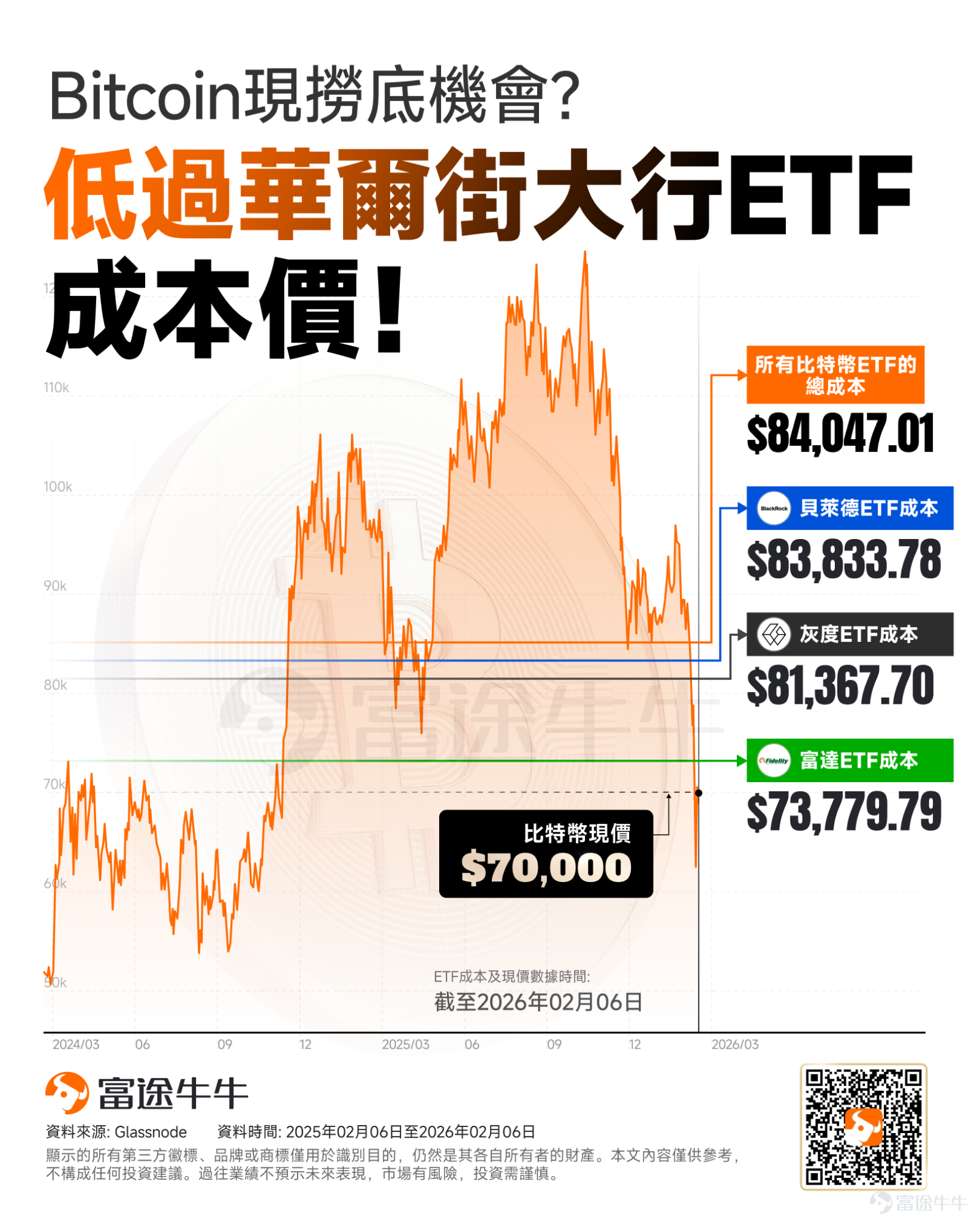
A rare price inversion phenomenon has occurred between the cryptocurrency and stock markets. Data released by Glassnode shows that as of February 6, 2026, the average cost basis for Bitcoin held by Wall Street giant ETFs is currently at a high of $84,047. The holding costs for top asset management institutions such as BlackRock and Grayscale are above $81,000, while the market quote for Bitcoin... $Bitcoin (BTC.CC)$ At that time, the market price was hovering around $70,000.
There is nearly a 20% difference between the two figures, which is a clear signal for investors on the sidelines or those seeking to increase their holdings. The current price at which ordinary investors can open positions in Bitcoin is cheaper than that of top Wall Street institutions with elite research teams.

Cryptocurrency ETF Cost Basis = Institutional Cost Basis?
To understand this price advantage, it's necessary to comprehend why institutional funds need to enter through the ETF channel.
Compliance is a red line that traditional financial giants cannot cross. Large pension funds, insurance funds, and family offices are restricted by strict regulations from the U.S. Securities and Exchange Commission (SEC) and the Financial Industry Regulatory Authority (FINRA),Institutional funds are unable to directly open accounts on cryptocurrency exchanges or manage private keys themselvesBecause the management of private keys involves complex custody security standards and audit processes that go beyond the operational scope of traditional financial institutions.
However, ETFs address this core issue. ETFs encapsulate Bitcoin, a non-standard digital asset, into a standardized securities product. Bitcoin ETFs can be traded through regular brokerage accounts on Nasdaq or the New York Stock Exchange, incorporated into financial terminal analysis systems, and included in auditor-approved financial statements.
The $84,000 cost paid by institutions includes compliance premiums, custodial fees, and market impact costs due to the large fund size. Institutions value legal channels for asset allocation, so the cost of holding crypto ETFs can be approximately viewed as the cost of holding crypto assets for traditional financial institutions outside the crypto circle.
At the same time, the logic behind institutions' holdings is based on asset rebalancing over the next five to ten years, with Bitcoin establishing its position as a major asset class through ETFs.Long-term allocation needs mean that institutions are unlikely to significantly alter their holdings due to short-term paper losses.
Current advantages in position-building costs
The capital scale of institutions like Blackrock and Fidelity dictates that they are better off being friends with time, giving the current $70,000 market price a 'cushion' attribute. Individual investors entering at this point are effectively ahead of major funds right from the starting line. This cost advantage could directly translate into higher returns during subsequent market rebounds.
Looking at an extended timeframe, Bitcoin's return on investment still holds a relative advantage.From 2015 to 2025, Bitcoin's overall returns have outperformed gold, the S&P 500 index, and US Treasury bonds.Despite experiencing multiple significant fluctuations, Bitcoin's alpha returns as an emerging asset class (excess returns compared to other benchmark indices) remain notable.

Meanwhile, the Crypto Fear & Greed Index fell to a historic low of 7 last weekend, indicating that the market is in an 'extreme fear' state.Michaël van de Poppe, founder of MN Capital, pointed out that this indicator, along with the Relative Strength Index, shows that the market is deeply oversold—similar conditions occurred during the 2018 bear market and the March 2020 pandemic crash, which may create conditions for a rebound.
Apart from institutional ETFs, DATs Crypto Treasury Company stated that it will not sell its crypto assets.$Strategy (MSTR.US)$Bitcoin Strategy Manager Chaitanya Jain posted on the X platform, stating: 'We will never stop buying Bitcoin.' He previously mentioned that Strategy is not a trader, does not engage in speculation, does not attempt to time the market entry, avoids technical analysis, and refrains from drawing lines on charts, adopting a buy-and-hold strategy for the long term.
$Ethereum (ETH.CC)$Cai Ku Company$Bitmine Immersion Technologies (BMNR.US)$Chairman Tom Lee stated on CNBC's live broadcast on February 8th that the recovery of Bitcoin and the entire cryptocurrency market has begun. He noted that the crypto market has 'endured six declines exceeding 50% but will recover just as quickly as it fell.'
Looking back, under the current market conditions, the Dollar-Cost Averaging (DCA) strategy leverages the advantage of the current price levels.Investors need not obsess over the lowest point; by setting fixed intervals for purchases, they can accumulate more shares when prices are below $70,000. Consistent DCA allows investors to gather sufficient low-cost positions during the market bottoming phase. Once prices return above institutional cost levels, the accumulated positions from DCA will yield considerable profits.

Monitor the performance of crypto-related stocks, the CLARITY Act, and this week’s macroeconomic data.
Having seized the opportunity to build positions at a low cost, investors should also focus on several external indicators that can verify market turning points.
The first indicator is the performance of cryptocurrency-related stocks.For example$Coinbase (COIN.US)$ Stock exchanges and major mining companies. In early 2026, the stock performance of some crypto companies began to diverge.
The second key indicator is the legislative progress of the CLARITY Act.This bill is currently the core issue in the crypto industry's compliance efforts.
The CLARITY Act aims to eliminate long-standing regulatory uncertainty that has plagued the industry by clarifying the legal definition and regulatory framework for digital assets. Once substantial progress or final passage of the bill is achieved, it will open the floodgates for traditional capital to enter the crypto market. Regulatory clarity will reduce compliance costs for institutions, attracting more funds that were previously on the sidelines due to policy risks.
On the macro front, this week will see the release of the January US nonfarm payroll report and CPI inflation data.Uncertainty surrounding the leadership outlook of the Federal Reserve has heightened market caution, with markets currently reassessing the timing of potential rate cuts.If signals of easing dollar liquidity are released, the crypto market is expected to continue its recovery.
The current price of Bitcoin has fallen below the average cost of some institutions, reflecting a divergence between market sentiment and long-term value. Rational investors can adhere to a steady, long-term allocation strategy to smooth out cyclical volatility and navigate through uncertainties.
 Futubull's Greed and Fear Index officially launches! Precisely capture turning points in market sentiment, providing a 'compass' for buying low and selling high. Click to unlock exclusive investment insights~ (Note: Update Futubull to the latest version.) Open Futubull >> Market >> Cryptocurrency >> Explore More,and you'll find the Greed and Fear Index!
Risk Disclaimer: The above content only represents the author's view. It does not represent any position or investment advice of Futu. Futu makes no representation or warranty.Read more


Comments (12)
to post a comment
71
93