
Big short investors turn bullish on Microsoft—could software stocks be staging a comeback?

Big swings in the US stock market present trading opportunities for end-of-term options in a high volatility environment
The selling spree has intensified further, but the 'calls for market rescue' have vanished
The sell-off on Wall Street has intensified and spread comprehensively. Previously, US stocks mainly showed a rotation from tech stocks to value stocks, but today it evolved into a broad-based decline across almost all sectors. Weak employment market data has exacerbated the market's pessimism, cryptocurrencies have plummeted, investors have flocked to US Treasuries as a safe haven, and the dollar has strengthened.
Last night, $Invesco QQQ Trust (QQQ.US)$ Down 1.4%, with a 3.99% drop since the start of the week — this decline is second only to the week of equivalent tariffs last year. The top seven US stocks were hit hard again, $Amazon (AMZN.US)$ and $Microsoft (MSFT.US)$ Both fell more than -4% last night, with Microsoft having dropped nearly 20% year-to-date. $iShares Silver Trust (SLV.US)$ Plummeted over 15% again, experiencing an 11th sharp drop in a month.
In yesterday’s article, OptionSir provided a detailed analysis to fellow investors about the core reasons behind this major selloff and strategies moving forward. Fellow investors who are interested can click to read ‘OptionSir on Macro | What to Do Amid Tech Stock Plunge? To Every Investor Holding On Through Account Shrinkage》。
Surprisingly, in the face of such a downturn, the 'calls for market rescue' seem to have disappeared.
Typically, in the past, when the market pulled back, there would often be moves to stabilize it. But this time, no Fed officials have stepped forward to calm the markets, and even Trump is no longer dominating the headlines. No one is rushing to make statements, and going forward, every rebound will need to be supported by real buying power, not just words.
At this stage, bottom-fishing is an emotional act, while surviving is a strategic move.Maintaining long-term confidence in quality equities while remaining respectful of the market are not contradictory. For funds that can be allocated over the long term, buying on dips in areas you believe in remains effective.
For investors, short-term panic may not be over yet, and software companies still face a crisis of market trust and self-validation. However, if we look at the long term, this could also be an opportunity to identify high-quality companies and position at more reasonable prices.
Volatility is both a risk and an opportunity. Is this the moment for end-of-day options?
In such an environment, many fellow investors might think, 'The volatility is too high; it's really difficult to trade.' However, some believe that high volatility represents both danger and opportunity. Choosing the right 'tools and pathways' to participate in the market and leveraging market fluctuations can be a strategy.
Many might ask: 'With such significant intraday volatility, if I had bought end-of-day put options yesterday, would I have already doubled my money?'
Indeed, volatility is the trader's oxygen.For seasoned traders, yesterday's one-sided plunge was a feast for 'end-of-day puts'.However, before wielding this sharp 'scalpel,' one must first learn how to hold the knife to avoid cutting an artery.
Today, riding on the lingering effects of yesterday's sharp drop as the backdrop, $Invesco QQQ Trust (QQQ.US)$ we will take this as an example to delve deeply into the practical logic behind end-of-day options.
End-of-day options (0DTE, Zero to Date)Generally refers to options contracts expiring on the same day, a product with unique characteristics where both risks and returns are highly concentrated, also known as 'doomsday wheels' in the market. If there is significant volatility in the price of the underlying asset, these contracts may produce gains of several dozen or even hundreds of times within the day (of course, they could also lead to losses in a short period).
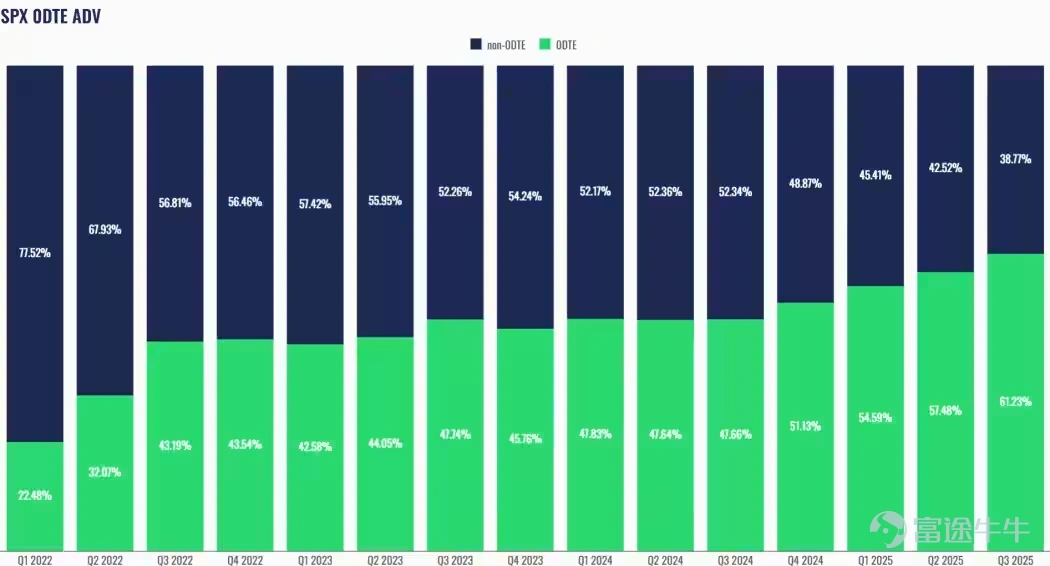
Doomsday options have seen astonishing growth in recent years and are increasingly popular among investors. According to data from CME Group (CBOE), $S&P 500 Index (.SPX.US)$ related tothe trading volume of doomsday options increased from 22% at the beginning of 2022 to 61% in the third quarter of this year, nearly tripling in less than three years, with the most typical example being $SPDR S&P 500 ETF (SPY.US)$ options.
![The selling spree has intensified further, but the 'calls for market rescue' have vanished The sell-off on Wall Street has intensified and spread comprehensively. Previously, US stocks mainly showed a rotation from tech stocks to value stocks, but today it evolved into a broad-based decline across almost all sectors. Weak employment market data has exacerbated the market's pessimism, cryptocurrencies have plummeted, investors have flocked to US Treasuries as a safe haven, and the dollar has strengthened. Last night, $Invesco QQQ Trust (QQQ.US)$ Down 1.4%, with a 3.99% drop since the start of the week — this decline is second only to the week of equivalent tariffs last year. The top seven US stocks were hit hard again, $Amazon (AMZN.US)$ and $Microsoft (MSFT.US)$ Both fell more than -4% last night, with Microsoft having dropped nearly 20% year-to-date. $iShares Silver Trust (SLV.US)$ Plummeted over 15% again, experiencing an 11th sharp drop in a month. In yesterday’s article, OptionSir provided a detailed analysis to fellow investors about the core reasons behind this major selloff and strategies moving forward. Fellow investors who are interested can click to read ‘[Share Link: OptionSir on Macro | What to Do Amid Tech Stock Plunge? To Every Investor Holding On Through Account Shrinkage]》。 Surprisingly, in the face of such a downturn, the 'calls for market rescue' seem to have disappeared. Typically, in the past, when the market pulled back, there would often be moves to stabilize the market. But this time, no Fed officials have stepped in to calm the markets, not even Trump...](https://nnqimage.futunn.com/sns_client_feed/999908/20260206/web-1770368001348-EDQafWsdr7.webp/big?area=2&is_public=true&imageMogr2/ignore-error/1/format/webp)
Source: CME Group
It's not like buying lottery tickets but rather trading 'Gamma explosions'
Many beginners understand doomsday options through a lottery mentality, thinking that buying a few Calls or Puts will lead to doubling their investment. However, from a professional perspective, what we trade with 0DTE options isGamma"。
Simply put, as options approach expiration, the Gamma value becomes extremely high. This means that even a small change in the price of the underlying asset can cause a dramatic non-linear jump in the option price (Delta).The leverage feature of options reaches its peak in doomsday wheels and is greatly amplified as expiration approaches.The closer it gets to the expiration date, the higher the Gamma value of at-the-money or slightly out-of-the-money options will become, meaning that even minor fluctuations in the underlying asset price could lead to substantial changes in the option price. This provides traders with the possibility of earning enormous returns with minimal capital, catering to the market's pursuit of short-term windfall profits.
Let's take a real-world example:Yesterday, QQQ opened at600.21 US dollars, and the intraday price once surged to604.81 US dollars, the day's highest point, but failed to hold steady. Subsequently, selling pressure pushed prices down. As prices fell from the high, selling pressure intensified, accompanied by significantly higher trading volume, forming a technical pattern known as 'high-volume decline', with prices dropping to as low as594.76 US dollars。
Suppose you entered a Put option with a strike price of 597 US dollars expiring on February 6 when the price broke below 599 US dollars after falling from its high. At that moment, this Put might still be out-of-the-money (OTM), priced around 4.59 US dollars.
But as QQQ quickly dropped to $597 within half an hour, this option instantly became at-the-money (ATM), and even fell to $594 with the flood of panic selling, turning it in-the-money (ITM). During this process, the option price surged rapidly from $4.59 to $7.03.
This is the power of a Gamma explosion—If you correctly predict the direction and momentum is strong enough, your returns can be exponential.
![The selling spree has intensified further, but the 'calls for market rescue' have vanished The sell-off on Wall Street has intensified and spread comprehensively. Previously, US stocks mainly showed a rotation from tech stocks to value stocks, but today it evolved into a broad-based decline across almost all sectors. Weak employment market data has exacerbated the market's pessimism, cryptocurrencies have plummeted, investors have flocked to US Treasuries as a safe haven, and the dollar has strengthened. Last night, $Invesco QQQ Trust (QQQ.US)$ Down 1.4%, with a 3.99% drop since the start of the week — this decline is second only to the week of equivalent tariffs last year. The top seven US stocks were hit hard again, $Amazon (AMZN.US)$ and $Microsoft (MSFT.US)$ Both fell more than -4% last night, with Microsoft having dropped nearly 20% year-to-date. $iShares Silver Trust (SLV.US)$ Plummeted over 15% again, experiencing an 11th sharp drop in a month. In yesterday’s article, OptionSir provided a detailed analysis to fellow investors about the core reasons behind this major selloff and strategies moving forward. Fellow investors who are interested can click to read ‘[Share Link: OptionSir on Macro | What to Do Amid Tech Stock Plunge? To Every Investor Holding On Through Account Shrinkage]》。 Surprisingly, in the face of such a downturn, the 'calls for market rescue' seem to have disappeared. Typically, in the past, when the market pulled back, there would often be moves to stabilize the market. But this time, no Fed officials have stepped in to calm the markets, not even Trump...](https://nnqimage.futunn.com/sns_client_feed/999908/20260206/web-1770373246692-y9UWQAXohP.png/big?area=2&is_public=true&imageMogr2/ignore-error/1/format/webp)
However, the flip side of the coin is Theta (time decay). End-of-life options are like an ice cube placed under the scorching sun—If the underlying asset does not make a sufficiently large move in a favorable direction before expiration, the time value of the option will quickly erode. For investors who directly buy calls/puts to bet on direction, all contracts that fail to become in-the-money by expiration will turn worthless, resulting in the loss of the entire premium.
Go with the flow: At this moment, forget about fundamentals
For intraday trading of end-of-life options, temporarily forget about P/E ratios, earnings reports, and the Fed’s long-term policies. Focus on key levels and immediate momentum.
When there is very little time value left, accurately predicting the movement of the underlying asset becomes critical, as it directly determines whether the option can transition from out-of-the-money to in-the-money. Successful end-of-life option trading often requires following the main trend of the day; going against the trend when time is limited carries extremely high risks.
Taking yesterday's market action as an example, before the market opened, one could draw lines on the chart. Was QQQ testing a key level in pre-market? Where was the low point from the previous day? Don’t rush into buying or selling just as the market starts moving, as it's easy to get caught in a 'false breakout' and lose on both sides.
The key points we need to focus on include:
1. High and low points within the first half-hour of trading (Opening Range Breakout):
The period from 9:30 to 10:00 is the most intense timeframe for bulls and bears competition.Statistical data shows that volatility typically amplifies during the morning trading session, peaking around 11:30 AM, then starts to slowly decline, with volatility picking up again in the final trading session.
Since trading activity concentrates on the same day, referring to the daily or weekly charts of the underlying asset holds little significance for investors. Even the intraday chart may not reflect short-term fluctuations.On individual stock quote pages, fellow investors can easily switch the time intervals of candlestick charts to obtain minute-level and hourly-level K-line charts.
![The selling spree has intensified further, but the 'calls for market rescue' have vanished The sell-off on Wall Street has intensified and spread comprehensively. Previously, US stocks mainly showed a rotation from tech stocks to value stocks, but today it evolved into a broad-based decline across almost all sectors. Weak employment market data has exacerbated the market's pessimism, cryptocurrencies have plummeted, investors have flocked to US Treasuries as a safe haven, and the dollar has strengthened. Last night, $Invesco QQQ Trust (QQQ.US)$ Down 1.4%, with a 3.99% drop since the start of the week — this decline is second only to the week of equivalent tariffs last year. The top seven US stocks were hit hard again, $Amazon (AMZN.US)$ and $Microsoft (MSFT.US)$ Both fell more than -4% last night, with Microsoft having dropped nearly 20% year-to-date. $iShares Silver Trust (SLV.US)$ Plummeted over 15% again, experiencing an 11th sharp drop in a month. In yesterday’s article, OptionSir provided a detailed analysis to fellow investors about the core reasons behind this major selloff and strategies moving forward. Fellow investors who are interested can click to read ‘[Share Link: OptionSir on Macro | What to Do Amid Tech Stock Plunge? To Every Investor Holding On Through Account Shrinkage]》。 Surprisingly, in the face of such a downturn, the 'calls for market rescue' seem to have disappeared. Typically, in the past, when the market pulled back, there would often be moves to stabilize the market. But this time, no Fed officials have stepped in to calm the markets, not even Trump...](https://nnqimage.futunn.com/sns_client_feed/999908/20260206/web-1770372260524-rlaGBMu3R8.jpeg/big?area=2&is_public=true&imageMogr2/ignore-error/1/format/webp)
2. Trend of VIX (Volatility Index):
Trading QQQ requires keeping an eye on $CBOE Volatility S&P 500 Index (.VIX.US)$ . If the VIX continues to rise during the day, it indicates that market risk aversion sentiment is increasing, which serves as the best protection for your Put positions.
![The selling spree has intensified further, but the 'calls for market rescue' have vanished The sell-off on Wall Street has intensified and spread comprehensively. Previously, US stocks mainly showed a rotation from tech stocks to value stocks, but today it evolved into a broad-based decline across almost all sectors. Weak employment market data has exacerbated the market's pessimism, cryptocurrencies have plummeted, investors have flocked to US Treasuries as a safe haven, and the dollar has strengthened. Last night, $Invesco QQQ Trust (QQQ.US)$ Down 1.4%, with a 3.99% drop since the start of the week — this decline is second only to the week of equivalent tariffs last year. The top seven US stocks were hit hard again, $Amazon (AMZN.US)$ and $Microsoft (MSFT.US)$ Both fell more than -4% last night, with Microsoft having dropped nearly 20% year-to-date. $iShares Silver Trust (SLV.US)$ Plummeted over 15% again, experiencing an 11th sharp drop in a month. In yesterday’s article, OptionSir provided a detailed analysis to fellow investors about the core reasons behind this major selloff and strategies moving forward. Fellow investors who are interested can click to read ‘[Share Link: OptionSir on Macro | What to Do Amid Tech Stock Plunge? To Every Investor Holding On Through Account Shrinkage]》。 Surprisingly, in the face of such a downturn, the 'calls for market rescue' seem to have disappeared. Typically, in the past, when the market pulled back, there would often be moves to stabilize the market. But this time, no Fed officials have stepped in to calm the markets, not even Trump...](https://nnqimage.futunn.com/sns_client_feed/999908/20260206/web-1770368001622-04bdpp40gE.png/big?area=2&is_public=true&imageMogr2/ignore-error/1/format/webp)
3. Volume Profile:
Pay attention to the price range where trading volume is most concentrated. Once the price quickly moves through this dense area, it often enters a 'vacuum zone,' accelerating upward or downward movements. This information can also be utilized."Breakout Pullback Strategy",When the pullback confirmation fails and the price reverses downward again, breaking below the recent local low set before the rebound, accompanied by an increase in trading volume (a surge in sell orders), it is a relatively suitable entry point.
However, two situations should be noted:
– "V-Shaped Reversal": Sometimes after the price breaks below support, it doesn't give you a chance to pull back and just plummets. In such market conditions, if you miss the opportunity, you miss it,It is better to miss an opportunity than to make a mistake.. The most忌讳 aspect of end-of-term options is losing emotional balance and forcing a chase order.
– "False Pullback": When the price pulls back, it directly surges above the resistance level and stabilizes there. This means that the previous breakout was a false breakout, and under no circumstances should you enter the market at this time.
A volatility shorting strategy with controllable risk
In the previous discussion, we covered the single-leg strategy for end-of-term option buyers. After understanding the core characteristics of end-of-term options, we can also translate these insights into specific trading strategies for sellers.
Although the one-sided downward trend yesterday was thrilling, the market is mostly range-bound on most days.Historical data shows that while extreme gains are very exciting, the success rate of outright buying Call/Put options to bet on market direction in end-of-day trading is actually quite low, especially more pronounced in volatile markets.In the unique environment of same-day expiration, short volatility strategies have become a more mainstream deployment approach due to their characteristic of 'harvesting time value.'
Among various short volatility strategies,Short Iron Condor (selling iron condor spreads) has become the preferred choice for many seeking relatively stable returns in end-of-term options due to its controllable risk and clear structure. This strategy has become a classic, market-tested representative and is increasingly popular in trading.
Short Iron Condoris essentially a protected 'rent collection,' or an upgraded version of the Short Straddle/Strangle strategy.Although both strategies can profit from a decline in volatility, it is important to note that the theoretical loss risk for both is unlimited.
![The selling spree has intensified further, but the 'calls for market rescue' have vanished The sell-off on Wall Street has intensified and spread comprehensively. Previously, US stocks mainly showed a rotation from tech stocks to value stocks, but today it evolved into a broad-based decline across almost all sectors. Weak employment market data has exacerbated the market's pessimism, cryptocurrencies have plummeted, investors have flocked to US Treasuries as a safe haven, and the dollar has strengthened. Last night, $Invesco QQQ Trust (QQQ.US)$ Down 1.4%, with a 3.99% drop since the start of the week — this decline is second only to the week of equivalent tariffs last year. The top seven US stocks were hit hard again, $Amazon (AMZN.US)$ and $Microsoft (MSFT.US)$ Both fell more than -4% last night, with Microsoft having dropped nearly 20% year-to-date. $iShares Silver Trust (SLV.US)$ Plummeted over 15% again, experiencing an 11th sharp drop in a month. In yesterday’s article, OptionSir provided a detailed analysis to fellow investors about the core reasons behind this major selloff and strategies moving forward. Fellow investors who are interested can click to read ‘[Share Link: OptionSir on Macro | What to Do Amid Tech Stock Plunge? To Every Investor Holding On Through Account Shrinkage]》。 Surprisingly, in the face of such a downturn, the 'calls for market rescue' seem to have disappeared. Typically, in the past, when the market pulled back, there would often be moves to stabilize the market. But this time, no Fed officials have stepped in to calm the markets, not even Trump...](https://nnqimage.futunn.com/sns_client_feed/999908/20260206/web-1770368001791-xweJFRlBQn.webp/big?area=2&is_public=true&imageMogr2/ignore-error/1/format/webp)
The iron condor strategy supplements the Short Strangle with two additional option legs, locking in the maximum predetermined loss.In the highly volatile end-of-day market conditions, the psychological advantage of 'knowing your maximum potential loss' is crucial.
– Lower spread (put side)Sell a put option with a lower strike price while buying another put option with an even lower strike price. The purchased option provides downside protection for the sold put, capping the maximum possible loss in the downward direction.
– Upper spread (call side)Sell a call option with a higher strike price while buying another call option with an even higher strike price. The purchased option provides upside protection for the sold call, capping the maximum possible loss in the upward direction.
– Lower breakeven point= Put strike price - Net premium
– Higher breakeven point= Call strike price + Net premium
![The selling spree has intensified further, but the 'calls for market rescue' have vanished The sell-off on Wall Street has intensified and spread comprehensively. Previously, US stocks mainly showed a rotation from tech stocks to value stocks, but today it evolved into a broad-based decline across almost all sectors. Weak employment market data has exacerbated the market's pessimism, cryptocurrencies have plummeted, investors have flocked to US Treasuries as a safe haven, and the dollar has strengthened. Last night, $Invesco QQQ Trust (QQQ.US)$ Down 1.4%, with a 3.99% drop since the start of the week — this decline is second only to the week of equivalent tariffs last year. The top seven US stocks were hit hard again, $Amazon (AMZN.US)$ and $Microsoft (MSFT.US)$ Both fell more than -4% last night, with Microsoft having dropped nearly 20% year-to-date. $iShares Silver Trust (SLV.US)$ Plummeted over 15% again, experiencing an 11th sharp drop in a month. In yesterday’s article, OptionSir provided a detailed analysis to fellow investors about the core reasons behind this major selloff and strategies moving forward. Fellow investors who are interested can click to read ‘[Share Link: OptionSir on Macro | What to Do Amid Tech Stock Plunge? To Every Investor Holding On Through Account Shrinkage]》。 Surprisingly, in the face of such a downturn, the 'calls for market rescue' seem to have disappeared. Typically, in the past, when the market pulled back, there would often be moves to stabilize the market. But this time, no Fed officials have stepped in to calm the markets, not even Trump...](https://nnqimage.futunn.com/sns_client_feed/999908/20260206/web-1770368001343-Wap9QYvjyC.webp/big?area=2&is_public=true&imageMogr2/ignore-error/1/format/webp)
This strategy is best suited for markets in low volatility, trendless box consolidation phases, or during calm periods following a major upswing or downturn. You need to set a reasonable profit range based on your judgment of the underlying asset's volatility. Too narrow a range can easily lead to losses if breached; too wide a range results in insufficient option premium collected, impacting profitability. Typically, this requires combining technical analysis such as historical volatility, support, and resistance levels.
On the individual stock options page, click Strategy, and you will find the system-predefined Short Iron Condor strategy.Click on Trade to enter the trading interface, where you can also adjust the strike prices of different options based on your own analysis.
(The design images displayed on the screen are for illustrative purposes only and do not constitute any investment advice or guarantee.)
![The selling spree has intensified further, but the 'calls for market rescue' have vanished The sell-off on Wall Street has intensified and spread comprehensively. Previously, US stocks mainly showed a rotation from tech stocks to value stocks, but today it evolved into a broad-based decline across almost all sectors. Weak employment market data has exacerbated the market's pessimism, cryptocurrencies have plummeted, investors have flocked to US Treasuries as a safe haven, and the dollar has strengthened. Last night, $Invesco QQQ Trust (QQQ.US)$ Down 1.4%, with a 3.99% drop since the start of the week — this decline is second only to the week of equivalent tariffs last year. The top seven US stocks were hit hard again, $Amazon (AMZN.US)$ and $Microsoft (MSFT.US)$ Both fell more than -4% last night, with Microsoft having dropped nearly 20% year-to-date. $iShares Silver Trust (SLV.US)$ Plummeted over 15% again, experiencing an 11th sharp drop in a month. In yesterday’s article, OptionSir provided a detailed analysis to fellow investors about the core reasons behind this major selloff and strategies moving forward. Fellow investors who are interested can click to read ‘[Share Link: OptionSir on Macro | What to Do Amid Tech Stock Plunge? To Every Investor Holding On Through Account Shrinkage]》。 Surprisingly, in the face of such a downturn, the 'calls for market rescue' seem to have disappeared. Typically, in the past, when the market pulled back, there would often be moves to stabilize the market. But this time, no Fed officials have stepped in to calm the markets, not even Trump...](https://nnqimage.futunn.com/sns_client_feed/999908/20260206/web-1770368001791-bQ38vEZotO.png/big?area=2&is_public=true&imageMogr2/ignore-error/1/format/webp)
The options we sell are closer to the current price, while the options we buy are further away.Under the same conditions, the closer an option is to the current price, the more expensive it is. Therefore, this is generally an income-generating strategy (a seller's strategy).
Alternatively, you can think of it as us selling two 'promises' to make money while buying two cheaper 'insurance policies' to prevent catastrophic losses.
Based on the current prices, the profit and loss status of the strategy can also be automatically calculated. We will explain using the Iron Condor in the diagram. $Invesco QQQ Trust (QQQ.US)$ :
Maximum profit occurs as long as, at expiration, the price of QQQ is between $594 and $600. Both 'promises' we sold become void, and the two 'insurance policies' we bought are worthless, allowing us to securely pocket the full net premium received from the sale.
If QQQ's price at expiration is between $590.36 and $603.64, we will still make a profit. This range is wider than the two strike prices we sold, providing some buffer space.
If the price of QQQ falls below $590 or rises above $603, our 'insurance' will kick in but won't cover all losses. The worst-case scenario would result in a loss of $236.
If the market experiences an unexpected one-sided major move (such as a sharp rise due to sudden significant positive news, or a plunge due to systemic risk), the Iron Condor strategy can prevent you from incurring substantial losses in a short period.
The art of exiting: Leave the party at its peak.
The hardest part of trading end-of-term options is not buying, but selling.
With extremely high Gamma, profits can erode as quickly as they grow.
When the QQQ Put you bought doubles or triples in value (which can happen quickly with end-of-term options), sell half of your position first. Recover your initial investment and let the profits run. If you notice a long lower shadow on QQQ’s 1-minute K-line chart, or if the RSI indicator shows a clear bottom divergence, don’t hesitate—exit the position completely.
Even if there’s further decline afterward, it no longer belongs to your profit.Intraday trading seeks certainty, not to capture every last bit of potential gain.
Finally, control risk and maintain patience.
QQQ's end-of-term options are an incredibly sharp double-edged sword. It can help you turn a few hundred dollars into several thousand during a steep decline like yesterday’s, but it can also wipe out ten thousand dollars of principal within two hours.
If you want to give it a try, be sure to follow one golden rule:Limit each investment to no more than 1-2% of your total funds.Consider it a tactical hedging tool on days of high volatility, or an advanced exercise in strategic decision-making, rather than a shortcut to wealth.
Finally, to every fellow investor who stayed glued to their screens last night, watching the account curve with concern, investing is a long-term game that tests human nature.While short-term turbulence can be unsettling, it often serves as a litmus test for asset quality and investment mindset. Though macroeconomic uncertainty and concerns about tech stocks have triggered volatility, history has repeatedly shown that high-quality assets will ultimately weather the cycle.
Yesterday's crash is now history; what matters is whether your 'surgical knife' will be sharp enough when the next opportunity arises. You can visit the NiuNiu Classroom or the OptionSir account to better equip yourself for market challenges and advance toward financial growth. You can also join the NiuNiu Circle to exchange ideas with key opinion leaders and fellow investors, helping you maintain logical clarity even in the darkest moments.
Let's get through tough times together, making investing simpler and less lonely. When the dust settles from this storm and prices regain their rhythm, you'll emerge as a winner in this strategic game.
Finally, here's a small perk for fellow investors—welcome to claim it!Beginner's Options Package
This event is exclusively for invited HK users, click to learn moreDetailed event rules >>
Futu's simulated trading challenge is now open for registration! Zero cost, zero risk, and you could win stock cash vouchers!
![The selling spree has intensified further, but the 'calls for market rescue' have vanished The sell-off on Wall Street has intensified and spread comprehensively. Previously, US stocks mainly showed a rotation from tech stocks to value stocks, but today it evolved into a broad-based decline across almost all sectors. Weak employment market data has exacerbated the market's pessimism, cryptocurrencies have plummeted, investors have flocked to US Treasuries as a safe haven, and the dollar has strengthened. Last night, $Invesco QQQ Trust (QQQ.US)$ Down 1.4%, with a 3.99% drop since the start of the week — this decline is second only to the week of equivalent tariffs last year. The top seven US stocks were hit hard again, $Amazon (AMZN.US)$ and $Microsoft (MSFT.US)$ Both fell more than -4% last night, with Microsoft having dropped nearly 20% year-to-date. $iShares Silver Trust (SLV.US)$ Plummeted over 15% again, experiencing an 11th sharp drop in a month. In yesterday’s article, OptionSir provided a detailed analysis to fellow investors about the core reasons behind this major selloff and strategies moving forward. Fellow investors who are interested can click to read ‘[Share Link: OptionSir on Macro | What to Do Amid Tech Stock Plunge? To Every Investor Holding On Through Account Shrinkage]》。 Surprisingly, in the face of such a downturn, the 'calls for market rescue' seem to have disappeared. Typically, in the past, when the market pulled back, there would often be moves to stabilize the market. But this time, no Fed officials have stepped in to calm the markets, not even Trump...](https://nnqimage.futunn.com/sns_client_feed/999908/20260206/web-1770373920350-BC1byKM7E9.webp/big?area=2&is_public=true&imageMogr2/ignore-error/1/format/webp)
Major upgrade to the US options mechanism! New Monday and Wednesday options added for nine major symbols including Tesla and NVIDIA. A step-by-step guide to profiting from end-of-term options using the NiuNiu tool >>
![The selling spree has intensified further, but the 'calls for market rescue' have vanished The sell-off on Wall Street has intensified and spread comprehensively. Previously, US stocks mainly showed a rotation from tech stocks to value stocks, but today it evolved into a broad-based decline across almost all sectors. Weak employment market data has exacerbated the market's pessimism, cryptocurrencies have plummeted, investors have flocked to US Treasuries as a safe haven, and the dollar has strengthened. Last night, $Invesco QQQ Trust (QQQ.US)$ Down 1.4%, with a 3.99% drop since the start of the week — this decline is second only to the week of equivalent tariffs last year. The top seven US stocks were hit hard again, $Amazon (AMZN.US)$ and $Microsoft (MSFT.US)$ Both fell more than -4% last night, with Microsoft having dropped nearly 20% year-to-date. $iShares Silver Trust (SLV.US)$ Plummeted over 15% again, experiencing an 11th sharp drop in a month. In yesterday’s article, OptionSir provided a detailed analysis to fellow investors about the core reasons behind this major selloff and strategies moving forward. Fellow investors who are interested can click to read ‘[Share Link: OptionSir on Macro | What to Do Amid Tech Stock Plunge? To Every Investor Holding On Through Account Shrinkage]》。 Surprisingly, in the face of such a downturn, the 'calls for market rescue' seem to have disappeared. Typically, in the past, when the market pulled back, there would often be moves to stabilize the market. But this time, no Fed officials have stepped in to calm the markets, not even Trump...](https://nnqimage.futunn.com/sns_client_feed/999908/20260206/web-1770373920829-Qlhkky7QG0.webp/big?area=2&is_public=true&imageMogr2/ignore-error/1/format/webp)
Disclaimer
This content does not constitute any offer, solicitation, recommendation, opinion, or guarantee of any securities, financial products, or tools. The risk of loss in buying and selling options can be substantial. In some cases, your losses may exceed the initial margin amount deposited. Even if you set contingent orders, such as 'stop-loss' or 'limit' orders, these may not necessarily prevent losses. Market conditions may make these orders unexecutable. You might be required to deposit additional margin within a short period. If you fail to provide the required amount within the specified time, your open positions may be liquidated. However, you will still be responsible for any account deficit arising from this. Therefore, before trading, you should study and understand options and carefully consider whether such trading suits you based on your financial situation and investment objectives. If you trade options, you should be familiar with the procedures upon exercising options and at expiration, as well as your rights and obligations when exercising options and at expiration.
Risk Disclaimer: The above content only represents the author's view. It does not represent any position or investment advice of Futu. Futu makes no representation or warranty.Read more


Comments (5)
to post a comment
128
63