Anthropic launches enterprise AI plugin, could this mark a turning point for the software sector?
How is your US stock account holding up these past two days?
For fellow investors holding tech and software stocks, they might feel the pain of asset shrinkage. However, the good news is, this fight isn't yours alone.
Below, I will attempt to work with everyone,In this storm of volatility, to see where the wind is coming from, hold on to our inner anchor, and try to find certainty amid uncertainty.
1. What happened last night? A stress test for tech stocks.
Yesterday (February 4), the three major U.S. stock indexes showed significant divergence. The tech-heavy $Nasdaq Composite Index (.IXIC.US)$ fell the most, by 1.51%, indicating that the technology sector is facing substantial profit-taking or adjustment pressures. $Dow Jones Industrial Average (.DJI.US)$ rose against the trend by 0.53%, showing a sector rotation within the market, with funds possibly flowing into relatively defensive or traditional economic sectors. $S&P 500 Index (.SPX.US)$ dropped 0.51%, underperforming the Dow, reflecting poor market breadth.
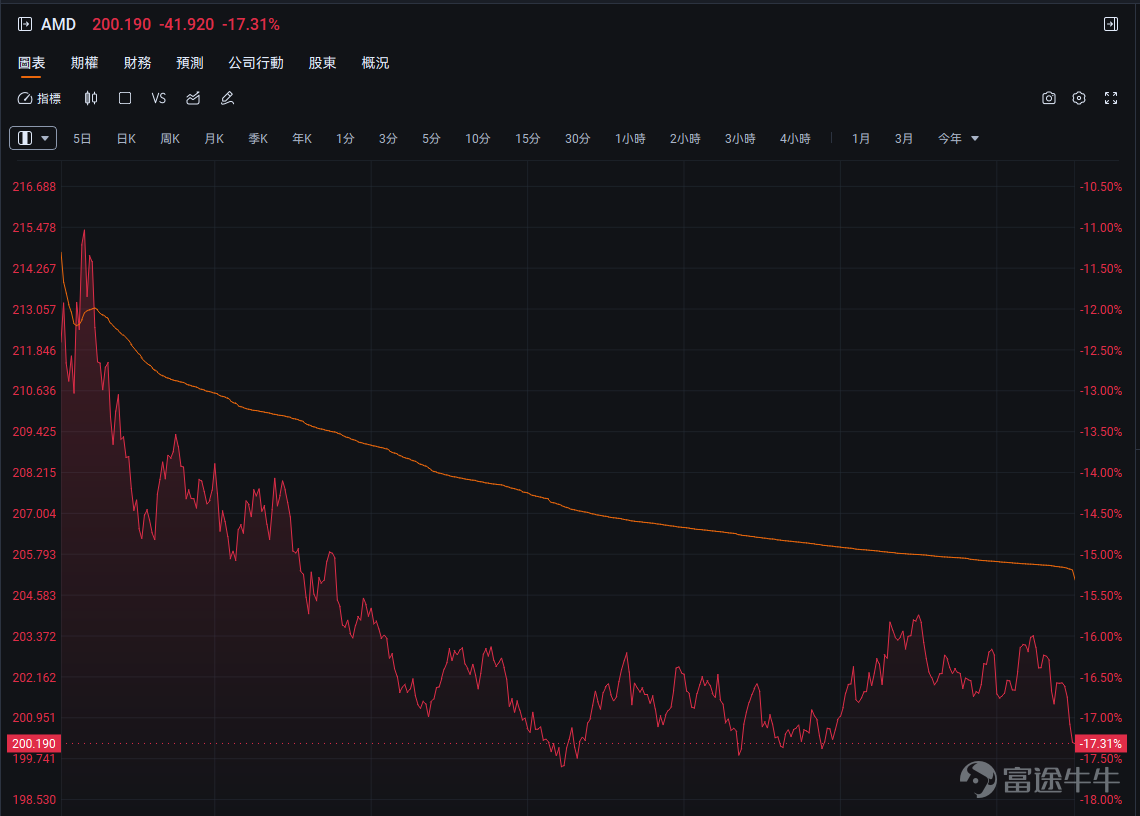
Technology stocks faced large-scale sell-offs. $Advanced Micro Devices (AMD.US)$ plunged 17.31%, marking its biggest single-day drop since May 2017, completely erasing all gains since 2026. Its earnings outlook fell short of market expectations, triggering investor panic.

The memory chip sector also suffered a collective collapse: $SanDisk (SNDK.US)$ plummeted nearly 16%, $Micron Technology (MU.US)$ dropped over 9%, $Western Digital (WDC.US)$ fell more than 7%. In addition, $Palantir (PLTR.US)$ Fell over 11%, $Oracle (ORCL.US)$ 、 $ASML Holding (ASML.US)$ falling more than 4%, $Broadcom (AVGO.US)$ 、 $Tesla (TSLA.US)$ 、 $NVIDIA (NVDA.US)$ fell more than 3%.
Tracking software stocks, $iShares Expanded Tech-Software Sector ETF (IGV.US)$ Continued to decline yesterday, with a drop of 1.82%, closing at $83.78, and significantly higher trading volume. This ETF has been falling for several consecutive days, with technical indicators showing it is in a severely oversold condition.

Sectors and individual stocks that rose against the trend were mainly concentrated in defensive and traditional economic areas, $Eli Lilly and Co (LLY.US)$ 、 $Super Micro Computer (SMCI.US)$ Surging 10.33% and 13.78% respectively, $Apple (AAPL.US)$ 、 $Walmart (WMT.US)$ 、 $PepsiCo (PEP.US)$ 、 $JPMorgan (JPM.US)$ Other individual stocks also recorded gains.
It can be clearly seen that Capital's risk-averse attribute stands out, shifting from high-volatility tech growth stocks to targets with strong profitability certainty and low volatility. In the absence of robust macroeconomic positive drivers, the market has entered an adjustment phase driven by corporate earnings and sector rotation.
2. Where is the wind coming from? Macro fog, weak performance, valuation pressure, fear of AI disruption
This big wind might be the result of the resonance of macro uncertainties, micro-performance, and valuation pressures.
The US ADP private sector employment report for January showed an increase of only 22,000 jobs, significantly lower than the market expectation of 45,000. This reflects a slowdown in labor market growth and has raised concerns about the pace of economic recovery.
The partial shutdown of the US government caused delays in the release of the January non-farm payroll report and CPI data. Discussions around the nomination of the Federal Reserve Chair and future policy paths are ongoing, leading to rising market uncertainty and increasing risk aversion. The VIX S&P 500 Volatility Index rose by 3.56% to 18.64, reflecting heightened market panic. Total trading volume for US stocks throughout the day was higher than the average of the past 20 trading sessions.
Investors have been taking profits from technology stocks that experienced significant gains earlier. Advanced Micro Devices (AMD) may be a key drag factor as its weak earnings, as a major AI computing concept stock, exacerbated concerns about the return cycle on AI investments and the sustainability of corporate capital expenditures. This sentiment likely spread to other semiconductor companies, putting direct pressure on QQQ, which is heavily weighted in tech stocks.
After rounds of hype surrounding AI, valuations in the tech sector seem to already reflect optimistic expectations for the future. However, under dual pressures from macro uncertainties and micro flaws, investors have become extremely sensitive, starting to weigh whether their investments are worthwhile. Any slight negative news could trigger sharp declines due to overvaluation, causing funds to quickly withdraw from these popular tech stocks and move towards safer options.

Why is this the darkest moment for software stocks recently?If there are specific triggers for the tech stock plunge, then the sell-off in software stocks feels more like a self-fulfilling collective psychological panic.
The spark of panic came from Anthropic's new tool. On February 3rd, the AI startup Anthropic released a productivity tool aimed at internal corporate lawyers, directly triggering a plunge in legal software and publishing company stocks—Thomson Reuters fell nearly 16%, and LegalZoom dropped 20%. This is just the tip of the iceberg. The market is concerned.
If AI can automatically handle legal documents, write code, and analyze data, what is the value of traditional SaaS companies?
Traditional SaaS companies generally adopt a subscription model based on per-user charges, but the widespread adoption of AI tools may lead companies to reduce hiring, thereby directly cutting down software subscriptions. Moreover, the rise of AI-assisted development tools such as vibe-coding (a hands-free coding approach) lowers the barrier to software development, making the moat of SaaS companies shallower.
The market’s attitude towards software stocks seems to have shifted from bearishness to doomsday panic, with stock prices pricing in the most pessimistic assumptions. Traders are dumping shares indiscriminately ('Get Me Out' trade). Traders described it as a 'just get me out' type of selling: 'People are selling everything without caring about price.'
Regarding this phenomenon, NVIDIA CEO Jensen Huang publicly defended software stocks: "It's hard to understand. Software products are tools; artificial intelligence will use these tools rather than reinvent them."
However, once market sentiment shifts, rational voices may seem powerless. JPMorgan pointed out that the market has adopted a 'guilty until proven innocent' attitude toward software stocks — unless companies can irrefutably prove that AI is a growth driver rather than an obstacle, even better-than-expected results cannot boost stock prices.
In fact, the current panic over software stocks may have something in common with concerns that AI will fully replace human jobs. However, in reality, humans can create more on top of AI, further enriching the entire human world. Similarly, AI will not make software less important but will instead make good software extremely crucial.
Companies that successfully integrate AI into their products and demonstrate that AI increases user stickiness or customer spending may become winners. Additionally, demand for certain types of software, such as cybersecurity, data infrastructure, and workflow systems (e.g., specific stocks like $Microsoft (MSFT.US)$ 、 $Snowflake (SNOW.US)$ 、 $Datadog (DDOG.US)$ 、 $Okta (OKTA.US)$ 、 $Zscaler (ZS.US)$ ), may also increase.
For investors, short-term panic may not be over yet, and software companies still face a crisis of market trust and self-validation. However, if we look at the long term, this could also be a period to identify high-quality companies and position oneself at more reasonable prices.
3. Having identified the external winds of change, let’s now look inward for our anchor points.
Facing significant drawdowns in your account, you may feel anxious, panicked, or even doubt yourself. But first, let me tell you, these emotions are completely normal, even instinctual. Studies show that people feel the pain of loss 2-2.5 times more intensely than the joy brought by equivalent gains. This is a very typical case ofloss aversion psychology.。
So when you see your account shrinking, your brain biologically amplifies this pain, possibly driving you to make irrational decisions like cutting losses to escape the suffering, which often leads to missing rebounds at the bottom, turning paper losses into permanent losses. Sigh!
But in fact, this may be the brain's stress response and does not represent the whole objective reality. Just like countless times when you are anxious about whether you forgot to lock the door, or even anxious about your house catching fire, or in your dreams, being chased by someone — it’s often an internal staging of a tense plot, but the reality is not so.
In fact, instead of masking pain through impulsive actions leading to bad outcomes, what you need to do more is acknowledge your emotions, accept their reasonableness, and allow their true existence.
So, what might the truth be?

The truth is, volatility is the norm in investing, especially for growth stocks.
Let's review the performance during the 2008 financial crisis. The level of panic at that time far exceeded today's situation, with many investors selling at the bottom out of fear. However, if you had held companies with strong competitive advantages like Microsoft or Adobe until now, the return would have exceeded 1000%. Even if you bought at the peak of the dot-com bubble in 2000, holding Microsoft till today would still yield an annualized return of over 8% — without even accounting for dividend reinvestment.
The current AI revolution is similar to the internet revolution back then; short-term panic selling is just an emotional release and does not change the long-term growth logic of the industry. Over-focusing on short-term fluctuations will only let emotions take control.
Benjamin Graham once said: Mr. Market shows up every day, offering you a quote. Sometimes he is overly excited, quoting absurdly high prices; other times he is depressed, quoting shockingly low prices. His emotions should not become the anchor for your valuation.
Warren Buffett also said: If you can't withstand a 50% drop in stock prices, you shouldn’t be investing in stocks. This isn’t encouraging reckless risk-taking, but reminding us that the long-term excess returns of equity assets are precisely compensation for enduring volatility. The current pullback is merely the normal 'fee' you pay for obtaining long-term gains.
Perhaps you also need to make a crucial mindset shift: price fluctuations don't equate to permanent loss of principal. If the competitive advantage and profitability prospects of the company you hold (like those mentioned with strong earnings reports) remain intact, then the current decline represents more of a paper loss rather than an actual one. Panic selling will only turn fluctuations into real losses.
Take the past few months as an example, from last October until now, your account may have gone through several ups and downs, sometimes making money, sometimes losing it. After experiencing this process, perhaps you’ve already personally understood what volatility means and gained some confidence to endure fluctuations while maintaining faith.
The fact is, when irrational collective behavior occurs, you still have your own choices.
AMD fell 17% in a day; did its intrinsic value really evaporate by 17% overnight? Clearly not. This is simply the pendulum of market sentiment swinging to another extreme. For companies with competitive advantages and robust cash flow, price declines actually increase long-term investment value rather than decrease it.
The indiscriminate sell-off in software stocks recently is fundamentally a contagion of market sentiment, driven by what Keynes referred to as 'animal spirits'—most investors see others selling and blindly follow suit, ignoring the fundamentals of individual stocks and the long-term value of the industry. Data from JPMorgan previously showed that during past market panics, investors who followed the herd in panic selling experienced long-term returns more than 30% lower than those who held onto quality assets.
The fact is, even amidst uncertainty, we can still find some certainty—the friends of time will eventually reap the fruits of time.
Staying calm and focused on the long term is the only way to navigate through the storm.
There’s no market that only rises and never falls, and no high-quality asset that only falls and never rises; valuations will ultimately revert to long-term fundamentals. Similarly, excessive pessimism will also be corrected. Take QQQ, for example: the Nasdaq 100 index it tracks comprises some of the world's top innovative companies. Historical data shows that despite multiple major pullbacks, its long-term compound returns remain impressive (approximately 20% annualized over the past decade).
The essence of technological progress is creative destruction—it brings both challenges and opportunities. Instead of trying to precisely predict who AI will render obsolete, it’s better to return to the essence of investing: seeking out companies with sustainable competitive advantages, strong pricing power, and excellent management teams. Regardless of how technology evolves, these core values are always the foundation for long-term success.
From a long-term perspective, this could also be an opportunity to adjust toward a healthier asset allocation and portfolio. Attempting to precisely time market tops and bottoms is fighting against probability; true long-term investors leverage the cognitive discount brought by panic, carefully reviewing their holdings, thinking about their longer-term outlook, and executing their plans with discipline.
Perhaps wealth creation is silent 99% of the time, only manifesting during 1% of explosive moments. The primary job of a long-term investor is to endure that 99% of the time and ensure they remain present.
The fact is, you’re not fighting alone.
When you feel anxious, remember: the top fund managers on Wall Street are also losing sleep right now. This is not the first time, nor will it be the last.
When you're facing account losses alone and don't know what to do, you can come to Niuniu Classroom or check out the OptionsSir account to make full use of the content we've prepared for you, helping you better navigate the market and move towards wealth growth. You can also join the Niuniu Circle to exchange ideas with KOLs and fellow investors, getting through tough times together and making investing simpler and less lonely.
When the market's 'voting machine' is dominated by panic, investors' inner 'weighing scales'—a deep understanding of human greed, anger, and ignorance, the ability to tolerate and coexist with temporary discomfort from losses, judgment of intrinsic asset value, and adherence to one’s trading system—becomes especially precious.
4. Alright, finally, let's talk about something practical!
Let's mainly look at $Invesco QQQ Trust (QQQ.US)$ , data primarily as of February 5th before the U.S. stock market opened.
QQQ has fallen to a new one-month low, and many technical indicators show that it is severely oversold—simply put, it has dropped sharply and quickly, so there may be a short-term rebound opportunity. However, it's important to note that although there was capital inflow yesterday, it was mainly retail investors buying, while larger funds were actually flowing out.

From the options trading perspective, market sentiment is relatively tense, with bearish bets more active than bullish ones (the call/put ratio exceeds 1), as everyone seems to be guarding against further stock price declines. The implied volatility (IV) percentile is also at a relatively high level, at 79%, reflecting expectations of significant future volatility.
Interestingly, however, there were large orders selling a significant number of put options at strike prices of 610 and 605 yesterday, which usually implies that major funds believe the stock price will struggle to break below these levels.


So,For long-term oriented investors, how can they currently utilize options strategies to turn volatility into an advantage?
Here are two option strategy approaches aligned with long-term thinking. The core goal of these strategies is not short-term speculation but to serve long-term holding — reducing holding costs, managing downside risks, or positioning for the future during market panic.
Strategy One: Cash-secured Put — Expressing the discipline of 'willingness to buy at a lower price'
This strategy suits investors planning to increase their core asset holdings in the future. When you are optimistic about tech stocks in the long run but believe that current market sentiment may cause further price fluctuations, you can proactively sell put options with strike prices below the current market price. Choose the nearest strong support level as your strike price and a level at which you're willing to buy.
This is a patient approach where 'if the market falls, it’s a good buying opportunity; if it doesn’t fall, you still make money.' If the market continues to drop to the strike price, you will purchase the asset at a pre-set price, typically lower than the current market price, thereby averaging down your cost. If the market rises or moves sideways, you earn premium income, which can directly be considered a subsidy for lowering future purchase costs.
It forces you to apply discipline against emotions, turning market pessimism into favorable conditions for yourself. However, note that it requires sufficient funds in your account to ensure smooth execution.
The profit and loss characteristics upon expiration can be referenced in the diagram below, provided for educational purposes only and does not constitute any investment advice.

Strategy Two: Covered Call — Generating cash flow for existing positions
This strategy is suitable for investors who already hold tech stocks or QQQ, plan to hold them long-term, but expect short-term fluctuations or mild rebounds.
While holding the underlying stock, sell a call option with a strike price higher than the current market price. This equates to 'collecting rent' on your position.
If the market does not rise to the strike price before the option expires, the entire premium is earned, directly reducing your shareholding cost, enhancing your patience to hold the asset, and allowing for rolling operations afterward.
If the market rises rapidly and exceeds the strike price, your position may be bought (exercised), but this allows you to cash out at a pre-set satisfactory price. Essentially, this strategy exchanges a portion of potential upside over a period of time for guaranteed cash flow and stronger resilience in holding positions.
The profit and loss characteristics at expiration for this strategy can be referenced in the figure below, which is intended solely for investment education purposes and does not constitute any investment advice.

If you want more inspiration regarding options strategies, you can easily get it on the mobile app or the new desktop version by following these steps!

Here's a small perk for everyone. If you plan to trade options soon,Feel free to claimOptions Beginner's Package(*This event is exclusively for HK invited users. Click to learn more.Detailed event rules>>). If you still don't dare to trade, you canClick hereParticipate in simulated trading challenges with zero cost and zero risk, and win stock cash vouchers!
5. Conclusion: Anchor in the storm, become a partner of time
Finally, let’s return to the question posed at the beginning: How should we handle it when our account value shrinks?
Investing is a long race that tests human nature; short-term storms may be unsettling, but they often serve as a litmus test for asset quality and investment mentality. While macro uncertainty and AI-related concerns have triggered sharp market swings, history has repeatedly proven that high-quality assets will ultimately endure through cycles.
Facing volatility, we are not powerless. As long-term investors, we can anchor our emotions and avoid panic selling; we can also use option tools to convert high market volatility into tangible cash flow or lower holding costs.
In the marathon of investing, every breath adjustment along the way is aimed at running more steadily toward the distant future. In the end, remember this: on the journey of investment, you are never alone—NiuNiu Classroom, OptionsSir, and many KOLs and fellow investors in the NiuNiu Circle are all here to support you!
Risk Disclaimer: The above content only represents the author's view. It does not represent any position or investment advice of Futu. Futu makes no representation or warranty.Read more
Comments (31)
to post a comment
436
289