
Hong Kong-listed AI 'twin leaders' see active trading! How to position in the AI sector for the Year

The AI community is buzzing! NVIDIA to host a seminar tomorrow, Moltbook goes viral, Google announces new technology... How should investors seize investment opportunities?
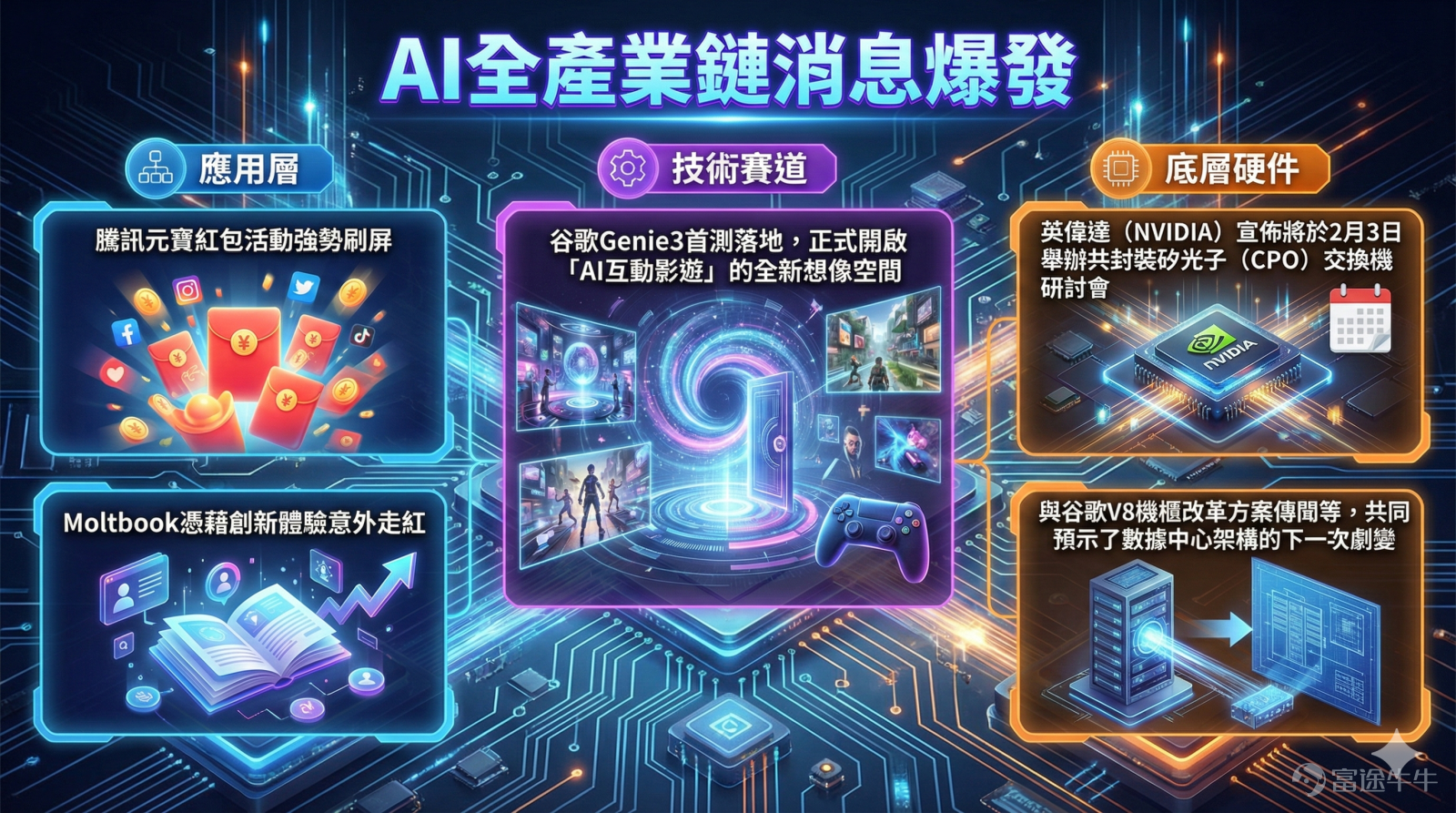
Since last Friday, a series of significant updates have flooded the AI community: the Yuánbǎo Red Packet event went viral, Moltbook suddenly gained popularity, Google Genie 3's initial testing was rolled out, NVIDIA announced it will host a co-packaged silicon photonics switch seminar, and Google’s V8 cabinet reform proposal gained traction.
![Since last Friday, a series of major announcements have flooded the AI community: the red packet event going viral, Moltbook suddenly gaining popularity, Google Genie 3’s first trial implementation, NVIDIA announcing a co-packaged silicon photonics switch seminar, and Google's V8 cabinet reform plan breaking out, among others. From the consumer-end red packet battles to the infrastructure-level technological revolution, these events are not isolated but rather signify that AI is transitioning from 'lab models' to the deep integration of 'mass applications' and 'physical infrastructure.' This article will provide an in-depth analysis of the above events and interpret the underlying investment logic. 01 Application Layer: Moltbook Goes Viral; Yuanbao and Qwen Ignite Red Packet War [Joyful]Tencent Yuanbao Unleashes Red Packet Rain Mode – The 'AI Entry War' Officially Begins With the approach of the 2026 Chinese New Year, amidst the escalating battle for consumer-end AI applications, $TENCENT (00700.HK)$ once again leverages its core strengths, using a combination strategy of 'social + cash giveaways' to break through strongly. At the start of February, Tencent’s AI assistant 'Yuanbao' broke through with its '1 billion red packets' campaign. Thanks to viral social network spread, related topics quickly topped Weibo’s hot search list and drove a surge in App downloads, successfully reaching the top spot on the App Store’s free apps chart.This marks Tencent's successful conversion of traffic advantage into market leadership in the consumer-end AI application race. It is worth noting that...](https://nnqimage.futunn.com/sns_client_feed/900080/20260202/web-1770038815540-4fkCEZ0a3w.png/big?area=1&is_public=true&imageMogr2/ignore-error/1/format/webp)
From the consumer-end red packet battles to the infrastructure-level technological revolution, these events are not isolated but signal that AI is transitioning from 'lab models' to a deep integration of 'mass-market applications' and 'physical infrastructure.' This article will analyze the aforementioned events in-depth and interpret the underlying investment logic.
01 Application Layer: Moltbook Gains Popularity, Yuánbǎo and Qwen Ignite Red Packet Wars
 Tencent's Yuánbǎo Kicks Off 'AI Entry War' with Red Packet Rain Mode
As the 2026 Spring Festival approaches, competition for C-end AI applications is intensifying. $TENCENT (00700.HK)$ Once again leveraging its core strengths, Tencent employs a 'social + cash giveaway' strategy to make a strong breakthrough.
At the start of February, Tencent's AI assistant 'Yuánbǎo' broke through with its '1 Billion Red Packet' campaign. Thanks to the viral spread via social networks, related topics quickly topped Weibo's hot search list and drove a surge in app downloads, successfully reaching the top spot on the App Store's free apps chart.This marks that Tencent has successfully transformed its traffic advantage into market leadership in the C-end AI application space.
Notably, $BABA-W (09988.HK)$Qwen APP announced today a 3 billion yuan investment to kick off its Spring Festival campaign,Fully integrating with Alibaba ecosystem businesses such as Taobao Flash Purchase, Damai, Fliggy, and Hema, offering nationwide freebies for eating, drinking, and entertainment during the Spring Festival. The initiative, set to launch on February 6, aims to provide users with a taste of a new lifestyle in the AI era by pushing AI from mere conversation to practical tasks through large-scale giveaways.
Moltbook builds an AI agent interaction platformMoltbook officially ushers in the era of pure AI agent social networking.Following the popularity of Clawdbot, Moltbook took over this weekend's spotlight. Its interface resembles Reddit, featuring mature sections, posts, and interactive systems, but its core rules are shocking:This is a social island exclusively for AI agents; humans can only observe and are strictly prohibited from participating.
🔍Analysis:
Regarding the red envelope battle among tech giants,The industry generally expects that future general-purpose AI agents will be able to integrate more vertical applications, and each user might only need a few AI agents to meet all online needs. This means,The traffic entry landscape of the internet era may be disrupted. Whoever can seize the traffic entry points of the AI era will control the distribution rights of digital traffic for the next decade.
As for Moltbook,The market widely believes that 2026 will be the first year of scaled deployment of Agents, reshaping the commercialization closed-loop logic of AI, and after coding, initiating a new round of ROI-CapEx narrative.
💰Investment Opportunities:
Kaiyuan Securities believes that whether it is the interaction between AI agents on the Moltbook platform or the social interactions among users and between users and AI agents facilitated by Yuanbao, these indicate that large model inference, long-text processing, and multimodal capabilities have evolved to a stage where human-like interaction has become robust. The path for AI social platforms—from niche verticals (such as role-playing games or emotional companion chats) to comprehensive social networking—appears to be well-established. This could lead to rapid user and traffic growth, opening up opportunities for monetization through advertising, e-commerce, entertainment, local life services, and education.It is recommended to continue investing in AI applications.
Previously, Niuniu compiled a chart of Hong Kong-listed AI application concept stocks. Fellow investors who are interested can follow it, especially key areas like large models/AI entry points such as $TENCENT (00700.HK)$ 、 $KUAISHOU-W (01024.HK)$ 、 $Alibaba (BABA.US)$ 、 $MINIMAX-W (00100.HK)$ 、 $Z.AI (02513.HK)$ which deserve special attention.
![Since last Friday, a series of major announcements have flooded the AI community: the red packet event going viral, Moltbook suddenly gaining popularity, Google Genie 3’s first trial implementation, NVIDIA announcing a co-packaged silicon photonics switch seminar, and Google's V8 cabinet reform plan breaking out, among others. From the consumer-end red packet battles to the infrastructure-level technological revolution, these events are not isolated but rather signify that AI is transitioning from 'lab models' to the deep integration of 'mass applications' and 'physical infrastructure.' This article will provide an in-depth analysis of the above events and interpret the underlying investment logic. 01 Application Layer: Moltbook Goes Viral; Yuanbao and Qwen Ignite Red Packet War [Joyful]Tencent Yuanbao Unleashes Red Packet Rain Mode – The 'AI Entry War' Officially Begins With the approach of the 2026 Chinese New Year, amidst the escalating battle for consumer-end AI applications, $TENCENT (00700.HK)$ once again leverages its core strengths, using a combination strategy of 'social + cash giveaways' to break through strongly. At the start of February, Tencent’s AI assistant 'Yuanbao' broke through with its '1 billion red packets' campaign. Thanks to viral social network spread, related topics quickly topped Weibo’s hot search list and drove a surge in App downloads, successfully reaching the top spot on the App Store’s free apps chart.This marks Tencent's successful conversion of traffic advantage into market leadership in the consumer-end AI application race. It is worth noting that...](https://nnqimage.futunn.com/sns_client_feed/900080/20260202/web-1770038810266-sCh9BtFVPU.png/big?area=1&is_public=true&imageMogr2/ignore-error/1/format/webp)
Additionally,A Sober Reflection Amidst Moltbook's Frenzy: When 150,000 AI Agents Engage in Unsupervised Social Interactions, Who Will Ensure Safety?The Mac Observer sharply pointed out that Moltbook is essentially still an experimental project. Here, data manipulation and fake public opinion can easily occur. More dangerously, when tens of thousands of AI agents interact without human control, virus implantation and unauthorized access may very likely erupt in unseen corners. This is not just a social experiment; it is also a major safety test. With the current rapid progress in AI applications, the deep integration of cybersecurity and large models has become urgently necessary.
Overall, Guolian Minsheng Securities stated that with the advent of the Agent era, the restructuring of the internet value chain has already begun. The focus is shifting from traditional emphasis on traffic scale to business models centered around action execution, capability invocation, governance control, and result-based payment. Under this new value system, cloud platforms, computing resource services, security governance tools, content licensing, and execution-based payment mechanisms will become the main profit drivers.
![Since last Friday, a series of major announcements have flooded the AI community: the red packet event going viral, Moltbook suddenly gaining popularity, Google Genie 3’s first trial implementation, NVIDIA announcing a co-packaged silicon photonics switch seminar, and Google's V8 cabinet reform plan breaking out, among others. From the consumer-end red packet battles to the infrastructure-level technological revolution, these events are not isolated but rather signify that AI is transitioning from 'lab models' to the deep integration of 'mass applications' and 'physical infrastructure.' This article will provide an in-depth analysis of the above events and interpret the underlying investment logic. 01 Application Layer: Moltbook Goes Viral; Yuanbao and Qwen Ignite Red Packet War [Joyful]Tencent Yuanbao Unleashes Red Packet Rain Mode – The 'AI Entry War' Officially Begins With the approach of the 2026 Chinese New Year, amidst the escalating battle for consumer-end AI applications, $TENCENT (00700.HK)$ once again leverages its core strengths, using a combination strategy of 'social + cash giveaways' to break through strongly. At the start of February, Tencent’s AI assistant 'Yuanbao' broke through with its '1 billion red packets' campaign. Thanks to viral social network spread, related topics quickly topped Weibo’s hot search list and drove a surge in App downloads, successfully reaching the top spot on the App Store’s free apps chart.This marks Tencent's successful conversion of traffic advantage into market leadership in the consumer-end AI application race. It is worth noting that...](https://nnqimage.futunn.com/sns_client_feed/900080/20260202/web-1770038806620-9ePh3YCvk5.png/big?area=1&is_public=true&imageMogr2/ignore-error/1/format/webp)
02 Technology Track: Google Releases World Model Genie 3
On January 30, 2026, $Alphabet-C (GOOG.US)$ DeepMind officially opened the experimental prototype Project Genie of the world model Genie 3 to AI Ultra users. Project Genie is an experimental AI prototype launched by Google DeepMind. Genie 3 can generate interactive 3D environments with physical consistency within seconds using simple text prompts.
The release of Genie3 triggered panic in the capital markets over the potential collapse of the traditional game engine business model, causing sharp pullbacks in the stock prices of game tool and platform companies.Among them, the leading game engine $Unity Software (U.US)$ plummeted 23% in a single day, reflecting the capital market's repricing due to the belief that its business moat had been completely dismantled. The UGC game creation platform $Roblox (RBLX.US)$ plunged 13%, as the market believes AI could disrupt the moat of this UGC platform; AI might cause Roblox to lose its exclusivity in 'low-barrier creation.' Even $Take-Two Interactive Software (TTWO.US)$ , with its prestigious GTA franchise, dropped nearly 8%.
![Since last Friday, a series of major announcements have flooded the AI community: the red packet event going viral, Moltbook suddenly gaining popularity, Google Genie 3’s first trial implementation, NVIDIA announcing a co-packaged silicon photonics switch seminar, and Google's V8 cabinet reform plan breaking out, among others. From the consumer-end red packet battles to the infrastructure-level technological revolution, these events are not isolated but rather signify that AI is transitioning from 'lab models' to the deep integration of 'mass applications' and 'physical infrastructure.' This article will provide an in-depth analysis of the above events and interpret the underlying investment logic. 01 Application Layer: Moltbook Goes Viral; Yuanbao and Qwen Ignite Red Packet War [Joyful]Tencent Yuanbao Unleashes Red Packet Rain Mode – The 'AI Entry War' Officially Begins With the approach of the 2026 Chinese New Year, amidst the escalating battle for consumer-end AI applications, $TENCENT (00700.HK)$ once again leverages its core strengths, using a combination strategy of 'social + cash giveaways' to break through strongly. At the start of February, Tencent’s AI assistant 'Yuanbao' broke through with its '1 billion red packets' campaign. Thanks to viral social network spread, related topics quickly topped Weibo’s hot search list and drove a surge in App downloads, successfully reaching the top spot on the App Store’s free apps chart.This marks Tencent's successful conversion of traffic advantage into market leadership in the consumer-end AI application race. It is worth noting that...](https://nnqimage.futunn.com/sns_client_feed/900080/20260202/web-1770038807290-BfexSIs7ef.png/big?area=1&is_public=true&imageMogr2/ignore-error/1/format/webp)
🔍Analysis:
Citi believes this panic selling is related to the recent crash of SaaS software companies caused by AI agents. Many investors didn't bother to understand how Genie would impact different business models of various gaming companies but chose to sell first and research later.
💰Investment Opportunities:
The core breakthrough of Genie 3 lies inPhysical ConsistencyandInteractivityThis means that AI is no longer just 'drawing' images but 'building' a physics-compliant, playable 3D space. This will reshape the industry chain for game development, metaverse infrastructure, and simulation training (such as autonomous driving and robotics).
First,World Models consume far more computing power than traditional LLMs. Generating real-time 3D environments and performing physical simulations require extremely high inference computing power. Investors should pay attention to $NVIDIA (NVDA.US)$ 、 $Advanced Micro Devices (AMD.US)$ chip companies such as NVIDIA.
Secondly,When AI lowers the barrier to producing 3D content, competition will return to IP (intellectual property) itself. Whoever owns the most popular characters and worldviews will be able to monetize them fastest with AI, like $Disney (DIS.US)$ which have massive IPs. If combined with Genie-like technology to develop interactive experiences, costs will drop significantly.
Third,For Chinese companies, Citi believes the above developments will have limited negative impact on Chinese gaming companies because Chinese users basically cannot access them. Assuming 'Project Genie' achieves potential success, it would actually benefit $TENCENT (00700.HK)$ Tencent's 'HunYuan World Model 1.5' and Tencent’s mini-game ecosystem. Because if Chinese game developers or users want to try similar virtual world creation experiences, WeChat’s mini-game ecosystem will be the most relevant platform due to its integration of gameplay, social interaction, and robust game distribution and sharing capabilities.
Finally, the emergence of Genie 3 is disruptiveto certain industries and may raise concerns about its business model in the short term.But in the long term, $Unity Software (U.US)$ 、 $Roblox (RBLX.US)$ these platforms, if they integrate tools like Genie, can actually lower the threshold for creation.
Layer 03 Hardware: Focus on NVIDIA and Google’s latest developments
NVIDIA to host a seminar titled 'Co-packaged Silicon Photonics Switch for Exascale AI Factories'$NVIDIA (NVDA.US)$ The webinar will be held from 14:00-15:00 Beijing Time on February 3, 2026,with the theme 'Co-packaged Silicon Photonics Switch for Exascale AI Factories'.
![Since last Friday, a series of major announcements have flooded the AI community: the red packet event going viral, Moltbook suddenly gaining popularity, Google Genie 3’s first trial implementation, NVIDIA announcing a co-packaged silicon photonics switch seminar, and Google's V8 cabinet reform plan breaking out, among others. From the consumer-end red packet battles to the infrastructure-level technological revolution, these events are not isolated but rather signify that AI is transitioning from 'lab models' to the deep integration of 'mass applications' and 'physical infrastructure.' This article will provide an in-depth analysis of the above events and interpret the underlying investment logic. 01 Application Layer: Moltbook Goes Viral; Yuanbao and Qwen Ignite Red Packet War [Joyful]Tencent Yuanbao Unleashes Red Packet Rain Mode – The 'AI Entry War' Officially Begins With the approach of the 2026 Chinese New Year, amidst the escalating battle for consumer-end AI applications, $TENCENT (00700.HK)$ once again leverages its core strengths, using a combination strategy of 'social + cash giveaways' to break through strongly. At the start of February, Tencent’s AI assistant 'Yuanbao' broke through with its '1 billion red packets' campaign. Thanks to viral social network spread, related topics quickly topped Weibo’s hot search list and drove a surge in App downloads, successfully reaching the top spot on the App Store’s free apps chart.This marks Tencent's successful conversion of traffic advantage into market leadership in the consumer-end AI application race. It is worth noting that...](https://nnqimage.futunn.com/sns_client_feed/900080/20260202/web-1770038810773-FsSZvaG2wF.png/big?area=1&is_public=true&imageMogr2/ignore-error/1/format/webp)
According to NVIDIA, hyperscale AI is redefining what modern data centers must deliver. As the next generation of AI workloads evolve towards massive model sizes, real-time inference, and interconnected AI factories across regions, infrastructure must evolve to achieve unprecedented scale, connectivity, and energy efficiency.
According to NVIDIA's official website, attendees will learn about the following during this webinar:
① How NVIDIA’s co-packaged optics technology achieves 10x higher resiliency, enabling applications to run uninterrupted for up to 5x longer.
② How co-packaged optics technology delivers superior performance per watt.
③How Spectrum-X Ethernet connects Al computing structures within data centers and scales across multiple AI data centers.
Overall, this seminar focused on how data centers can achieve supercomputing-level performance via NVIDIA photonics switches, NVLink, and Spectrum-X Ethernet against the backdrop of larger AI models and real-time inference.
💰Investment opportunities:
Overall, the global AI wave is driving robust demand for computing power, accelerating changes in the competitive landscape of the optical communications market and the development trend of high-speed optical interconnects.
PreviouslyOutlook 2026 | Don’t Just Focus on NVIDIA! By 2026, the Optical Communication Industry May Become the Strongest Growth Area—What Opportunities Should You Watch?An article also noted that CPO technology is evolving into two major camps, led by Broadcom and NVIDIA respectively. Among them, Broadcom entered the market with its Tomahawk series of switches integrating CPO technology; NVIDIA, through the Spectrum-X ecosystem and the next-generation Quantum Photonics silicon photonics network switch—including updating the Quantum-X silicon photonics switch solution in December 2025—has announced that its CPO products will enter mass production, accelerating the practical deployment of AI data centers.
In other words, the momentum in optical communications is expected to extend from optical modules to upstream and downstream segments. AI networks are shifting from Scale-out to Scale-up, leading to a clearer competitive landscape within the industry. Relevant companies have been compiled for reference by fellow investors:
![Since last Friday, a series of major announcements have flooded the AI community: the red packet event going viral, Moltbook suddenly gaining popularity, Google Genie 3’s first trial implementation, NVIDIA announcing a co-packaged silicon photonics switch seminar, and Google's V8 cabinet reform plan breaking out, among others. From the consumer-end red packet battles to the infrastructure-level technological revolution, these events are not isolated but rather signify that AI is transitioning from 'lab models' to the deep integration of 'mass applications' and 'physical infrastructure.' This article will provide an in-depth analysis of the above events and interpret the underlying investment logic. 01 Application Layer: Moltbook Goes Viral; Yuanbao and Qwen Ignite Red Packet War [Joyful]Tencent Yuanbao Unleashes Red Packet Rain Mode – The 'AI Entry War' Officially Begins With the approach of the 2026 Chinese New Year, amidst the escalating battle for consumer-end AI applications, $TENCENT (00700.HK)$ once again leverages its core strengths, using a combination strategy of 'social + cash giveaways' to break through strongly. At the start of February, Tencent’s AI assistant 'Yuanbao' broke through with its '1 billion red packets' campaign. Thanks to viral social network spread, related topics quickly topped Weibo’s hot search list and drove a surge in App downloads, successfully reaching the top spot on the App Store’s free apps chart.This marks Tencent's successful conversion of traffic advantage into market leadership in the consumer-end AI application race. It is worth noting that...](https://nnqimage.futunn.com/sns_client_feed/900080/20260202/web-1770038808425-pNtPhJu5zn.webp/big?area=1&is_public=true&imageMogr2/ignore-error/1/format/webp)
Photonic integrated circuit design (including DSP/electronic chips):include $Intel (INTC.US)$ 、 $Broadcom (AVGO.US)$ 、 $Coherent (COHR.US)$ 、 $Cisco (CSCO.US)$ 、 $NVIDIA (NVDA.US)$ 、 $Lumentum (LITE.US)$ 、 $Marvell Technology (MRVL.US)$ 、 $POET Technologies (POET.US)$ 、 $Nokia Oyj (NOK.US)$ 、 $MACOM Technology Solutions (MTSI.US)$ 、 $Credo Technology (CRDO.US)$ 、 $Astera Labs (ALAB.US)$ 、 $Semtech (SMTC.US)$ 、 $ZTE (00763.HK)$ 。
Silicon photonics and CMOS wafer fabs:include $Taiwan Semiconductor (TSM.US)$ 、 $United Microelectronics (UMC.US)$ 、 $Intel (INTC.US)$ 、 $GlobalFoundries (GFS.US)$、 $Tower Semiconductor (TSEM.US)$ 、 $STMicroelectronics (STM.US)$ 、 $SkyWater Technology (SKYT.US)$ 。
Optical module suppliersinclude $Coherent (COHR.US)$ 、 $Lumentum (LITE.US)$ 、 $Applied Optoelectronics (AAOI.US)$ 、 $CIG (06166.HK)$ , among which, Coherent andLumentumA long-established powerhouse offering full vertical integration capabilities from chips to modules.
EMS (Electronic Manufacturing Services) / Connectorsinclude $Amphenol (APH.US)$ 、 $Celestica (CLS.US)$ 、 $Fabrinet (FN.US)$ 、 $Jabil (JBL.US)$ 、 $FIT HON TENG (06088.HK)$ 、 $TIME INTERCON (01729.HK)$Wait for the company;
System Equipment Opticalinclude $Arista Networks (ANET.US)$ 、 $Cisco (CSCO.US)$ 、 $Nokia Oyj (NOK.US)$ 、 $Ciena (CIEN.US)$ 、 $Hewlett Packard Enterprise (HPE.US)$ 、 $Dell Technologies (DELL.US)$ ;
Packaging and Testinginclude $ASE Technology (ASX.US)$ 、 $Amkor Technology (AMKR.US)$ ;Fiber Optic Cablesinclude $Corning (GLW.US)$ 、 $YOFC (06869.HK)$ ;Epitaxial Wafer Supplierinclude $AXT Inc (AXTI.US)$ ;InP (Indium Phosphide) Wafer Fabinclude $Coherent (COHR.US)$ 、 $Lumentum (LITE.US)$ ;
Equipment - Data Communication Devicesinclude $Arista Networks (ANET.US)$ 、 $Cisco (CSCO.US)$ 、 $NVIDIA (NVDA.US)$ 、 $Hewlett Packard Enterprise (HPE.US)$ 、 $Dell Technologies (DELL.US)$ ;Equipment - Telecommunication Devicesinclude $Ciena (CIEN.US)$ 、 $Nokia Oyj (NOK.US)$ 、 $LM Ericsson Telephone (ERIC.US)$ 、 $ZTE (00763.HK)$ 。
Google V8 cabinet reformMorgan Stanley’s latest research report pointed out, $Alphabet-C (GOOG.US)$ To further enhance core AI computing capabilities, Google will fully promote the mass production of TPU v7/v8 clusters in 2026, with TPU v7 expected to officially begin mass production between August and September.The rollout timeline for the V8 series has been moved forward to October-November.The total annual shipment volume of the entire TPU v7/v8 series is expected to reach 4.2 million units, marking an over 150% increase compared to the core model shipments in 2025, leading to a significant expansion of the computing cluster scale.
Cathay United Electronics stated that due to global capacity shortages of HBM, which are unlikely to meet AI growth demands in the next two to three years, and traditional HBM being constrained by a motherboard-fixed design that imposes capacity limits, it is anticipated that Google will propose a new solution.Launched in 2027, the physical form involves removing HBM and establishing a standalone DRAM memory cabinet (containing 16-32 trays), dynamically allocating memory through pooling technology.
The technology in between has been broken down from the original single, simple HBM component into three parts:
Transport Layer:Adopting full optical interconnection. Through OCS (Optical Circuit Switching) and customized CXL-like protocols, ensuring efficient cross-cabinet communication. The CPU, GPU, and memory sticks in the memory pool share a common protocol.
Storage Layer:Using large-scale DRAM arrays to replace HBM, significantly increasing the addressable space. Memory corresponding to a single TPU can leap from 192GB/256GB to 512GB or even above 768GB.
Control Layer:Adding dedicated memory-side CPU servers for management.
💰Investment opportunities:
Overall, if Google indeed implements this 'HBM removal, full optical interconnection, memory pooling' roadmap by 2027, it will be a game-changing blow to the current AI hardware architecture.
The core beneficiaries will include:
1. Optical interconnection: The demand for all-optical switching and high-speed optical engines will explode. Key areas of focus include $Broadcom (AVGO.US)$、 $Marvell Technology (MRVL.US)$、 $Taiwan Semiconductor (TSM.US)$etc.
Taiwan Semiconductor: Whether it's the manufacturing of TPUs or the packaging of optical engines with computing cores, Taiwan Semiconductor’s advanced packaging technology is indispensable.
Broadcom: Broadcom is currently the dominant leader in global CPO switching chips and optical components. Although Google uses its self-developed OCS, it is difficult to bypass Broadcom’s patent barriers in terms of optical physical layer technology.
Marvell Technology: The company provides DSP (digital signal processing) and silicon photonics driver chips. It is a long-term partner of Google in the fields of CPO and customized ASICs.
Additionally, Google’s OCS typically uses MEMS mirror technology, which means related MEMS foundries or precision optics component manufacturers will benefit (e.g., $Lumentum (LITE.US)$ )。
2. CXL and memory interface chips: Core chips responsible for memory pooling scheduling and high-speed interconnects, such as relevant controllers and interface chips, will see both value and demand increase significantly. Areas of focus include $Astera Labs (ALAB.US)$、 $Rambus (RMBS.US)$、 $MONTAGE TECH (06809.HK)$etc.
AsteraLabs: Currently the hottest CXL connectivity chip company in the U.S. stock market. It is a core supplier that addresses the issue of PCIe/CXL signal attenuation over long distances (at the rack level). Google’s solutions are highly reliant on these Retimer chips.
Rambus: A veteran in memory interface IP and chips. Rambus provides interface chips (RCD/DB) required for DDR5/CXL, and directly benefits from the extremely high specifications (such as MRDIMM) demanded by memory pooling.
Montage Technology: One of the ‘three giants’ of global memory interface chips. Specializing in server memory buffer chips (RCD/DB) and CXL controllers, Montage Technology is an indispensable component for DRAM pooling.
3. DRAM memory sticks: The consumption of standard DDR memory will increase exponentially. Stay tuned. $Micron Technology (MU.US)$、 $CSOP SK Hynix Daily (2x) Leveraged Product (07709.HK)$and $CSOP Samsung Electronics Daily (2x) Leveraged Product (07747.HK)$The DRAM (Dynamic Random Access Memory) market is highly concentrated, dominated by the three major manufacturers Samsung Electronics, SK Hynix, and Micron, with a combined market share exceeding 96%.
4. Supporting CPUs and PCBs: Each memory cabinet requires a management CPU, and demand for large server PCBs will also rise. Stay tuned to companies like $Arm Holdings (ARM.US)$and other companies.
In addition,'The Rise of Google's AI Empire! What Are the Gold-Mining Opportunities in the Supply Chain?'An article once noted that Google’s 'full-stack innovation' system, spanning chips, clusters, and even applications, is accelerating its formation. Google’s supply chain is not only redefining the data center architecture of Cloud Service Providers (CSPs), but also becoming the core engine driving growth in cutting-edge industries such as high-speed optical modules, MEMS, and thin-film lithium niobate.Therefore, Google’s supply chain is worth closely tracking in 2026.
![Since last Friday, a series of major announcements have flooded the AI community: the red packet event going viral, Moltbook suddenly gaining popularity, Google Genie 3’s first trial implementation, NVIDIA announcing a co-packaged silicon photonics switch seminar, and Google's V8 cabinet reform plan breaking out, among others. From the consumer-end red packet battles to the infrastructure-level technological revolution, these events are not isolated but rather signify that AI is transitioning from 'lab models' to the deep integration of 'mass applications' and 'physical infrastructure.' This article will provide an in-depth analysis of the above events and interpret the underlying investment logic. 01 Application Layer: Moltbook Goes Viral; Yuanbao and Qwen Ignite Red Packet War [Joyful]Tencent Yuanbao Unleashes Red Packet Rain Mode – The 'AI Entry War' Officially Begins With the approach of the 2026 Chinese New Year, amidst the escalating battle for consumer-end AI applications, $TENCENT (00700.HK)$ once again leverages its core strengths, using a combination strategy of 'social + cash giveaways' to break through strongly. At the start of February, Tencent’s AI assistant 'Yuanbao' broke through with its '1 billion red packets' campaign. Thanks to viral social network spread, related topics quickly topped Weibo’s hot search list and drove a surge in App downloads, successfully reaching the top spot on the App Store’s free apps chart.This marks Tencent's successful conversion of traffic advantage into market leadership in the consumer-end AI application race. It is worth noting that...](https://nnqimage.futunn.com/sns_client_feed/900080/20260202/web-1770038815536-UflxP1A7Qa.png/big?area=1&is_public=true&imageMogr2/ignore-error/1/format/webp)
Summary
The dense signals at the start of 2026 indicate that AI is accelerating from 'proof of concept' towards 'large-scale implementation.' Investors' focus should no longer be on generalized AI concepts, but rather delve into the industrial fabric—On the application front,Locking onto oligopolies that control traffic entry points and the Agent ecosystem;On the infrastructure side,Invest in hardcore leaders driving architectural transformation. In this leap from the lab to the physical world, only those who understand underlying technological shifts will be able to precisely capture the era's dividends.
Risk Disclaimer: The above content only represents the author's view. It does not represent any position or investment advice of Futu. Futu makes no representation or warranty.Read more


Comments (2)
to post a comment
122
185