
BTC surpasses $75,000! Has the upward channel been fully opened?

Crypto market approaches institutional cost line! What to focus on next? What hedging tools are available?
From the weekend to Monday, the crypto market suffered a heavy blow due to significant news from US politics: President Trump formally nominated former Federal Reserve Governor Kevin Warsh to serve as the Federal Reserve Chair.
Waller is known in the financial world for his "hawkish" stance, and he has long advocated for a tough anti-inflation policy. Therefore, this personnel nomination is interpreted by the capital markets as a signal of liquidity tightening. In Waller's policy toolbox, maintaining high interest rates and aggressively reducing the Federal Reserve's balance sheet are his core propositions. For the cryptocurrency market, which is highly dependent on dollar liquidity, this anticipated "tight monetary policy" is akin to directly siphoning off the oxygen that sustains high valuations.
Due to the rapid trading and settlement, cryptocurrencies such as Bitcoin and Ethereum are viewed by market funds as assets that can escape and be liquidated the fastest. Coupled with the ongoing geopolitical tensions, the dual negative factors resonated, leading to the collapse of the weekend market.
What the cryptocurrency market will focus on next: the defense of the cost line, cyclical laws, and Walsh's statements.
The life-and-death game of institutional cost lines
Historically, the cost line of institutional investors' positions may constitute the most solid psychological support level in the market, and it is also a strategic high ground contested by both bulls and bears. Therefore, pay attention to$Strategy (MSTR.US)$ and $Bitmine Immersion Technologies (BMNR.US)$Waiting for the position data of leading institutions helps us observe the movements of major players.
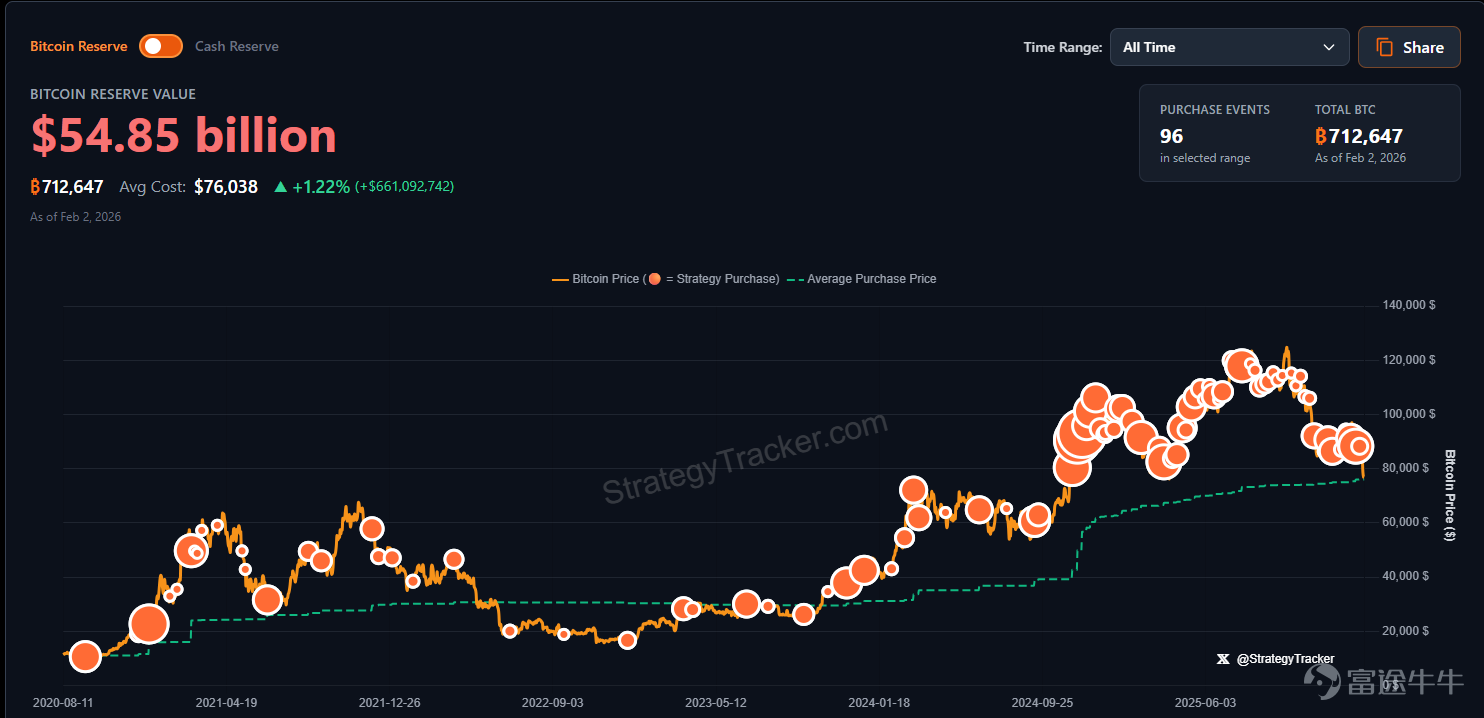
Strategy, as the largest corporate holder of Bitcoin in the world, has its cost basis viewed as the market's "Maginot Line." According to data from saylortracker.com, due to MSTR in early 2026$Bitcoin (BTC.CC)$When the price was at a high of $90,000, they still aggressively increased their holdings, and their average Bitcoin position has been significantly raised to $76,038.
![From the weekend to Monday, the crypto market suffered a heavy blow due to significant news from US politics: President Trump officially nominated former Federal Reserve Governor Kevin Warsh to serve as the Federal Reserve Chair. Warsh is well-known in financial circles for his 'hawkish' stance, consistently advocating strong anti-inflation policies. Thus, this appointment has been interpreted by the capital markets as a signal of liquidity tightening. In Warsh's policy toolkit, maintaining high interest rates and aggressively reducing the Federal Reserve's balance sheet are core proposals. For the crypto market, which heavily relies on dollar liquidity, such expectations of 'tight monetary policy' effectively removes the oxygen sustaining high valuations. Due to fast trading and settlement, crypto assets like Bitcoin and Ethereum are considered by market participants as assets that can be quickly exited and liquidated. Combined with recent ongoing geopolitical tensions, these dual negative factors led to the market crash over the weekend. What to watch next in the crypto market: the battle at the cost line, cyclical patterns, and Warsh’s statements A life-or-death battle around institutional cost lines Historical experience suggests that the cost basis of institutional investors may form the strongest psychological support level in the market and is a strategic battleground for both bulls and bears. Therefore, monitoring... $Strategy (MSTR.US)$ and $Bitmine Immersion Technologies (BMNR.US)$ Position data from leading institutions like [...] helps us observe...](https://nnqimage.futunn.com/sns_client_feed/999978/20260202/web-1770027440798-UH3eqyH5Bd.png/big?area=2&is_public=true&imageMogr2/ignore-error/1/format/webp)
This week, the price of Bitcoin briefly fell below the key level of $76,000, which means that Strategy's large Bitcoin holdings have entered a state of unrealized loss, putting pressure on Strategy's stock price as well.
The market is starting to pay attention to whether Michael Saylor will adopt a "defensive accumulation" strategy. Recently, Strategy raised the preferred stock dividend to 11.25% to attract funds. Whether this high-yield bond issuance strategy can successfully extend the term will determine whether below $76,000 is a "golden pit" or a "bottomless pit." Because once the price of Bitcoin continues to fall below the cost line, Strategy will face the risk of debt default and may be forced to sell Bitcoin to repay leveraged interest.
At least for now, Michael Saylor has once again posted Bitcoin Tracker information, writing 'More Orange.' Based on previous experience, Strategy may disclose additional purchase data this week.
![From the weekend to Monday, the crypto market suffered a heavy blow due to significant news from US politics: President Trump officially nominated former Federal Reserve Governor Kevin Warsh to serve as the Federal Reserve Chair. Warsh is well-known in financial circles for his 'hawkish' stance, consistently advocating strong anti-inflation policies. Thus, this appointment has been interpreted by the capital markets as a signal of liquidity tightening. In Warsh's policy toolkit, maintaining high interest rates and aggressively reducing the Federal Reserve's balance sheet are core proposals. For the crypto market, which heavily relies on dollar liquidity, such expectations of 'tight monetary policy' effectively removes the oxygen sustaining high valuations. Due to fast trading and settlement, crypto assets like Bitcoin and Ethereum are considered by market participants as assets that can be quickly exited and liquidated. Combined with recent ongoing geopolitical tensions, these dual negative factors led to the market crash over the weekend. What to watch next in the crypto market: the battle at the cost line, cyclical patterns, and Warsh’s statements A life-or-death battle around institutional cost lines Historical experience suggests that the cost basis of institutional investors may form the strongest psychological support level in the market and is a strategic battleground for both bulls and bears. Therefore, monitoring... $Strategy (MSTR.US)$ and $Bitmine Immersion Technologies (BMNR.US)$ Position data from leading institutions like [...] helps us observe...](https://nnqimage.futunn.com/sns_client_feed/999978/20260202/web-1770027440850-uVvjGsAdLT.png/big?area=2&is_public=true&imageMogr2/ignore-error/1/format/webp)
At the same time, the survival status of miners remains a key indicator for judging market bottoms. With the increase in mining difficulty by 2026 and fluctuations in energy costs, the industry's average mining cost has significantly risen. If the coin price stays below the shutdown price for mainstream mining machines over the long term, miners will be forced to sell their inventory of Bitcoin to cover electricity bills, potentially triggering the final market plunge. Conversely, if institutions and miners successfully establish a bottom at the current price level and refuse to sell, then $76,000 could be established as a long-term 'value floor.'
The 'sticking to outdated methods' of Bitcoin’s four-year cycle theory
In the field of technical analysis, Bitcoin's four-year halving cycle remains the bible for many veteran players. Although 'sticking to outdated methods' cannot precisely predict the future, historical patterns often rhyme.
Bitcoin remains in a bull market cycle for approximately 1,064 days before and after the halving event, followed by a bear market adjustment lasting about 364 days. As of February 2026, theoretically, we are currently in a bear market adjustment phase, with the next bull market expected to begin in October 2026.
![From the weekend to Monday, the crypto market suffered a heavy blow due to significant news from US politics: President Trump officially nominated former Federal Reserve Governor Kevin Warsh to serve as the Federal Reserve Chair. Warsh is well-known in financial circles for his 'hawkish' stance, consistently advocating strong anti-inflation policies. Thus, this appointment has been interpreted by the capital markets as a signal of liquidity tightening. In Warsh's policy toolkit, maintaining high interest rates and aggressively reducing the Federal Reserve's balance sheet are core proposals. For the crypto market, which heavily relies on dollar liquidity, such expectations of 'tight monetary policy' effectively removes the oxygen sustaining high valuations. Due to fast trading and settlement, crypto assets like Bitcoin and Ethereum are considered by market participants as assets that can be quickly exited and liquidated. Combined with recent ongoing geopolitical tensions, these dual negative factors led to the market crash over the weekend. What to watch next in the crypto market: the battle at the cost line, cyclical patterns, and Warsh’s statements A life-or-death battle around institutional cost lines Historical experience suggests that the cost basis of institutional investors may form the strongest psychological support level in the market and is a strategic battleground for both bulls and bears. Therefore, monitoring... $Strategy (MSTR.US)$ and $Bitmine Immersion Technologies (BMNR.US)$ Position data from leading institutions like [...] helps us observe...](https://nnqimage.futunn.com/sns_client_feed/999978/20260202/web-1770027441407-jtdDhcU3fh.png/big?area=2&is_public=true&imageMogr2/ignore-error/1/format/webp)
A sharp decline represents a violent shakeout in the mid-to-late stages of a bull market. If the cycle theory remains valid, the current pullback is part of a 'mid-game break' within the bull market process. Historical data shows that corrections during the middle of a bull market typically range between 20% and 30%. Such deep corrections aim to wash out highly leveraged positions and build momentum for the subsequent peak.
Two different 'Warsh narratives': focus on the latest statements
For the newly nominated Fed Chair candidate Warsh, the market holds two starkly contrasting interpretations, and the interplay between these narratives will dominate upcoming policy expectations.
The first narrative is the 'liquidity killer.'The 'Warsh effect' directly implies tighter monetary policy, higher real interest rates, and a smaller Fed balance sheet. Under this narrative, a stronger dollar pressures risk assets, and the liquidity environment critical to cryptocurrencies will be severely squeezed. This was the direct logic behind this weekend's sharp drop.
The second narrative is 'productivity-driven leniency.'Although Warsh has been labeled as a hawkish figure, he recently hinted that he would be willing to give the green light to interest rate cuts under conditions of significant productivity improvement. More importantly, the Trump administration as a whole still tends to support the cryptocurrency industry, viewing Bitcoin as a strategic asset against fiat currency depreciation. As a candidate nominated by Trump, Warsh's policy implementation needs to balance the overall strategy of the White House.
Investors need to wait for his official statement to analyze his true stance — the hearing by the US Senate Banking Committee will be an important opportunity.Although the US Senate has not yet announced a specific hearing date, considering that the current chairman Powell’s term will end on May 15, the hearing is expected to take place in late February to March, allowing sufficient time for review and a full vote.
Hedging and Positioning in Panic: What Targets Are Worth Watching?
In the face of the current extreme market conditions, investors' strategies should be divided into two dimensions: short-term defense and long-term positioning.
In the short term, market sentiment remains skewed towards panic. For risk-averse investors, using hedging tools to protect spot positions is a wise move. In the Hong Kong stock market, $CSOP Bitcoin Futures Daily (-1x) Inverse Product (07376.HK)$ is worth paying close attention to.As an inverse Bitcoin ETF, this product becomes an effective tool to hedge against spot losses amid a Bitcoin crash.By allocating such inverse ETFs, investors can hedge against short-term market value drawdown risks without selling their long-term holdings.
In addition to the above hedging tools, inverse DATs company ETFs: for example, $T-Rex 2X Inverse MSTR Daily Target ETF (MSTZ.US)$ 、 $Defiance Daily Target 2X Short BMNR ETF (BMNZ.US)$ , or other inverse ETFs related to cryptocurrency concepts: $GraniteShares 2x Short COIN Daily ETF (CONI.US)$ 、 $YieldMax Short COIN Option Income Strategy ETF (FIAT.US)$ , are also a good choice.
In the long term, Bitcoin falling below Strategy's cost line of $76,000 has historically been a rare 'golden pit.' For investors who firmly believe in the long-term value of Bitcoin, such pullbacks caused by macro sentiment are often regarded as excellent opportunities to accumulate positions.For instance, Bitcoin DCA (Dollar-Cost Averaging) is an investment method involving fixed regular contributions, where investors buy Bitcoin with a fixed amount of money at regular intervals (e.g., weekly or monthly), regardless of whether the price goes up or down.
In the current environment of extreme volatility and prices approaching institutional cost levels, it is very difficult for ordinary investors to precisely 'buy the bottom.' The Bitcoin DCA approach aims to reduce the risk of market fluctuations by spreading out purchase times and avoids the challenge of trying to time the market, thereby achieving a more averaged buying cost.
![From the weekend to Monday, the crypto market suffered a heavy blow due to significant news from US politics: President Trump officially nominated former Federal Reserve Governor Kevin Warsh to serve as the Federal Reserve Chair. Warsh is well-known in financial circles for his 'hawkish' stance, consistently advocating strong anti-inflation policies. Thus, this appointment has been interpreted by the capital markets as a signal of liquidity tightening. In Warsh's policy toolkit, maintaining high interest rates and aggressively reducing the Federal Reserve's balance sheet are core proposals. For the crypto market, which heavily relies on dollar liquidity, such expectations of 'tight monetary policy' effectively removes the oxygen sustaining high valuations. Due to fast trading and settlement, crypto assets like Bitcoin and Ethereum are considered by market participants as assets that can be quickly exited and liquidated. Combined with recent ongoing geopolitical tensions, these dual negative factors led to the market crash over the weekend. What to watch next in the crypto market: the battle at the cost line, cyclical patterns, and Warsh’s statements A life-or-death battle around institutional cost lines Historical experience suggests that the cost basis of institutional investors may form the strongest psychological support level in the market and is a strategic battleground for both bulls and bears. Therefore, monitoring... $Strategy (MSTR.US)$ and $Bitmine Immersion Technologies (BMNR.US)$ Position data from leading institutions like [...] helps us observe...](https://nnqimage.futunn.com/sns_client_feed/999978/20260202/web-1770027442383-sczfOKHFaq.png/big?area=2&is_public=true&imageMogr2/ignore-error/1/format/webp)
![From the weekend to Monday, the crypto market suffered a heavy blow due to significant news from US politics: President Trump officially nominated former Federal Reserve Governor Kevin Warsh to serve as the Federal Reserve Chair. Warsh is well-known in financial circles for his 'hawkish' stance, consistently advocating strong anti-inflation policies. Thus, this appointment has been interpreted by the capital markets as a signal of liquidity tightening. In Warsh's policy toolkit, maintaining high interest rates and aggressively reducing the Federal Reserve's balance sheet are core proposals. For the crypto market, which heavily relies on dollar liquidity, such expectations of 'tight monetary policy' effectively removes the oxygen sustaining high valuations. Due to fast trading and settlement, crypto assets like Bitcoin and Ethereum are considered by market participants as assets that can be quickly exited and liquidated. Combined with recent ongoing geopolitical tensions, these dual negative factors led to the market crash over the weekend. What to watch next in the crypto market: the battle at the cost line, cyclical patterns, and Warsh’s statements A life-or-death battle around institutional cost lines Historical experience suggests that the cost basis of institutional investors may form the strongest psychological support level in the market and is a strategic battleground for both bulls and bears. Therefore, monitoring... $Strategy (MSTR.US)$ and $Bitmine Immersion Technologies (BMNR.US)$ Position data from leading institutions like [...] helps us observe...](https://nnqimage.futunn.com/sns_client_feed/999978/20260202/web-1770027441922-pHYpPG9d2f.png/big?area=2&is_public=true&imageMogr2/ignore-error/1/format/webp)
Risk Disclaimer: The above content only represents the author's view. It does not represent any position or investment advice of Futu. Futu makes no representation or warranty.Read more

Comments
to post a comment
11
36