
The Federal Reserve remains on hold! When will the rate cut window reopen?

Tengsi's Rate Cut Cycle Analysis | A Pause, Not an End! Behind the Fed’s Rate Cut Game: The Balancing Act of Inflation, Employment, and Economic Codes
The Federal Reserve announced on January 28, 2026,pause rate cutsthat it would maintain the federal benchmark rate in the 3.5%-3.75% range, concluding three consecutive rate cuts since September 2025. The meeting statementremoved the phrase 'increased employment risks'andupgraded the assessment of economic activity from 'moderate' to 'solid', signaling a cautious approach to monetary policy.
Reviewing our previous column analysis ('How Major Assets Performed During the Seven Easing Cycles Since 1980')Reviewing the Fed's rate cuts over the years, how have bonds of different maturities performed?), the pace and type (preventive/recession-driven) of the rate-cutting cycle,as well as changes in economic fundamentals,have always been the core variables influencing asset trends.
How many rate cuts have there been in this round since 2024? Why was it paused?This article will review the process of this round of rate cuts and analyze the underlying logic behind the pause using historical experience.
Review: Rate cut actions since September 2024 (as of January 2026)
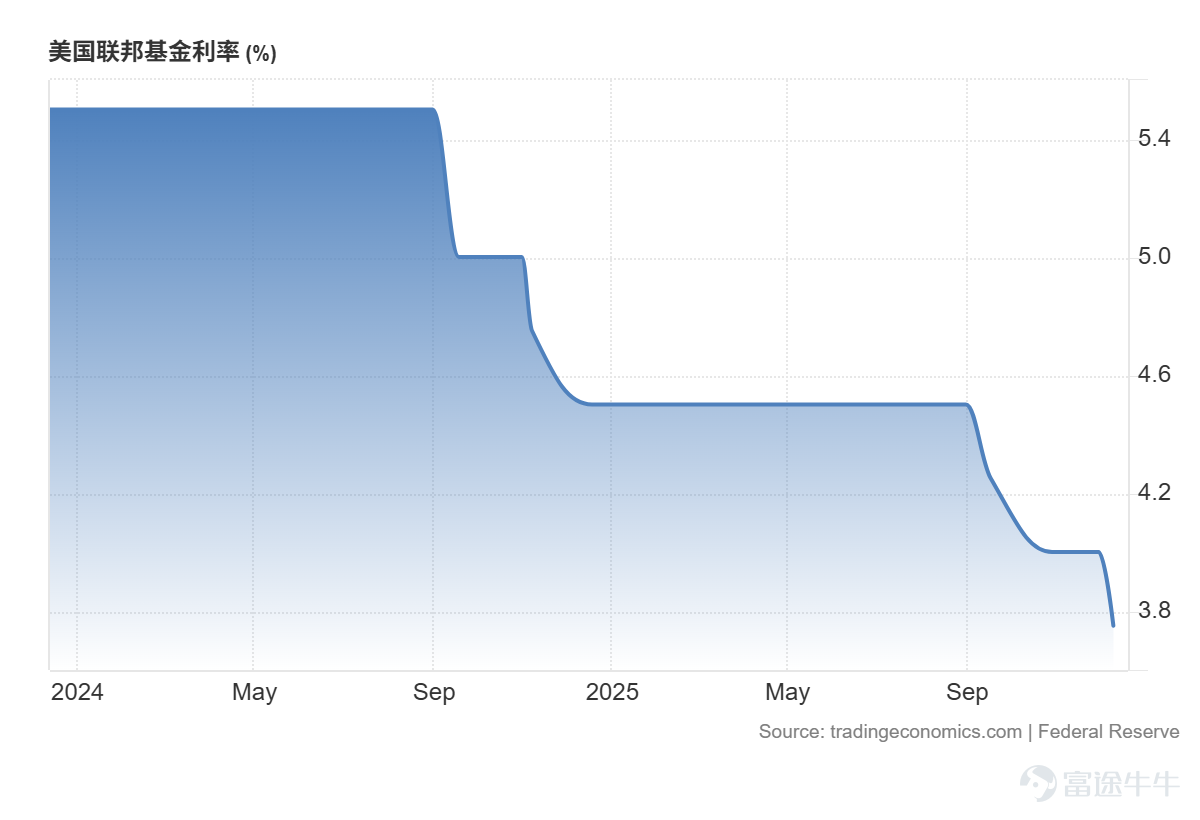
According to the previous definition of a rate-cutting cycle, in September 2024, the Fed lowered interest rates by 50 basis points from a peak of 5.25%-5.50%, marking the official start of this rate-cutting cycle. As of December 2025,a total of six rate cuts have been completed,with a cumulative reduction of 175 basis points,Interest rates have been cut to the range of 3.50%-3.75%。
An easing cycle refers to a period when the federal funds rate is consecutively lowered by at least 50 basis points (bps) from its peak, typically in response to economic recessions, slowing inflation, or financial crises.
Based on historical reviews, this round of rate cuts is highly similar to thePreventive rate cutsof 1995 and 1998 — both aimed at addressing risks of slowing economic growth. Specifically:
• September 18, 2024
The first rate cut of 50 bps occurred on September 18, 2024, with interest rates being lowered from the 5.25%-5.50% range to 4.75%-5.00%.
At that time, economic signals were already quite clear: ADP data showed weak job growth in the private sector, while the unemployment rate, though still low, had risen slightly. The U.S. economy appeared to be expanding moderately on the surface but was actually facing dual pressures from potential risks in domestic financial markets and external trade frictions. The core purpose of the rate cut was to counteract the risk of economic downturns.
• November and December 2024
Two consecutive rate cuts of 25 bps each occurred in November and December 2024, gradually bringing the policy rate down to the 4.25%-4.50% range.
Significant divisions within the Fed were evident at the December 2024 interest rate meeting: among the 19 officials present, 8 supported further interest rate cuts in 2025 (some advocated lowering rates to the 2% range), while 7 opposed continued easing (3 of whom favored a rate hike). The divergence between hawkish and dovish stances foreshadowed potential future policy shifts.
• January to May 2025
Maintain policy rate stability. During this period, US economic data showed fluctuating characteristics, with divergent trends in the labor market and inflation. The Fed entered a policy observation phase and temporarily halted its easing pace.
• September, October, and December 2025
Restarted the rate cut cycle, implementing 25-basis-point cuts in September, October, and December. Given the ongoing cooling trend in the labor market and temporary easing of inflationary pressures, the Fed fine-tuned its easing measures, ending the year with a policy rate range of 3.50%-3.75%.
The December rate cut decision passed with a 7-3 vote, the highest number of dissenting votes since September 2019, further intensifying internal divisions.
![On January 28, 2026, the Federal Reserve announcedpause rate cutsthat it would keep the federal benchmark rate in the range of 3.5%-3.75%, ending three consecutive rate cuts since September 2025. The meeting statementremoved the phrase 'increased employment risks'andupgraded its assessment of economic activity from 'moderate' to 'solid', signaling cautious policy. Review our previous column analysis ([Share Link: 'How Major Assets Performed During the Seven Rate Cut Cycles Since 1980?'][Share Link: Looking Back at the Fed's Rate Cuts: How Have Bonds of Different Maturities Performed?]), the pace and type (preventive/recession-driven) of rate cuts,and changes in economic fundamentalshave always been the core variables influencing asset trends. How many rate cuts have occurred since 2024? Why was there a pause?This article will review the current round of rate cuts and analyze the underlying logic behind pausing them based on historical experience. Review: The Rate Cut Actions Since September 2024 (as of January 2026) According to the previous definition of a rate-cutting cycle, in September 2024, the Federal Reserve lowered the interest rate by 50 basis points from its peak range of 5.25%-5.50%, marking the official start of this rate-cutting cycle. As of December 2025,a total of six rate cuts have been completed,with a cumulative reduction of 175 basis points,The interest rate has been cut to the 3.50%-3.75% range。 An easing cycle refers to a period when the federal funds rate is consecutively reduced by at least 50 basis points (bps) from its peak, typically indicating...](https://nnqimage.futunn.com/sns_client_feed/12486530/20260128/web-1769572081769-jkahpuxAlA.png/big?area=1&is_public=true&imageMogr2/ignore-error/1/format/webp)
Behind the Pause: Balancing Inflation, Employment, and Economic Growth
At the January 28 meeting, Fed Chair Jerome Powell stated that the currenteconomy is showing 'solid expansion',Signs of stabilization in the labor market are emerging, although inflation is higher than the target,The impact of tariffs may have peaked,Future policies will be data-dependent, emphasizing the maintenance of the Federal Reserve's independence. After last year’s cumulative rate cuts of 75 basis points,The current level of U.S. interest rates is already close to or within the neutral rate range.At present, the situation faced by the Federal Reserve is:Inflation is facing obstacles in its decline, while employment deterioration remains limited.
Inflation: Declines are obstructed; persistence is more stubborn than expected
Whether inflation can continue to fall to the 2% targetis the core anchor point for the Federal Reserve’s pace of rate cuts—a fact we highlighted in our previous analysis of the 1995 soft-landing case. The latest data shows thatNovember's PCE and core PCE were both 2.8% year-over-year., the rate of decline is notably slower compared to the first half of 2025. This aligns with our earlier warning that 'inflation persistence might exceed expectations,' and overly aggressive interest rate cuts could lead to a rebound in inflation, repeating the stagflation mistakes of the 1970s.
Employment: The job market shows divergent pressures, and its stability still requires observation.
The employment situation is another key target for the Fed’s interest rate cuts. The current U.S. employment landscape exhibits divergence:
On one hand, non-farm payroll growth fell short of expectations, data was revised downward, and the private sector remained sluggish. Data released by the U.S. Bureau of Labor Statistics (BLS) on January 9 showed that the U.S. non-farm payroll only increased by 50,000 in December 2025, below market expectations of 65,000. Coupled with an annual increase of just 584,000 jobs, this marks the weakest annual performance since the pandemic in 2020.
On the other hand,In December 2025, the U.S. unemployment rate dropped to 4.4%, lower than the market expectation of 4.5%, showing clear improvement from 4.6% in November. Wage growth remained robust at 3.8% year-over-year, indicating some relief in the deterioration of employment conditions.
This‘weak growth but falling unemployment rate’divergence essentially reflects structural adjustments in the U.S. labor market—modest recovery in labor force participation has driven down the unemployment rate, but weaker hiring intentions among companies have pressured employment growth. For the Fed, the job market neither shows signals of a recession requiring urgent loosening measures nor achieves an ideally stable state. This ambiguity leads policymakers to pause rate cuts, waiting for more data to confirm the true trend in the labor market.
Economy: Growth resilience exceeds expectations, providing support for a pause.
The resilience of the current U.S. economic growth is stronger than market expectations. The Bureau of Economic Analysis (BEA) released updated estimates for Q3 2025 GDP data, showing thatthe real gross domestic product (GDP) grew at an annual rate of 4.4% in Q3, accelerating from the 3.8% growth rate in Q2, and was revised up by 0.1 percentage points from the preliminary estimate.。
In terms of growth drivers, the coordinated expansion of consumer spending, exports, government spending, and investment has become a core support, while a decline in imports further boosted GDP growth. From an industry perspective, private services and manufacturing performed notably, with actual value-added increasing by 5.3% and 3.6%, respectively, offsetting a 0.3% decline in government sector value-added.
![On January 28, 2026, the Federal Reserve announcedpause rate cutsthat it would keep the federal benchmark rate in the range of 3.5%-3.75%, ending three consecutive rate cuts since September 2025. The meeting statementremoved the phrase 'increased employment risks'andupgraded its assessment of economic activity from 'moderate' to 'solid', signaling cautious policy. Review our previous column analysis ([Share Link: 'How Major Assets Performed During the Seven Rate Cut Cycles Since 1980?'][Share Link: Looking Back at the Fed's Rate Cuts: How Have Bonds of Different Maturities Performed?]), the pace and type (preventive/recession-driven) of rate cuts,and changes in economic fundamentalshave always been the core variables influencing asset trends. How many rate cuts have occurred since 2024? Why was there a pause?This article will review the current round of rate cuts and analyze the underlying logic behind pausing them based on historical experience. Review: The Rate Cut Actions Since September 2024 (as of January 2026) According to the previous definition of a rate-cutting cycle, in September 2024, the Federal Reserve lowered the interest rate by 50 basis points from its peak range of 5.25%-5.50%, marking the official start of this rate-cutting cycle. As of December 2025,a total of six rate cuts have been completed,with a cumulative reduction of 175 basis points,The interest rate has been cut to the 3.50%-3.75% range。 An easing cycle refers to a period when the federal funds rate is consecutively reduced by at least 50 basis points (bps) from its peak, typically indicating...](https://nnqimage.futunn.com/sns_client_feed/12486530/20260128/web-1769573107849-jxB0hByxXD.png/big?area=1&is_public=true&imageMogr2/ignore-error/1/format/webp)
Considering these three aspects, the combination of a heated economy and ambiguous employment trendswill bring the Federal Reserve’s focus back to inflation.Pausing interest rate cuts has become the natural choice during this “observation period.”
(Note: This article is based on publicly available information and historical data and does not constitute investment advice.)
[Column Preview]
Thank you for reading this analysis of the rate-cutting cycle! This column will continue to update on the Federal Reserve's interest rate policy developments, providing systematic and in-depth market interpretations based on historical patterns and current similarities and differences.
What content would you like to see next? Which indicators or data do you want us to help interpret most? And any other macroeconomic themes or investment strategy questions you care about, feel free to leave a comment!
Your feedback will help us provide more focused and practical content. Looking forward to continuing the discussion with you in the next issue!
$S&P 500 Index (.SPX.US)$ $Nasdaq Composite Index (.IXIC.US)$ $Dow Jones Industrial Average (.DJI.US)$ $Hang Seng Index (800000.HK)$ $Hang Seng TECH Index (800700.HK)$$U.S. 2-Year Treasury Notes Yield (US2Y.BD)$$U.S. 10-Year Treasury Notes Yield (US10Y.BD)$$iShares 0-3 Month Treasury Bond ETF (SGOV.US)$$SPDR Bloomberg Barclays 1-3 Month T-Bill ETF (BIL.US)$$iShares 1-3 Year Treasury Bond ETF (SHY.US)$$iShares 3-7 Year Treasury Bond ETF (IEI.US)$$iShares 7-10 Year Treasury Bond ETF (IEF.US)$$iShares 20+ Year Treasury Bond ETF (TLT.US)$
Risk Disclaimer: The above content only represents the author's view. It does not represent any position or investment advice of Futu. Futu makes no representation or warranty.Read more


Comments
to post a comment
3
3