
有沒有一種戰法可以穿越牛熊市?

DeepWay Technology Accumulated Losses Exceed 1.7 Billion: High Payables and Overlapping Major Customers & Suppliers Weaken Current Ratio
Recently, DeepWay Technology Co., Ltd. (hereinafter referred to as 'DeepWay Technology') filed for an IPO on the Hong Kong Stock Exchange, with CICC and China Merchants Bank International acting as joint sponsors.
In this IPO, DeepWay plans to primarily use the proceeds for R&D; sales and after-sales service network expansion; infrastructure development; working capital and general corporate purposes.
99% of revenue comes from a single business line, with cumulative losses exceeding 1.7 billion yuan
Tianyancha shows that DeepWay was founded in 2020 as a technology company specializing in new energy heavy trucks and intelligent road freight solutions. The company is focused on leveraging electrification and intelligent technologies to drive the global road freight industry towards a zero-carbon, efficient, and safe new phase of logistics.
According to CIC Consulting, the global road freight market is vast, reaching $3.9 trillion in 2024, making it an essential component of the modern economy. However, the industry has long been constrained by three major pain points: high carbon emissions, high total cost of ownership, and safety risks. DeepWay is committed to addressing these issues through electrification and intelligent technologies.
DeepWay chose trunk road freight, which accounts for over 50% of road freight capacity, as its entry point and began commercializing its technology in 2023. During the performance record period, the company's revenue mainly came from sales of new energy heavy trucks and parts.

From 2023 to 2024 and January-June 2025, revenue from new energy heavy truck sales was 425 million yuan, 1.961 billion yuan, and 1.497 billion yuan, accounting for 99.9%, 99.6%, and 99.4% of revenue during the respective periods, making it the company’s primary source of income.
DeepWay noted that the company expects revenue from new energy heavy truck sales to continue growing, while also planning to generate additional revenue through intelligent road freight solutions. However, based on its revenue structure, DeepWay remains highly dependent on new energy heavy truck sales, posing a risk of reliance on a single business line.
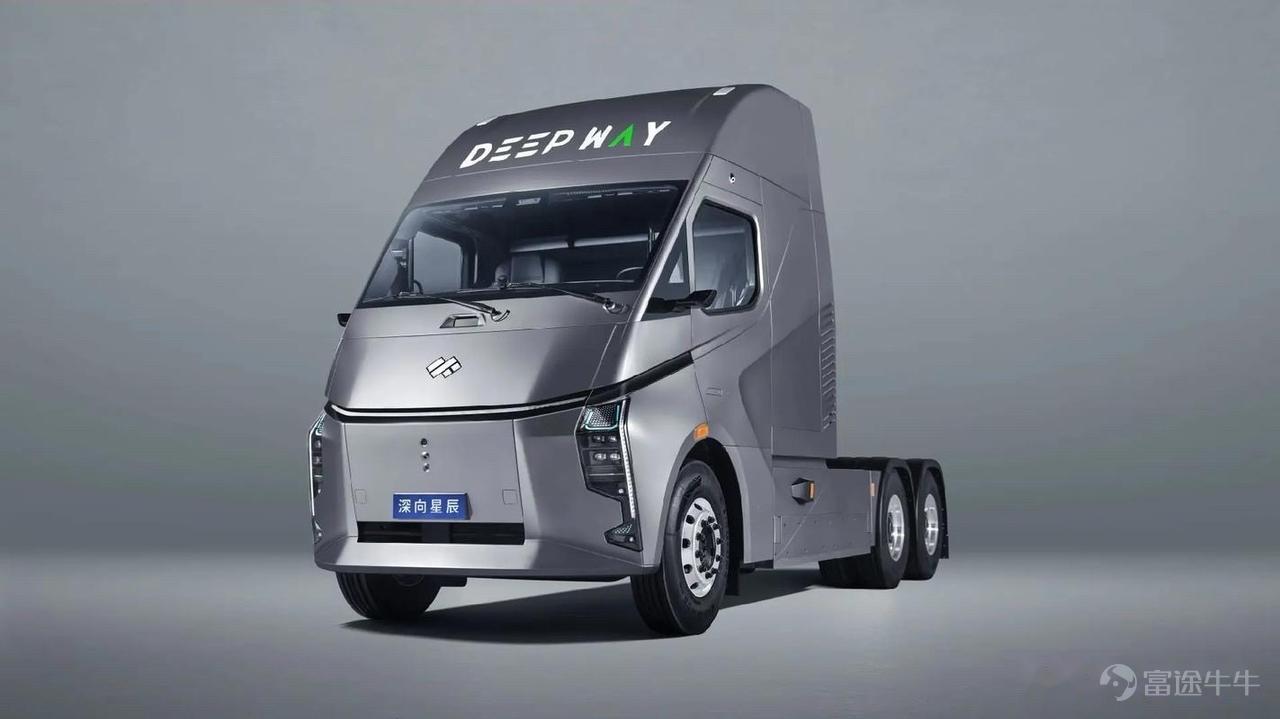
From 2023 to 2024 and January-June 2025, DeepWay delivered 509, 3,002, and 2,873 new energy heavy trucks, respectively, most of which were the DeepWay StarAdder model. The suggested retail price for the company’s new energy heavy trucks typically ranges from 470,000 to 700,000 yuan (including VAT). Starting May 2025, DeepWay began producing the DeepWay StarRoute model, delivering 130 units of this model by June 30, 2025.
Despite relying on new energy heavy trucks for the majority of its revenue, DeepWay's overall revenue scale has grown rapidly. However, the company still faces challenges such as low gross profit margins, indicating room for improvement in overall profitability.
From 2022 to 2024 and January-June 2025 (hereinafter referred to as the reporting period), DeepWay generated revenue of 0, 427 million yuan, 1.969 billion yuan, and 1.506 billion yuan, with gross profits of 0, 1.8 million yuan, 9.8 million yuan, and 44.1 million yuan, respectively. Revenue growth in 2024 and January-June 2025 was 362.5% and 97.5%, respectively.
More concerning is that as a technology-driven company, DeepWay Tech has maintained high upfront expenditures, with expanding losses in each period and cumulative losses exceeding 1.7 billion yuan.
During the reporting period, the company's net profits were -266 million yuan, -389 million yuan, -675 million yuan, and -371 million yuan, respectively.
In 2023-2024 and January-June 2025, the company’s net profit margins were -91.4%, -34.3%, and -24.6%, while gross profit margins were 0.4%, 0.5%, and 2.9%, respectively.
DeepWay Tech stated: As the company's business scale continues to expand, it has not yet achieved profitability, mainly because its R&D and technological innovation are still in the early investment stage. However, during the performance record period, the company’s net loss ratio narrowed, reflecting improvements in operational efficiency and cost structure. Looking ahead, the company expects to achieve sustainable growth and profitability by increasing revenue, improving gross margin, and controlling and optimizing operating costs.
Zhang Xiang, Chief Expert of New Energy at Grand International Exhibition Co., Ltd., noted that the new energy heavy truck sector is not as large-scale as the passenger vehicle sector, and currently, the adoption of new energy in heavy trucks is still in its infancy. Moreover, the penetration rate of new energy heavy trucks is much lower than that of passenger vehicles, so the company is still in the cash-burning phase and has yet to turn a profit.
During the reporting period, the company’s R&D expenses were 231 million yuan, 352 million yuan, 365 million yuan, and 179 million yuan, respectively; sales and marketing expenses were 0, 30.736 million yuan, 120 million yuan, and 75.059 million yuan, respectively; administrative expenses were 28.249 million yuan, 75.124 million yuan, 121 million yuan, and 64.560 million yuan, respectively.
To put it more intuitively, in 2023-2024 and January-June 2025, the company’s R&D expenses accounted for approximately 82%, 18%, and 11% of the corresponding period’s revenue, respectively.
Explosive increase in payables; positive cash flow in H1 2025
DeepWay Tech’s upstream suppliers mainly include customized truck partners as well as cell, automotive electronics, R&D services, and equipment suppliers, while downstream customers mainly consist of industrial and consumer goods express service providers, logistics companies, port and mining operators, and sales and service providers who can resell, lease, or use trucks, along with several battery leasing companies.
What drew significant market attention was that DeepWay Tech gradually increased its procurement from key suppliers during the period. In 2024, purchases from the top five suppliers accounted for 90% or more of total purchases. Moreover, in the same year, the top five customers contributed more than half of total revenue. This reliance on a small number of suppliers and customers undoubtedly impacts the stability of the company’s revenue structure.
During the reporting period, the company's procurement amounts from its top five suppliers were RMB 56.6 million, RMB 839 million, RMB 3.372 billion, and RMB 3.178 billion, accounting for 48.1%, 88.1%, 92.3%, and 83.1% of total purchases during each respective period. Meanwhile, the procurement amounts from the largest supplier were RMB 19.7 million, RMB 608 million, RMB 2.229 billion, and RMB 1.606 billion, respectively representing 16.8%, 63.8%, 61.0%, and 42.0% of total purchases during the corresponding periods.
On the other hand, during the reporting period, revenue generated from the top five customers was RMB 0, RMB 351 million, RMB 999 million, and RMB 774 million, accounting for 0%, 82.5%, 50.7%, and 51.4% of total revenue during each respective period. In the same periods, revenue from the largest customer was RMB 0, RMB 148 million, RMB 505 million, and RMB 258 million, accounting for 0%, 34.8%, 25.7%, and 17.1% of total revenue during the respective periods.
Additionally, Shenzhen Xiang Technology pointed out that there are overlaps between customers and suppliers. One of the company’s top five customers is also one of its top five suppliers. Specifically, Customer A (a subsidiary of Supplier A) purchases batteries from Shenzhen Xiang Technology to rent them to end users, while Supplier A supplies batteries to Shenzhen Xiang Technology for use in the company’s new energy heavy trucks.
While concentration in the upstream and downstream supply chains remains high, it has also introduced new financial risk issues, with the most prominent being a sharp increase in the company’s trade and other payables.
During each reporting period, the company’s inventory was RMB 4.05 million, RMB 149 million, RMB 158 million, and RMB 462 million, respectively. The inventory turnover days for 2023, 2024, and January-June 2025 were 66 days, 29 days, and 38 days, respectively.
The company’s trade and other receivables during each period were RMB 39.426 million, RMB 321 million, RMB 1.175 billion, and RMB 1.415 billion, respectively. Trade receivables turnover days for 2023, 2024, and January-June 2025 were 72 days, 108 days, and 136 days, respectively.
In terms of liabilities, at the end of each reporting period, Shenzhen Xiang Technology’s trade and other payables were RMB 105 million, RMB 196 million, RMB 1.093 billion, and RMB 2.38 billion, respectively. Net current liabilities were -RMB 531 million, -RMB 994 million, -RMB 1.717 billion, and -RMB 2.092 billion, respectively.
Due to limited self-sustaining capabilities, Shenzhen Xiang Technology heavily relies on bank loans to maintain its operational expenses. At the end of each reporting period, the company’s bank borrowings were RMB 100,000, RMB 20 million, RMB 590 million, and RMB 742 million, respectively. As of the end of September 2025, the company’s bank borrowings increased to RMB 812 million.
At the end of each reporting period, net cash flow from operating activities was -RMB 225 million, -RMB 715 million, -RMB 430 million, and RMB 509 million, respectively. The company’s cash flow turned positive in the first half of 2025.
Shenzhen Xiang Technology stated: 'The cash inflow of RMB 509 million recorded in 2025 was mainly due to the company’s pre-tax loss of RMB 371 million, adjusted for non-cash and non-operating items, including a fair value loss of RMB 75 million on financial liabilities measured at fair value through profit or loss, depreciation of property, plant, and equipment of RMB 22.6 million, and financing costs of RMB 11.4 million. These amounts were further adjusted for changes in working capital, primarily an increase of RMB 125.7 million in trade and other payables; partially offset by an increase in inventory of RMB 305 million and an increase in trade and other receivables of RMB 244 million.'
As of the end of each reporting period, DeepWay Technology's financial liabilities measured at fair value through profit or loss were RMB 4.65 billion, RMB 13.9 billion, RMB 18.96 billion, and RMB 21.91 billion, respectively.
In terms of solvency, during each reporting period, the company's current ratios were 0.2, 0.4, 0.5, and 0.6, which have long been below 1, indicating significant debt repayment pressure.
The second-largest shareholder, Baidu, has related-party transactions.
As of the latest practicable date, founder, chairman, and CEO Jun Wan directly holds 4.68% of DeepWay Technology’s shares; Shanghai Junwei, Beijing Chengyue, and employee incentive platforms, together with Jun Wan, jointly control approximately 26.22% of the issued shares. Through this concert party arrangement, Jun Wan collectively controls 26.22% of the company's shares and is the actual controller of the company. The second-largest shareholder, Baidu, holds 17.28% of the company’s shares.
DeepWay Technology stated in its prospectus that its business relies on cloud technology operations, and certain data is stored in cloud databases. The company depends on cloud services in multiple aspects.
During the reporting period, the amounts of related-party transactions for the procurement of cloud services and OTA services from Baidu were RMB 4.081 million, RMB 4.075 million, RMB 3.884 million, and RMB 1.943 million, respectively.
DeepWay Technology expects that from 2026 to 2028, the maximum annual aggregate amount payable under the Baidu service framework agreement will be RMB 31.7 million, RMB 54.5 million, and RMB 86.1 million, respectively.
On September 30, 2021, DeepWay Technology entered into an Intellectual Property License Agreement (the "License Agreement") with Baidu. Under the License Agreement, Baidu allows the company to use certain patents registered in China (including patents under examination or already approved as of the date of the License Agreement) (the “Licensed Patents”) and software (namely Apollo Driving Assistance Software, named Apollo ANP v2.0) (together with the Licensed Patents, collectively referred to as the “Licensed Intellectual Property”) in its main business operations in China, on a royalty-free basis in perpetuity starting from the date of the License Agreement. The consideration for the license was RMB 145 million, to be settled by 2025. (Produced by Harbor Finance)
"Harbor Business Observation" by Shi Zifu
Risk Disclaimer: The above content only represents the author's view. It does not represent any position or investment advice of Futu. Futu makes no representation or warranty.Read more
Comments
to post a comment