
Amazon Releases Latest AI Chip to Compete with NVIDIA and Google!

Google Soars, NVIDIA Plummets! TPU vs GPU: Who Will Dominate the Future of AI Computing Power? Which Industrial Chains Are Expected to Benefit?
Amid lingering concerns over an 'AI bubble', $Alphabet-C (GOOG.US)$with its globally impressive Gemini 3 large model and full-stack AI capabilities, it has become the most prominent player in the U.S. tech sector, with its stock price surging recently.
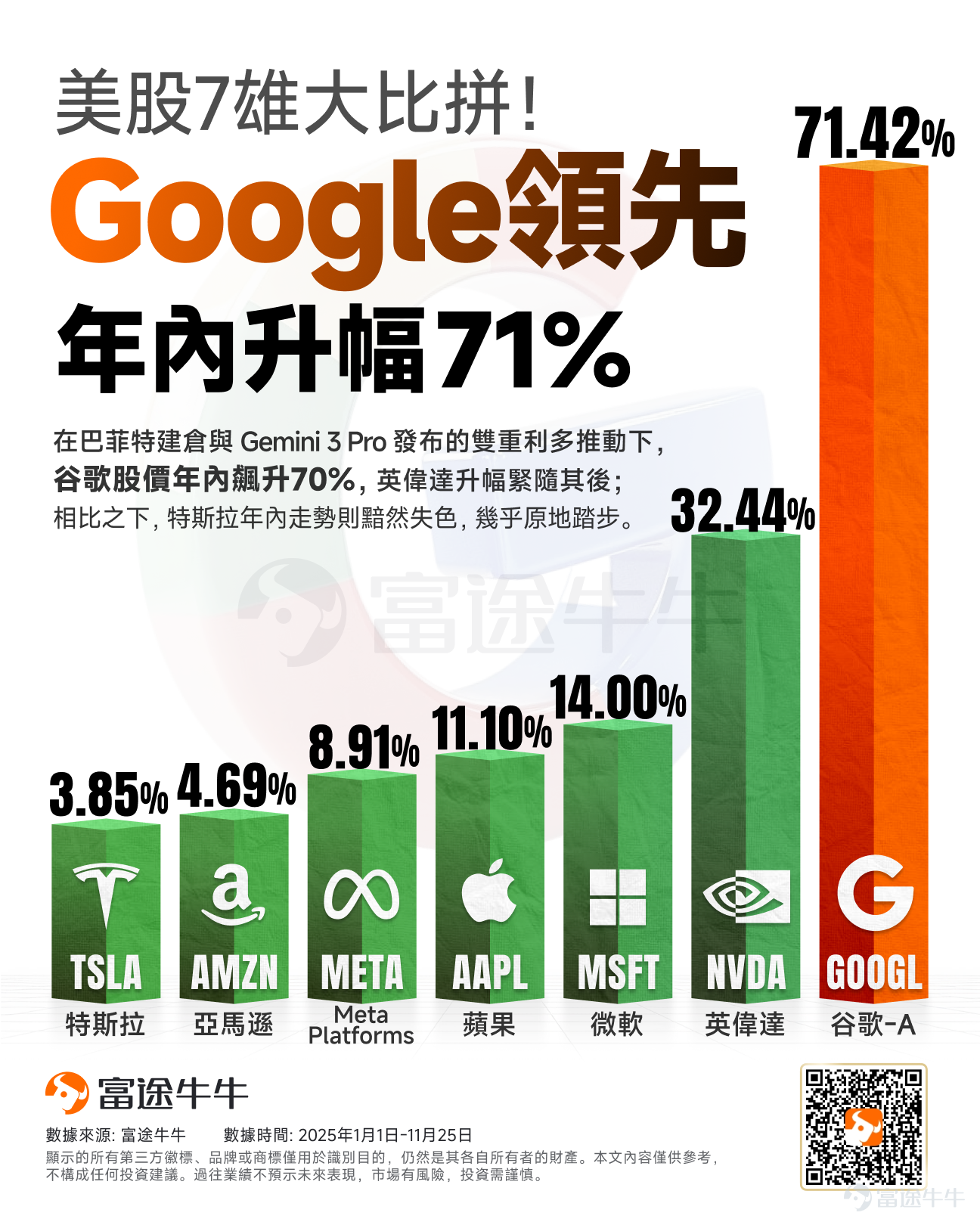
This month alone, Google’s stock price has risen more than 14%, bringing its market capitalization just shy of joining the $4 trillion club.So far this year, the cumulative increase has been approximately 70%, making it the top performer among the 'Mag 7' in the U.S. stock market.
The sudden rise of Google's AI chips has become $NVIDIA (NVDA.US)$a major factor in the continuous decline of the company's share price, resulting in a $1 trillion loss in market value in less than a month.

As Google's stock price repeatedly hits new highs, funds are rotating out of chip giant NVIDIA towards Google. On the surface, the market logic is that Google's TPUs will replace NVIDIA's GPUs.However, the fundamental flaw in this narrative lies in the simplistic analogy of the two as 'interchangeable chips.'
Can TPUs really replace GPUs?
The core difference between TPUs and GPUs lies in 'specialization' versus 'generalization.'TPUs are like top-tier racing cars specifically built for the AI track—exceptionally efficient with controllable costs; whereas GPUs resemble versatile off-road vehicles capable of adapting to various terrains. Precisely because TPUs sacrifice generalization to focus on specialization, they achieve superior cost-performance ratios in large model tasks.

Produced by banana2
NVIDIA's core competitive advantagelies in its 'hardware-software integration' moat built around CUDA, rather than the hardware itself.A mature developer ecosystem, comprehensive toolchains, and extensive model compatibility make GPUs the default choice for enterprises and cloud service providers (such as AWS and Azure).
In contrast, TPUs are deeply coupled with Google Cloud services, presenting a high usage barrier: models often require specific optimizations, deployment processes are complex, and software adaptability is limited. This essentially creates a 'vendor lock-in' effect, confining users within Google's ecosystem.
Therefore,TPUs and GPUs do not represent a simple substitution relationship but rather an embodiment of specialized division of labor within the AI computing power market:GPUs continue to dominate the broadly demanded general-purpose computing market, while TPUs represent a dedicated computing pathway focused on achieving ultimate efficiency.
Overall,Despite the strong momentum of TPUs, no one—including Google—currently aims to completely replace NVIDIA GPUs.The pace of AI development makes this impossible at present.
Gartner analyst Gaurav Gupta stated,Even though Google has its own chips, it remains one of NVIDIA’s largest customers,because it must maintain flexibility for its clients. If a client's algorithms or models change, GPUs are better suited to handle a broader range of workloads.
Meryem Arik, CEO of AI startup Doubleword, also noted,Google’s TPUs primarily attract a small number of companies with substantial computing expenses.Such as Meta and Anthropic. Moreover, there is a key limitation:"Once you use TPUs, you are locked into Google's cloud ecosystem."AI developers can only access TPUs through Google’s own cloud services, whereas using NVIDIA GPUs offers greater flexibility.
Ben Barringer, Head of Technology Research at Quilter Cheviot, pointed out that the chip industry"is not a zero-sum game with only one winner."In fact, even tech companies that have contracted for TPUs are still making significant investments in NVIDIA chips. For instance, just weeks after Anthropic reached a TPU agreement with Google, it announced a major deal with NVIDIA.
Is NVIDIA a good buy on the dip?
Recently, NVIDIA, which once boasted a market capitalization of $5.15 trillion, saw its value shrink by $1 trillion in less than a month, falling from $5.15 trillion to $4.15 trillion.
Overnight, NVIDIA, in a rare move following a sharp drop in its stock price, proactively addressed concerns that its dominance in the artificial intelligence (AI) chip sector might be challenged by Google.
NVIDIA posted that it currently leads the industry by a generation.It is the only platform capable of running all AI models and being versatile across various computing scenarios, emphasizing that its chips offer 'higher performance, versatility, and interchangeability' compared to Google's TPU and other ASIC chips.Google stated that the demand for its custom TPUs and NVIDIA GPUs is accelerating, and it will continue to support both as usual.
Notably, the strong performance of Gemini 3 has also pressured its competitors into increasing their procurement of NVIDIA chips to engage in more intense model training competitions.
In terms of valuation, NVIDIA's Forward P/E is approximately 24x.Bank of America's latest view also indicates that the market for AI data centers is rapidly expanding, with the market size expected to grow fivefold by 2030, surpassing $1.2 trillion. At that time, NVIDIA will still dominate the market, but its market share may decrease from the current estimate of 85% to 75%. The bank believes thatNVIDIA is currently significantly undervalued, with substantial potential for earnings growth.

Additionally, although Google's chain has recently shown strong upward momentum, the outlook for NVIDIA's chain should not be underestimated:
For more on Google's chain, click here >>New Trends in AI Investment! Google Emerges as the Strongest Leader Among the Magnificent Seven; Which Companies Are the 'Hidden Champions'?

Specifically:
Memory: HBM includes SK Hynix ( $CSOP SK Hynix Daily Max (2x) Leveraged Product (07709.HK)$ ), Samsung Electronics ( $CSOP Samsung Electronics Daily Max (2x) Leveraged Product (07747.HK)$ )、 $Micron Technology (MU.US)$ ; HDD includes $Seagate Technology (STX.US)$ ; SSD includes $Western Digital (WDC.US)$ ;
Communication:Optical modules include $Coherent (COHR.US)$ 、 $Fabrinet (FN.US)$ ; copper interconnects include $Amphenol (APH.US)$ 、 $Credo Technology (CRDO.US)$ ;
Heat dissipation: $Vertiv Holdings (VRT.US)$ 、Power supply: $INNOSCIENCE (02577.HK)$ 、PCB: $TTM Technologies (TTMI.US)$ ;
In fact, the Mag 7 remain in fierce competition, constantly striving to outperform one another. Today, Google announces positive developments; tomorrow, Tesla achieves a breakthrough; and the day after, Microsoft unveils new progress.This ongoing rotation of leadership, with no company willing to fall behind, not only drives these tech giants to continuously enhance their competitiveness but also collectively propels the upward spiral of their market valuations.
Risk Disclaimer: The above content only represents the author's view. It does not represent any position or investment advice of Futu. Futu makes no representation or warranty.Read more


Comments (10)
to post a comment
92
261