
Amazon Releases Latest AI Chip to Compete with NVIDIA and Google!

Learn Investing from the Titans | Debunking the AI Bubble Theory! Buffett Makes a Large Investment in Google — What’s the Logic Behind It?
Over the weekend, a piece of news swept through investment circles.
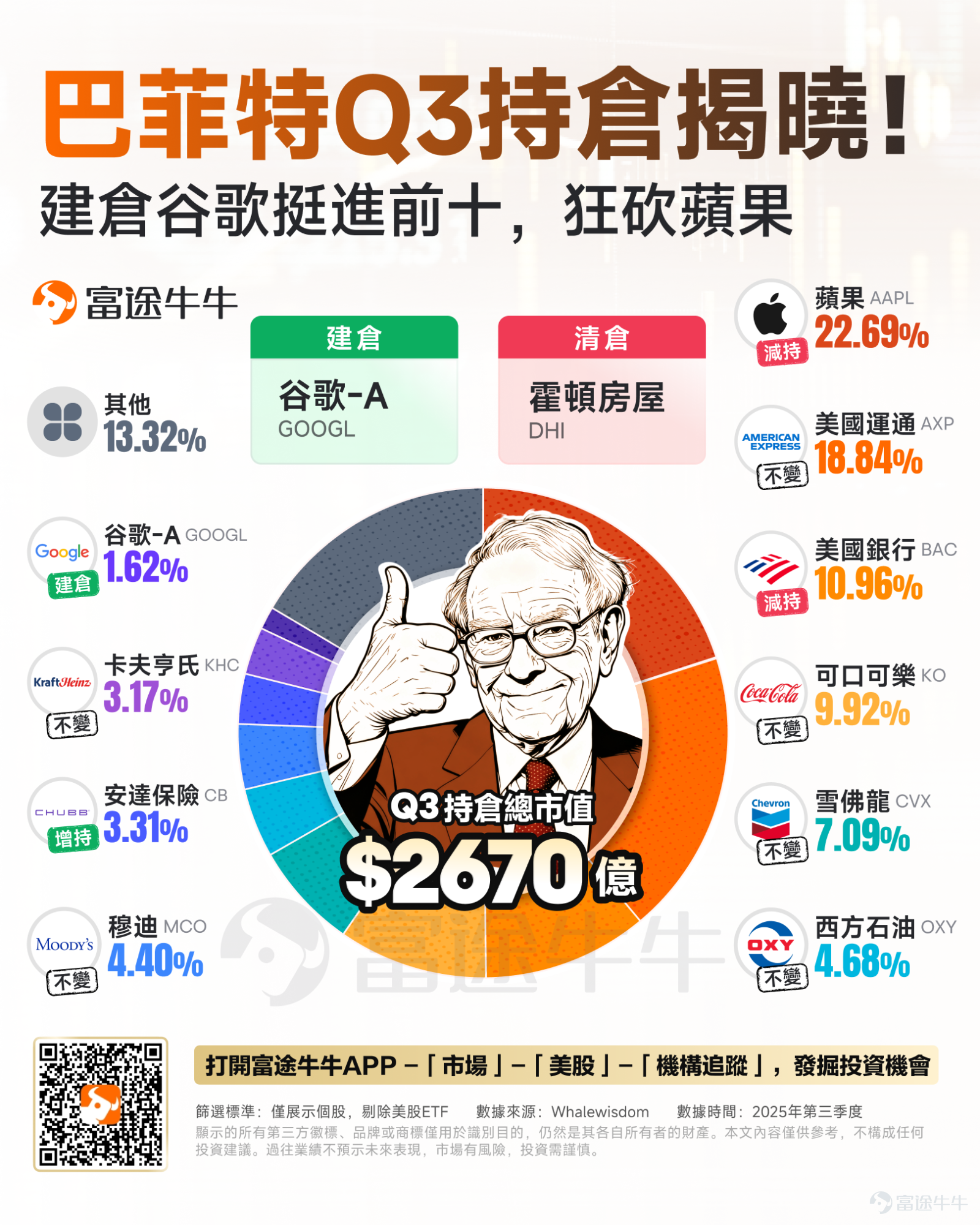
Berkshire Hathaway, led by the Oracle of Omaha, Warren Buffett, $Berkshire Hathaway-A (BRK.A.US)$released its holdings report showing that as of the end of the third quarter this year, the company had established a position worth $4.3 billion in $Alphabet-C (GOOG.US)$ , and continue to reduce holdings $Apple (AAPL.US)$ 。This is also very likely to be the last major investment move by the company before Buffett’s retirement at the end of this year.

However, many investors may wonder why Berkshire Hathaway invested in Google? What are the next moves from Google that are worth anticipating? These questions will be addressed one by one.
Why did Berkshire Hathaway invest in Google?
Considering Buffett's traditional value investing philosophy and his cautious stance toward high-growth technology stocks, this move is surprising. However, a closer examination of Google's business reveals that Buffett’s investment might be replicating what he achieved with Apple.
Based on Google’s Q3 earnings report, the company's revenue, profit, and full-year capital expenditure guidance all exceeded analysts' expectations, with several key businesses achieving double-digit percentage growth,The Gemini app has more than 650 million monthly active users.Segmented business data:
- Cloud Revenue: Google Cloud revenue for Q3 was $15.16 billion, compared to analyst expectations of $14.75 billion.
– Service Revenue: Google’s service revenue in Q3 was $87.05 billion, surpassing analysts’ expectations of $84.67 billion.
– Search and Other Revenue: Google’s search and other revenue in Q3 amounted to $56.57 billion, exceeding analysts’ expectations of $54.99 billion.
– YouTube Advertising Revenue: YouTube advertising revenue in Q3 reached $10.26 billion, above analysts’ forecasts of $10.03 billion.
– Google Advertising Revenue: Google’s advertising revenue in Q3 totaled $74.18 billion, surpassing expectations of $72.46 billion.
– Google Cloud Backlog: At the end of Q3, Google Cloud’s order backlog stood at $155 billion.
– Other Bets: Including autonomous vehicle company Waymo and life sciences division Verily, generated revenue of $429 million but incurred an operating loss of $1.1 billion.

Source: APP ECONOMY INSIGHTS
From the business performance outlined above,the advertising segment, as the primary revenue driver, contributes the majority of the company’s profits, while cloud services represent the second growth curve for the company.
Goldman Sachs noted in its latest research report thatIn its Q3 earnings report, Google comprehensively showcased the competitive advantages of its "full-stack AI" strategy.
Analyst Eric Sheridan noted thatfrom foundational model development, cloud computing infrastructure to consumer and enterprise applications, Google has successfully positioned itself across all segments of the AI value chain. This vertical integration capability is translating into tangible financial returns.
As we previously discussed in"Targeting NVIDIA! Google Launches Most Powerful Chip—What Opportunities in the Supply Chain Should Investors Watch?",Google is the company quietly reaping profits across the AI value chain—all while remaining under the radar. Google is the only company that operates as a full-stack artificial intelligence provider: data → algorithms → hardware → cloud servers.

Recall that when Warren Buffett invested in Apple back in 2016, many joked that he was 'finally catching up with the smart era.' However,what he valued was not the smartphone itself but its powerful ecosystem moat.Once users enter the closed-loop system created by devices like the iPhone and MacBook, they find it difficult to leave due to high switching costs.
Today, he examines Google with the same logic.What he is investing in is not the cutting-edge AI technology itself,but its strategic positioning as the "water, electricity, and coal" of a new era—a form of infrastructure that becomes indispensable to businesses and society once adopted.This is Buffett: always cutting to the essence of business while others chase appearances.
Additionally, investor @laochenusa on social media platform X stated that the following three charts explain why Buffett bought Google and sold Apple:
Revenue Trend Divergence:GOOG continues to rise, while AAPL has remained nearly flat for five years—revenue determines a company’s "future potential," with one expanding and the other stagnating. This is one of Buffett’s most sensitive signals.
Free Cash Flow (FCF):AAPL has passed its peak, while GOOG remains on an upward trajectory—FCF is the metric Buffett values most, as it reflects the real cash flowing into a company. The trend tells us: Apple has entered maturity, while Google is still in its growth phase.
Profit Trend:AAPL’s growth is slowing, while GOOG continues to grow rapidly and has even surpassed AAPL — capital flows only to 'companies with re-accelerating profits,' not to 'stable but non-growing companies.'

Source: X
What developments from Google are worth looking forward to next?
Looking ahead, Google's large AI model Gemini and the next-generation TPU have become the primary focus for investors. At the hardware level, Google’s TPU is beginning to challenge NVIDIA’s GPU dominance; at the model level, Gemini shows impressive performance; and at the application level, Google’s products are being comprehensively restructured by AI.
1. Gemini 3.0 serves as the linchpin of AI-driven narratives
As of the time of writing, data from Polymarket, the world’s largest prediction market, indicates that nearly 90% of participants predict that the highly anticipated Google Gemini 3.0 large model will be released this week. Regarding the specific release date, nearly 79% of market participants are betting on November 18th.

Google CEO Sundar Pichai publicly shared the Polymarket prediction data last weekend, accompanied by a thoughtful “🤔🤔” emoji, further fueling market anticipation.Insiders describe the new model as 'extremely stunning' and anticipate significant improvements in coding and multimedia content generation.
For Google, the release of Gemini 3.0 holds strategic significance.Since the release of ChatGPT at the end of 2022, Google was once considered to be playing catch-up in the AI race, even issuing a "red alert" internally. Citing insiders, Business Insider reported that the new model could give Google an opportunity to take the lead, especially after OpenAI’s ChatGPT-5 failed to make an immediate significant impact.
The most profound implication is that if the capabilities of the new model are systematically validated, AI may be transitioning from a complex "stochastic parrot" to a system with genuine understanding. Mark Humphries, a professor of history at Wilfrid Laurier University in Canada, pointed out: "If this behavior proves to be reliable and replicable, it points to something profound: true reasoning might not require explicit rules or symbolic frameworks to emerge but can arise from scale, multimodality, and sufficient exposure to structured complexity."
Overall, for Google, which has long been involved in the AI race but rarely taken center stage, there are three reasons why Gemini 3.0 is drawing significant attention: 1) With GPT-5's upgrade being labeled as "mediocre," the AI narrative urgently needs a breakthrough that can clearly demonstrate progress; 2) The number of users of Google's Gemini is rapidly approaching the leading position among AI applications previously held by ChatGPT; 3) On the eve of Warren Buffett's retirement, Berkshire Hathaway added Google to its top ten holdings, sparking widespread interest in the capital markets.
Previously,The Ripple Effect of AI Gold Rush! A Comprehensive Overview of Gemini and Anthropic's U.S. Stock 'Circle of Friends'A previous article also outlined Google Gemini's industry chain, which interested fellow investors can click to view.

The first layer consists of AI infrastructure., $Cipher Digital (CIFR.US)$ and $TeraWulf (WULF.US)$ Originally cryptocurrency miners, these entities have now signed long-term contracts with Google to provide services for AI-related computing. Although they have smaller market capitalizations and higher execution risks, they also illustrate how AI demand is spreading into the power and real estate sectors.
The second layer is the chip layer, $Broadcom (AVGO.US)$ which has long provided customized network chips and Ethernet switching solutions for Google's TPU; $NVIDIA (NVDA.US)$ serving as the core computing power carrier for Gemini inference tasks; $Arm Holdings (ARM.US)$ it also provides the CPU design used in Google Axion servers and most mobile devices that will run Gemini functionalities.
The third layer consists of application partners,For example, $Box Inc (BOX.US)$ 、 $Open Text (OTEX.US)$ 、 $Manhattan Associates (MANH.US)$ 、 $Salesforce (CRM.US)$ 、 $S&P Global (SPGI.US)$ 、 $ServiceNow (NOW.US)$ and $Workday (WDAY.US)$ They will integrate Gemini-based agents into their own software suite.
2. A direct challenge to NVIDIA! Google to launch its most powerful AI chip, the TPU Ironwood.
On November 6, Google Cloud announced in its official blog that the company has officially released the seventh-generation TPU (Tensor Processing Unit) — 'Ironwood,' which will be officially launched in the coming weeks.
The company stated thatthis chip is "custom-built for the most demanding workloads,"with performance in training and inference improved fourfold compared to the sixth-generation Trillium TPU.
In fact, NVIDIA's biggest competitor at present is the ASIC chip, with Google's TPU, which is currently developing at the fastest pace, recently securing a multi-billion-dollar contract from Anthropic.
Previously,Targeting NVIDIA! Google launches its most powerful chip—what opportunities in the supply chain are worth watching?This article also provides a detailed analysis of Ironwood’s advantages and related supply chain companies:

Google’s TPU chips are primarily co-designed with $Broadcom (AVGO.US)$ ; manufacturing is completed by $Taiwan Semiconductor (TSM.US)$ 、 $Amkor Technology (AMKR.US)$ , utilizing CoWoS packaging technology; modules are mainly $Celestica (CLS.US)$ Secured an 80% market share, and $Jabil (JBL.US)$ ; Rack assembly $Jabil (JBL.US)$ accounts for 60% of the market share, $Flex Ltd (FLEX.US)$ accounts for 35%; the PCB supply chain is represented by $TTM Technologies (TTMI.US)$ Among others, the leading cable suppliers are $Amphenol (APH.US)$ ; optical modules encompass $Lumentum (LITE.US)$ , while in the fiber optics sector, it is $Yangtze Optical Fiber and Cable (06869.HK)$Its single-mode G.652.D products are used for OCS backbone optical cables, with a market share of 60%; the switches include$Broadcom (AVGO.US)$ 、 $Celestica (CLS.US)$ ; for heat dissipation, it is mainly $Furukawa Electric Co., Ltd. (5715.JP)$ 。
Summary
Google has been the biggest winner in the U.S. stock market so far this year. Driven by the artificial intelligence boom, which has fueled robust growth in Google Cloud, the company's stock price has surged 46% cumulatively.
In 2018, Buffett admitted that despite recognizing Google's advertising potential early on, he failed to invest in the company promptly, which he described as a 'missed opportunity.'Buffett’s reference to 'recognizing Google's advertising potential' pertains to the collaboration between Geico, an auto insurance subsidiary of Berkshire Hathaway, and Google — Geico was an early client of Google, paying the company $10 for each ad click at the time.
There has also been external speculation that the recent acquisition of Google shares was likely executed by one of Berkshire Hathaway's investment managers, either Todd Combs or Ted Weschler.
However, overall,Munger once lamented missing the chance to invest in Google before his passing. Buffett's decision to purchase Google shares before stepping down, to some extent, rectified this long-standing regret.
 Futubull's [Opportunities Page] has launched tracking for celebrity portfolio opportunities! Choose from multiple celebrity portfolios, follow the masters' strategies with one click, precisely lock onto high-quality targets, and invest with greater confidence!
Risk Disclaimer: The above content only represents the author's view. It does not represent any position or investment advice of Futu. Futu makes no representation or warranty.Read more


Comments (646)
to post a comment
529
188