
The battle between Tesla's bulls and bears tests the faith of investors.

Tesla enters its lucky month! Will Musk's trillion-dollar compensation package succeed, and how should investors place their bets?
$Tesla (TSLA.US)$ Tesla announced that it will hold a shareholders' meeting on November 6, during which shareholders will vote on three key proposals.These include the CEO Musk's compensation plan, equity incentive program, and board of directors elections.
Recently, Tesla's stock price has recovered from its April losses and even approached its historical high. The market widely believes thatthis shareholders' meeting could determine Tesla's strategic direction for the next decade and define the ceiling of Tesla’s market valuation.
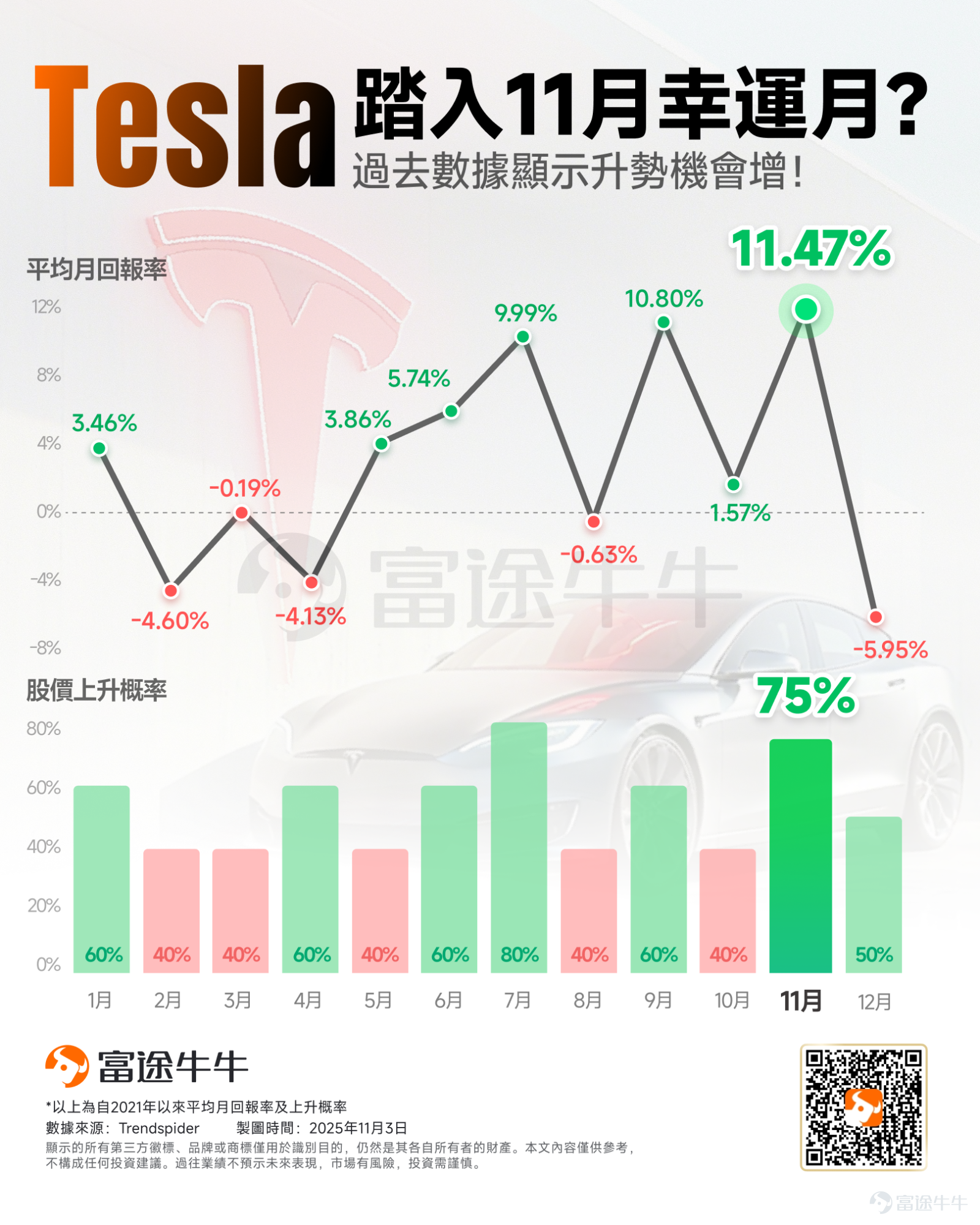
In fact, based on the trend over the past five years, November has been Tesla's second-strongest performing month, with an average monthly return of11.47%, the probability of a stock price increase reached75%。

So, what are the highlights of this shareholders' meeting? How is the market viewing this meeting? How will investors place their bets? This article will explain each point in detail.
What are the highlights of this shareholders' meeting? How is the market viewing this meeting?
Media analysis points to two key areas of focus: first, Elon Musk’s compensation package; second, the potential release of the Gen 3 robot. Specifically:
Elon Musk’s compensation package
Previously, according to media reports, Tesla proposed a compensation agreement to Elon Musk with a potential value of approximately $1 trillion,which is the largest executive compensation package in U.S. corporate history.
The goals of the plan include: completing the delivery of 20 million vehicles, putting 1 million autonomous taxis (Robotaxis) into commercial operation, achieving 10 million active FSD subscriptions, delivering 1 million robots, and increasing the company’s market capitalization from the current approximately $1 trillion to at least $8.5 trillion. The relevant plan spans 10 years.
The controversy surrounding Musk's compensation plan primarily focuses on the staggering amount: if Musk achieves all performance targets, he could receive up to $1 trillion in compensation. This enormous reward will only be realized if he successfully increases the company’s value to eight times its current market capitalization.For Musk, he has repeatedly emphasized that his primary focus is on voting control and overall strategic influence, especially as Tesla ventures into the robotics field.
Musk himself previously highlighted the importance of the voting outcome on social media: "This shareholder vote will determine Tesla's future and potentially the future of the world."If the compensation plan is rejected, he has explicitly stated that he might leave Tesla or step down as CEO.
As the vote approaches, the positions of Tesla's major shareholders are becoming increasingly clear.

Morgan Stanley warned,that if Musk's compensation plan is not approved, Tesla's stock price may face an immediate selloff of over 10%, which would be perceived by the market as a vote of no confidence in his leadership.A rejection of the plan could also create uncertainty regarding the company’s strategic outlook and exacerbate the risk of losing key talent.
Potential release of the Gen 3 robot
According to Pacific Securities, Tesla's CEO performance award plan stipulates that Musk must achieve 12 market capitalization targets (up to $8.5 trillion) and 12 operational targets (e.g., delivering 20 million vehicles, achieving $400 billion in EBITDA, etc.) over the next decade. Upon completion of each milestone, he will unlock approximately 35 million shares as a stock reward.Among these developments, Tesla Optimus will serve as a critical step in achieving this breakthrough.
Tesla is expected to unveil a prototype of the Optimus V3 version in Q1 2026, specifically between February and March, and commence mass production. The company aims to establish a production line capable of manufacturing one million humanoid robots annually by the end of 2026. This capacity is planned to reach ten million units at the mid-term stage, with long-term goals targeting an annual output of 50 to 100 million units, striving to create what it calls "the greatest product in history."
The core challenges for humanoid robots encompass application control, software engineering, hardware, model training, manufacturing, and supply chain management. For instance, replicating the dexterity of the human hand involves complex design considerations such as degrees of freedom, muscle strength, and finger length. Engineering actuators for the forearm and hand poses a challenge greater than all other parts of the robot combined. Breakthroughs in dexterous hand technology will determine the progress of mass production. On the supply chain front, Tesla must vertically integrate the production of key components. Scaling up training requires transferring real-world AI technologies from automotive applications to robots while completing multi-dimensional model training for general mobility, specific tasks, and voice interaction.Currently, the Optimus robot can already navigate autonomously within Tesla's engineering headquarters campus and respond to visitor navigation requests.
At this year’s shareholder meeting, the market anticipates updates on Tesla Optimus Gen 3. Expectations for Gen 3 include:
1. Enhanced motor capabilities: More stable and faster walking, potentially including jogging, navigating stairs, or handling more complex terrains.
2. Improved fine manipulation skills: Greater degrees of freedom in the hands, enabling the completion of more intricate assembly or operational tasks.
3. Higher autonomy: Relying on more powerful end-to-end AI models, it will be able to comprehend complex natural language commands and execute multi-step tasks.
4. A design closer to mass-production readiness: Further optimizations in materials, structure, and actuation methods to prepare for cost control and eventual mass production.
Some market analysts believe that the significance of Gen 3 may extend far beyond the hardware itself. Tesla is more likely to present an ecosystem-level solution centered around robots. This would include open-source hardware designs, a unified software operating system, and a scalable AI training platform. Ultimately, it will leverage deep integration with core technologies like the Dojo supercomputer and Full Self-Driving (FSD) systems to define future industry standards for robotics.
If there is disclosure of progress regarding Gen 3 this time, it may drive a联动effect within the robotics sector. Previously,The robotics wave is just beginning! Follow Tesla and this timeline to seize new investment opportunities!A review of robot-related concept stocks in the Hong Kong and US stock markets showed the following:

Tesla may unveil a flying car prototype within the year.
Additionally, last Friday, Musk revealed in a recent podcast that he plans to launch a prototype of a flying car.
According to the timeline disclosed by Musk,Tesla plans to complete and showcase a functional flying car prototype in the weeks leading up to the end of 2025.Musk stated that this unveiling will be "momentous" and could potentially become the "most unforgettable product launch in history."
Analysts have noted that if Tesla indeed showcases a flying car prototype, it will undoubtedly ignite market enthusiasm. This news could not only boost Tesla's stock price but also compel competitors in both the aviation and automotive industries to accelerate their research and development efforts.
How will investors place their bets?
Tesla's current implied volatility (IV) is 61.22%, placing it at the 31st percentile of its historical range. Based on the distribution of options trading volume and open interest, up to November 7, trading activity has been concentrated in the $450 strike price for both call and put options. Regarding open interest, call options account for a high proportion of 72%, primarily concentrated around the $450, $460, and $500 strike prices.

Fellow investors with higher risk tolerance may also use options tools to leverage small investments for potentially larger returns.
If fellow investors are optimistic about Tesla’s long-term performance, while waiting for an upward movement, they can adopt the following strategies to reduce holding costs, generate additional income, or establish positions at a lower cost.

In the first scenario, if holding Tesla shares directly, one might consider employing a Covered Call strategy. When anticipating a modest increase in the stock price over a certain period, selling out-of-the-money calls can help collect premiums, thereby reducing the overall cost basis of the position.
In another scenario, if not holding Tesla shares but willing to purchase them at a lower price in the future, a Short Put strategy could be appropriate. This involves selling out-of-the-money puts, allowing one to earn premiums when the stock price remains stable or rises.However, if the stock price falls below the strike price, the investor would be obligated to take delivery of the shares. It is important to note that sufficient cash reserves must be available to cover this obligation; otherwise, there may be risks of forced liquidation and additional costs.
If a moderate rise in the stock price is expected, a Bull Call Spread strategy can also be adopted. This involves “buying Call A” and “selling Call B,” where the strike price of Call A is less than that of Call B. The purpose of “buying Call A” is to capitalize on the bullish outlook and benefit from an increase in the underlying stock price, while “selling Call B” aims to offset the cost of “buying Call A.”
For more detailed options strategies, fellow investors can refer to the course materials.[Option Strategies]Continue Learning>>
Risk Disclaimer: The above content only represents the author's view. It does not represent any position or investment advice of Futu. Futu makes no representation or warranty.Read more


Comments (12)
to post a comment
55
140