
股神再加碼!日股市場點樣投資?

Futu Research | The bullish market trend in the Japanese stock market continues, and it is worth paying attention to these ETFs for investing in the Japanese market.
Introduction
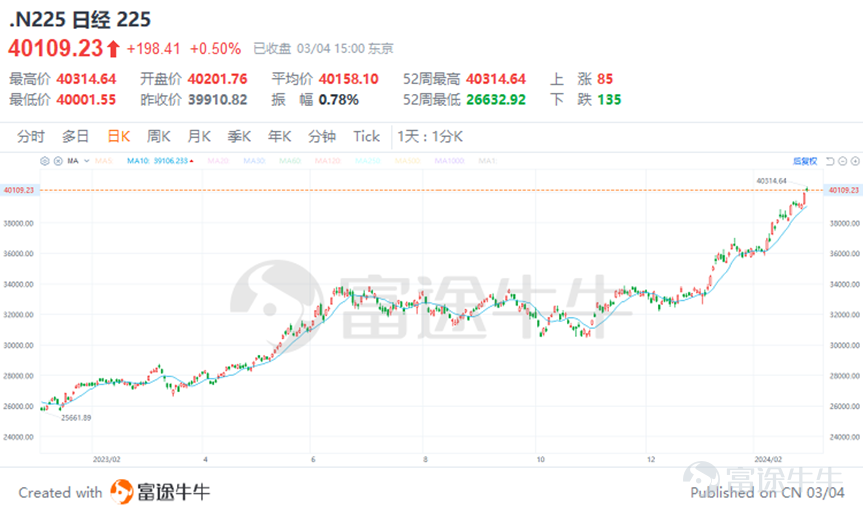
The Japanese stock market has experienced a significant reversal of its narrative logic since 2023, showing a stable and attractive trend. The Nikkei stock index has achieved its largest increase since 1989, benefiting from continuous growth in corporate profits, improved capital efficiency, and policy support for market liquidity. Today, the Nikkei 225 index closed up 0.5% at 40109.23 points, marking the first time in history for it to close above 0.04 million points.

Why is the Japanese market continuing to rise?
Warren Buffett's view on the long-term pricing logic of the stock market can be explained using his famous metaphor: "In the short term, the stock market is a voting machine; in the long term, the stock market is a weighing machine."
It is evident that in Japan, the "voting machine" and the "weighing machine" are resonating.
1. Short-term voting machine
Currently, the Japanese economy is benefiting from wage growth, mild inflation leading to a consumption revival, and continuous improvement in corporate profits generating stable cash flows. In terms of GDP per capita denominated in yen, there has been growth (although it has declined when considering relative depreciation against the US dollar).
Figure: per capita GDP in Japan calculated in yen.
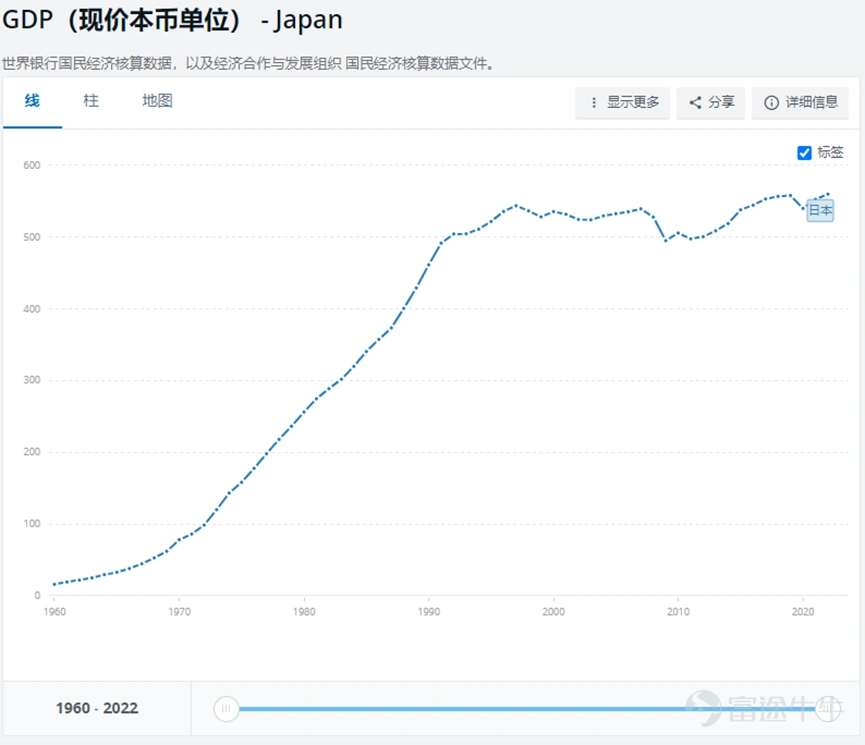
Data source: World Bank database.
And there is a huge potential for foreign capital inflow, only one-fourth of historical peak. Analysis shows that the current price-to-earnings ratio of the Japanese stock market is only about 15 to 16 times, far lower than the 60 times during the economic bubble burst in the 1990s.
Figure: Estimated price-to-earnings ratio of Japanese stocks.

Data source: MacroMicro.
2. Long-term weighing machines.
Global investors not only pay attention to the long-term shareholdings of international giants such as Berkshire Hathaway in large Japanese trading companies, but also closely monitor the active transformation of Japanese listed companies in enhancing shareholder value. In 2023, Japanese listed companies have shown an unprecedented level of buybacks, with the total amount of buybacks soaring to a new record of approximately 9.6 trillion yen for the year, hitting a new high for the second consecutive year.
Therefore, without considering the depreciation of the yen, the Japanese stock market has entered a magnificent bull market. Moreover, we have very sufficient tools for trading. ETFs, as a convenient investment tool, provide investors with a simple and efficient way to participate in the performance of the Japanese stock market.Both domestic and overseas markets have a variety of ETFs to choose from. Next, we will introduce several representative Japanese stock ETF products.
I. Japanese Stock ETFs in the Hong Kong Stock Market
To invest in the Japanese stock market, there are three options available in the Hong Kong stock market:
1. $ChinaAMC MSCI Japan Hedged to USD ETF (03160.HK)$: Tracks the MSCI Japan Stock Index (100% USD Hedged) with an annual management fee of 0.5%.
2. $Global X Japan Global Leaders ETF (03150.HK)$: Tracks the FactSet Japan Global Leaders Index, allowing investors to invest in 20 leading Japanese global companies across different industries, including consumer electronics, computers, automobiles, semiconductors, and medical devices. It has an annual management fee of 0.68%.
3. $CSOP Nikkei 225 Index ETF (03153.HK)$CSOP is launching the first ETF to track the Nikkei 225 index in Hong Kong at the end of January 2024. The listing price of this ETF is set at HK$78 per unit, with a minimum trading unit of 10 shares and an annual management fee rate of 0.99% of the fund's net asset value.
ETFs in the US stock market:
1.$iShares MSCI Japan ETF (EWJ.US)$It provides a way to invest in the Japanese stock market, tracking the MSCI Japan Index.
2.$WisdomTree Japan Hedged Equity ETF (DXJ.US)$ This ETF not only invests in the Japanese stock market but also reduces the impact of exchange rate fluctuations by hedging the Japanese yen exchange rate risk. For investors involved in Japanese ETFs who are concerned about depreciation of the exchange rate, this ETF is highly anticipated.
3.$Ishares Jpx-Nikkei 400 Etf (JPXN.US)$Investing in high-quality Japanese companies included in the JPX-Nikkei 400 Index, covering multiple industries.
4. $JPMorgan BetaBuilders Japan ETF (BBJP.US)$: Tracks the Morningstar Japan Target Market Exposure Index and provides broad exposure to the Japanese stock market.
5. $Vanguard FTSE Pacific ETF (VPL.US)$: Tracks the FTSE Japan Index, including companies of various sizes listed on the Japanese exchange.
3. The significant uncertainty faced by current investments in Japanese ETFs is exchange rate risk.
Different levels of economic development, market size, political stability, and regulatory environment in different countries and regions can significantly impact the performance of overseas and cross-border ETFs. Therefore, in-depth research into the macroeconomic conditions, monetary policies, trade relationships, and potential risks of the target before investing is essential.
For Japan stock ETFs, the risk most likely to result in losses is exchange rate risk.
Represented by [Placeholder], the new forces in the car manufacturing industry also face challenges during an economic downturn.$CSOP Nikkei 225 Index ETF (03153.HK)$For example:
The underlying assets of the fund are priced in yen, which means that the fund invests in Japanese company stocks priced in yen. However, in the primary market, when investors want to add investments to the fund (cash subscriptions) or exit investments (redemptions), these transactions are conducted in the form of dollars exchanged for yen.
In addition, dividends distributed to investors by the fund, if any, are paid in Hong Kong dollars. This means that the net asset value of the fund may be affected by fluctuations in the exchange rate between the US dollar and the Japanese yen: if the US dollar appreciates or depreciates against the yen, the asset value of the fund may increase or decrease.
On the secondary market, which is the Hong Kong Stock Exchange, investors buy and sell units of this ETF in Hong Kong dollars. Therefore, for investors trading this fund in the Hong Kong stock market, they not only need to pay attention to the performance of the fund itself, but also the exchange rate fluctuations between the Hong Kong dollar and the Japanese yen. Exchange rate fluctuations may result in additional costs or losses when buying or selling the fund, even if the fund's performance remains stable, it may still affect the final investment return due to exchange rate factors.
Therefore, when investing in Japanese stock ETFs and facing exchange rate risks, from our research, the simplest way is to directly choose ETFs with currency hedging to avoid depreciation risks. However, there is another aspect to consider because if the yen undergoes continuous appreciation, it may also lead to a potential decrease in returns.
Risk Disclaimer: The above content only represents the author's view. It does not represent any position or investment advice of Futu. Futu makes no representation or warranty.Read more


Comment (1)
to post a comment
29
66