
奈飛Q4新增訂戶創紀錄,已贏得流媒體戰爭?

Futu Research | After Netflix continues to soar, what is the current investment value?
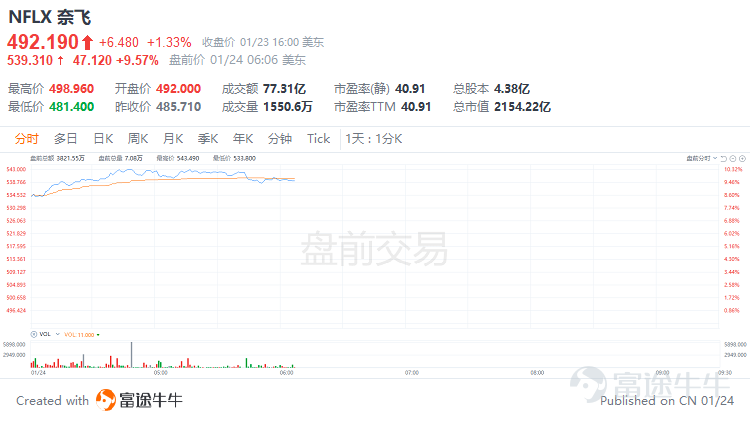
$Netflix (NFLX.US)$Netflix released its quarterly report after the market on Tuesday EST. The results far exceeded expectations, driving Netflix's pre-market share price to rise by more than 10%.
![$Netflix (NFLX.US)$Netflix released its quarterly report after the market on Tuesday EST. The results far exceeded expectations, driving Netflix's pre-market share price to rise by more than 10%. Netflix is the world's largest streaming company. Its main business revenue is mainly paid streaming subscription revenue, accounting for 99.54% of revenue. Other DVD revenue is almost negligible. The streaming media industry is mainly content-driven, and high-quality film and television content is the most fundamental guarantee for the company's growth. On the basis that content is king, the growth in the number of subscribers and ARM (each subscriber contributes revenue) will be the main driving force for the company's performance growth. Specifically, when it comes to the company's business-level analysis, we focus on the two key indicators of the number of new user subscriptions and ARM (revenue contributed by each subscriber). 1. How is Netflix's performance? Conclusion 1: The company's performance far exceeded expectations, mainly driven by the growth of subscribers. With us[Share Link: Foresight]Expectations are basically the same. In 23Q4, Netflix's revenue increased 12% year over year to US$8.83 billion, exceeding the company's guidance of US$8.7 billion and Bloomberg's agreed expectations, mainly driven by an increase in the number of subscribers. Throughout 2023, the company's revenue increased 23% year over year to 7 billion US dollars, growing rapidly. Judging from the historical situation, Netflix was able to achieve continuous growth for most of the quarter. This is quite impressive, but it also accumulated a very high valuation premium in the early period. From 202Q1-2024, there was a lack of growth 4...](https://nnqimage.futunn.com/12106320/editor_image/83931a71c75d3bacafd56cf5af78366f.png/big?imageMogr2/ignore-error/1/format/webp)
Netflix is the world's largest streaming company. Its main business revenue is mainly paid streaming subscription revenue, accounting for 99.54% of revenue. Other DVD revenue is almost negligible.
The streaming media industry is mainly content-driven, and high-quality film and television content is the most fundamental guarantee for the company's growth. On the basis that content is king, the growth in the number of subscribers and ARM (each subscriber contributes revenue) will be the main driving force for the company's performance growth.
Specifically, when it comes to the company's business-level analysis, we focus on the two key indicators of the number of new user subscriptions and ARM (revenue contributed by each subscriber).
1. How is Netflix's performance?
Conclusion 1: The company's performance far exceeded expectations, mainly driven by the growth of subscribers.
With usForesightExpectations are basically the same. In 23Q4, Netflix's revenue increased 12% year over year to US$8.83 billion, exceeding the company's guidance of US$8.7 billion and Bloomberg's agreed expectations, mainly driven by an increase in the number of subscribers.
Throughout 2023, the company's revenue increased 23% year over year to US$7 billion, a rapid increase. Judging from the historical situation, Netflix was able to achieve continuous growth in most quarters, which was quite impressive, but it also accumulated a very high valuation premium in the early period. In the four quarters where growth was lacking in 2022/Q1-2024, the stock price experienced a significant reduction in valuation.
Figure: 18Q1-23Q4 Company Revenue and Growth Rate (million USD;%)

Source: The company's official website, compiled by Futu Securities
Conclusion 2: Benign expansion of profit margins.
23Q4 operating profit reached 1.5 billion US dollars, and the operating profit margin increased to 17% from 7% in the same period last year, mainly due to higher than expected revenue growth, reduced content expenses, and proper cost optimization. The company's operating profit margin for the full year of 2023 was 21%, higher than the company's expectations of 18%-20%. The 23Q4 EPS was $2.11, lower than the agreed forecast of $2.23. It was mainly a non-cash loss of $239 million due to exchange rate fluctuations.
Overall, Netflix's profit margin was highly seasonal. The operating profit margin increased from 18.34% in 2020 to 20.62% in 2023, and the net interest rate rapidly increased from 11.05% in 2020 to 16.04%.
Figure: 18Q1-23Q4's operating profit margin and net interest rate

Source: The company's official website, compiled by Futu Securities
Conclusion 3: Free cash flow increased dramatically, supporting healthy growth in the company's operations and shareholder returns.
Free cash flow for 23Q4 was $1.6 billion, and the company's total free cash flow for the full year of 2023 was $6.9 billion, including about $1 billion in delayed spending due to the Hollywood strike. The company's free cash flow reached a record high, indicating that the company's operations have entered a healthy development path, which is expected to support high-quality content spending in 2024. As cash on hand increases, judging from Netflix's historical good performance of returning cash to shareholders, along with the increase in cash flow, it will also increase shareholder returns.
Figure: Free cash flow for 19Q1-23Q4 companies (million dollars;%)

Source: The company's official website, compiled by Futu Securities
Judging from the company's overall performance, the boost to revenue and profit was immediate after the crackdown on shared accounts, but let's take a look at the two key operating indicators of the number of new subscribers and ARM (each subscriber contributes revenue) to deduce future trends.
2. The growth of new subscribers exceeding expectations is the main driving force for the company's performance
What greatly exceeded expectations was that 23Q4 added 13.12 million new subscribers, setting a record for the highest number of new users added in the fourth quarter, far exceeding the consensus estimate of 8.91 million, bringing the total number of subscribers to 260 million.By region, all new subscribers in all regions exceeded expectations. Among them, there was a net increase of 2.81 million paid streaming subscribers in the US and Canada (UCAN); in the fourth quarter, there was a net increase of 2.91 million paid streaming subscribers in the Asia-Pacific region, exceeding analysts' expectations of 2.08 million; and in Europe, the Middle East, and Africa, Netflix added more than 5 million new users.
Why is it growing so fast? We can further disassemble it at the level of the work.
Figure: Net increase in 19Q1-23Q4 subscribers

Source: The company's official website, compiled by Futu Securities
The company's subscriber growth exceeded expectations due to several key factors:
(1) Quality fourth quarter content.The streaming media industry is mainly content-driven, and high-quality film and television content is the most fundamental guarantee for the company's growth. The fourth quarter has high-quality content series. It is a traditional peak season for content, including the final season of “Sex Education” (Sex Education) and “The Crown” (The Crown), the movie “The Killer” (The Killer), the reality show “Squid Game: The Challenge” (Squid Game: The Challenge), the original innovative show “All the Light We Cannot See” (All the Light We Cannot See), etc. Although the company's content production was delayed due to the strike, there are plenty of high-quality content reserves, which have had a significant effect on attracting new users and retaining old users. According to data from Antenna Research, Netflix has the lowest monthly user turnover rate among streaming platforms; only 2% of users were lost in December.
(2) Continued crackdown on shared accounts.Judging from the data, very few users unsubscribed due to the crackdown on shared accounts. Some shared accounts were directly converted into fully paid users, showing very good user stickiness and high retention rates. According to data disclosed by the company in early 2023, there are as many as 100 million shared accounts worldwide, and it is estimated that 50% of shared accounts will become paid sharing users or fully paid users. It is expected that some users will gradually convert into fully paid users or additional paid users over the next few quarters.
(3) Low-cost advertising packages attract new users to subscribe.According to the latest data disclosed by the company, the number of monthly active users of advertising members in early 2024 has exceeded 23 million, increasing by 8 million in less than 3 months (15 million in November 2023 and 5 million in May 2023), and the growth rate is accelerating. Beginning in the second and third quarters of 2023, the company successively abolished basic ad-free packages in some regions and raised prices for old basic packages and premium packages, which in disguise increased the appeal of advertised packages to new users.
As a result, Netflix has achieved good results in “content creation+crackdown on shared accounts+preferential customer acquisition”, which in turn has led to the growth of new users. So what is the situation with ARM?
3. ARM (revenue per subscriber) had limited growth in the fourth quarter and is expected to improve in the 2024 fiscal year
The company's ARM remained basically flat year over year, and the impact of price increases on Q4 was limited.The 23Q4 company ARM increased 1% year over year (with the exchange rate unchanged), which was basically in line with the company's expectations. The main reason was that the low price advertising package lowered ARM, and at the same time, the increase in membership prices was limited over the past 18 months, so ARM did not change much. Although the company announced about 10%-20% price increases for basic membership packages and advanced prices in the US, the UK, and parts of France in the third quarter, it relieved the downward pressure on ARM. However, considering that the price increase covered relatively little, and that the price increase was announced in mid-late October 2023, the impact on ARM in the fourth quarter was limited.
Figure: Netflix's 2018 to present ARM (average revenue per subscriber)

Source: The company's official website, compiled by Futu Securities
By region, ARM is growing faster in the UCAN region, while ARM in the APAC region has declined slightly.ARM in the UCAN region grew to $16.64, with significant year-over-year and month-on-month increases, mainly due to the positive impact of price increases; ARM in the EMEA region grew to 10.75 US dollars, a slight decrease from month to month; ARM in the APAC region was 7.31 US dollars, which declined year on year and month over month, mainly due to the adoption of low price strategies to attract users and the addition of many new low price advertising packages.
Figure: ARM by Netflix region (average revenue per subscriber)

Source: The company's official website, compiled by Futu Securities
Looking forward to the future, the increase in the number of ad members is expected to increase ad ratings, thereby increasing CPM and increasing advertising revenue.Based on the comparable rates of fubo TV, The Roku Channel, and Hulu (on an hourly basis), it is estimated that the advertising package can bring each user $10 in ad revenue per month, so the ARM for ad plan users is expected to be consistent with the standard plan. In the future, as advertising revenue grows, it is expected to drive the overall improvement of ARM.
4. What is the current investment value of the company
The company performed well this quarter. User growth hit a record high in a single quarter, driving the company's revenue to exceed expectations, mainly due to the supply of high-quality content, effective crackdown on shared accounts, and the increase in the attractiveness of low-cost advertising packages. What we need to do further is calculate Netflix's future investment returns.
In the long run, the income from investing in a company comes from: increase in earnings per share* increase in valuation+shareholder returns. We break it down separately:
(1) Earnings per share
Number of users: The company expects a year-on-year increase in the number of new paid users in 24Q1, but due to the low content season, the number of new users will slow down compared to 23Q4, so we predicted it ourselves. It is expected that with strong content construction, continued crackdown on shared accounts, low-cost advertising packages, and streaming media's continued replacement of traditional TV shares, the company's new subscribers will continue to grow healthily even though they cannot continue the current strong increase.
ARM: Driven by price increases and ad revenue growth, the company ARM is expected to improve in FY24. The company's revenue is expected to achieve high double-digit growth throughout 2024, and global ARM is expected to maintain growth on an unchanged exchange rate. The 24Q1 company's revenue is expected to increase by 13%, taking into account the 3% foreign exchange headwind.
Profit margin and free cash flow: The company raised its operating profit margin for the full year of 2024 from 22%-23% to 24%. The company's profitability has steadily increased, and it has entered a healthy development channel. Considering the company's significant increase in content spending in 2024, free cash flow is expected to fall back to $6 billion in 2024.
As a result, overall earnings per share will still achieve at least double-digit growth in 2024.
(2) Shareholder returns
Netflix used 2.5 billion US dollars to repurchase 5.5 million shares in the fourth quarter, and the company's current repurchase plan still has a repurchase limit of 8.4 billion US dollars. Assuming that all of the $8.4 billion repurchase amount is used in 2024, the shareholder return will be around 4%;
Assuming a quarterly repurchase of 2.5 billion US dollars and a year repurchase of 10 billion US dollars, the return to shareholders is around 5%.
However, if we open the “balance sheet,” we can see that Netflix, as a conscientious company, has declined from 8.577 billion US dollars to 7.138 billion US dollars in the past six months. Some of this may have been used to buy back stocks, making its own repurchase amount higher than free cash flow, so we estimate that Netflix's shareholder return is more likely to be around 4%.
(3) Valuation
Assuming that the company's growth logic is not broken, the company's revenue is expected to be US$38.836 billion and US$43.655 billion in 2024 and 2025, respectively, and net profit of US$7.767 billion and US$9.037 billion respectively. Supported by rapid performance growth, Netflix's target price is expected to be in the 532-620 range.
Assuming that the company's growth logic breaks down, streaming competition intensifies, and content quality falls short of expectations, the company will price “risk-free interest rate+equity operating risk”. We are optimistic: if revenue and profit do not change, then the competitive landscape intensifies, and if 4% shareholder return falls to 5% bonus risk return, it will decline 25%. Therefore, when the market is concerned about intense competition, it is expected that there will be 25% room for decline.
Taken together, Netflix's investment value is a good judgment:
Situation 1: If the company's current EPS is likely to achieve double-digit growth, shareholder returns of about 4%, and shareholder returns remain unchanged, then the target price for 2024 is expected to be in the 532-620 range;
Scenario 2: If in the context of Condition 1, the competitive landscape deteriorates, but profits are not affected, then the overall stock price is expected to fluctuate up and down from the current position;
Scenario 3: If the competitive landscape is extremely intense, there is a greater risk that valuations will decline.
According to our comprehensive judgment, Situation 1 and Case 2 are more likely. Therefore, Netflix is a company that is currently not cheap but has strong competitiveness. However, Netflix is also in an environment where competitors in the industry are not too bad. For investors, they still need to pay close attention to the future competitive landscape, which will have a big impact on the valuation.
Risk Disclaimer: The above content only represents the author's view. It does not represent any position or investment advice of Futu. Futu makes no representation or warranty.Read more


Comments
to post a comment
16
20