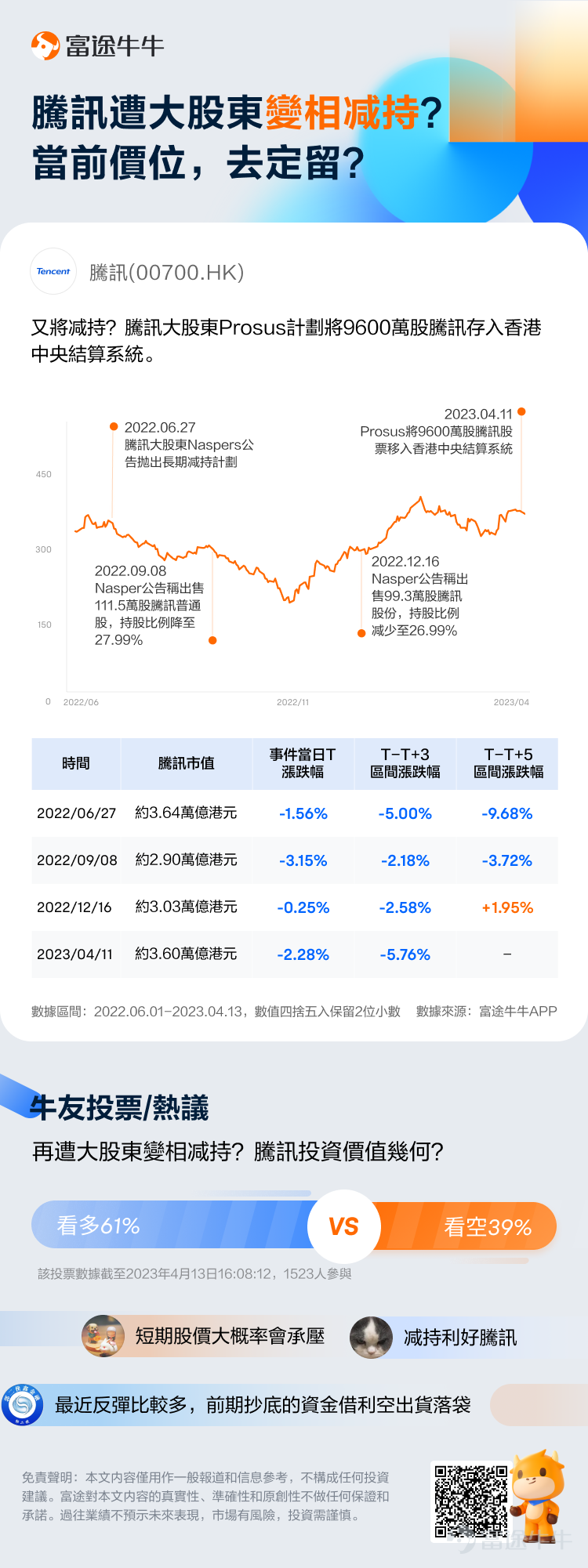

再遭大股東變相減持?騰訊投資價值幾何?

[mooer Talk Hot Topics] Is Tencent's holdings reduced in disguise by the majority shareholders again? What signal is it releasing? Current price, going to stay?
Want to cut your holdings again? On April 11, local time, Prosus, the largest shareholder of Tencent and a Dutch subsidiary of South Africa's Naspers Group, issued an announcement stating that as part of continuing to implement the company's repurchase plan, Prosus will take administrative measures this week to deposit an additional 96 million shares of Tencent shares held in a certified form (certified form) into the Hong Kong Central Clearing System so that these stocks can be traded in an orderly manner in the market according to the repurchase plan. As soon as the news came out,$TENCENT (00700.HK)$The stock price plummeted on Wednesday. At one point, it fell nearly 6%, and finally closed down 5.15%.
According to reports, as of April 11, Tencent's share capital was 9.57 billion shares, and Prosus expects to reduce its holdings by about 1% of Tencent's total share capital this time. Based on the 96 million Tencent shares that Prosus plans to move, the total value of these shares is approximately HK$36.154 billion based on yesterday's closing price.
What signals does the transfer of stocks to CCASS send?
The Hong Kong Stock Exchange Central Clearing and Settlement System (CCASS) is a securities central clearing and settlement system set up by Hong Kong Central Clearing Limited to manage securities trading on the Stock Exchange. Shares held by shareholders of Hong Kong stock companies can be traded by transferring them to CCASS institutions (such as Goldman Sachs, Citi, Damo, etc.).
Adding individual shares to the CCASS system is not equivalent to selling, but they are basically viewed by the market as preparation for sale. Industry veterans said that since shareholders transfer shares to the CCASS system and back again require additional costs, no one will sacrifice the liquidity they have already gained in a market dominated by institutions like Hong Kong. (Some market investors' speculations and interpretations)
How many times have the majority shareholders reduced their holdings?
Naspers, which has a history of more than 100 years, started in the newspaper and publishing industry. In 2001, MIH, a subsidiary of NASPERS holding company Prosus, bought 46.5% of Tencent's shares and became its majority shareholder. Over 20 years, the return on investment has exceeded 7,000 times, making it one of the most profitable transactions in venture capital history.
In the past two years, in order to raise funds to buy back its shares to save stock prices, Naspers Group broke its promise of “not reducing its holdings in Tencent for three years” in June of last year. It is expected that the average daily sales of Tencent shares will not exceed the average daily trading volume of the company's shares by about 3-5%.

Recent Tencent News
Since November 2022, Tencent's stock price has rebounded all the way from a low of HK$188 to over HK$400, then fluctuated at HK$330-400. Currently, the cumulative increase in the stock price is still close to double compared to the end of October last year, outperforming the Hang Seng Index by a large margin.
In addition to the majority shareholders reducing their holdings, many institutions have also increased their holdings. Among the top ten shareholders, Pioneer Pioneer, BlackRock, Norges Bank Investment Management, and E-Fangda have all continued to increase their holdings in Tencent in the past two years.
Tencent's own share buybacks are also continuing. Tencent implemented repurchases for 104 days during the 2022 trading day. A total of 10,7.083 million shares were repurchased, with a cumulative repurchase amount of HK$33.787 billion.
On the evening of March 22, Tencent announced its results report for the fourth quarter and full year of 2022. Compared to the previous two quarters, Tencent's revenue stabilized in the fourth quarter of last year, net profit returned to double-digit growth, and the performance clearly “turned clear.”
mooer talk about hot topics
 What do you think of the majority shareholders continuing to reduce their holdings?
The first decline was because the majority shareholders themselves were going to die; it was not a performance issue. Second, all of Tencent's repurchased shares were cancelled instead of continuing to be put on the market, which did not increase liquidity, and also increased the value of the shares in disguise. Finally, after reducing the absolute majority shareholder in foreign capital, Tencent's shareholding structure will be more conducive to management's control and meet the central government's requirements. Everyone is advised to be careful about shorting. Secondly, Tencent's dividends are also far higher than the wealth management products on the market. You should think and think.
It has been more than half a year since South Africa's majority shareholders announced production cuts in June last year. Market sentiment has almost unleashed, and after Tencent released its earnings report, they have begun repurchases of 350 million dollars a day to hedge against the reduction in South Africa's majority shareholders' holdings.
What hurts the market the most is that South Africans don't clearly say how much they want to reduce their holdings and when, so we can only estimate based on South Africans themselves saying that they are reducing their holdings in Tencent to raise funds to buy back up to 265 million shares of the parent company, and reducing their holdings by 3 to 5% every day. The pessimistic expectation is that their holdings will be reduced until June 2024, and the optimistic expectation is that their holdings will be reduced until the third quarter of this year.
According to convention, the Q1 earnings report will be issued on Wednesday May 17 next month, and then repurchases will be prohibited on the 17th of this month. In other words, only NASPERS will be sold off starting next week, and the decline will accelerate at that point.
NASPERS regularly reduces its holdings by 100 million shares every 4 months, and sold 300 million shares for about 90 billion in the last year. Tencent's buyback took about 200 trading days - the day before the 100 financial reports. The 100 days before the repurchase cost about 30 billion dollars. Use 30 billion versus 90 billion, judge for yourself.
The majority shareholder Prosus will move 96 million shares of Tencent shares into the Hong Kong clearing system. What signal will it release? What is the impact on Tencent's stock price and investment value?
Tencent's current price, go or stay? How will Tencent's stock price go in the near future?
Come and share your views~ Participate in discussions and express your wonderful opinions in the comments section of this post for a chance to get:
Wonderful Review Award:5 coworkers with the best mooer can get 188 pointsParticipation is a prize for fun:Participate in discussions (30 words or more) to get 66 pointsActivity time: Until April 19, 2023 24:00
For example, the wonderful posts above were selected based on comprehensive considerations such as content quality and amount of interaction. In order to ensure smooth reading, on the basis of not changing the opinions of the original text, there were minor edits on the basis of not changing the opinions of the original text, which did not constitute any investment or financial advice. The above was rewarded by @的牛友将会获得188积分 for “Wonderful Hot Review.”
Risk Disclaimer: The above content only represents the author's view. It does not represent any position or investment advice of Futu. Futu makes no representation or warranty.Read more


Comments (171)
to post a comment
57
49