
淚目!美股熱門中概股集體大漲

Alibaba and Tencent lead the "q&m dental buyback" initiative: Is the 300 billion bottoming out, or collectively supporting the bubble?
In the midst of a major crisis, tech giants are using billions of dollars to try to hit the bottom of the stock market.
According to incomplete statistics from Snow Leopard Financial News, in the past nearly a year, the total amount of repurchases announced by tech stocks in the Hong Kong stock market and well-known Chinese concept stocks in the US amounts to at least about 300 billion yuan, including the scale of Alibaba in the billions of dollars and Mogu Street in the tens of millions of dollars.
If we count from May 2021, the "Sixth Buyback Trend" in the Hong Kong stock market has been continuing for nearly a year (the fifth buyback trend ended in January 2020). As of April 21, 2022, the total amount of repurchases by listed companies in the Hong Kong stock market has reached 16.5 billion Hong Kong dollars, a year-on-year increase of 140%, approaching half of last year's total repurchase amount.
In the US-listed Chinese concept stock market, Alibaba$Alibaba (BABA.US)$Announced a massive $25 billion buyback in March, triggering a domino effect in the market, with Chinese concept stocks and tech giants in the Hong Kong stock market joining the buyback army: Xiaomi$XIAOMI-W (01810.HK)$Announced a billion Hong Kong dollar buyback, Tencent began repurchasing shares for 14 consecutive trading days at the end of March, spending over 6 billion Hong Kong dollars since the beginning of the year.
How is this wave of share buybacks in 2022 different from the past? Behind these key differences, how much more turbulence will there be in the future?
The Sixth Wave
Generally, companies repurchase shares when they believe the existing stock price is significantly lower than the intrinsic value, thus boosting market confidence and stabilizing stock prices.
This round of share buybacks is not only the longest in duration among all repurchases, but also the most substantial. In 2021, the total scale of share buybacks in the Hong Kong stock market reached 38.25 billion Hong Kong dollars, a 137% increase compared to 2020.
Entering the first quarter of 2022, with the release of the 2021 Q4 and full-year financial reports by internet technology giants one after another, the focus of this collective buyback has shifted from Hong Kong stocks to US-listed Chinese stocks. Alibaba kicked off the trend by earmarking 25 billion US dollars for share repurchases.
On March 22, Alibaba announced an increase in its buyback plan from 15 billion to 25 billion US dollars, setting a new high in Chinese stock buybacks, which was approximately 10% of Alibaba's market cap at that time.
The massive buyback also sparked market enthusiasm, causing Alibaba's stock price to surge by 11%, simultaneously driving a rebound in all Chinese stocks: that day, iQIYI rose over 24%, Bilibili surged 20%, and PDD Holdings rose nearly 19%.
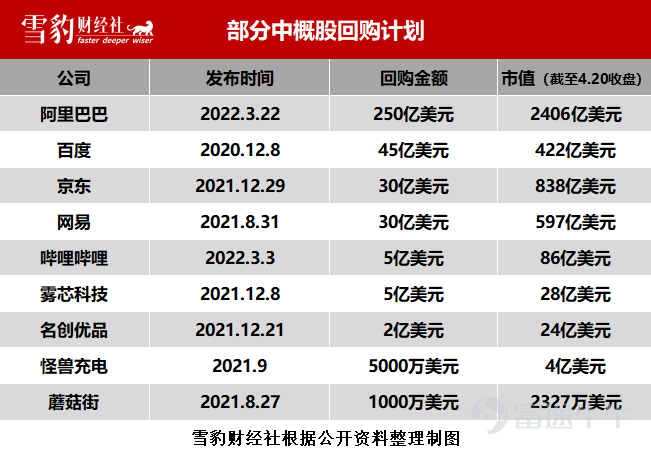
Not only did Chinese stocks follow Alibaba in price increases, they also rushed to 'bottom fish' by pouring out real money: Baidu$Baidu (BIDU.US)$(USD 4.5 billion), JD.com$JD.com (JD.US)$(USD 3 billion), NetEase$NetEase (NTES.US)$(USD 3 billion) and other major companies successively announced buyback plans of up to several billion dollars; even the "smaller companies" like Dada Nexus$Dada Nexus (Delisted) (DADA.US)$、叮咚买菜$Dingdong (DDL.US)$and Amber Charging$Energy Monster(Delisted) (EM.US)$etc., also tighten their belts and allocate tens of millions of dollars for buybacks.

The wave of buybacks quickly swept from the United States to Hong Kong.
The "Buyback King" of Hong Kong stocks last year, Xiaomi, was the first to respond by announcing a HKD 10 billion buyback plan; Tencent, while not announcing specific buyback plans, bought back shares continuously for 14 trading days from the end of March to mid-April, totaling HKD 6.4 billion since the beginning of the year, close to Xiaomi's HKD 8.4 billion scale last year. If the buyback trend is maintained, this year's Hong Kong stock Buyback King may change hands to Tencent.$TENCENT (00700.HK)$。

From the perspective of the Hong Kong stock market as a whole, in the past year, the stock prices have been severely hit, but cash-rich network technology stocks are still the main force in buybacks. In the Hong Kong stock buyback, there is also a phenomenon of large companies leading and small companies following. In addition to Tencent, Xiaomi and other large companies throwing out billion-dollar buyback orders, pa gooddoctor and pdd holdings have also joined the buyback wave. $PA GOODDOCTOR (01833.HK)$JD Health.$JD HEALTH (06618.HK)$pop mart $POP MART (09992.HK)$and others have also joined the buyback trend.
However, although the buyback army is fierce this time, the capital markets still show no signs of recovery. Since March, the Hang Seng Index has fallen nearly 10%, and the Hang Seng Tech Index continues to probe down more than 23%. If we calculate from May last year, the two major indexes have fallen by 29% and 51% respectively.
After the previous five buyback waves in the Hong Kong stock market, the Hang Seng Index and the Hang Seng Tech Index both experienced medium to long-term stabilization and rebound, with average cumulative gains of 19% and 52.9% respectively after one year.

More willing, and more brutal.
Buffett once said that companies must meet two conditions to consider buybacks, one of which is 'having sufficient funds.' However, behind the buyback of tech giants this time, there is a sense of tightening the belt.
Despite a 75% plunge in net income in Q4 last year, Alibaba still plans to use $25 billion in cash for repurchases, a figure higher than Alibaba's entire net income for the year. Tencent, once hailed as the 'most profitable internet company,' also faced two consecutive quarters of negative net income growth in nearly a decade, but still carried out large-scale buybacks.
There are even companies that squeeze out money to buy back shares when they are losing money.
JD incurred a net loss of 3.6 billion yuan for the full year of 2021, but still announced a $3 billion repurchase plan. There are many companies like JD who buy back shares even when in a loss-making state, such as Bilibili, Dada Nexus, JD Health, and more.
Even ByteDance, which has not yet gone public, is buying back options held by employees at the moment. According to reports from multiple media outlets, on April 15th, ByteDance announced internally a buyback of options at $142 per share, an 8% increase from the previous buyback price.
Major companies spare no expense in buybacks regardless of losses, relying on their solid financial foundation. In this wave of buybacks, more names of small and medium-sized companies are appearing. For example, Monster Charge has a market cap of only $0.4 billion but allocated $50 million for buybacks, with the company's cash flow being only $0.43 billion. The most aggressive move belongs to Mogu Inc, with a market cap of only $23 million, yet allocating $10 million for buybacks.
Behind the nationwide buyback effort lies a brutal systemic collapse caused by the pandemic, Chinese concept stock crash, and the harsh winter in the tech industry.
To this day, the world is still shrouded under the wing of the pandemic, the black swan. Both the consumer end and the supply end have suffered immense impacts. Especially technology internet companies that have long been integrated into every aspect of people's consumer lives are at the forefront of the impact.
In the financial reports of many companies, 'affected by the epidemic' has become a high-frequency keyword. The pandemic-induced economic downturn has further exacerbated the situation, causing significant impacts in e-commerce, online advertising, and other fields, leading to significant fluctuations in consumer e-commerce platform revenue represented by Alibaba, JD, PDD, etc. Companies involved in offline business have been more directly impacted, such as Meituan, Ctrip, etc.
If the pandemic has an all-round impact on the economy, then the stock disaster of Chinese concept stocks in the U.S. stock market is more like a precise strike.
Chinese concept stocks have become a 'Chinese beggar stock' within a year. According to Wind data, as of April 14, 2022, there are a total of 280 Chinese concept stocks listed in the U.S. 60 are priced below $1, 68 are priced between $1 to $2; in terms of market cap, 79 are below 35 million dollars, 101 are below 50 million dollars, and 135 are below 0.1 billion dollars. (Refer to Snow Leopard Finance),After the trend, the "one-dollar store" of China concept stocks opens.》)
Chinese concept stocks have become a 'Chinese beggar stock' within a year. According to Wind data, as of April 14, 2022, there are a total of 280 Chinese concept stocks listed in the U.S. 60 are priced below $1, 68 are priced between $1 to $2; in terms of market cap, 79 are below 35 million dollars, 101 are below 50 million dollars, and 135 are below 0.1 billion dollars. (Refer to Snow Leopard Finance),After the trend, the "one-dollar store" of China concept stocks opens.》)
According to a report by Ernst & Young, as of March 2022, the total market capitalization of China concept stocks listed on major stock exchanges in the US is approximately 1.1 trillion US dollars, which evaporated over 1 trillion US dollars compared to the peak in 2021, equivalent to a halving.

The Hang Seng Index in the Hong Kong stock market has also experienced a huge drop. The Hang Seng Tech Index, known as the Eastern Nasdaq, dropped 70% last year. During this time, Tencent and Alibaba halved, and education stocks started from '10 cents'.
Under the impact of the epidemic and stock market turmoil, the winter of technology internet seems particularly long. Internet giants that were already facing peak growth and no longer enjoying dividends find it difficult to tell new stories.
The giants once held huge amounts of funds, horizontally connecting investment businesses to build commercial empires, but even they took a solid blow in the cold winter. Whether it's traditional CVC (Corporate Venture Capital) BAT, Xiaomi, or investing in newcomers like JD and Bilibili, overall performance has been dragged down by investment losses. (See details in Xuebao Finance Society'sDid the big companies self-sabotage their 'golden fingers'? What's next for BAT's 'Redwoods'?》)

Confident or gambling against the huge wave?
When the giants make a move, will it create towering waves or just ripples? It mainly depends on external and internal factors.
Changes in the macro environment, the disappearance of traffic dividends, and the impact of the epidemic black swan event have caused the rapid growth of the internet industry over the past 10 years to suddenly slam on the brakes: the market opportunities are increasingly blurry, business growth is weak, and 'cost reduction and efficiency increase' and 'quality growth' have become key words in the financial reports of many technology internet companies.
CEOs of internet giants, who are in the eye of the storm of public opinion, not only have to acknowledge the difficult current situation but also bear the heavy responsibility of stabilizing morale. This winter may be tougher to endure than before. (For details, see Xuebao Finance Society'sHow will Tencent, Alibaba, and ByteDance get through the winter? CEOs have reached a rare consensus.》)
The recent situation of Chinese concept stocks has not shown a turning point. Since March, there have been 5 batches totaling 40 Chinese concept stocks listed on the U.S. Securities and Exchange Commission's 'Delisting Watchlist', including prominent stocks such as Baidu, iQIYI, and Weibo.
The father of security analysis, Buffett's mentor Graham once said, "In the short term, stock prices are a voting machine; in the long term, they are a weighing machine." Ultimately, a company's fundamental business operations are the moat, and it is the internal factor that determines whether it can weather the bull and bear markets and stand out.
Companies with a stable core business foundation are more likely to weather the storm successfully. Tencent has conducted seven waves of repurchases in its history, successfully bottoming out and maintaining an upward trend in the future because of the company's stable fundamentals. with dominant positions in core sectors such as gaming and social media, the stock price is expected to remain bullish long-term. (See details in Snow Leopard Financial Society's "Tencent buying Tencent at a low price, Tencent selling "Tencent".》)

Buffett believes another condition for buybacks is, "CEOs must believe that the current stock price is far below the intrinsic value of the company."
This means that only those companies with stable cash flow and solid fundamentals will have high investment value caused by super low stock prices in special environments.
After all, to withstand the adverse currents and successfully reach shore, one relies not on the gold chain around their neck, but on a strong and robust physique.
(Author: Yan Xuegong)
Risk Disclaimer: The above content only represents the author's view. It does not represent any position or investment advice of Futu. Futu makes no representation or warranty.Read more


Comments (21)
to post a comment
35
88