
對俄制裁再加碼!市場會受何影響?
Haiyin Research Institute Hot Topics Quick Review: What is the impact of Russia's use of “food weapons”?

Summary:
Russia announced that it will only export food to friendly countries
The EU may face another food shortage after the energy crisis
The impact on China is limited, but it may raise import costs
Background of the incident:
On April 1, Deputy Chairman of the Russian Federal Security Council Medvedev said that Russia will only export food to friendly countries using roubles and national currency settlements.
Earlier, after the Russian-Ukrainian conflict broke out, Russia added 48 countries and regions to the unfriendly list in the face of Western sanctions. Including: the United States, the United Kingdom, Japan, the European Union (all 27 countries), Australia, Canada, etc.

The Haiyin Research Institute believes
As one of the world's major grain exporting regions, Russia and Ukraine accounted for 26% and 20% of the global share of wheat and corn exports in 2021, respectively, which can be described as significant.
After the Russian-Ukrainian conflict broke out, due to major military operations in Ukraine, which affected spring planting to a certain extent, it is expected that Ukraine's grain exports may decline this year.
This time Russia offered a “food weapon.”The EU is likely to be the most affected.First, the EU is geographically closer to Russia and Ukraine; second, Russian and Ukrainian wheat and corn accounted for 30% and 50% of EU imports last year, respectively. (Data source: CMB International, same as above)
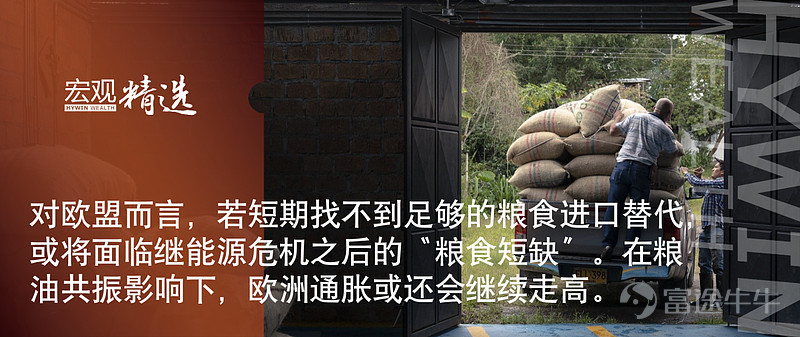
As far as the EU is concerned, if it cannot find sufficient food import alternatives in the short term, it may face a “food shortage” following the energy crisis. Under the influence of the grain and oil resonance, European inflation may continue to rise, but whether the ECB will adopt a more hawkish policy as a result remains to be further observed and evaluated.
Furthermore, since this year, CBOT wheat futures have increased by a cumulative total of 32.68%, corn futures have increased by 25.91%, and soybean futures have risen by a cumulative total of 20.32%. This is not only fueled by the Russian-Ukrainian conflict, but is also related to factors such as global fertilizer price increases and South America's climate drought.
Specifically, Russia is the world's largest exporter of nitrogen fertilizer, second of potash fertilizer, and the third largest exporter of phosphate fertilizer. Affected by sanctions, global fertilizer supply has declined and prices have risen sharply, causing farmers to be unwilling to sow. The recent US announcement to lift restrictions on Russian chemical fertilizer imports is a signal.
In other words,Grain-exporting countries such as the United States and Australia may also decline in grain production and exports this year due to restrictions on fertilizer supply and price increases. Under supply shocks, the world may face a rare food security problem.
As far as China is concerned, although Russia and Ukraine are not the main importers of China's staple food, in the context of global integration, if global food prices rise, it will inevitably affect China's import costs. Coupled with repeated epidemics in many parts of the country, it has also had a certain impact on agricultural production.
However, due to China's abundant grain reserves, domestic food prices and overall supply are still manageable.
From an investment perspective,More opportunities can be exploited on the main line of seed industry safety and food security, which has been mentioned many times by senior officials; in addition, the pig food ratio has been below the warning line for many months. Under the influence of rising global agricultural product prices, the future market of the farming sector is also worth taking a closer look.
Disclaimers:
Source: Liu Hua, Haiyin Research Institute
This report was produced by Haiyin Wealth Management Co., Ltd. The information in this report comes from publicly available materials and information, but Haiyin Wealth Management Limited (hereinafter referred to as “Haiyin Wealth”) does not guarantee the accuracy and completeness of this information and information. The information, opinions, etc. in this report are for investors' reference only and do not constitute bids or levies for the securities transactions described. This information or opinion does not take into account the specific investment purpose, financial situation, or specific needs of the person receiving this report, and does not constitute a personal recommendation for anyone at any time.
$Santech Holdings (STEC.US)$$Nasdaq (NDAQ.US)$$Dow Jones Industrial Average (.DJI.US)$
$Santech Holdings (STEC.US)$$Nasdaq (NDAQ.US)$$Dow Jones Industrial Average (.DJI.US)$
Risk Disclaimer: The above content only represents the author's view. It does not represent any position or investment advice of Futu. Futu makes no representation or warranty.Read more


Comments (11)
to post a comment
35
42