
巴菲特參投的Nubank上市首日大漲近15%

Former Sequoia partner, achieved the third largest IPO this year: market cap of 300 billion.
The third largest IPO of this year was born.
Investment news, last night (December 9), Latin America's largest fintech unicorn Nubank debuted on the NYSE with an opening price of $11.25, up 25%. At the close, the company's stock price was $10.33, up 14.78%, with a market capitalization of $47.6 billion (about RMB 300 billion).
Nubank's story began with a bad banking account opening experience, and founder David Vélez was a former partner at Sequoia Capital. In 2011, David went to Brazil to conduct Sequoia's investment business in Latin America. During this time, he had an account opening experience in Brazil that lasted for six months, which made him see an opportunity. When Sequoia Capital closed its operations in Brazil, he stayed behind to start Nubank and launched the first online credit card service in 2014. Since then, it has gained nearly 50 million users and has been called the "Card King".
To challenge traditional banks, David relied on the support of a group of comrades. Since its establishment, David's former employer, Sequoia Capital, has participated in almost every early round of financing for Nubank, totaling at least seven times; and global institutions such as Tencent Investment, DST, Tiger Global, and GIC have entered the game. In early 2021, investment guru Warren Buffett invested $500 million, once again causing a sensation for Nubank.
There is no doubt that Nubank has created a venture capital myth in Latin America. And through the growth of this unicorn, investors see a pleasing scene - from Latin America to Southeast Asia, India, Africa, emerging markets are mass producing internet unicorns. They seem to be repeating the path of China's new economy over the past twenty years...
At the age of 40, as a former partner of Sequoia Capital, he ventured into entrepreneurship and created a market cap of 300 billion.
The protagonist of the story, David Vélez, was born in 1981 in a small business owner's family in Colombia. From a young age, David started sorting buttons in his uncle's factory to earn pocket money. At the age of 12, he used his birthday red envelope and summer job earnings to buy a cow, which helped him earn part of the undergraduate tuition for Stanford University.
During his college years, David was deeply influenced by the atmosphere of Stanford and desired to join the entrepreneurial wave in Silicon Valley. After graduating from Stanford University, he worked for several investment banks. It was not until 2011 that he went to Brazil as a partner at Sequoia Capital, responsible for the firm's investment business in Latin America.
Over the next two years, David visited different types of Brazilian companies with his investment team to investigate the venture capital environment. However, they found that many Brazilian entrepreneurs lacked innovative ideas, and some startup founders simply copied the American model without truly solving local problems. What was even more shocking was that Brazil did not have enough talent reserve, with only 42 computer science engineers graduating from the University of São Paulo each year. In the end, they unanimously believed that the development of the technology sector in Latin America was lagging behind and limited in its potential for investment value, so they had to close their business in Brazil.
Sequoia Capital failed to successfully expand into the Latin American market, but David saw an entrepreneurial opportunity. This idea came from an experience of opening an account - one time when David, who had just arrived in Brazil from the United States, went to a bank in São Paulo to open a personal account. He was required to check his luggage in a locker outside the bank and had to wait for 45 minutes before being allowed to enter the bank to conduct business. Furthermore, the bank asked him to return to the bank six times within the next four months before finally successfully opening the account. This terrible experience made David see the huge opportunity in the Brazilian financial market.
In 2013, David, along with his friends Edward Wible and Cristina Junqueira, founded Nubank, specializing in financial services. At that time, the financial landscape in Brazil was extremely rigid, with low efficiency in financial services and multiple expensive fees.
Soon after, the newly established Nubank launched a credit card. This card had no annual fees and could be fully controlled through a mobile app, with monthly interest rates ranging from 2.75% to 14%. Quickly, Nubank's credit card opened up the market among potential financial customers not covered by traditional banks. Through word of mouth, Nubank distributed its purple credit cards to most parts of Brazil with almost no customer acquisition costs.
By 2017, Nubank's credit card business became profitable. In May of the same year, the company obtained a banking license in Brazil, allowing it to provide services such as savings accounts (all digital) and checks. To date, Nubank has expanded its reach to markets such as Colombia, Mexico, and Argentina, and its business scope has expanded to include savings, loans, insurance, and more.
After 8 years, 40-year-old David has turned Nubank into the largest fintech unicorn in Latin America and stepped onto the IPO stage. On December 9, Eastern Time, Nubank successfully listed on the NYSE with a market cap of $47.6 billion (approximately RMB 300 billion).
An IPO supported by a credit card, with 40 million users and annual revenue of $700 million.
So, what supports Nubank's market cap of 300 billion?
Most notably, its extraordinary customer acquisition ability in Latin America. According to the prospectus, as of September 30, 2021, Nubank has 48.1 million users, accounting for approximately 28% of the population aged 15 and above in Brazil. Among them, about 73% are monthly active users, and in Brazil, Mexico, and Colombia, Nubank adds more than 2 million net customers on average per month. And Nubank can recoup customer acquisition costs in less than 12 months on average.

In addition, over 70% of Nubank's users are under the age of 40, with an average age of 34. Nubank expects significant growth in their youngest users (aged 20-24) in the next decade, with a projected increase of approximately 70% in their actual income. Given the unique environment of the Latin American banking industry, Nubank has disrupted the existing system, continuously increasing its user base and getting younger in markets with poor customer service and low penetration rates.
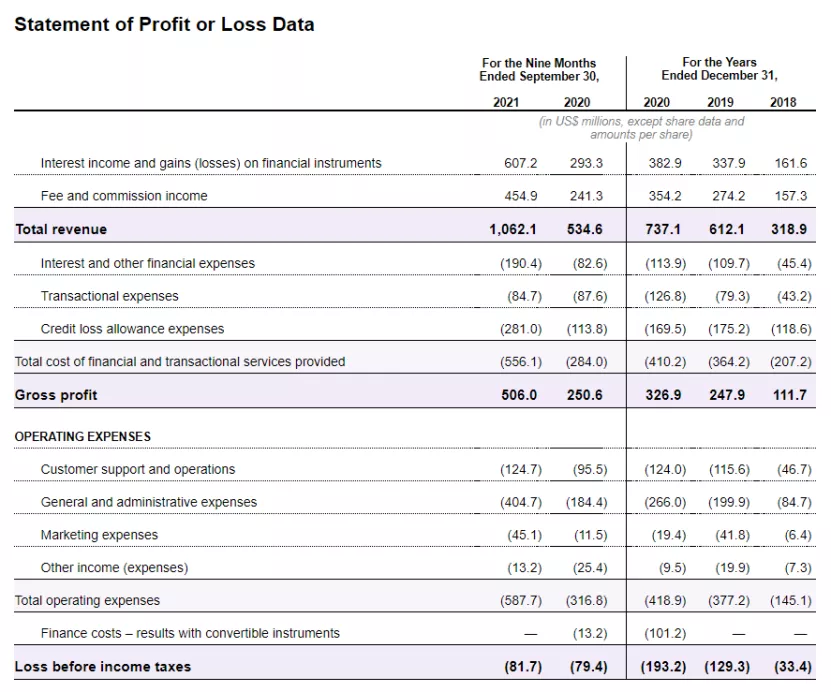
How profitable is Nubank? According to the prospectus, in 2020, Nubank's gross profit was $326.9 million, a 31.9% increase from $247.9 million in 2019. In the first nine months of 2021, Nubank's gross profit was $506 million, a 101.9% increase from the same period last year.
As a key factor in retaining customers, much of Nubank's success relies on the success of its credit card business. According to the prospectus, 80-90% of Nubank's users are acquired through word-of-mouth referrals and free recommendations, which has contributed to the rapid growth of Nubank's customer base.
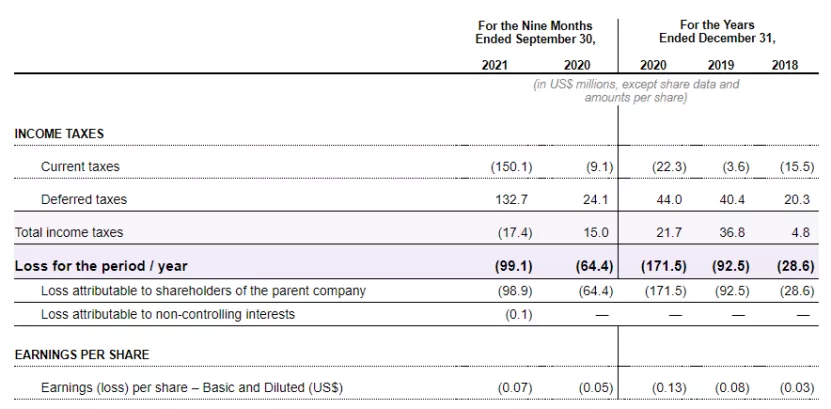
However, Nubank's losses continue to increase. According to the prospectus, in 2018, 2019, and 2020, Nubank had revenues of $319 million, $612 million, and $737 million respectively, with losses of $28.6 million, $92.5 million, and $171.5 million. It may be difficult for Nubank to achieve profitability for a long time.
With a number of major shareholders in hand, Nubank is perfecting its own ecosystem, strengthening platform construction, and continuing to expand into new markets such as Mexico and Colombia. Data shows that since starting operations in Mexico early in 2020, in less than two years, Nubank has become the largest credit card issuer in the country. As of September 30, 2021, Nubank has 0.76 million customers, far exceeding the existing banks in Mexico. This once disruptive player in the Brazilian banking market, has the potential to revolutionize traditional markets in Latin America.
With fierce financing, Redpoint Ventures has invested in at least 7 rounds, while Tencent and Buffett have also joined the ranks.
The story of Ant Group shaking the elephant is well known, but in the Brazilian banking domain dominated by major tycoons, Nubank has a group of comrades behind it.
Since its establishment, Nubank has attracted well-known institutions such as Sequoia Capital, Redpoint Ventures, Tencent Investments, DST, Tiger Global Fund, GIC, Berkshire Hathaway, and many other major players from around the world. Prior to going public, Nubank went through multiple rounds of financing totaling over 2 billion US dollars. David's former employer, Sequoia Capital, has almost never been absent.
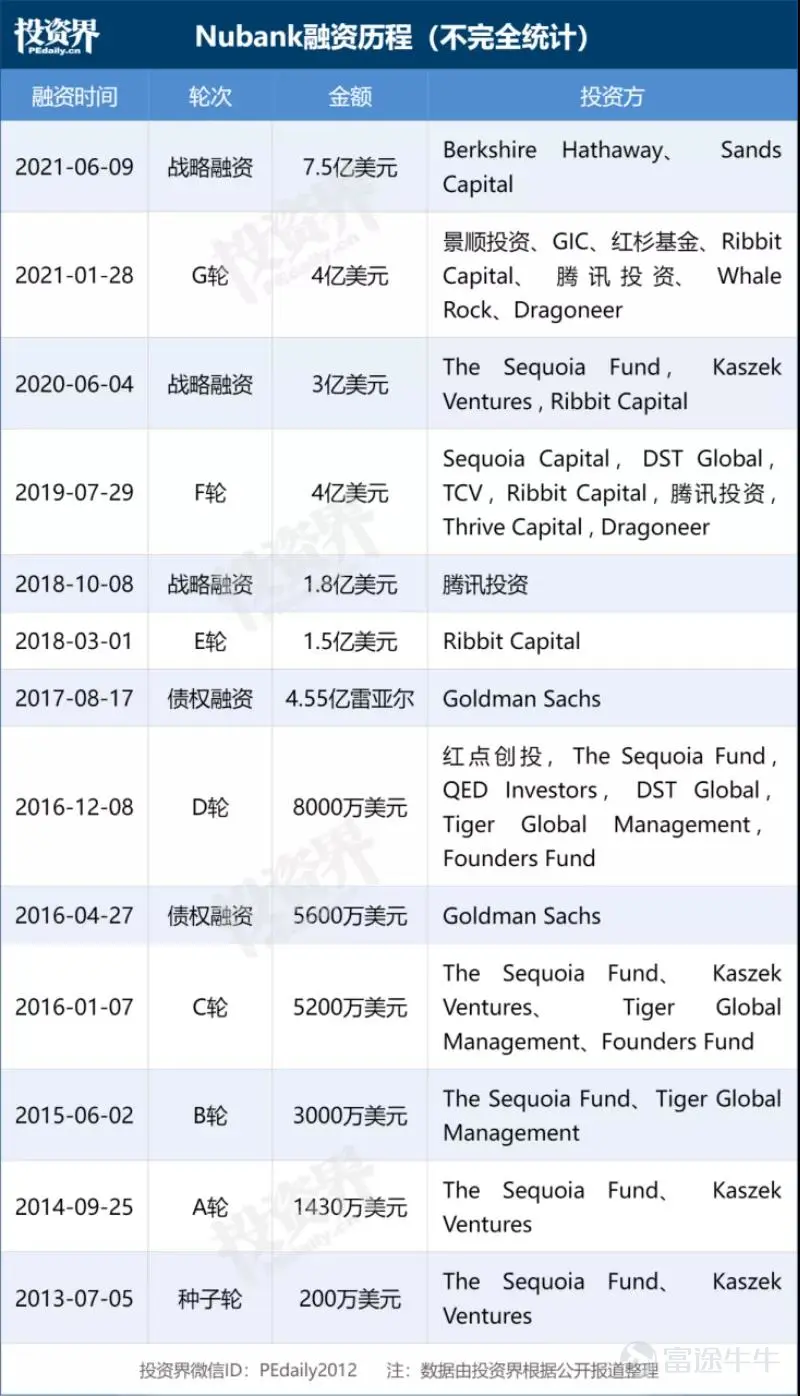
Initially, Sequoia closed its Latin American operations but opened a door for the old employee David. In 2013, David returned from Brazil to Sequoia Capital's office in California, where he met his former mentor, Leone. At David's persuasion, Leone invested 1 million US dollars, becoming David's first investor. Soon, David received another 1 million US dollars from Kaszek Ventures. The story of the Brazilian online bank began to show results, and with the seed funding of 2 million US dollars, David started the digital bank EOS.
A similar scenario reoccurred. A year later, David knocked on the door of Sequoia's US office again, introducing his startup platform EOS to former colleagues. This time, Sequoia Capital was divided in opinion, but eventually agreed to invest 14 million US dollars, on the condition of securing an investment from a Latin American company. Thus, David approached Kaszek Ventures and, following Sequoia's advice, renamed the company Nubank, eventually securing 14.3 million US dollars in Series A funding from Sequoia Capital and Kaszek.
This was Sequoia Capital's first investment in Brazil. Based on advice from Sequoia partner Roelof Botha, David recruited female partner Cristina Junqueira with banking experience, and Princeton computer science graduate Edward Wible, both of whom later became pillars of Nubank.
After receiving millions of dollars from Sequoia Capital, Nubank launched its first product - a credit card. Subsequently, Nubank's expansion was swift, with Sequoia making multiple follow-up investments, and the company's financing coming in continuously, with millions of dollars coming in every year. Meanwhile, Tencent Investments, who was observing the overseas markets, saw an opportunity in Nubank.
Tencent's investment has always been known for its speed and accuracy. In October 2018, Tencent invested $180 million in Nubank, becoming one of the shareholders of this unicorn and bringing help in the areas of payments, consumer loans, engineering, and machine learning. Reuters once pointed out that this was Tencent's first appearance in the largest economy in Latin America.
In fact, just six months before Tencent's investment, Nubank had just received $150 million in Series E financing. David didn't lack money, but he saw Tencent's advantage in data science and machine learning, which was the bottleneck that Nubank, which lacked technical talent at the time, wanted to break through. In this way, Tencent got its ticket to the Latin American market, while Nubank made significant improvements in technology.
Coming from an investment bank, David is very good at financing, and even Warren Buffett's money is in his pocket.
The company is headquartered in the football capital of Brazil, and David often compares Nubank to football when introducing it. Buffett, who has little interest in Brazil and football, has a great liking for this new business that has come out of Brazil. In June of this year, Nubank received $500 million investment from Berkshire Hathaway, a subsidiary of Buffett's company, and an additional $250 million investment from Sands Capital, with a valuation of up to $30 billion, setting a new financing record in Latin America.
David revealed that during the financing negotiations in March this year, Nubank's growth rate and new insurance business were the areas that Buffett was most interested in. The data he provided showed that Nubank's daily user growth at the end of 2020 was almost 0.04 million, and the customer acquisition cost was almost zero, which is a height that many banks find difficult to reach.
Once upon a time, David's concept of a digital bank was mocked by Latin American investors as "ants that can't beat elephants". Today, the support of many big shots has doubled Nubank's valuation, and in August of this year, it led the Series B financing of the Indian digital bank Jupiter. Nubank, which has become a super unicorn, is now expanding its territory.
In the past, there was a desert of venture capital, and now there is a big outbreak in emerging markets, and unicorns are being born in large numbers.
Nubank's rise has created a venture capital myth in Latin America. In fact, if we expand our vision from Latin America to Southeast Asia and Africa, we can see an exciting scene - emerging markets are giving birth to Internet unicorns in large numbers.
Last week, Grab, known as the "Southeast Asian version of Didi" in the early years, successfully debuted on the Nasdaq through an SPAC, setting a record for the largest SPAC merger in history. And behind this super unicorn is a young Chinese-American born in the 1980s named Chen Bingyao. In 2012, despite opposition from his family, he resolutely founded Grab.
Over the past 9 years, Grab, with Malaysia as its starting point, has successively entered the Philippines, Vietnam, Indonesia, Thailand, Singapore, and other regions, becoming a super app that integrates transportation, food delivery, mobile payments, and more. Along the way, Grab has gathered a lineup of luxury investment partners, including SoftBank, Vertex Ventures, GGV Capital, Hillhouse Capital, Sequoia Capital, Lightspeed Venture Partners, Ping An Ventures, Alibaba, Didi, and Toyota.
Among the many Southeast Asian unicorns, Sea, known as the "Tencent of Southeast Asia," is the most well-known. Let's go back to 2009, when a Tianjin native named Li Xiaodong established Garena, the predecessor of Sea, in Singapore, focusing primarily on the gaming business. One year later, Garena received investment from Tencent in China and secured the exclusive distribution rights for the popular game "League of Legends" in Southeast Asia, becoming the largest gaming platform in Southeast Asia.
In addition to Tencent, Sea has also attracted the attention of Hillhouse Capital, which is rare. Here's an interesting story: After Wang Xing's most trusted brother, Gan Jiawei, joined Hillhouse Capital, he was sent to Singapore for nearly half a year, using his rich experience from Alibaba and Meituan to help Sea achieve rapid growth. Today, Sea has a total market cap of over $140 billion, and 43-year-old Li Xiaodong tops the list of Singapore's richest people with a net worth of $19.8 billion.
In addition, Mynt, the first unicorn company in the Philippines, is a joint venture established by Ant Group, an affiliate of Alibaba Group, and Ayala Corporation, a Philippine developer. Flash Express, a unicorn company in Thailand, has received strong support from Chinese investors such as Hillhouse Capital and Alibaba's eWTP Fund. Bukalapak, the recently listed Indonesian e-commerce unicorn, is backed by Ant Group and New Hope Group.
Now let's turn our attention to another emerging market - India. One of the hottest events in the Indian venture capital circle this year was the successful IPO of the unicorn food delivery platform Zomato. Founded in 2008, Zomato was initially a food recommendation platform similar to Yelp. Later, Zomato expanded into online food ordering and delivery services and became known as the "Indian version of Meituan." Prior to this, the company had received three rounds of investment from Ant Financial.
Not long ago, ByteDance also made a move in the Middle East by investing in iMile, a local e-commerce logistics company that is on its way to becoming a unicorn. In 2017, Huang Zhen (Rita), who had previously worked for Huawei and Alibaba's overseas departments, saw the business opportunities in the e-commerce field and founded iMile, focusing on the weakest link in the Middle East. After 4 years of establishment, iMile has completed 3 rounds of financing, with ByteDance participating in the latest round of financing totaling $40 million. It is reported that the company's valuation has reached $350 million.
Africa is another vibrant blue ocean for venture capital. In August of this year, the Nigerian mobile payment platform OPay raised $400 million in financing, led by SoftBank Vision Fund, with participation from Sequoia China, Redpoint China, Source Code Capital, SoftBank Asia, 3W Capital, and Meituan-Dianping's Longzhu. After this financing round, OPay was valued at $2 billion, making it one of the most dazzling unicorns on the African continent.
It is little known that the soul figure of this company is Zhou Yahui. Born in 1977, he is a serial entrepreneur and an internet celebrity investor. In 1999, Zhou Yahui dropped out of Tsinghua University and started his entrepreneurial journey. In 2008, he founded Kunlun Wenhui, focusing on the gaming business, and in 2015, Kunlun Wenhui went public on the Growth Enterprise Market (GEM). Since then, he has ventured into the investment business and has invested in well-known unicorns such as Yingke and Dada, earning him the title of "unicorn catcher" in the industry.
It is not difficult to see that these unicorns that have grown in emerging markets, to a greater or lesser extent, can be seen with Chinese elements, either by borrowing from the Chinese model or with investments from Chinese investors and technology giants.
In response to this, a well-known institutional investor in Beijing said, "Before the pandemic, I frequently visited Southeast Asia to investigate projects. I have tasted the Indonesian version of 'Hey Tea' and 'Luckin Coffee' in Indonesia, and I have also seen 'Wenhe You' in Cambodia and Vietnam. I have also witnessed a new wave of payment wallets and food delivery subsidies in Indonesia and Singapore's malls. In addition to consumer goods, gaming and content payments in emerging markets will also create a huge opportunity. For a long time, platform opportunities will continue to emerge for cross-border models."
This perfectly illustrates Masayoshi Son's famous time machine theory: taking advantage of the differences between countries at different stages of development, developing a business in a relatively advanced country and then bringing the experience of that business's development to a relatively later country when the business operation is mature, copying the successful business model as if traveling back in time.
They are following the path of China's new economy over the past twenty years - internet model innovation is booming in various emerging markets. Southeast Asia, India, the Middle East, Africa, Latin America... those once overlooked venture capital deserts are now producing one unicorn after another.
Risk Disclaimer: The above content only represents the author's view. It does not represent any position or investment advice of Futu. Futu makes no representation or warranty.Read more


Comments (8)
to post a comment
21
37