
互聯互通再升級,微信試行鬆綁外鏈

Alibaba Finally Taps into WeChat's Gold Mine

New progress has been made in the 'interconnectivity' between Tencent and Alibaba, the two tech giants.
On the evening of November 29, WeChat announced that it would adjust its external link management measures effective immediately. Users will be able to directly access external links in one-on-one chat scenarios (i.e., private chat windows). Additionally, a pilot program will be launched to allow direct access to e-commerce external links within group chats.A trial has been initiated to enable direct access to external e-commerce links.
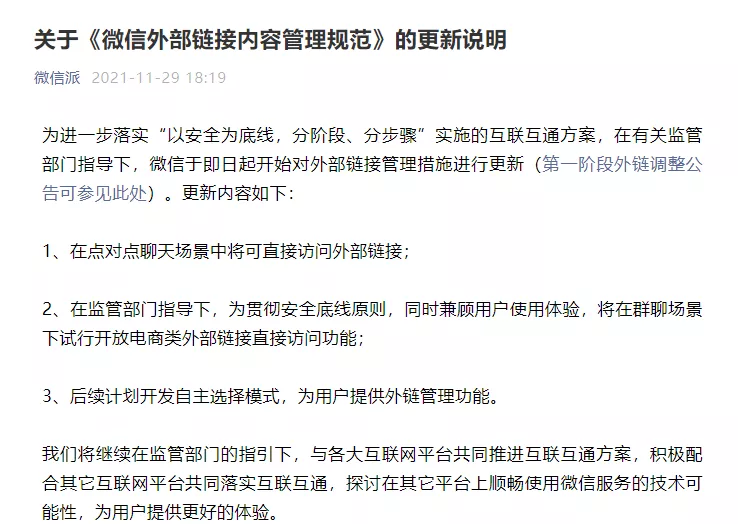
In addition, WeChat plans to develop a user-selectable mode in the future, providing users with external link management capabilities. This may imply that WeChat users will have the autonomy to decide whether to directly open external links such as those from Taobao and PDD Holdings.
Testing by Letter List (ID: wujicaijing) revealed that sharing product links from apps like Taobao, Tmall, and Douyin to private WeChat chat windows,allows the links to be opened directly upon clicking;however, sharing the same links to group chats displays the message 'To view, please long-press the URL, copy it, and open it using a browser.' A senior industry insider stated that WeChat group chats are temporarily unable to access Taobao links directly due to the platform's massive data volume, requiring gradual implementation to mitigate pressure. After midnight tomorrow, group chats on WeChat will be able to directly access external e-commerce links.
Moreover, in an announcement of less than 300 words, WeChat mentioned 'guidance from regulatory authorities' three times and emphasized 'safety baselines' twice, indirectly reflecting the profound influence of policy factors on this adjustment.
While opening its own traffic pool, WeChat made a countermove, stating that it would 'cooperate with major internet platforms to jointly advance interconnectivity solutions, actively working with other internet platforms to implement interconnectivity,'and explore the technical feasibility of enabling smooth use of WeChat services on other platforms.
In other words, since we are opening our arms to you, there is no reason for you to keep your doors closed.
The term 'other platforms' primarily refers to Alibaba. Currently, Alibaba has shown goodwill to Tencent through relatively peripheral sectors such as Ele.me and Youku, recently integrating WeChat Pay. However, in its core Taobao-based e-commerce operations, Alibaba remains unmoved.
Regarding the latest adjustments to WeChat, Alibabadid not respond.
Although this opening is not complete, for Alibaba, which has been craving traffic, it represents a long-awaited victory. Even if links can only be shared in private chats, Taobao’s e-commerce ecosystem will still tap into WeChat's social network – a goldmine that the entire Chinese internet industry covets deeply.
Since 2013, Alibaba and Tencent have blocked each other amid escalating competition, forcing users to rely on copying and pasting convoluted 'Martian codes' (Taobao purchase commands) as they struggled to navigate between the two giants’ closed ecosystems. It wasn’t until eight years later, under the regulatory trend of breaking monopolies, that the high walls between these two camps began to crumble.
However, this is unlikely to result in a perfect win-win 'century handshake.'
From an overall interest perspective, Tencent may not be willing to watch Taobao's e-commerce platform blatantly draw from WeChat’s traffic pool, especially in the post-bonus era where every bit of traffic holds intrinsic value.
While Alibaba has shown more initiative, entering WeChat’s ecosystem will inevitably come at a higher cost. However, its bargaining chips are limited; only the payment scenario offers significant appeal, and whether or not to exchange this with Tencent requires careful consideration.
Today, after much delay, Tencent has finally made the first move under regulatory pressure. How Alibaba will 'receive, transform, and respond' will pose a strategic challenge of immense complexity.
A
The initial impetus for mutual openness between Tencent and Alibaba originated from regulatory authorities.
Starting in July this year, the Ministry of Industry and Information Technology (MIIT) launched a six-month special rectification campaign targeting the internet industry, during which blocking URL links was identifiedSeverely affecting user experience, harming user rights, and disrupting market order,is one of the key focuses of this special governance campaign.
By mid-July, rumors about Tencent and Alibaba opening up to each other began to circulate. According to reports by The Wall Street Journal and several other foreign media outlets, sources claimed that Alibaba and Tencent were respectively drafting plans to ease restrictions.
Initial measures may include:Alibaba integrating WeChat Pay into Taobao and Tmall; Tencent reducing the difficulty of sharing Alibaba products within WeChat,or allowing some Alibaba services to launch as mini-programs on WeChat.
The potential end of an eight-year ecosystem isolation between the two giants, allowing each other access to their core domains, will undoubtedly have a profound impact on China’s internet landscape. This news quickly became a focal point of industry attention.
Half a month later, Alibaba Chairman and CEO Daniel Zhang stated during an earnings call that the social value generated by large-scale circulation among platforms would far exceed small-scale circulation within a single platform; interconnectivity between platforms would certainly bring new reform dividends.

Zhang Yong
Zhang specifically mentioned the recent special rectification campaign by the Ministry of Industry and Information Technology (MIIT), which targets malicious URL blocking and interference with the operation of other companies’ products or services. “We think it is very necessary. We will comply with government requirements and work with other platforms.”Looking ahead, both sides are moving toward each other.”
On the other hand, as Tencent was the party that stood to benefit less from the interconnectivity initiative, it initially showed little enthusiasm.
Two weeks after Daniel Zhang’s public call for action, Tencent President Martin Lau responded to related rumors during an earnings call on August 18. He stated that Tencent’s ecosystem is open but emphasized the focus on helping small merchants and SMEs succeed, while noting that interconnectivity between platforms is a 'highly complex issue.'
However, by early September,regulators intervened with high-profile involvement,providing direct on-site guidance for interconnectivity, which significantly accelerated Alibaba and Tencent's progress in 'moving toward each other.'
According to a report by *Caijing* magazine, on September 9, the Ministry of Industry and Information Technology (MIIT) organized an administrative guidance meeting attended by executives from companies such as Alibaba, Tencent, ByteDance, Huawei, Baidu, Xiaomi, 360, and NetEase. The services and products of these companies cover nearly all internet users in China.
At this meeting, the MIIT mandated that all platforms must, according to set standards, lift their blocking measures by September 17, or enforcement actions would be taken.
Faced with strict orders, Tencent’s actions notably sped up.
On September 17, WeChat released a statement titled 'Adjustments to the External Link Content Management Regulations,' announcing that new external link management measures would be implemented in phases and steps.
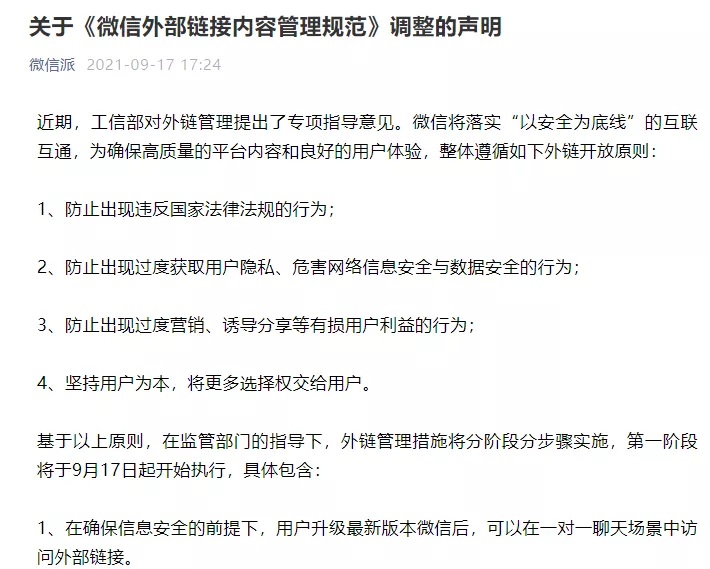
However, in this statement, WeChat only mentioned allowing users to access external links in private chats, without addressing the critical issue of e-commerce external links. Additionally, users are required to undergo a secondary security confirmation when opening links.
In today's statement,WeChat has taken another step forward,not only allowing private chat access to e-commerce external links but also beginning to trial the opening of such links in group chats.
Once these measures are officially implemented, consumers will no longer have to endure the hassle of copying and pasting links, while merchants on Alibaba-affiliated e-commerce platforms will have the opportunity to leverage WeChat’s social ecosystem to develop more innovative strategies and benefit from both major internet ecosystems.
B
In this mutual convergence, Alibaba stands to gain significantly higher potential benefits and has demonstrated a more proactive stance. It clearly needs to present an attractive proposition to negotiate with Tencent.The key trump card selected for this purpose is payment.。
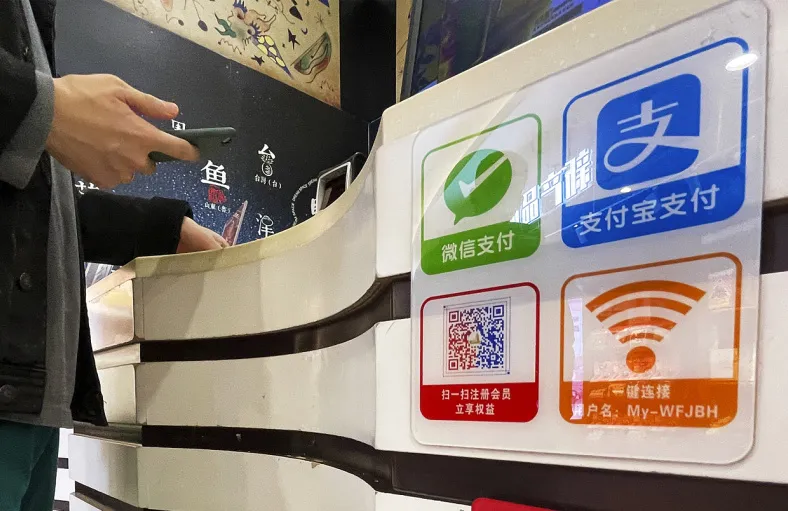
For a long time, Alipay has been the primary payment tool for Taobao-based e-commerce. Supported by the massive transaction volumes on apps like Taobao and Tmall, Alipay holds over 50% of the domestic mobile payment market share, surpassing WeChat Pay.
However, in the face of longer-term interests, Alibaba has also extended an olive branch.
On September 18, some users discovered that Taocaicai, the community e-commerce platform under Alibaba, had added an option for 'Ask a friend to pay via WeChat' in addition to Alipay. The day before, WeChat had just announced the opening of link redirection in private chats.
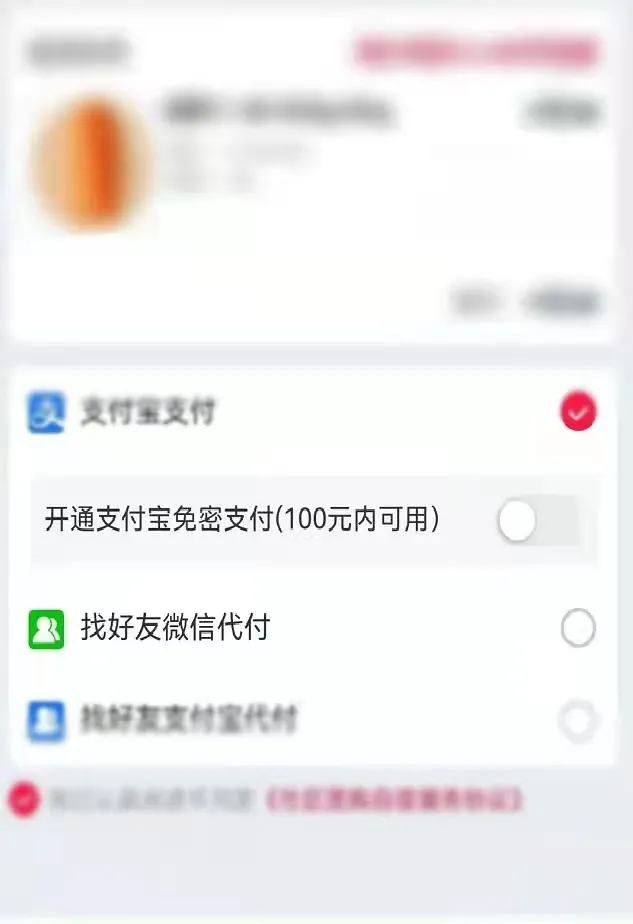
Previously, Alibaba-affiliated apps such as Ele.me, Youku, Damai, Kaola, and Shuqi had already integrated WeChat Pay. Additionally, it was reported that Taote, Xianyu, and Freshippo have also applied to integrate WeChat Pay and are currently awaiting approval.
Ten days later, Alibaba confirmed the authenticity of the news that its applications were progressively integrating WeChat Pay, reiterating its commitment to "working together with other platforms toward the future, moving in the same direction."
Interestingly, when asked by the media about payment options for Taobao and Tmall, a Taobao representative stated that they would "be user-experience-oriented, prioritize security, and gradually implement multiple payment methods in phases," a phrasing strikingly similar to Tencent's official tone.
By early October, Taote officially launched "WeChat QR code payment." As one of the fastest-growing apps within Alibaba’s ecosystem, placing Taote in the open integration matrix without directly adopting WeChat Pay—unlike Taocai or Ele.me—demonstrates certain strategic considerations on Alibaba’s part in this competitive landscape.
While Alibaba has repeatedly extended olive branches, Tencent appears somewhat deliberately oblivious to these overtures.
Beyond external links, WeChat Mini Programs represent another focal point of contention for Alibaba. Earlier this year, Alibaba applied to launch Mini Programs for Taote and Xianyu, but neither has gone live to date.
C
The fundamental reason behind Alibaba's strong desire for WeChat to open up external links isits own growthhas increasingly plateaued.
Over the past few years, the number of domestic internet users has neared saturation, while PDD Holdings emerged from lower-tier markets, intensifying pressure on Alibaba’s growth and making access to WeChat’s traffic more critical than ever.
As of the end of the second quarter this year, Alibaba's China retail market had 828 million annual active buyers, an increase of 17 million from the previous quarter. In comparison, PDD Holdings reported 849.9 million annual active buyers, adding 26 million quarter-on-quarter, surpassing Alibaba.
Moreover, Alibaba's traffic acquisition costs have been rising. According to financial reports, Alibaba’s customer acquisition cost has exceeded RMB 1,000 for multiple quarters, the highest in the industry.
The most ideal way for Alibaba to tap into WeChat’s traffic pool would be to restore external e-commerce links, allowing users to share and click through. Alibaba would not need to pay Tencent to directly access private domain traffic such as user chats, group chats, and Moments; moreover, the conversion efficiency of socially-driven links would be guaranteed.
However, at present,Tencent has shown little interest in Alibaba's payment strategy.Whether Taobao's e-commerce ecosystem will be fully integrated into WeChat remains uncertain.
Tencent’s core businesses are social networking and gaming. In these two sectors, Tencent has yet to face significant challenges: WeChat’s MAU (monthly active users) has reached 1.25 billion, while QQ boasts 600 million MAUs; although game IPs like Honor of Kings, Peacekeeper Elite, and League of Legends are aging, they still generate substantial revenue.
In these two areas, Alibaba’s commercial and logistics capabilities have limited applicability; the user traffic of Taobao’s e-commerce platform and Alipay is highly purpose-driven for shopping, and even if opened to Tencent, it would be difficult to divert users to broader entertainment scenarios such as gaming.
This implies that, aside from continued policy-level advocacy, Alibaba must offer more compelling incentives to encourage Tencent to open its ecosystem sooner.
Tencent must also consider the implications of Taobao's e-commerce platform entering its ecosystem.The impact on WeChat's existing e-commerce ecosystem.
Over the past few years, Tencent has rolled out initiatives such as Smart Retail, mini-program stores, and live streaming via mini-programs to attract merchants to do business within the WeChat ecosystem. If Taobao’s e-commerce platforms were to enter WeChat, their financial resources and capabilities would far exceed those of small and medium-sized businesses on the WeChat platform, akin to introducing a giant鲶鱼. This would significantly compress the survival space for other merchants.
Moreover, key players in Tencent's alliance, such as PDD Holdings and JD.com, are likely not welcoming the arrival of Taobao’s e-commerce platforms.
After receiving investments, both PDD Holdings and JD.com have moved closer to Tencent. For instance, PDD Holdings prioritizes WeChat Pay in its payment options, followed by Duoduo Wallet and then Alipay; JD.com has consistently not supported Alipay payments. Both companies have heavily invested in the Tencent ecosystem.
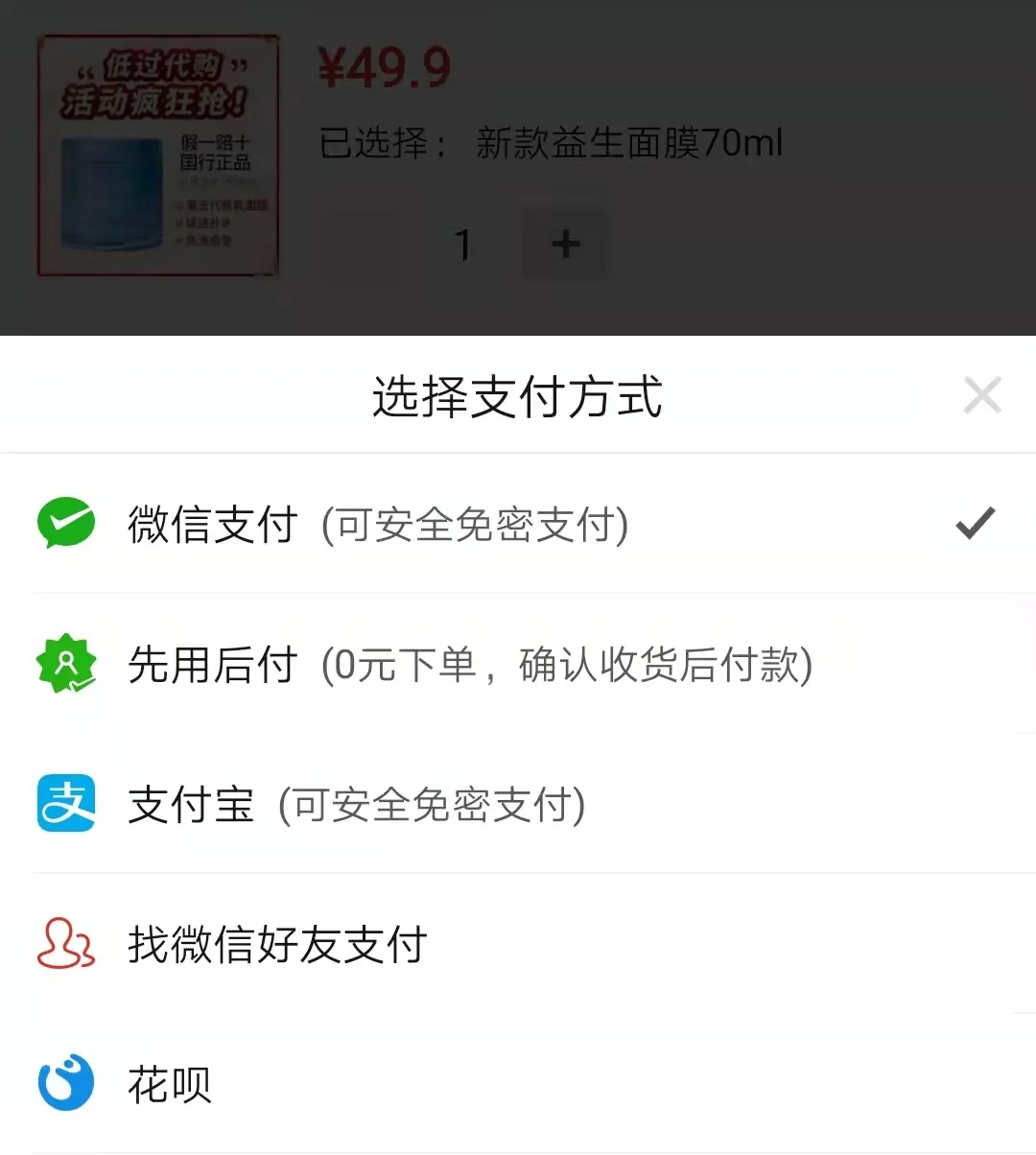
If Taobao’s e-commerce presence becomes increasingly prominent within the WeChat ecosystem—whether through direct link redirections or launching mini-programs and nine-grid placements—it will objectively divert potential orders from PDD Holdings and JD.com.
An even bigger issue is that if Taobao's e-commerce can enter, then Douyin and Kuaishou e-commerce might also gain similar opportunities. The preferential treatment PDD Holdings and JD.com enjoy as part of the inner circle could easily vanish. Balancing the interests of these insiders presents a significant challenge for Tencent amid the broader trend toward interconnectivity.
This also indicates that breaking down barriers between platforms involves numerous interest exchanges and will not be achieved overnight. In reshaping China's internet landscape, this is bound to be a prolonged and intricate commercial game.
Risk Disclaimer: The above content only represents the author's view. It does not represent any position or investment advice of Futu. Futu makes no representation or warranty.Read more


Comments (11)
to post a comment
21
50