
Jensen Huang personally "promotes NVIDIA"! In the $3-4 trillion AI boom, which companies stand to benefit the most?
Jensen Huang believes that this supercycle of AI infrastructure is far from over.
On September 10 local time, at the Goldman Sachs Communacopia + Technology Conference, $NVIDIA (NVDA.US)$ CEO Jensen Huang reiterated:By 2030, global AI infrastructure spending is expected to reach $3 trillion to $4 trillion.
When the host brought up this forecast, Jensen Huang even joked that everyone should pause to "admit I was right." More interestingly, midway through his talk, he pointed out directly:"I'm here today to promote NVIDIA stock."and described NVIDIA asa company with both growth and value characteristics.
While it may seem like a "stock pitch," the real highlight of this speech is Jensen Huang's reinterpretation of NVIDIA's growth logic for the coming years.If the market's trading theme for NVIDIA over the past two years was GPU shortages, then what NVIDIA truly aims to capture next goes far beyond just the GPU market.
1. What NVIDIA truly aims to capture is no longer limited to the GPU market
Jensen Huang repeatedly emphasized that while the market still views NVIDIA as a GPU company, what it actually sells is a complete AI factory solution.
From GPUs and CPUs to NVLink, networking, full-system integration, and the CUDA software stack, NVIDIA is continuously expanding its "wallet share" in AI capital expenditure. A single GPU system can now be valued at approximately $8.5 million, with the Grace Blackwell NVLink72 rack seeing a recent monthly growth rate of about 27%.
The underlying logic is that as Moore's Law slows down, competition is shifting from individual chip performance to system-level co-design: optimizing chips, packaging, memory, networking, and software together, with the goal of producing more tokens at lower costs.
This is also the core reason behind Jensen Huang's bullish outlook on the $3–4 trillion AI infrastructure market—AI is evolving from "information retrieval" to "real-time generation," and from chatbots to Agents, requiring the world to rebuild a new computational infrastructure.
Therefore, NVIDIA's bet is not merely on selling more GPUs, but on capturing a larger share of the value within the entire AI factory ecosystem.
2. In the $3-4 trillion AI boom, who stands to benefit the most?
If NVIDIA's assessment holds true, the greatest investment opportunities will not be confined to NVIDIA itself. As AI factories expand, they will require increasing amounts of wafers, packaging, memory, networking, power, and data center resources. Based on insights from this conference, there are three main themes worth watching closely going forward.
Category 1: The most certain "upstream shovel sellers"—wafers, packaging, and storage
Jensen Huang was very direct about the bottlenecks in the AI supply chain: wafers, advanced packaging, DRAM, LPDDR, connectors, and voltage regulators—almost every upstream segment is facing supply pressure.
More importantly, NVIDIA believes that supply, not demand, remains the true constraint on revenue growth. Jensen Huang reaffirmed the company's confidence in achieving approximately 70% year-over-year growth in the next fiscal year, noting that demand growth could even exceed 100% if not limited by supply constraints.
This means that if AI capital expenditure continues to expand, the most direct beneficiaries will remain the companies controlling scarce production capacity: $Taiwan Semiconductor (TSM.US)$It remains the core link.
Whether for GPUs, ASICs, or increasingly complex future AI chips, advanced process nodes and advanced packaging cannot bypass Taiwan Semiconductor. NVIDIA itself is becoming increasingly reliant on CoWoS, NVLink, and large-scale system integration to break through the limitations of Moore's Law.
Secondly, $SK hynix (SKHY.US)$、 $Samsung Electronics (005930.KR)$、 $Micron Technology (MU.US)$and other memory manufacturers.
In the past, the market focused more on HBM. However, Jensen Huang’s recent emphasis on DRAM and LPDDR indicates that as AI servers move further toward rack-scale architectures and agent inference demand explodes, the memory bottleneck is spreading from HBM to a broader range of high-performance storage solutions.
Therefore, the investment thesis for the first layer of AI infrastructure is clear: the more computing power required, the greater the demand for wafers, packaging, and storage.This segment represents the most certain "pick-and-shovel" opportunity within the entire $3–4 trillion AI industry chain.
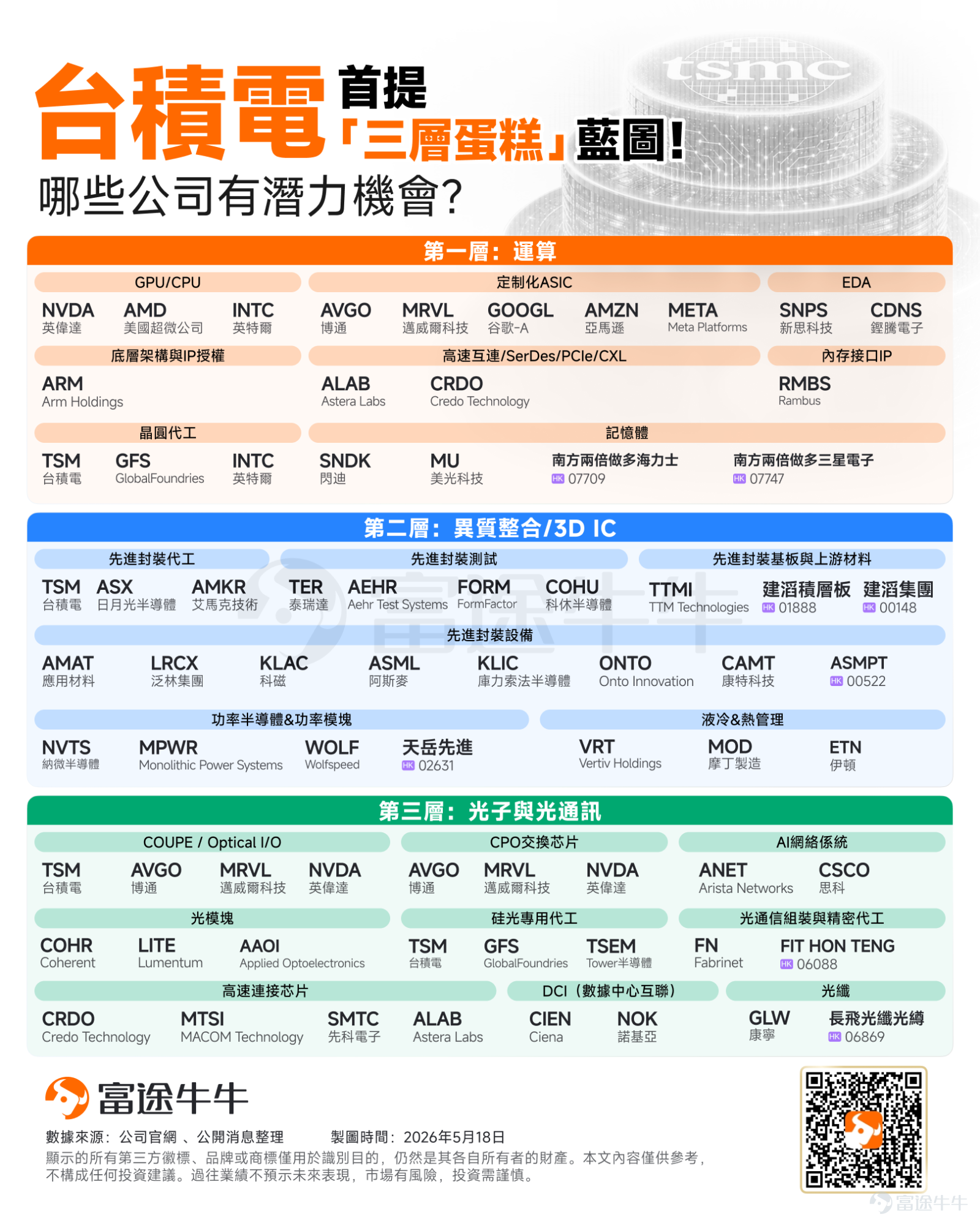
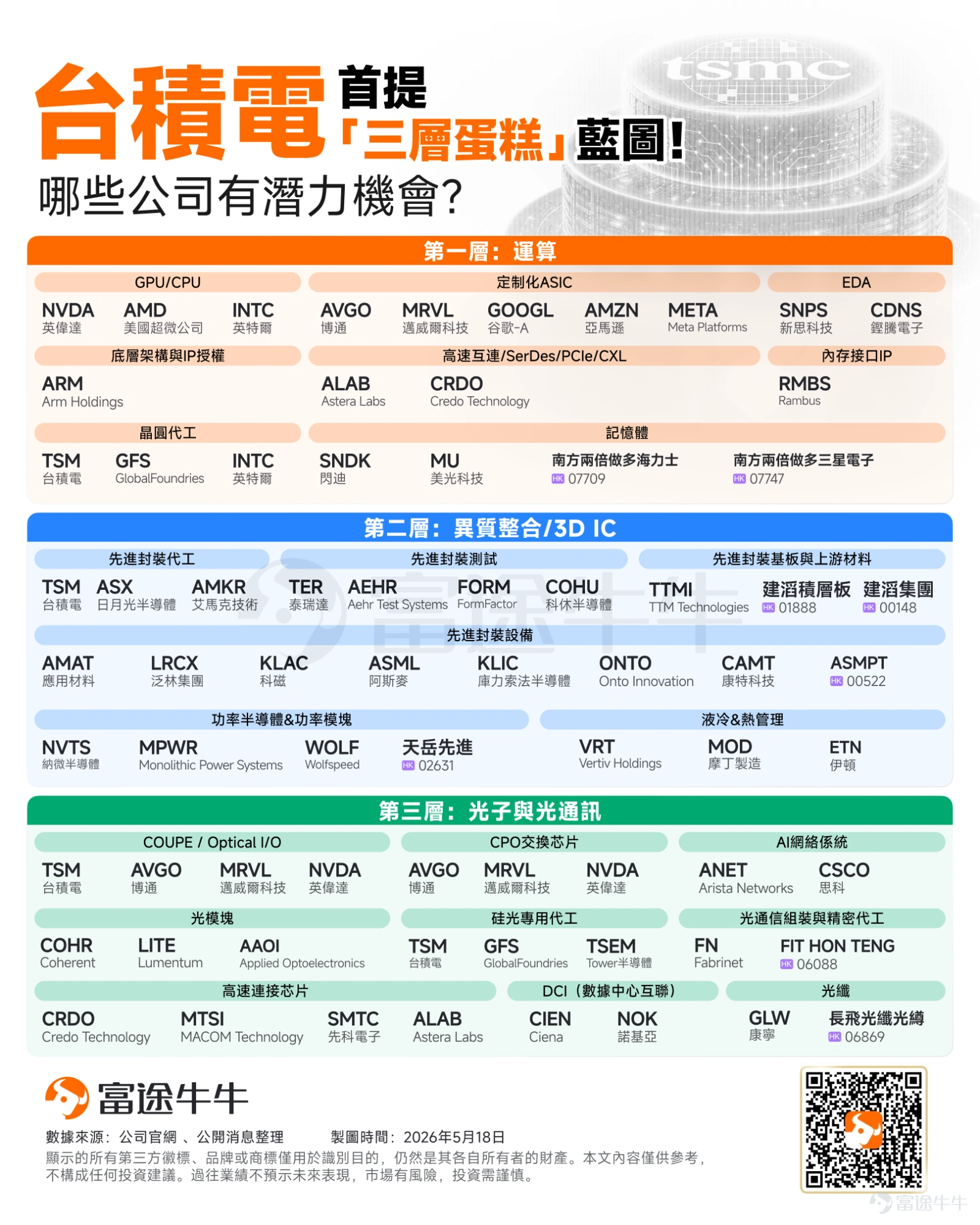
This aligns with the views previously expressed by C.C. Wei, Co-CEO of Taiwan Semiconductor."Taiwan Semiconductor Unveils 'Three-Layer Cake' Blueprint! Which Companies Have Potential Opportunities?"The article also mentioned that C.C. Wei stated that, when breaking it down from a chip perspective, AI chips can actually be further subdivided into three core layers.
--
--
--
Category 2: The scarcest resources in the next cycle—electricity, data centers, and Neocloud.
However, compared to chips, what is more noteworthy at this conference is that the AI bottleneck is shifting from "availability of GPUs" to "availability of electricity, land, and data centers."
Jensen Huang stated that NVIDIA is now even tracking every gigawatt of data center land, power, and facility resources globally. This reflects the fact that AI infrastructure is rapidly entering the "GW Era."
For example, Huang mentioned an AI infrastructure project in Australia during the conference, with plans for approximately 2GW of computing infrastructure by 2027, corresponding to an investment scale of around $80 billion.
This also explains why NVIDIA has been continuously supporting $CoreWeave (CRWV.US)$、 $NEBIUS (NBIS.US)$、 $IREN Ltd (IREN.US)$ 、neocloud providers such as Nscale, Lambda, and Firmus over the past two years.What these companies truly offer is no longer simple "GPU leasing," but rather a bundled package of GPU + land + power + data center facilities + financing capabilities, forming a complete computing infrastructure.
Jensen Huang has even referred to neoclouds as a crucial distribution channel for NVIDIA's future architecture, as they help NVIDIA secure land and power resources beyond traditional Cloud Service Providers (CSPs).
Therefore, a significant shift in future AI trading may be: while the market previously focused on GPU shipment volumes, it will increasingly pay attention to gigawatts (GW) going forward. Those who possess cheap, stable power, land, and data center capacity are likely to become the core beneficiaries of the next wave of AI capital expenditure.
This also implies that data centers, power equipment, grid infrastructure, and neoclouds may become the new main themes in AI infrastructure trading, following GPUs and HBM.
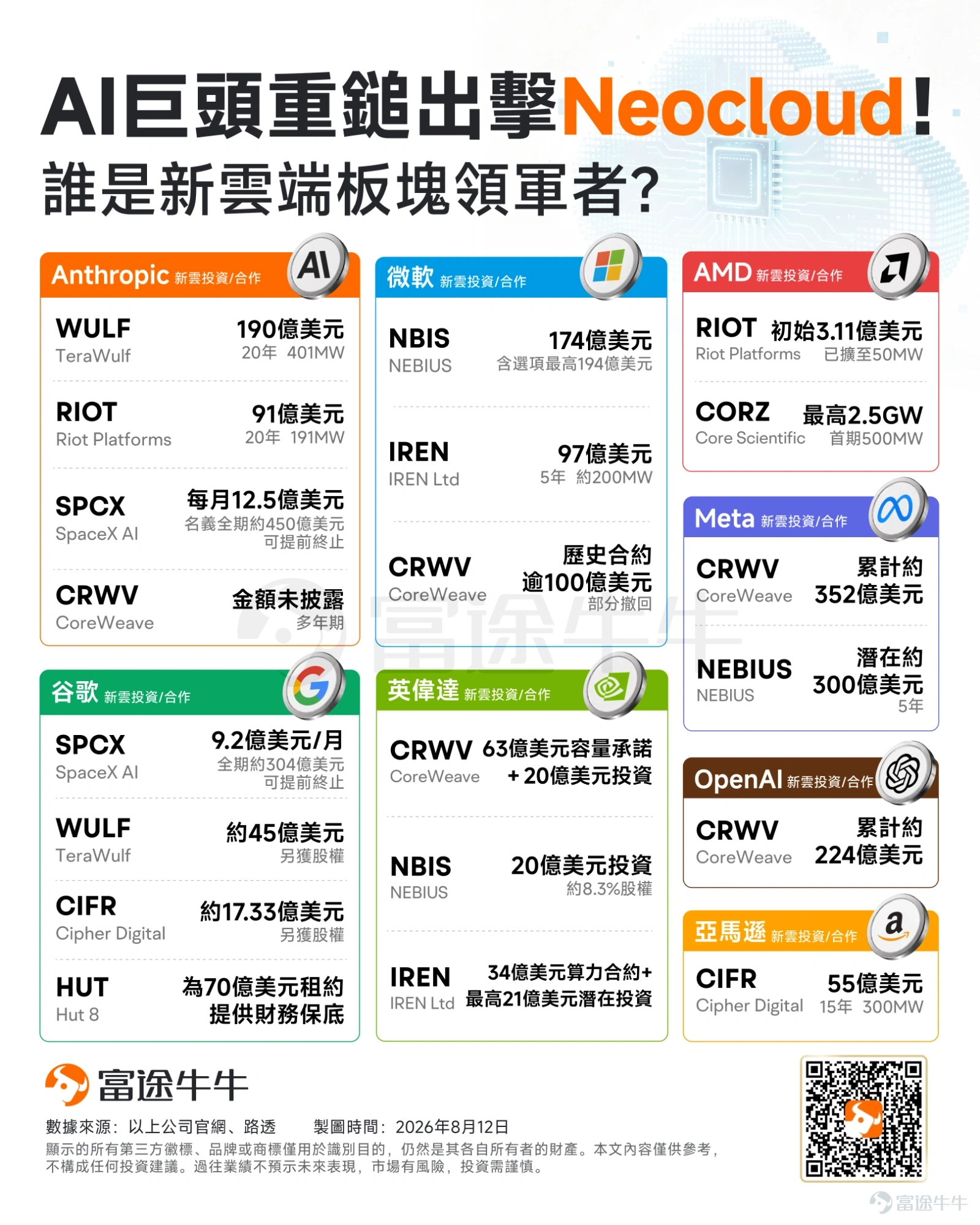
Previously,"Anthropic Signs 20-Year Compute Deal with Riot, CoreWeave's Backlog Surpasses $100 Billion! Why Are AI Giants Betting Big on Neocloud?"The article also includes a relevant chart; interested fellow investors can click to view it.
--
--
--
Category 3: Diffusion from AI factories to applications—Cybersecurity and Physical AI
As infrastructure deployment expands, the market must ultimately answer one question: What exactly is all this computing power being used for?
Jensen Huang's first answer remains coding. However, he believes that the next major killer app scenario for AI, following coding,It is very likely cybersecurity.
The logic is also straightforward: AI can continuously write code and persistently hunt for vulnerabilities. In the future, Red Team agents can launch attacks 24/7, while Blue Team agents continuously detect and remediate threats. This round-the-clock, high-frequency operational model is naturally suited for AI.
Jensen Huang explicitly named $CrowdStrike (CRWD.US)$ , and stated that NVIDIA is leveraging the Nemotron model to build an automated red team/blue team adversarial framework. Therefore, $CrowdStrike (CRWD.US)$ 、 $Palantir (PLTR.US)$ 、 $Cisco (CSCO.US)$ companies in this category essentially represent the next phase of the AI supply chain, shifting focus from CapEx to ROI realization.
Previously, NVIDIA, Taiwan Semiconductor, and memory manufacturers were selling "what is needed to build AI," whereas these software and security companies are answering: why enterprises are willing to continue paying for AI.
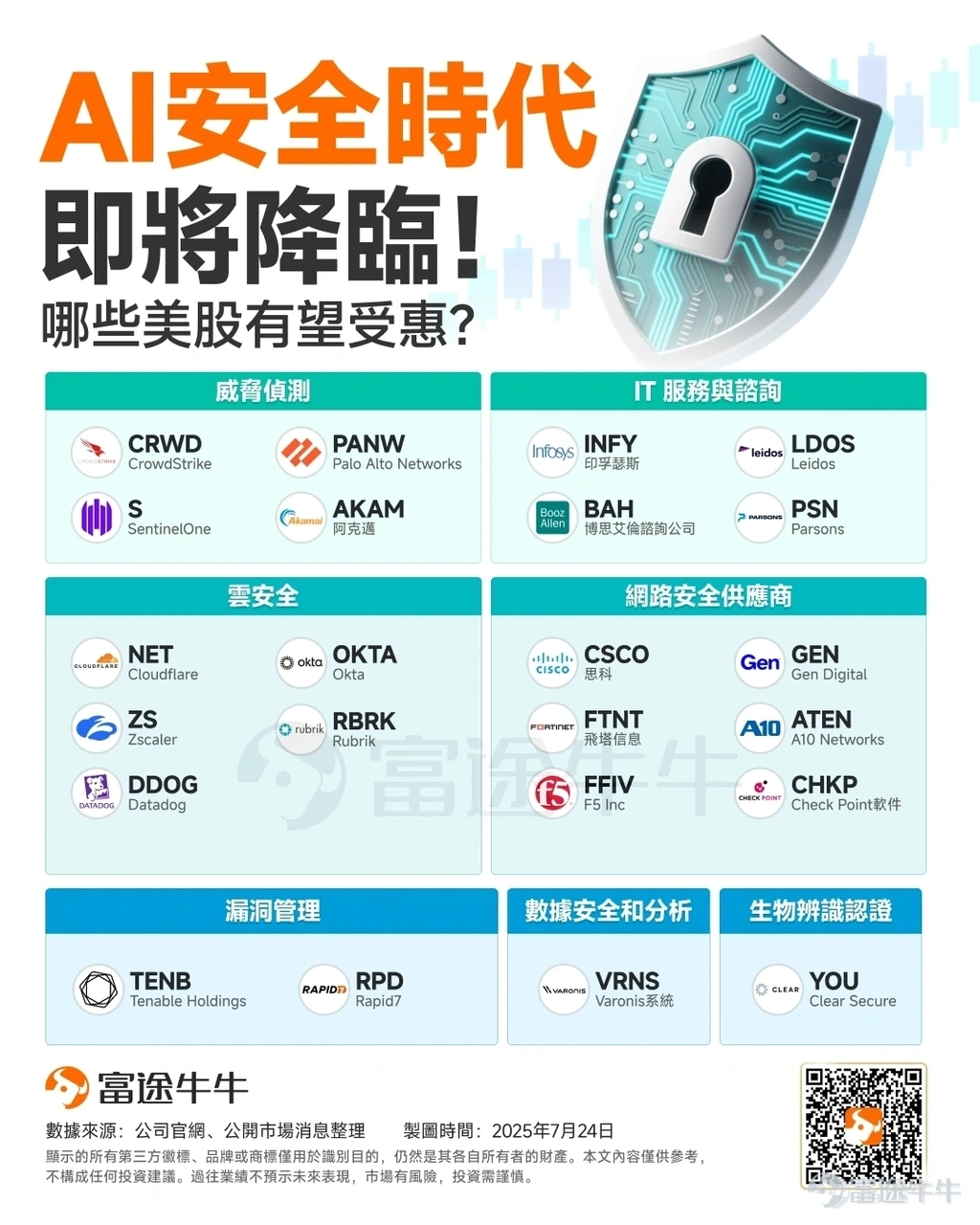
Notably, cybersecurity stocks have performed exceptionally well year-to-date."'Protecting AI' Is the Real Money Printer! CRWD and OKTA Earnings Explode: Which Cybersecurity Stocks Are Worth Watching?"The article also outlines the core drivers of this industry and related concept stocks for fellow investors:
--
--
--
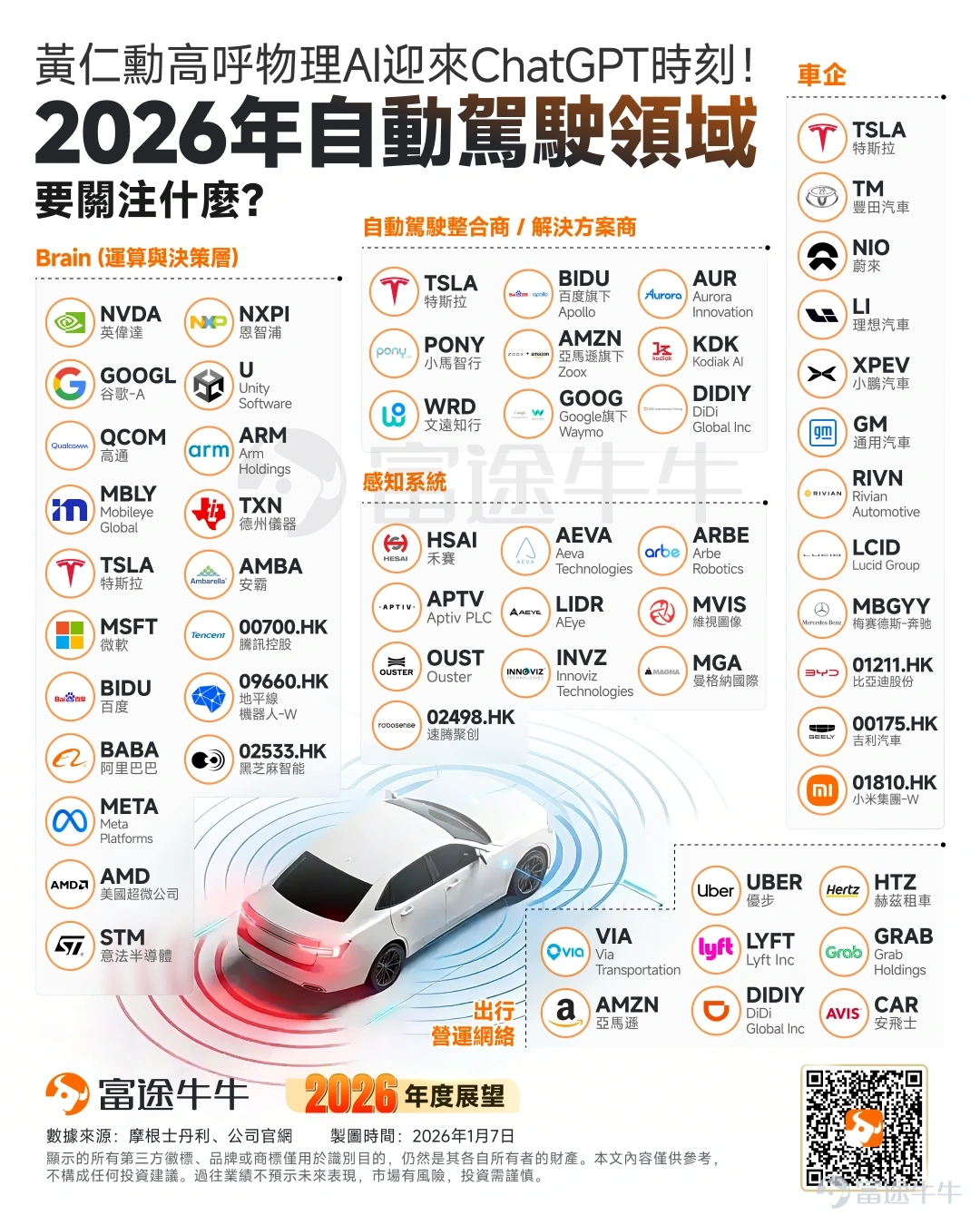
Looking further ahead,refers to Physical AI, which Jensen Huang emphasized.
He believes that the first truly mature killer app for Physical AI isAutonomous Driving, with significant progress expected in the next 2 to 3 years, followed by further expansion into warehouse AMRs, logistics robots, and robotic manipulation systems. This implies that the endgame for AI infrastructure extends beyond data centers. As models begin to truly understand and control the physical world, automobiles, robotics, logistics, and even 6G could become the new entry points for computing power in the next phase.
2026 Outlook | Is Autonomous Driving on the Eve of an Explosion? NVIDIA's Models Ignite Market Enthusiasm; 5 Core Opportunities Worth Watching!We have also outlined the relevant core opportunities:
--
--
--
III. Conclusion
Overall, the signal sent by Jensen Huang this time is clear: the core of the AI trade is shifting from "whether there are enough GPUs" to "whether the entire AI infrastructure can continue to expand."
As NVIDIA evolves from a single-chip company into an AI factory platform, the scope of beneficiaries will expand synchronously from GPUs to wafers, packaging, memory, power supply, and data centers, and further extend to cybersecurity, autonomous driving, and Physical AI.
For investors, the focus in the next phase should not merely be on which companies "have an AI concept," but on who truly controls the scarcest and most irreplaceable links in the AI expansion process. If the $3–4 trillion AI feast continues to materialize, the true alpha may lie within these new bottlenecks.
Risk Disclaimer: The above content only represents the author's view. It does not represent any position or investment advice of Futu. Futu makes no representation or warranty.Read more


Comments (11)
to post a comment
123
281