The Fed raises interest rates for the first time in three years! How will the market react?

Niu Niu Watches Futures | Soybeans and Wheat Surge to Multi-Year Highs: Triple Storm Resonance—Is a "Super Cycle" for Agricultural Products Coming?
Recently, investors focusing on the commodities sector should have noticed a signal: international agricultural futures, represented by soybeans and wheat, are experiencing a rally that somewhat exceeds market expectations. Prices for some varieties have quietly reached their highest levels in three years.
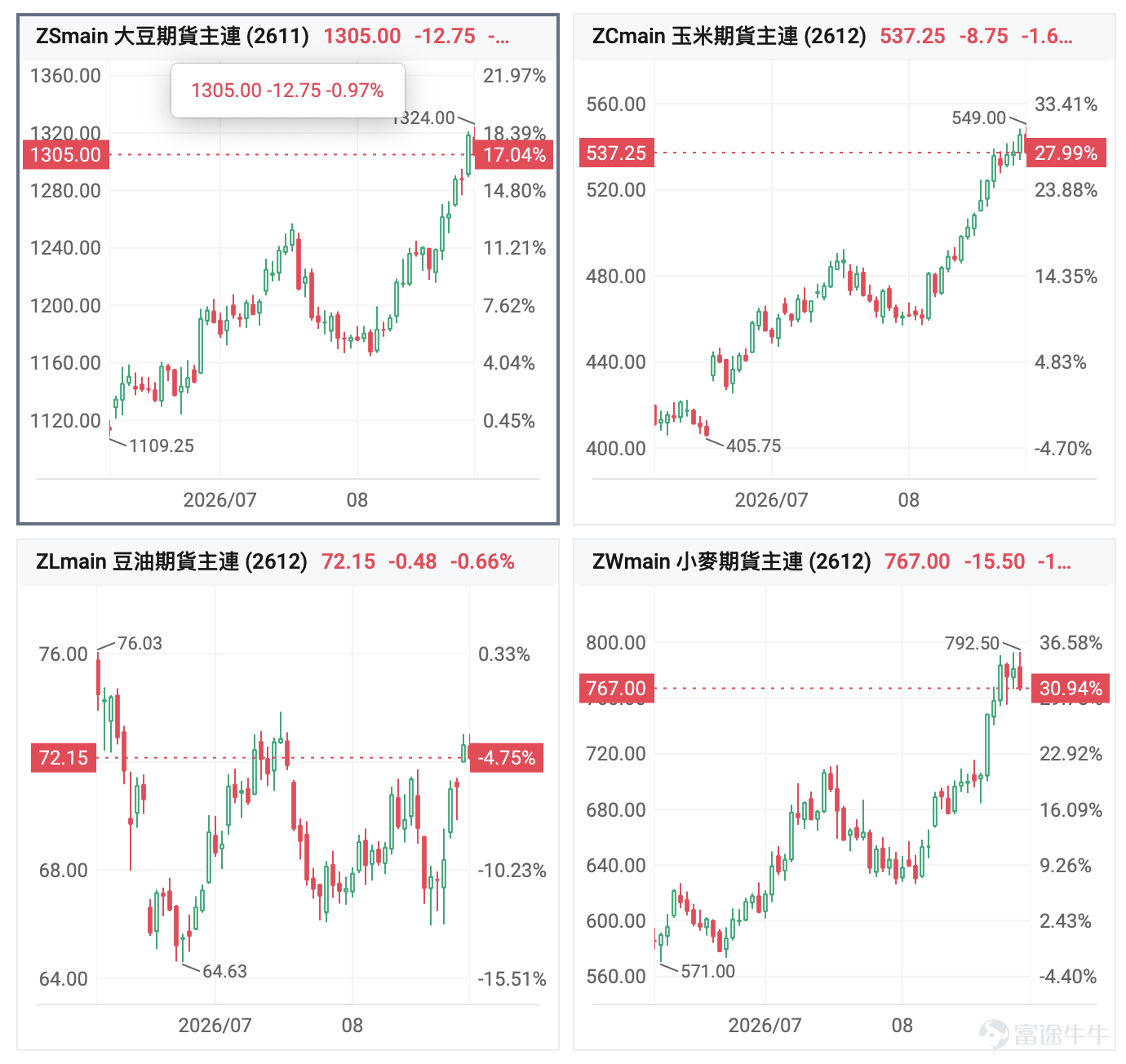
On September 2, $Soybean Futures (NOV6) (ZSmain.US)$ hit a high of 1,324 cents per bushel, marking a new high in nearly two years. During the same period, $Chicago SRW Wheat Futures (DEC6) (ZWmain.US)$ reached 792.5 cents per bushel, the highest level since February 2023; $Corn Futures (DEC6) (ZCmain.US)$ touched 549 cents per bushel, with a cumulative gain of approximately 15% since August.

This wave of price increases has swept across the entire agricultural futures sector, driven by factors far beyond simple seasonality. Such synchronized, sustained rallies across multiple commodities often indicate that the market is repricing for certain systemic risks.
Geopolitical conflicts, extreme weather, and energy policies have converged within the same time window. The pressure on the global food supply side has already been transmitted into futures pricing.
1. How three forces are igniting a supercycle in agricultural commodities?
Layer 1: Visible supply disruptions—the halt of the Black Sea Grain Corridor
Russia and Ukraine together account for more than one-quarter of global wheat exports.This grain export corridor, centered on the Black Sea, has long been a vital source of staple foods for the Middle East, North Africa, and parts of Asia.
However, since the beginning of this year, military strikes by both Russia and Ukraine on Black Sea ports and grain terminals have continued to escalate.Core grain export hubs such as the Port of Odesa in Ukraine have suffered direct damage, causing grain exports from the region to plummet by over 97% compared to normal levels, bringing them to a near standstill.This is not just a trade statistic; it means that more than one out of every four bags of flour globally faces a severe supply gap.
In August, due to attacks on its ports, Ukraine lowered its grain export forecast for the 2026/27 crop year from the previous 43 million tons to 38–40 million tons. Russia is also under pressure. According to SovEcon, Russian wheat exports in August fell to 2 million tons, a 55.6% year-on-year decline and 60% below the five-year average, hindered by operational disruptions at Black Sea and Azov Sea ports. Russia's wheat exports in September may drop to the lowest level for the month since 2010.
While global wheat inventories are not scarce, the logistical shock of 'having grain but being unable to ship it' is forcing the market to pay higher freight costs and endure longer lead times for alternative sources.
Meanwhile, ongoing tensions in the Middle East are affecting agricultural commodity prices through another transmission channel.Rising energy prices have directly driven up costs for fertilizers, agricultural machinery, and logistics, systematically increasing production costs in the grain sector.This effect is implicit and will continue to steadily permeate the landed price of every batch of grain.
Layer 2: The Threat of a Super El Niño
Meteorological data shows that the world officially entered an El Niño state in May 2026.Current climate models predict that the intensity of this El Niño will continue to climb, with a 95% probability of reaching "super" strength levels during the autumn and winter of this year.
Historically, super El Niño events have been highly correlated with extreme weather events in major global agricultural regions. Typical side effects include severe droughts in eastern Australia and South American soybean-producing areas, as well as irregular rainfall patterns in Southeast and South Asia.Once planting conditions in major grain-producing regions are disrupted, market expectations of reduced output will quickly be reflected in futures prices.
In a recent research report, Guojin Securities pointed out that,The substantive impact of El Niño on crop yields typically has a lag effect of 6 to 12 months.In other words, the full destructive impact of this super El Niño on global agriculture may not be fully realized until the 2027 planting season.This suggests that current market pricing is likely still in the "expectations-driven" phase, with actual supply contraction yet to materialize.
For major American crops like soybeans and corn, this time window is particularly critical.Localized weather damage has already appeared in the main U.S. corn-producing regions. Concerns over reduced U.S. corn output have intensified significantly since August, which is one of the direct drivers behind the accelerated rise in corn futures over the past month.
Layer 3: Policy surprises ignite biofuel demand
Just as geopolitical tensions and weather conditions were sufficient to form a bullish thesis, a policy decision by the U.S. government has added further fuel to this rally.
On Monday, the U.S. Environmental Protection Agency (EPA) announced that it would grant 1.76 billion exemption credits for the 2025 compliance year, marking the largest volume of exemptions for small refinery mandatory blending requirements since 2017.
However, the EPA made the unexpected decision to reallocate the difference between the projected and actual exemption volumes for 2025 to the mandatory blending obligations for 2026 and 2027,effectively deferring the lost biofuel demand to future years.
The market interprets this as an endorsement of long-term biofuel demand at the policy level.
The deeper logic lies in the correlation with energy prices.As global prices for fossil fuels like diesel continue to rise, more countries have the economic incentive to increase biofuel blending ratios. This essentially "converts" a portion of food supplies into fuel consumption, further squeezing the available supply of edible grains against an already tight supply backdrop.The hidden link between food and energy is becoming increasingly prominent.
II. Major Agricultural Futures
Soybean Industry Chain: $Soybean Futures (NOV6) (ZSmain.US)$、 $Mini Soybean Futures (NOV6) (XKmain.US)$、 $Micro Soybean Futures (NOV6) (MZSmain.US)$、 $Soybean Oil Futures (DEC6) (ZLmain.US)$、 $Micro Soybean Oil Futures (DEC6) (MZLmain.US)$ 、 $Soybean Meal Futures (DEC6) (ZMmain.US)$ 、 $Micro Soybean Meal Futures (DEC6) (MZMmain.US)$
The core drivers are the triple resonance of geopolitical conflicts, rising planting costs, and biofuel policies.
$Soybean Futures (NOV6) (ZSmain.US)$ : On September 2, $Soybean Futures (NOV6) (ZSmain.US)$ quoted at 1,296 cents/bushel, rebounding approximately 37% from the December 2024 low of 947 cents, but still below the historical high in 2012.

$Soybean Oil Futures (DEC6) (ZLmain.US)$ : Soybean oil is a byproduct of soybean crushing; as the cost of US soybeans rises, soybean oil prices naturally follow suit. Furthermore, soybean oil is not only an edible oil but also a key raw material for biodiesel. Geopolitical conflicts in the Middle East have pushed up international oil prices, expanding profit margins for biodiesel and heating up market expectations for soybean oil as an industrial raw material, $Soybean Oil Futures (DEC6) (ZLmain.US)$ rising by as much as 60% from the beginning of the year to the early June peak, followed by volatile corrections and consolidation after June.

$Soybean Meal Futures (DEC6) (ZMmain.US)$ : Soybean meal is a byproduct of soybean crushing. Rising US soybean prices also push up the import cost of soybean meal, but its price increases are usually weaker than the former two due to constraints from downstream breeding demand, with a gain of approximately 16% since the beginning of the year.

Wheat: Leading the gains $Chicago SRW Wheat Futures (DEC6) (ZWmain.US)$ 、 $Micro Wheat Futures (DEC6) (MZWmain.US)$
$Chicago SRW Wheat Futures (DEC6) (ZWmain.US)$It has been the strongest performer in this round of agricultural commodity rallies,with a year-to-date increase of approximately 53%;
The core driver is almost entirely attributable to the Russia-Ukraine conflict and disruptions in Black Sea logistics. Although global wheat inventories are sufficient, blocked export routes from the Black Sea have forced importing countries to turn to alternative sources such as Australia, Argentina, and the EU, sustaining a premium. Consequently, wheat futures are highly sensitive to geopolitical news.

Corn: Expectations of reduced production $Corn Futures (DEC6) (ZCmain.US)$ 、 $Micro Corn Futures (DEC6) (MZCmain.US)$
$Corn Futures (DEC6) (ZCmain.US)$ Its gain (approximately 23% year-to-date) is weaker than $Chicago SRW Wheat Futures (DEC6) (ZWmain.US)$ that of wheat, but the accelerated rise since August, with a 15% increase in August alone, is primarily driven by expectations of reduced output in U.S. corn-growing regions, as weather factors have caused substantial disruptions since August.

3. How should we interpret this market rally?
The current rise in agricultural commodity futures exhibits a clear hierarchical structure:
Short-term (already priced in):Black Sea supply disruptions and EPA biofuel policies—these events have already occurred and are reflected in current prices.
Medium-term (currently being priced in):Downward revisions to US corn yields, restructuring of global export patterns, and the pass-through of energy prices to planting costs—the market is currently trading on these factors.
Long-term (expectations trading):The potential impact of a super El Niño on the 2027 planting season—the market is starting to position itself early, but there is a 6–12 month lag and uncertainty regarding realization.
Given the persistence of these three driving factors, a reversal is unlikely in the short term.The resolution path for the Russia-Ukraine conflict remains unclear, with significant uncertainty surrounding the restoration of the Black Sea grain corridor. The probability forecast for a super El Niño continues to rise, and the pattern of high energy prices is also difficult to change in the short term.
However, variables remain regarding the final intensity of El Niño and the trajectory of the Black Sea situation, implying increased volatility in agricultural products. The pressure for profit-taking after sustained price increases cannot be ignored.
At current levels, soybeans and wheat still have room to reach historical highs. Whether a super cycle will materialize may depend on the continued resonance of these three forces. Investors should closely monitor progress in Black Sea negotiations, updates on El Niño intensity, and planting data.
 Fellow investors, among soybean, wheat, and corn futures, which one are you more bullish on?
All-category futures at a glance,Click to start futures trading >>
Monitor underlying asset quotes in real-time to seize investment opportunities!

Disclaimer
The above information does not represent the stance of Futu. It is provided for reference only and does not constitute any investment advice. The risk of loss in trading futures can be substantial; in certain circumstances, losses may exceed the initial margin deposited. Market conditions may prevent the execution of contingency orders such as stop-loss or limit orders. Investors should research and understand futures before trading, and carefully consider whether such transactions are suitable for them based on their financial situation and investment objectives. Futures trading carries high risks and is not suitable for all investors. Before engaging in any futures trading strategy, investors should thoroughly understand the associated risks and assess their own risk tolerance.
Risk Disclaimer: The above content only represents the author's view. It does not represent any position or investment advice of Futu. Futu makes no representation or warranty.Read more


Comment (1)
to post a comment
31
27