
Super Central Bank Week is here—will the Fed lean hawkish?

Options Sir on Macro | Back-to-Back Inflation Data Releases—When Will the Market Turmoil End?
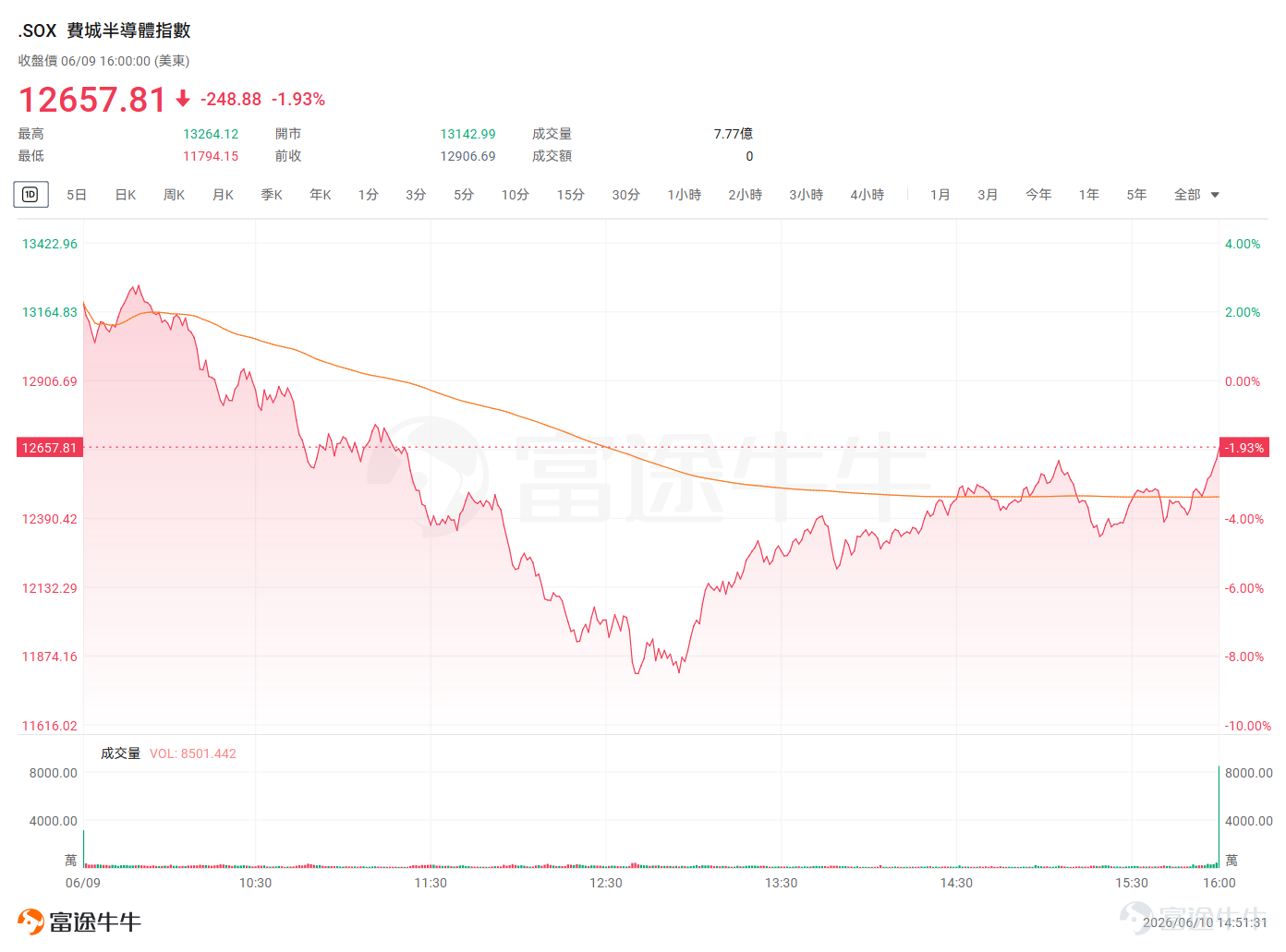
If you watched U.S. equity markets last night, your mood was probably akin to riding a roller coaster without a seatbelt. $PHLX Semiconductor Index (.SOX.US)$ The market plunged nearly 9% intraday, though it pared losses to close down almost 2%. Such extreme volatility sends only one message: the market remains fragile.

This Wednesday (tonight) and Thursday (tomorrow night), the U.S. will release May’s CPI and PPI data back-to-back.。Markets expect May’s year-over-year CPI to rebound above 4%, reaching 4.2%—the first time since 2023—while PPI may remain above 6%.
It’s rare to see two key inflation reports released on consecutive days like this.This isn’t just a test for the Federal Reserve—it’s an ultimate stress test for every investor’s mindset and strategy.
After the 'Black Friday' nonfarm payrolls release, markets saw a clear rebound on Monday, but yesterday’s trading once again cast a shadow. Could the inflation data over the next two days act as the match that reignites market turmoil?
Back-to-back inflation reports: CPI above 4%—and then what?
Looking back at last month, both April’s CPI and PPI came in hotter than expected, directly triggering a sharp spike in U.S. Treasury yields. The 10-year Treasury yield breached the 4.5% mark, while the 30-year yield surged above 5%. The underlying logic chain is very straightforward:Persistent inflation → The Fed cannot cut rates → May even need to hike rates → Risk-free rates surge → Tech stocks under pressure.
Since late February, when the U.S. and Israel launched strikes against Iran, the Middle East conflict has lasted over 100 days. Iran’s disruption of shipping through the Strait of Hormuz has driven global energy prices sharply higher, with WTI crude up roughly 60% year-to-date. Rising energy costs have not only directly pushed up gasoline prices but also broadly permeated various sectors through shipping, packaging, fertilizers, and other channels.The Federal Reserve’s latest Beige Book explicitly identified energy costs as the primary source of current inflationary pressures.
However, it’s important to note that headline CPI and core CPI may diverge. May’s headline CPI reading could appear very 'hot,' but many institutions expect core CPI (excluding food and energy) to rise by only about 0.2%. This suggests that inflation is still primarily driven by oil prices, while core components such as shelter and auto insurance may be cooling.
This creates a particularly tricky situation for markets:On one hand, headline inflation has re-broken above 4%; on the other, core inflation isn’t that hot—giving the Fed reason to remain on the sidelines. Such conflicting data is the hardest to trade—it could simultaneously trigger intense bullish and bearish battles.
Now, turning to tomorrow night’s PPI: the Producer Price Index reflects businesses’ input costs. If PPI continues to rise, it means wholesale price pressures haven’t fully passed through to retail yet, potentially keeping CPI under upward pressure in the coming months.U.S. April PPI already surged 6% year-over-year, and markets expect May’s figure to climb further—potentially exceeding 6.4%.
Markets see another nerve-wracking sell-off: structure remains unstable
The rally in U.S. equities since late March has essentially been a localized bull market driven by an 'AI barbell' trade. Capital has become extremely crowded into AI mega-caps—especially AI hardware—while traditional consumer and cyclical stocks have been left ignored. Last week, Broadcom’s revenue guidance fell short of market expectations, triggering a sharp selloff in AI-related assets, which intensified further on Friday after the stronger-than-expected nonfarm payroll data. This is a classic hallmark of crowded trades: when sentiment shifts, exits are narrow, and nobody gets out unscathed.
After Broadcom reported earnings last Thursday, Sir already gave everyone a heads-up: 'Walking a tightrope at great height—a gentle breeze can stir huge waves,' and highlighted the 'art of defense.'Fellow investors who are interested can review it~
At the time, Sir sensed something was off—but didn’t anticipate that Black Friday would be quite so extreme.Following Monday’s strong market rebound, we saw another harrowing night yesterday—markets opened as if 'enjoying hotpot and singing songs,' $Nasdaq Composite Index (.IXIC.US)$ briefly gaining over 1%, only to later plunge more than 3%; the semiconductor index mentioned in our opening was even more alarming.
At this stage of the market cycle, capital flows exhibit both a 'siphoning effect' and a 'blood-replacement effect.' Simply put, a 'siphoning effect' occurs when gains in a few sectors come at the expense of losses across most others.Marked by last Friday’s move, the market has now begun showing signs of a 'blood-replacement effect'—outflows from tech stocks aren’t translating into effective sector rotation but instead causing broad-based market bleeding.
Last night’s sharp drop wasn’t born of baseless animosity. It was an instinctive stress response by investors facing looming uncertainty under the triple pressures of high valuations, extreme positioning, and elevated interest rates.
Hasn’t uttered a word since taking office—waiting for Big Boss Wash to speak
Will everything be fine if we just get through tonight’s and tomorrow night’s data releases? Not necessarily. The real main event may come next week—On June 16–17, newly appointed Federal Reserve Chair Kevin Warsh will preside over his first FOMC meeting since taking office.
Here’s a detail that has markets deeply unsettled: since officially assuming office on May 22, Warsh hasn’t uttered a single word in public.This means all current market fears and speculation about him are based solely on his statements during his confirmation hearing before taking office. His actual policy stance since formally assuming the role remains a complete black box. Such an 'information vacuum' is precisely the kind of environment financial markets dislike most.
During his earlier confirmation hearing, Warsh openly criticized the Fed’s current communication approach, articulating a particularly sharp core view:He argued that forward guidance is largely meaningless—revealing too much to markets can easily lead the Fed to be led around by market expectations, tying its own hands. He advocates abandoning the dot plot, reducing forward guidance, and even cutting back on the frequency of public speeches by Fed officials.
This evokes memories of the Greenspan era’s 'monetary mystique'—the approach of saying nothing before meetings and only releasing decisions after rate hikes, leaving markets to react on their own,rather than the current practice where interest rate markets fully price in expectations days in advance.
After nearly a month of silence since officially taking office, how he sets the tone in his debut next week has become the biggest uncertainty hanging over US equities. Markets are most concerned about two things:
Remove the 'dovish bias': The Fed is expected to formally delete the 'dovish bias' from its policy statement, returning to a neutral and steady stance. This means the previous market expectation—that the Fed would step in to rescue markets whenever trouble arose—has vanished.
Confusion over the dot plot: There are rumors that the Fed might stop publishing the dot plot at this meeting. If that actually happens, the market would be like an airplane suddenly losing its navigation system, completely lacking an anchor to price the Fed’s interest rate path for this year. Short-term positioning would become extremely chaotic, and volatility could rise further.
Therefore, macro concerns won’t fully subside until Waller breaks his silence and clearly articulates a formal framework.Until next week’s FOMC meeting, markets will remain in an anxious state of waiting for the other shoe to drop.Macro uncertainty may only ease on a provisional basis once Waller officially speaks out.
Options strategies amid uncertainty
Options can’t yet be traded in the pre-market session. CPI data will be released at 8:30 p.m. tonight (pre-market hours), so by the time regular trading opens, the market will likely have already priced in most of the reaction to the data.However, PPI data and next week’s Fed rate decision are still ahead—so it’s wise to equip your portfolio with some 'bulletproof armor.'
Strategy 1: Buy Insurance for Your Long Position – Protective Put
Compared to the 'high crowding + low volatility' environment mentioned by Sir last Thursday,market volatility has started to rise noticeably in recent days, meaning the 'insurance premiums' in the market are becoming more expensive.However, if you currently hold a significant long position and don’t want to exit prematurely, the most straightforward approach is still to buy insurance—specifically, purchase a small number of at-the-money or slightly out-of-the-money put options while holding the underlying stock.
Both last Friday’s and last night’s first-half moves in the Philadelphia Semiconductor Index (SOX) demonstrated that when a black swan event strikes, the downside can be beyond imagination. Buying puts is like purchasing property insurance for your portfolio. If economic data comes in far worse than expected and U.S. stocks plunge, your puts will gain substantial value, offsetting losses in your underlying holdings; if the data is benign and U.S. equities rebound, you only lose the premium paid (the 'insurance cost'), while fully capturing any upside in your stock position.
Implied volatility (IV) is currently high, making options relatively expensive.Consider options with slightly longer maturities to cover the risk around next week’s Fed interest rate decision.At the same time, avoid buying deep out-of-the-money puts, as they may not provide effective protection.

(The design images displayed on the screen are for demonstration purposes only and do not constitute any investment advice or guarantee; market movements are frequent, and the illustrated option prices do not represent actual conditions)
Strategy 2: Use a 'Collar' to Reduce Entry CostIf you feel options are a bit too pricey to justify buying outright, you can also use a collar strategy to lower your initial cost.Sell out-of-the-money call options while simultaneously buying out-of-the-money put options.The premium received from selling the calls can offset the cost of buying the puts, potentially achieving a 'zero-cost' hedge.
The benefit of this approach is that you forgo some upside potential (you won’t capture gains beyond the strike price of the sold call), but you cap your downside risk (losses below the put’s strike price are protected). In the current environment of elevated market volatility, this strategy might just help you 'sleep better at night.'

(The design images displayed on the screen are for demonstration purposes only and do not constitute any investment advice or guarantee; market movements are frequent, and the illustrated option prices do not represent actual conditions)
Friends, investing has never been an easy endeavor—especially during this transitional period marked by the weakening of old frameworks and the absence of clear new rules.
Tonight’s CPI and tomorrow night’s PPI are far more than just two cold, hard numbers—they are litmus tests for the true state of U.S. inflation and the opening act that will shape the script for Waller’s debut next week.During this painful phase of Federal Reserve leadership transition and policy framework recalibration, markets are bound to experience violent turbulence as they search for new anchors.
For ordinary investors, two behaviors must be strictly avoided right now: first, 'blindly trying to catch a falling knife,' assuming that a sharp drop automatically means a rebound is due, while ignoring the breakdown in macro fundamentals; second, adopting a 'gambler’s mindset' by placing one-sided bets on inflation data in hopes of striking it rich overnight.
Amid macro uncertainty, acknowledging what you don’t know, managing risk, and preserving capital matter more than anything else.
Finally, here's a small perk for fellow Futubull investors, welcome to claim it.Options Beginner Pack
*This event is exclusive to invited HK users. Click to learn more.Detailed event rules>>
Market conditions are complex and volatile,Options StrategyOverwhelmed by choices? Futubull helps you build a portfolio in three steps.Options Strategymaking investing simple and efficient!

Option Risk Warning:An option is a contract that grants the holder the right, but not the obligation, to buy or sell an asset at a fixed price on a specific date or at any time before that date. The price of an option is influenced by various factors, including the current price of the underlying asset, the strike price, time to expiration, and implied volatility. Implied volatility reflects the market’s expectations for the level of volatility in the option over a future period. It is a data point derived inversely from the Black-Scholes option pricing model and is generally regarded as an indicator of market sentiment. When investors anticipate greater volatility, they may be more willing to pay a higher price for options to hedge risks, resulting in higher implied volatility. Traders and investors use implied volatility to assess the attractiveness of option prices, identify potential mispricings, and manage risk exposure.
Disclaimer:This content does not constitute any offer, solicitation, recommendation, opinion, or guarantee of any securities, financial products, or tools. The risk of loss in trading options can be substantial. In some cases, losses may exceed the initial margin deposited. Even if you set contingent orders such as 'stop-loss' or 'limit' orders, these may not prevent losses. Market conditions may make such orders unexecutable. You may be required to deposit additional margin within a short period. If you fail to provide the required amount within the specified time, your open positions may be liquidated. However, you will still be responsible for any shortfall in your account. Therefore, before trading, you should study and understand options and carefully consider whether such trading is suitable for you based on your financial situation and investment objectives. If you trade options, you should be familiar with the procedures for exercising options and the rights and obligations upon exercise and expiration. Options trading carries extremely high risks and is not suitable for all investors. Investors should carefully readCharacteristics and Risks of Standardized Options。
Risk Disclaimer: The above content only represents the author's view. It does not represent any position or investment advice of Futu. Futu makes no representation or warranty.Read more


Comments
to post a comment
14
14