
English
Back
Open Account
The Federal Reserve launches reforms! How to position for the Worshe era?
Option Mover The Moo
joined discussion · Jun 8 17:31 ·

Futubull Volatility Hunter | A 'rent-collecting' strategy to profit without big stock moves: Oracle shows exceptional volatility premium ahead of earnings!

Hello everyone, and welcome to this week's 'Bullish Volatility Hunter'.
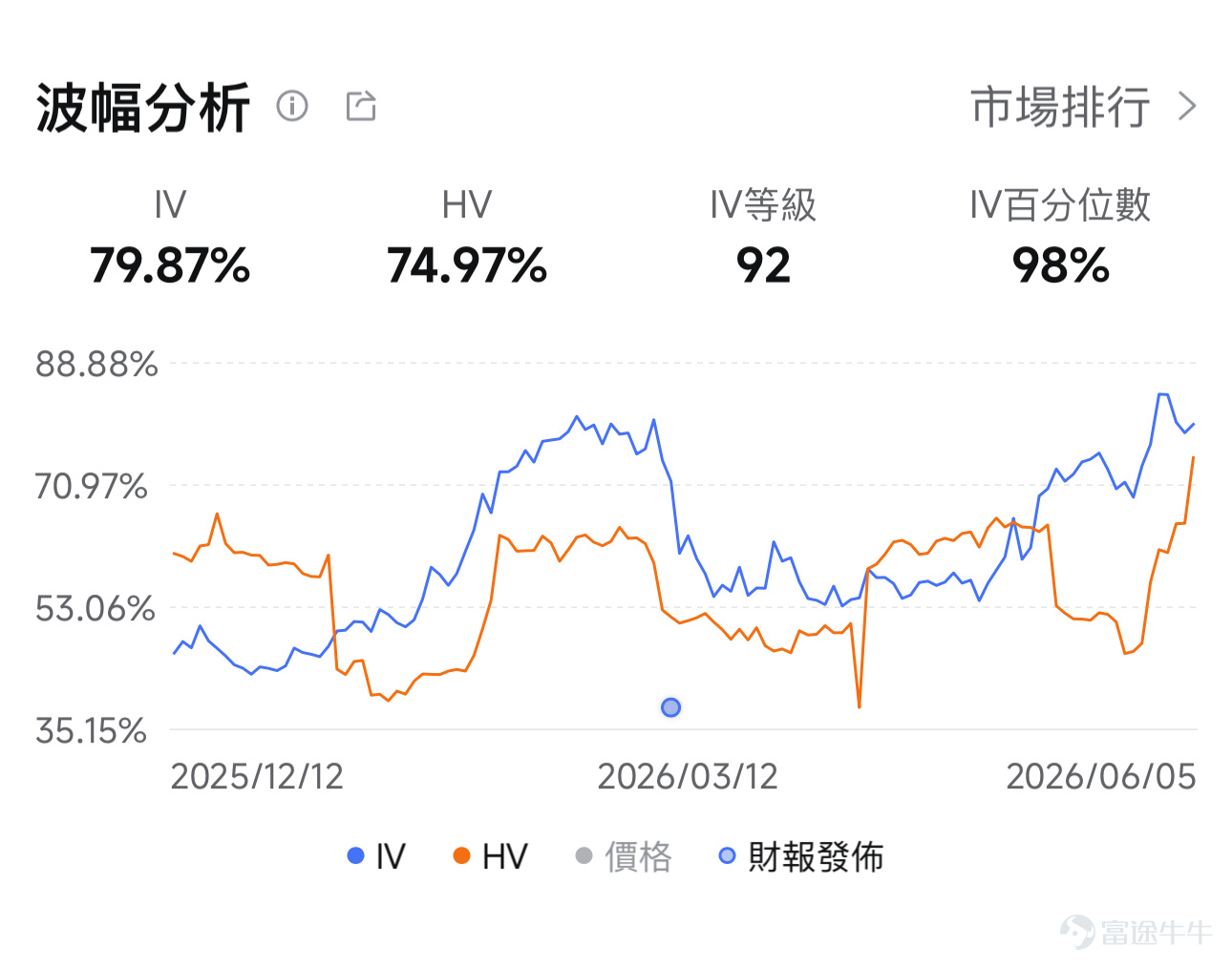
After U.S. market hours on June 10, $Oracle (ORCL.US)$ will release its latest earnings report. On June 5, the options market saw single-day volume of 427,700 contracts and open interest of 2,627,700 contracts, indicating significant market positioning ahead of Oracle’s earnings.Oracle’s current implied volatility is approximately 79.87%, with an IV rank of 92—placing it at an extremely high percentile within its one-year historical range—suggesting the stock could experience substantial price swings on earnings day.Given the current environment of 'high implied volatility + strong expected move,' buying outright call or put options would expose traders to a potential volatility crush, leading to significant premium decay.Therefore, the core options strategy for Oracle’s upcoming earnings should be 'to align with high volatility and collect premium.'
This Week's Hottest Earnings Calendar
[June 10, after U.S. market close] Oracle (ORCL)
Analysts forecast total revenue for the quarter at approximately $19.09 billion, representing a year-over-year increase of about 20%; earnings per share are expected to be $1.47 (GAAP).
In this earnings report, the market will be looking to verify whether the encouraging figures from last quarter can be effectively sustained and realized in this full-year statement.
1. Has the $50 billion capital expenditure plan actually been spent?
Oracle has set a full-year capital expenditure target of $50 billion for this year, with the majority allocated to rapidly building new data centers globally. It has already spent $39.2 billion over the first three quarters, meaning it would need to invest approximately another $10.8 billion in the fourth quarter alone to meet its annual goal. If Q4 spending falls significantly short of $10.8 billion, it would indicate that construction progress is lagging behind schedule—requiring corresponding delays to the delivery timelines promised in already-signed contracts.
2. Is the backlog of contracts still growing?
For Oracle, this primarily refers to multi-year compute capacity leases locked in by customers in advance—for example, an AI company committing to purchase a certain scale of cloud computing resources from Oracle annually over the next five years.
3. Can Oracle maintain its cloud revenue growth rate?
Oracle’s cloud business consists of two segments: first, OCI (Oracle Cloud Infrastructure), which provides compute capacity leasing where customers run workloads on Oracle’s servers; and second, SaaS application software, including enterprise management systems such as Fusion ERP and NetSuite. Last quarter’s overall cloud revenue growth of 44% was almost entirely driven by OCI. If OCI’s growth rate in Q4 slows to the 60%–70% range, total cloud revenue growth may struggle to maintain last quarter’s pace.
4. What is Oracle’s capital expenditure plan and guidance for fiscal year 2027?
The $50 billion capital expenditure for fiscal year 2026 is already a done deal and has been fully priced in by the market. The real uncertainty lies in 'how much Oracle will spend in fiscal year 2027' and 'what guidance management provides for the coming period.' If leadership delivers more concrete and above-consensus guidance this time, it could act as a catalyst for the stock price to break higher—and vice versa.
IV Structure Analysis
Oracle (ORCL)
Reference data date: June 5
With an IV percentile of 98% and an IV rank of 92, this means that only about five trading days in the past year have seen higher implied volatility (IV) than today.In other words, the option premium you’re collecting now is more expensive than on most days over the past 365 days.Combined with an IV/HV ratio of 1.06x (the market’s pricing of future volatility is slightly above the actual 30-day historical volatility),this reflects a typical structure where the market pays a premium ahead of the upcoming earnings season.Although the premium level isn’t extreme (it hasn’t reached 1.2x or higher), the absolute IV level (79.9%) is already in a historically very high range when viewed alongside its percentile ranking.Option sellers are thus receiving premiums with considerable thickness.
Limited-time high IV premium option strategy
Oracle (ORCL)
Sell Put Strategy Reference
Hello everyone, and welcome to this week's 'Bullish Volatility Hunter'. After U.S. market hours on June 10 (Eastern Time), $Oracle (ORCL.US)$ will release its latest earnings results. On June 5 alone, the options market saw 427,700 contracts traded and 2,627,700 open interest, indicating clear market positioning ahead of Oracle’s earnings.Oracle’s current implied volatility stands at approximately 79.87%, with an IV rank of 92—placing it in an extremely high percentile within the past year’s historical range—suggesting significant price swings may occur on earnings day.Given the current environment of 'high IV + strong expected volatility,' buying outright call or put options would expose traders to a potential volatility crush, causing option premiums to sharply decline.Therefore, the core options strategy for Oracle’s upcoming earnings should be: 'be a friend of high volatility and collect option premiums.' This Week's Hottest Earnings Calendar [June 10, after U.S. market close] Oracle (ORCL) Analysts forecast total revenue for the quarter at approximately $19.09 billion, representing a year-over-year increase of about 20%; earnings per share are expected at $1.47 (GAAP). This earnings report will test whether the encouraging figures from last quarter can be effectively sustained and realized in this full-year statement. 1. Has the $50 billion capital expenditure plan actually been spent? Oracle has set a full-year capital expenditure target of $50 billion this year, with the majority allocated to rapidly building new data centers globally. Cumulative spending through the first three quarters...
Reference strike price: $185 (anchored above the 50-day moving average of $179.43, providing a buffer zone)
Suggested expiration date: June 18, 2026
Reference premium: approximately $425 per contract, equivalent to a cost reduction of $4.25 per share (actual prices can be checked in the Futubull app under: Stock → Options Chain)
Covered Call Strategy Reference
Hello everyone, and welcome to this week's 'Bullish Volatility Hunter'. After U.S. market hours on June 10 (Eastern Time), $Oracle (ORCL.US)$ will release its latest earnings results. On June 5 alone, the options market saw 427,700 contracts traded and 2,627,700 open interest, indicating clear market positioning ahead of Oracle’s earnings.Oracle’s current implied volatility stands at approximately 79.87%, with an IV rank of 92—placing it in an extremely high percentile within the past year’s historical range—suggesting significant price swings may occur on earnings day.Given the current environment of 'high IV + strong expected volatility,' buying outright call or put options would expose traders to a potential volatility crush, causing option premiums to sharply decline.Therefore, the core options strategy for Oracle’s upcoming earnings should be: 'be a friend of high volatility and collect option premiums.' This Week's Hottest Earnings Calendar [June 10, after U.S. market close] Oracle (ORCL) Analysts forecast total revenue for the quarter at approximately $19.09 billion, representing a year-over-year increase of about 20%; earnings per share are expected at $1.47 (GAAP). This earnings report will test whether the encouraging figures from last quarter can be effectively sustained and realized in this full-year statement. 1. Has the $50 billion capital expenditure plan actually been spent? Oracle has set a full-year capital expenditure target of $50 billion this year, with the majority allocated to rapidly building new data centers globally. Cumulative spending through the first three quarters...
Reference strike price: $245 (current price + 15%; anchored to the upper Bollinger Band at $245.11, leaving sufficient buffer)
Reference expiration date: 2026-06-12
Reference premium: approximately $487.5 per contract, reducing the effective holding cost by $4.875 per share (actual prices can be checked in the Futubull app under individual stock → options chain)
Comprehensive scenario analysis of earnings
Hello everyone, and welcome to this week's 'Bullish Volatility Hunter'. After U.S. market hours on June 10 (Eastern Time), $Oracle (ORCL.US)$ will release its latest earnings results. On June 5 alone, the options market saw 427,700 contracts traded and 2,627,700 open interest, indicating clear market positioning ahead of Oracle’s earnings.Oracle’s current implied volatility stands at approximately 79.87%, with an IV rank of 92—placing it in an extremely high percentile within the past year’s historical range—suggesting significant price swings may occur on earnings day.Given the current environment of 'high IV + strong expected volatility,' buying outright call or put options would expose traders to a potential volatility crush, causing option premiums to sharply decline.Therefore, the core options strategy for Oracle’s upcoming earnings should be: 'be a friend of high volatility and collect option premiums.' This Week's Hottest Earnings Calendar [June 10, after U.S. market close] Oracle (ORCL) Analysts forecast total revenue for the quarter at approximately $19.09 billion, representing a year-over-year increase of about 20%; earnings per share are expected at $1.47 (GAAP). This earnings report will test whether the encouraging figures from last quarter can be effectively sustained and realized in this full-year statement. 1. Has the $50 billion capital expenditure plan actually been spent? Oracle has set a full-year capital expenditure target of $50 billion this year, with the majority allocated to rapidly building new data centers globally. Cumulative spending through the first three quarters...
Finally, here's a small perk for fellow investors. Welcome, fellow investors, to claim your benefit.Options Beginner Pack
*This event is exclusive to invited HK users. Click to learn more.Detailed event rules>>
Risk Warning
An option is a contract that gives the holder the right, but not the obligation, to buy or sell an asset at a fixed price at any time on or before a specific date. The price of an option is influenced by various factors, including the current price of the underlying asset, the strike price, the time to expiration, and implied volatility. Implied volatility reflects the market's expectation of the option’s volatility over a certain period in the future. It is derived inversely from the Black-Scholes (BS) pricing model and is generally considered an indicator of market sentiment. When investors expect greater volatility, they may be more willing to pay higher prices for options to help hedge risks, leading to higher implied volatility. Traders and investors use implied volatility to evaluate.Option priceto enhance attractiveness, identify potential mispricing, and manage risk exposure.
Disclaimer
This content is for reference only and should not be considered as an offer, solicitation, invitation, or advice to buy or sell any investment product or make any investment decision. It should also not be interpreted as professional advice. Options contracts are derivative products and may not be suitable for all investors. You should carefully consider your own investment experience, investment objectives, financial resources, and other relevant conditions before deciding whether to participate in such transactions. The risk of loss in trading options contracts can be substantial. In some cases, losses may exceed the initial margin deposited. Even if you have set contingent orders, such as 'stop-loss' or 'limit' orders, they may not prevent losses. Market conditions may render such orders unexecutable. You may be required to deposit additional margin within a short period. If you fail to provide the required amount within the specified time, your open positions may be liquidated. However, you will still be responsible for any shortfall in your account resulting from such liquidation. Therefore, before trading, you should study and understand index options and carefully consider whether such trading is suitable for you based on your financial situation and investment objectives. If you trade options, you should be familiar with the procedures for exercising options and the rights and obligations upon expiration.
Risk Disclaimer: The above content only represents the author's view. It does not represent any position or investment advice of Futu. Futu makes no representation or warranty.Read more
Thumbs Up
20
86K Views
Report
Comment (1)
Write a Comment...
1
20
13