
Nasdaq and S&P 500 hit new highs! Is it still a good time to invest?
US stocks stage a triumphant return!
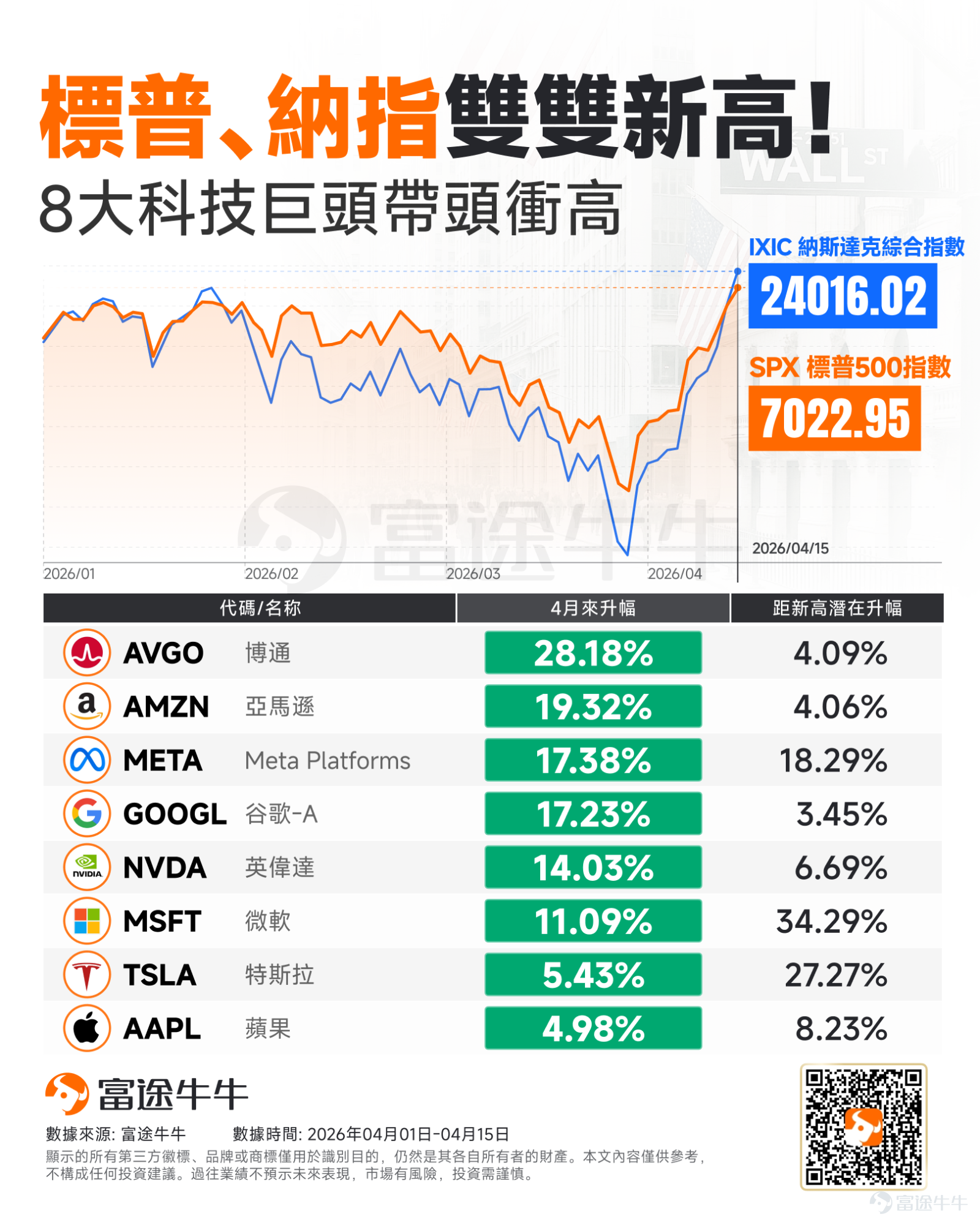
On Wednesday, $S&P 500 Index (.SPX.US)$ and $Nasdaq Composite Index (.IXIC.US)$ Both hit new all-time highs, with the S&P closing above the psychological 7,000-point level for the first time. Despite vessel traffic through the Strait of Hormuz still far below pre-conflict levels, the fragile ceasefire agreement between the US and Iran is expected to hold, significantly boosting investor confidence.
Amid an epic convergence of macro tailwinds, AI-related fundamentals materializing, and massive systemic buying, Wall Street is witnessing a capital feast led by tech giants.
As macro headwinds ease, sectors across the board are flourishing.
The recent recovery in market confidence has been primarily driven by the easing of geopolitical risks. Although vessel traffic through the Strait of Hormuz remains far below pre-conflict levels, the fragile ceasefire agreement reached between the US and Iran is expected to hold, injecting a strong dose of confidence into investors.
In this record-breaking rally of major indexes,The core engine remains the tech giants,如$Broadcom (AVGO.US)$ up more than 28% since April, $Amazon (AMZN.US)$ up over 19%, just a step away from an all-time high, $Meta Platforms (META.US)$ 、 $Alphabet-C (GOOG.US)$ 、 $NVIDIA (NVDA.US)$ 、 $Microsoft (MSFT.US)$ with others up more than 11%.
In fact, on April 1st,“Warren Buffett Holds $370 Billion in Cash, Watching from Sidelines: How Are US Stocks Valued Right Now? Have Tech Giants Dropped into the ‘Sweet Spot’?”an article pointed out that valuations of these companies had reached a relatively low point recently; interested fellow investors can click to view.

Goldman Sachs analysis noted that although there hasn’t been any explosive 'new' news in the market recently, several ongoing fundamental factors are playing a decisive role, proving thatmassive AI capital expenditures are translating into tangible business profits and technological progress:
$Amazon (AMZN.US)$ : CEO Jassy revealed in his letter to shareholders that AWS’s AI services have achieved an annualized operating income exceeding $15 billion. Even more exciting for the market is that Amazon's self-developed Trainium chips are now being used to train Anthropic’s Mythos model, showcasing its strong competitiveness in AI infrastructure.
$Meta Platforms (META.US)$ Its subsidiary, Superintelligence Lab, successfully launched the Muse Spark AI model, providing investors with tangible evidence that its AI strategy is proceeding steadily.
$Broadcom (AVGO.US)$ With a nearly 30% increase in stock price within the month, it outperformed its peers. The company announced a significant long-term partnership with Google to jointly develop TPUs until 2031 and further expanded its collaboration with Anthropic.
$Tesla (TSLA.US)$:A major breakthrough has been achieved in its self-developed chips. Elon Musk announced that the next-generation AI5 chip has completed the tape-out process and is expected to enter mass production at Samsung and Taiwan Semiconductor's U.S. plants by 2027. The performance of AI5 is 40 times better than its predecessor. With dual-chip configurations, its computing power can rival NVIDIA’s Blackwell while offering advantages in cost and power consumption.
An even more notable recovery came from traditional software and cloud computing giants. $Microsoft (MSFT.US)$ 。The company rose by 11% in just three trading days, adding nearly $300 billion to its market value.Statistics from market research firm Bespoke show that this week marks only the third time since the dot-com bubble burst that established tech giants have seen gains exceeding 2% for three consecutive days.
Bernstein analysts pointed out that Microsoft Azure’s cloud platform revenue growth is expected to accelerate over the next two quarters. This is because the cycle from purchasing hardware to generating revenue typically takes about six months, and this conversion point is approaching.He believes the current share price represents a reasonable entry point for new investors.

As risk appetite rebounds, the market is no longer reliant on a single sector.In addition to the ongoing tech stock rally, frontier sectors such as quantum computing and nuclear power concept stocks have also shown excellent momentum recently, indicating that market funds are actively seeking targets with long-term growth potential.
In the quantum computing sector, NVIDIA announced a new addition to its family of open-source models — the 'Ising' quantum AI model, aimed at accelerating the development of quantum processors. Spurred by this news, quantum computing has recently experienced a strong surge, such as $Xanadu Quantum Technologies (XNDU.US)$ rising over 2x, $Quantum (QMCO.US)$ 、 $IonQ Inc (IONQ.US)$ 、 $D-Wave Quantum (QBTS.US)$ with increases in the range of 20%~50%.
Among these, Hana Du Quantum Technology is the world’s first publicly listed pure optical quantum computing company. On March 27, it went public on Nasdaq and the Toronto Stock Exchange through a SPAC merger. Its core focus is on optical quantum computing, characterized by room-temperature operation, low cost, and leading software ecosystem, primarily targeting commercial applications in AI, pharmaceuticals, and materials.

In addition, nuclear power stocks, which have been quiet for a while, have also started rising recently. On the news front, the White House recently launched the U.S. National Space Nuclear Power Program, pushing the entire sector higher, with $Oklo Inc (OKLO.US)$ rising over 27%, $NANO Nuclear Energy (NNE.US)$ 、 $BWX Technologies (BWXT.US)$ 、 $Graham (GHM.US)$ 、 $Energy Fuels (UUUU.US)$ and others up more than 10%.

Overall, optimism is spreading comprehensively. Abundant capital is stabilizing heavyweight tech stocks while actively shifting towards seeking breakout opportunities in frontier technologies like quantum computing and nuclear energy, marking that the U.S. stock market is entering a healthy sector rotation phase.
A frenzy of capital: short-covering ignites, CTA systematic buying fuels the fire
If the AI fundamentals are the main course of this feast,The catalyst in terms of capital inflows has been an absolute game-changer.Goldman Sachs succinctly summarized this wave of capital momentum as:‘Short-covering acted as the igniter, while systematic buying by CTAs (Commodity Trading Advisors) served as the accelerant.’
At the start of April, trend-following CTA funds had compressed their equity exposure to an extremely bearish level. However, as prices stabilized and triggered a reversal in trend signals, systematic buying pressure began to surge intensely.
At the beginning of this week, Goldman Sachs' latest model estimated that trend-following CTA funds bought $19 billion worth of U.S. equities last week; looking ahead to this week, under neutral market conditions, CTAs are expected to buy another $43.5 billion worth of U.S. stocks, or up to $82 billion globally — a figure approaching historical highs. Previously, CTAs had reduced equity exposure to extreme bearish levels entering April, but now with price stabilization triggering a reversal of trend signals, systematic buying pressures are being released en masse.

Cold Reflection Amidst Extreme Euphoria: Four Potential Risks Worth Noting
Tom Lee, co-founder of U.S.-based investment firm Fundstrat Global Advisors, predicted that the S&P 500 index could climb to 7,300 points before experiencing a major correction. Specifically, he listed three main reasons for his bullish stance: resilience in the U.S. market despite surging oil prices, corporate earnings growth, and diminished inflation threats.
However, although indices have reached new highs and market sentiment is exuberant, risks lurk beneath the surface of this ‘extreme euphoria.’ Fellow investors enjoying the benefits must remain highly vigilant about the following four potential risks:
Technical Overbought Conditions and Mean Reversion Risk:Excessive gains over a short period have pushed major indices and key stocks into severely overbought territory, creating imminent pressure for technical corrections and mean reversion.
Technical analysts commonly use this indicator to measure market momentum. A reading above 70 typically suggests that the index has entered the 'overbought' zone, while a reading below 30 indicates 'oversold.' As of Wednesday's close, the RSI was at 69.3.

The 'double-edged sword' effect of CTA funds:CTA funds, which have been driving the market to new highs, are typical trend followers. Once there is any sign of instability leading to a trend reversal, these massive buy-side positions could quickly turn into relentless quantitative selling pressure, potentially triggering a stampede in the market.
Exhaustion of 'short-covering' momentum:The momentum from funds forced to buy back due to failed short positions has nearly run its course. When the 'ignition' fades, if there is no new incremental capital or unexpected positive fundamental developments to take over, the upward momentum of the market will face serious challenges.
Geopolitical variables: The 'fragile ceasefire agreement' currently supporting market confidence remains highly uncertain. If US-Iran negotiations hit a bottleneck or unexpectedly collapse, the shipping crisis in the Strait of Hormuz may escalate again. This would not only directly impact global energy prices and supply chains but also potentially bring back inflation concerns, becoming a major black swan event that could burst the current market euphoria.
In summary, the US stock market in April demonstrated strong resilience and explosive power, with the commercialization of AI technology and the boost from quantitative funds contributing to the current all-time high. However, maintaining a level-headed approach amidst the frenzy and closely monitoring geopolitical negotiations and shifts in funding momentum will be key for investors to achieve steady success moving forward.
Risk Disclaimer: The above content only represents the author's view. It does not represent any position or investment advice of Futu. Futu makes no representation or warranty.Read more
Comments (2)
to post a comment
42
77
