The Fed raises interest rates for the first time in three years! How will the market react?

Hot Topics in 5 Minutes | Undercurrents in US Treasuries: What is a US Treasury Auction? Why might tonight's auction be significant?
The US market appeared calm on the surface this week—on the macro front, there were hardly any major data releases aside from the upcoming FOMC meeting minutes (which reflect the meeting held three weeks prior); on the earnings front, although there were also $Walmart (WMT.US)$ and other large-cap companies reporting, they were not the main market focus, as tech earnings have temporarily wrapped up. However, beneath this calm surface, undercurrents are stirring; the sustained rise in US Treasury yields can no longer be ignored by the market.
Undercurrents Beneath the Calm: Why Are US Treasury Yields Rising?
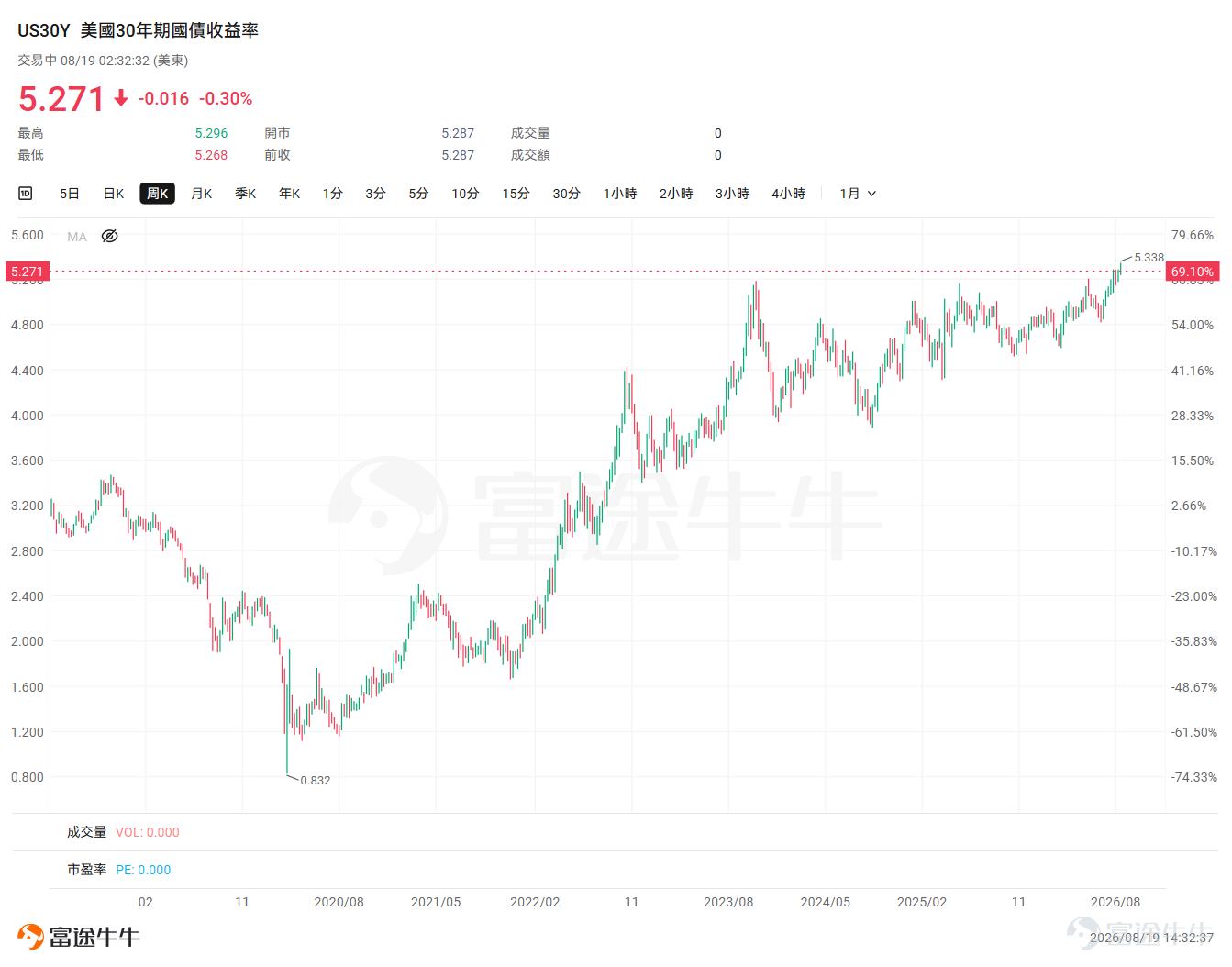
Recently, yields on long-term US Treasuries have continued to climb, approaching or even breaking through key levels seen over the past few decades. As of August 18, $U.S. 30-Year Treasury Bonds Yield (US30Y.BD)$ surged to 5.33%, hitting a new high since June 2007; $U.S. 10-Year Treasury Notes Yield (US10Y.BD)$ yields also rose to around 4.75%, the highest level in 19 months。
This upward trend is not driven by a single factor, but rather the result of multiple converging pressures:
Concerns over government deficits: Debt scale approaching $40 trillion
The total U.S. federal government debt has surpassed the $40 trillion mark and continues to expand rapidly. The Congressional Budget Office (CBO) has raised its forecast for the fiscal year 2026 budget deficit to $2.1 trillion. In the first 10 months of fiscal year 2026, interest payments on U.S. federal debt reached $1.17 trillion, with the full-year figure expected toFor the first time exceeding $1.2 trillion, even surpassing the US annual defense budgetInvestors' concerns about fiscal sustainability are intensifying, demanding a higher risk premium to hold long-term bonds.
A surge in massive corporate bond issuances for AI infrastructure is diverting funds from Treasuries.
Growing in tandem with government financing needs is a frenzied wave of bond issuance by tech giants. Led by $Alphabet-A (GOOGL.US)$ 、 $Microsoft (MSFT.US)$ 、 $Meta Platforms (META.US)$ AI hyperscalers such as [companies], which are issuing long-term corporate bonds on an unprecedented scale to build data centers.
According to estimates,US corporations have issued nearly $1.7 trillion in bonds year-to-date, a 27% year-on-year increase, already exceeding the total issuance volume for the entire year of 2025.These corporate bonds have significantly diverted investor capital that might otherwise have flowed into Treasuries, further pushing up long-term bond yields.
How do rising yields suppress the stock market?
As Treasury yields continue to climb, especially when risk-free rates (such as the 10-year and 30-year US Treasury yields) rise, the impact is transmitted to the stock market through the following channels:
As discount rates rise, higher risk-free rates imply a lower present value for future cash flows, putting direct pressure on high-growth stocks whose valuations rely heavily on distant cash flows (particularly AI-related concept stocks);
The opportunity cost of capital increases. As Treasury yields rise, representing the theoretical "risk-free return," investors will reassess the risk-reward profile of holding equities. Some capital may flow out of the stock market and into bonds, leading to net outflows from equities;
Corporate financing costs increase, driving up the cost of issuing debt. This raises the hurdle rate for returns on capital expenditure, potentially curbing future investment and expansion plans.
Tonight's "major test": Why is the 20-year Treasury auction so important?
Tonight (at 1:00 AM Beijing time on August 20), the U.S. Treasury will conduct a$16 billion auction of 20-year U.S. Treasury bonds. This auction could serve as a "litmus test" for recent sentiment in the U.S. Treasury market.
Why is the 20-year maturity considered the "weakest link" in the U.S. Treasury market?
The 20-year Treasury bond has a unique historical background.It is a "reissued bond."—The U.S. Treasury stopped issuing 20-year Treasury bonds in the 1980s and only resumed issuance in May 2020 to meet the massive stimulus demands following the pandemic. This means that, compared to "evergreen" maturities like the 10-year and 30-year, the 20-year Treasury bond:
Has a shorter trading history and relatively lower liquidity: Market participants' trading habits and pricing models have not fully adapted to this instrument, so volatility is often amplified when unexpected events occur.
Has a relatively weaker investor base: Many long-term allocation funds have the 10-year or 30-year as their "default allocation," while the 20-year is sometimes viewed as a "suboptimal choice," leading to insufficient stability on the demand side.
Historically,20-year Treasury auctions have experienced several "tail events," where the winning yield was significantly higher than market expectations, or the bid-to-cover ratio (a demand indicator) was notably low, triggering a spike in yields.A typical example isMay 21, 2025, when the 20-year Treasury auction results were dismal, directly triggering severe market turbulence and a sharp single-day drop in U.S. stocks.
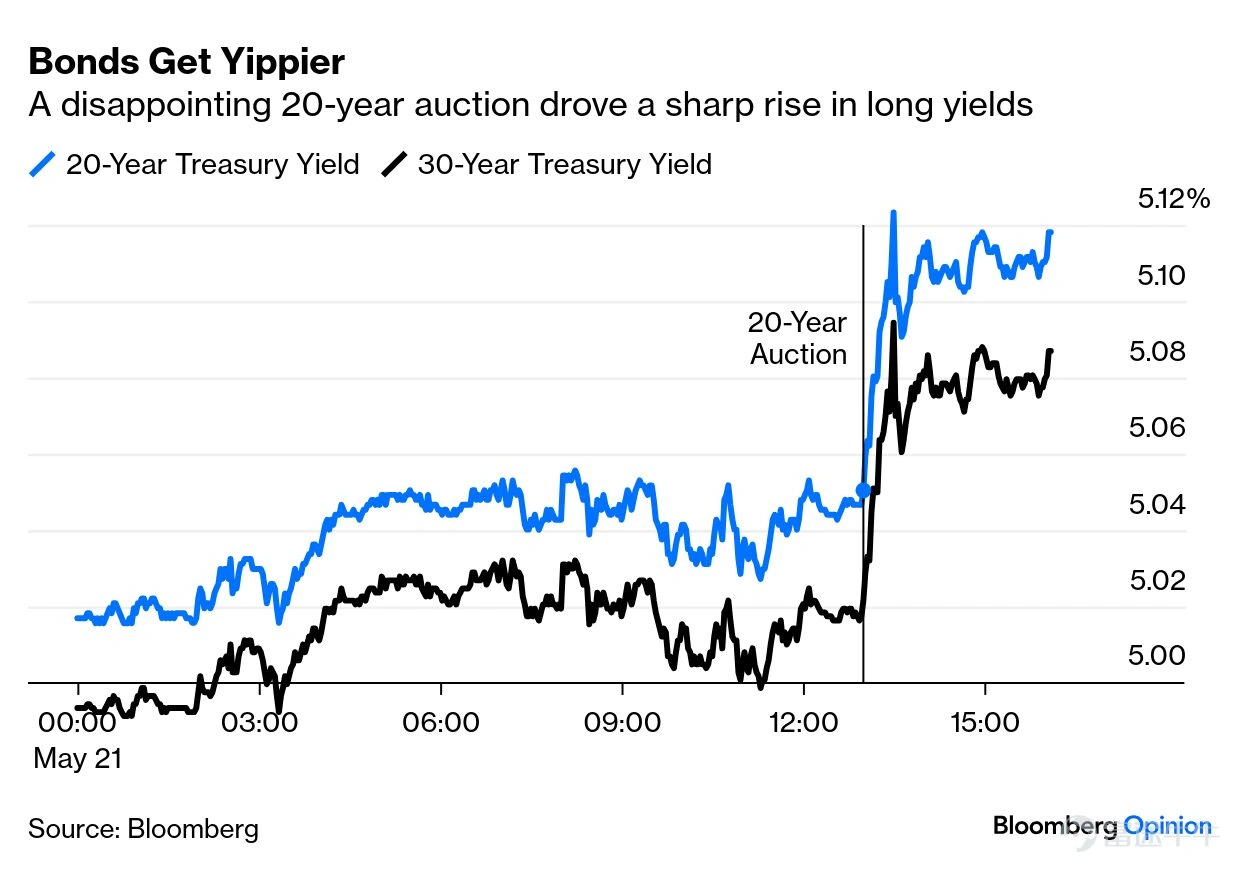
Tonight's auction results will directly test the true strength of market demand for long-term Treasury bonds in the current high-interest-rate environment.If the auction results are poor (i.e., "weak demand"), it could further push up long-term yields, thereby exacerbating valuation pressure on the stock market, particularly for interest-rate-sensitive tech and growth stocks.
How to Understand U.S. Treasury Auctions: Insights Accessible to Everyday Investors
U.S. Treasury auctions are nothing to fear; they are essentially a bidding process for borrowing. We only need to focus on two core metrics:
Bid-to-Cover Ratio – a measure of demand intensity
The bid-to-cover ratio is calculated by dividing the total bid amount (the total sum offered by buyers) by the actual issuance amount (the total volume the Treasury intends to sell).
A higher ratio indicates more buyers and stronger demand; typically,above 2xis considered normal; if it falls below 2x or even lower, it may be seen as a signal of weak demand. For example, in the recent auction of 20-year U.S. Treasuries on May 21, 2025, the bid-to-cover ratio dropped to2.46x, although above 2, it has dropped significantly compared to previous instances and is at a historical low, triggering market disappointment.
Winning Bid Yield vs. When-Issued Yield — Measuring whether the "price" is reasonable
The When-Issued Yield represents the market's expected yield for the bond prior to the auction, while the Winning Bid Yield is the final yield at which the auction clears.When the Winning Bid Yield is significantly higher than the When-Issued Yield, it indicates that buyers demand higher returns to participate, reflecting insufficient demand., this phenomenon is known as a "tail."
Most of the time, US Treasury auctions are routine affairs with minimal market impact. However, two scenarios warrant special attention::
When yields are at historical highs or in sensitive ranges: As seen now, with the 30-year yield hitting a 19-year high, market nerves are on edge, and any auction result may be interpreted with amplified significance.
When issuance volume increases substantially: If the Treasury suddenly increases the issuance size, the market may become concerned due to supply pressure.
The U.S. Treasury's official website publishes the auction schedule in advance, typically releasing the schedule for the upcoming quarter on the first Wednesday of each month. Auction results are usually announced around 1:00 PM Eastern Time (1:00 AM Beijing Time the following day).
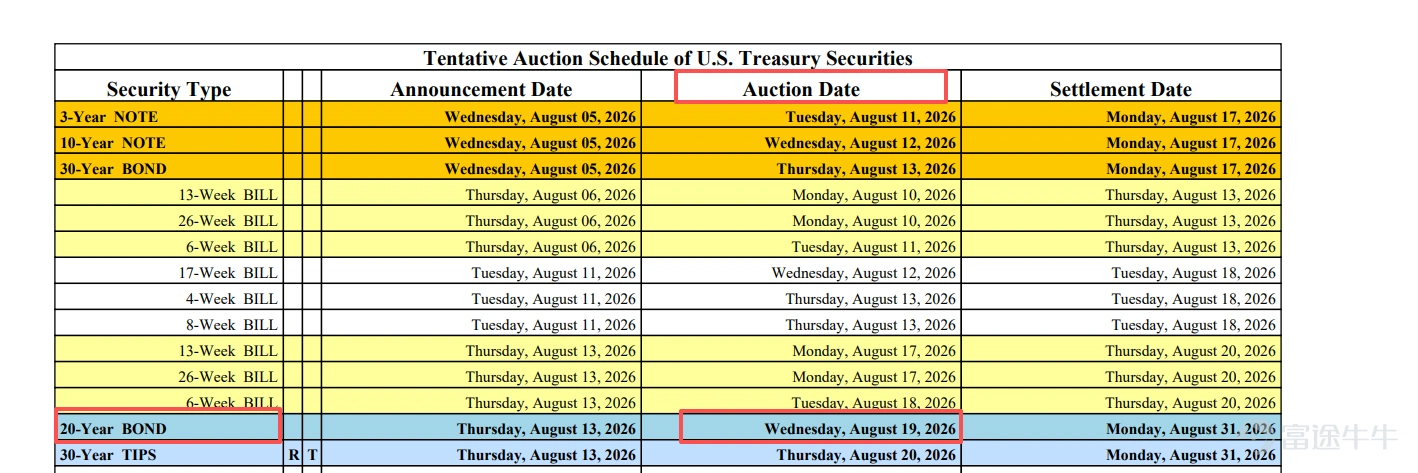
Image source: U.S. Department of the Treasury.
Defensive choices in a rising interest rate environment
Reading this, many fellow investors may sigh: "I just want to make some money; do I really need to understand macroeconomics from top to bottom and company fundamentals inside out?" The answer is: You don't need to master everything, but you must understand the broader market environment you are operating in.
Currently, U.S. Treasury yields continue to rise, indicating that the global asset pricing "anchor" is shifting, which could significantly amplify market volatility. For ordinary investors, the following strategies are worth considering:
Adjust portfolio allocation and embrace "defensive" assets
In an environment of rising interest rates and pressure on the stock market, sectors with stable cash flows, reasonable valuations, and lower sensitivity to interest rates tend to be more resilient:EnergyThis sector benefits from geopolitical conflicts driving up oil prices and boasts strong internal cash flows, showing relative strength during periods of rising interest rates;FinancialsFor this sector, especially banks, rising interest rates typically widen net interest margins and enhance profitability; whereasConsumer Staples and HealthcareDue to inelastic demand, these sectors are less affected by economic cycles, attracting capital seeking stable returns.
Specifically, representative ETFs tracking the corresponding S&P 500 sector indices include: $Energy Select Sector SPDR Fund (XLE.US)$ 、 $Financial Select Sector SPDR Fund (XLF.US)$ 、 $Consumer Staples Select Sector SPDR Fund (XLP.US)$ and $The Health Care Select Sector SPDR® Fund (XLV.US)$ , allowing investors to gain diversified exposure to the aforementioned defensive sectors.
Shift to short-duration bonds
When interest rates are high and may continue to rise, short-term bonds (such as Treasuries with maturities of 1-3 years) are a more robust choice.They have relatively lower sensitivity to interest rates; even if rates continue to rise, their price decline is far smaller than that of long-term bonds, offering flexibility to adapt to future rate changes.
$iShares 0-3 Month Treasury Bond ETF (SGOV.US)$ and $SPDR Bloomberg Barclays 1-3 Month T-Bill ETF (BIL.US)$ Focusing on ultra-short-term Treasuries offers minimal volatility and strong liquidity, with current yields exceeding 4%; $iShares 1-3 Year Treasury Bond ETF (SHY.US)$ while others provide slightly longer duration.
Meanwhile, as previously mentioned, growth tech stocks are the biggest victims of rising interest rates, as higher discount rates impact valuation logic.。The major ETFs representing growth tech stocks— $Invesco QQQ Trust (QQQ.US)$ and $VanEck Semiconductor ETF (SMH.US)$ among others, may all face pressure.
Meanwhile, long-term bonds and long-term bond ETFs, such as $iShares 20+ Year Treasury Bond ETF (TLT.US)$ , have seen staggering declines from their 2020 peaks. Long-term bond ETFs are extremely sensitive to interest rates; the longer the duration, the greater the price volatility. Until the upward trend in interest rates reverses, buying the dip on long-term bond ETFs carries significant risk.
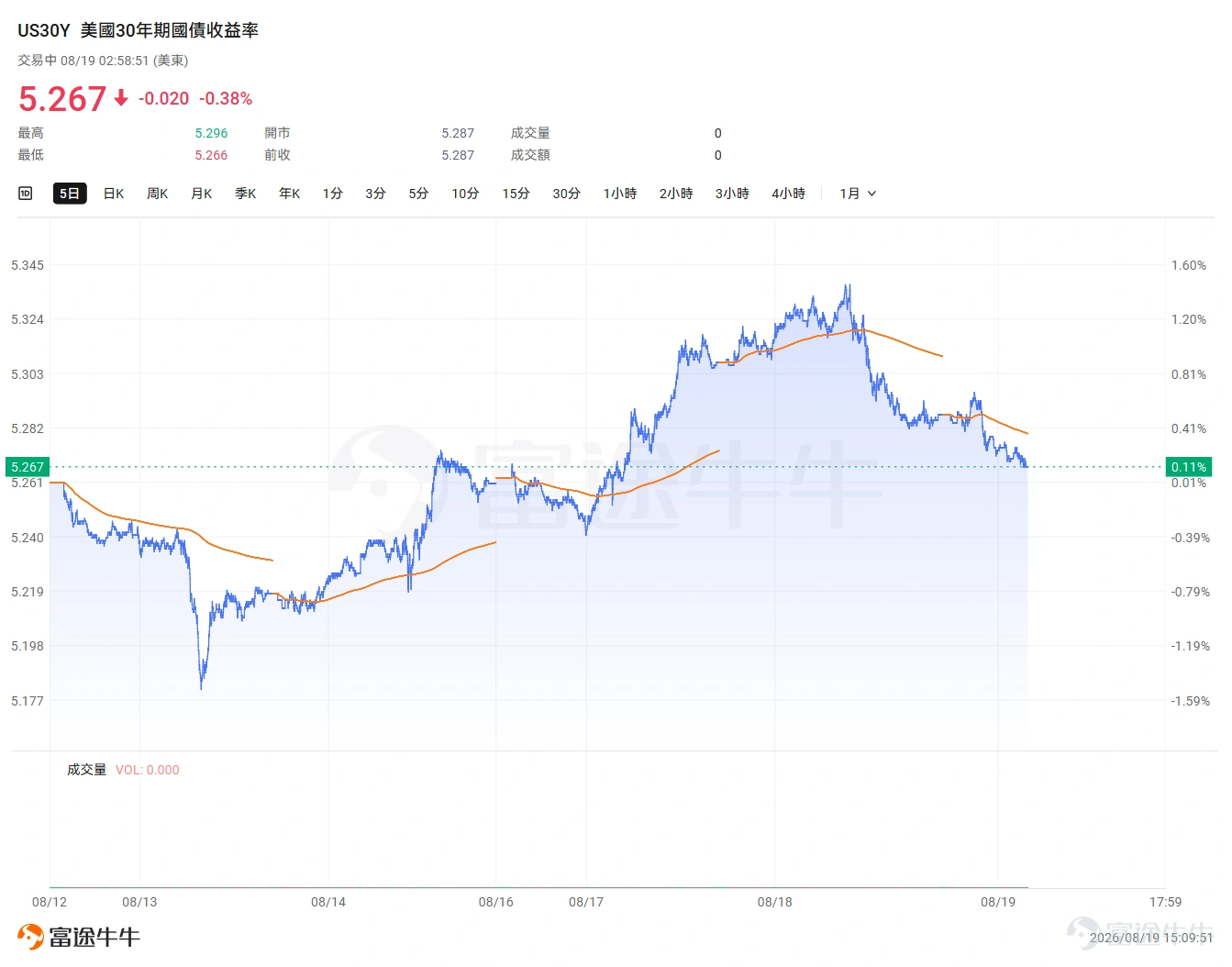
However, it is worth noting that after yesterday's surge, U.S. medium- to long-term bond yields had retreated by the time of publication.Tonight's auction of 20-year U.S. Treasury bonds will clearly reflect global capital's "confidence in the U.S. budget." If the results are favorable, the market may continue to find relief; if the auction "goes off the rails," it could spark a new round of rising yields, further transmitting pressure to the stock market. Let's wait and see how it unfolds.
Risk Disclaimer: The above content only represents the author's view. It does not represent any position or investment advice of Futu. Futu makes no representation or warranty.Read more


Comments (9)
to post a comment
49
157