The Fed raises interest rates for the first time in three years! How will the market react?

Options Sir on Macro | This Week's Focus: The CPI 'Main Shock' Night – After a Surprisingly Weak NFP, How Will the Fed’s September Rate Hike Uncertainty Resolve?
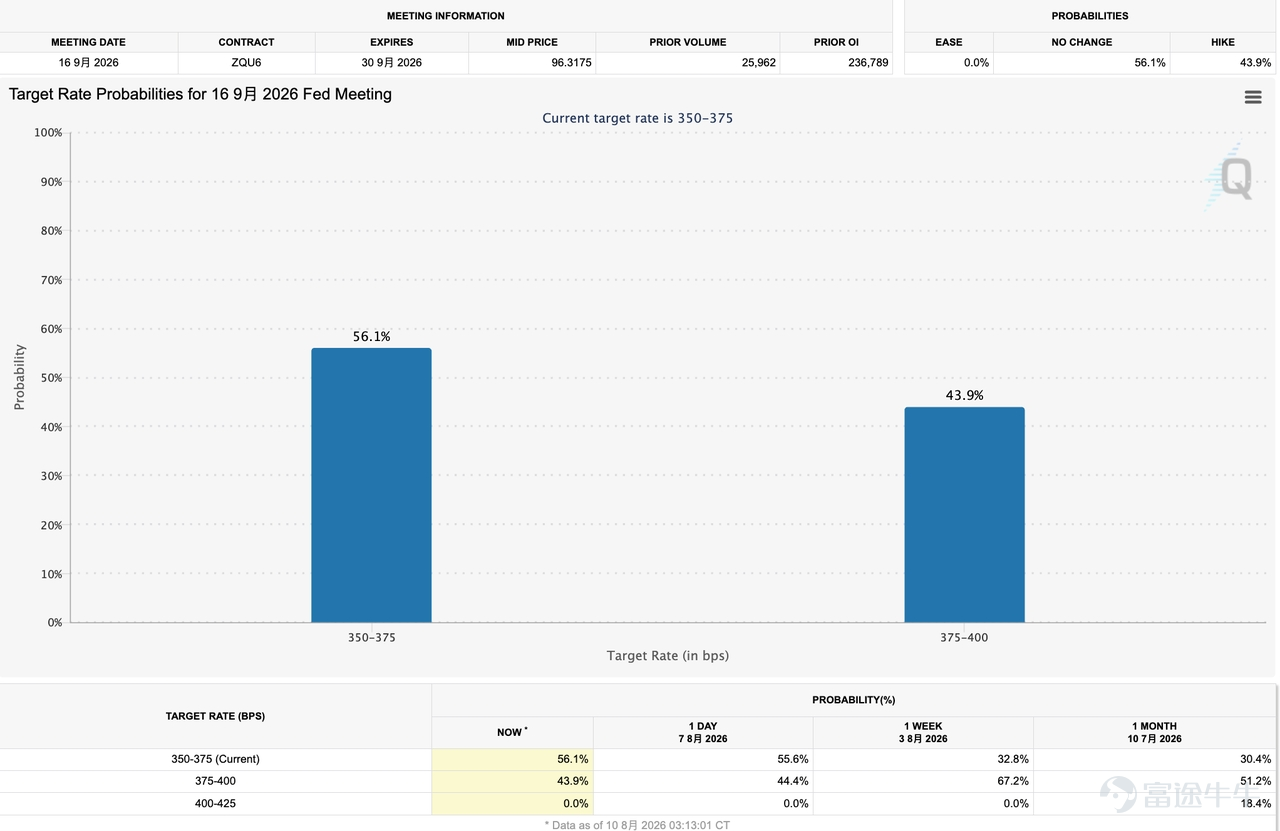
Last Friday, the U.S. July nonfarm payrolls report dropped a major variable into global capital markets: nonfarm payrolls declined by 23,000, far below the market expectation of approximately 83,000. Following the release, market expectations for a Fed rate hike in September quickly diminished, with the dollar and Treasury yields weakening in tandem, while U.S. equities and gold saw a temporary rebound. As of this writing, CME FedWatch data shows the probability of a 25-basis-point rate hike in September has fallen to 43.9%.

Right now, fellow investors may be more concerned about the next question: Will the July CPI—set to be released this Wednesday (August 12)—push the probability of a September FOMC rate hike higher again, or further confirm a 'hold steady' stance? Under the Waller-era framework of 'less forward guidance and greater reliance on data,' the market impact of this inflation reading could be larger than in any typical, uneventful month.
I. This Wednesday’s Triple Data Release: What Questions Will CPI, PPI, and Retail Sales Each Answer?
This week’s U.S. macroeconomic calendar is highly packed, serving as the first stress test en route to the September FOMC meeting.
(1) CPI: Does inflation persistence still exist?
The July CPI will be released at 8:30 a.m. ET on August 12.Market consensus broadly points to a year-over-year headline CPI increase of +3.4% and a core CPI increase of +2.5%; both figures remain significantly above the Federal Reserve's 2% target. In June, headline CPI posted a rare sharp month-over-month decline in recent years due to a substantial drop in energy prices, but the stickiness in core services prices did not dissipate accordingly.
Ellen Zentner, Chief Economic Strategist at Morgan Stanley Wealth Management, noted that the weak jobs report has eased immediate pressure for a September rate hike, but if inflation data remains hot, hawkish voices within the Fed may not stay quiet.
For investors, a CPI print above expectations typically pushes up U.S. Treasury yields and weighs on growth stock valuations; conversely, another softer-than-expected reading would reinforce the narrative of 'weakening labor market + easing inflation,' potentially further boosting market risk appetite.
(2) PPI: Will it indicate whether cost pressures are seeping downstream?
The U.S. July PPI will be released Thursday at 8:30 p.m. ET, offering a more direct look at businesses’ input costs.Markets expect July’s headline PPI to rebound by 0.2% month-over-month, with core PPI rising 0.3% month-over-month, ending the decline seen in June. As a leading indicator for CPI, changes in industrial goods and logistics service prices typically feed through to consumer prices with a lag of one to two months.
If PPI shows significant strength while CPI remains moderate, markets may interpret this as 'businesses have not yet fully passed on cost pressures'—a short-term positive for corporate profit expectations but a medium-term concern for renewed acceleration in consumer prices. Conversely, if both PPI and CPI ease in tandem, it would suggest a path of cooling driven by both demand and costs.
(3) Monthly Retail Sales: Can domestic demand remain resilient despite weakening employment?
At 20:30 ET on Friday, the U.S. July monthly retail sales report will be released, offering insight into whether softening labor conditions have already started to weigh on consumer spending.Following the unexpectedly weak nonfarm payrolls data, markets are especially sensitive to signs of a pullback in consumption: a significant miss in retail sales would signal deteriorating household income expectations and contracting spending, heightening concerns about 'stagflation' in the U.S. economy and pressuring broad equity markets; conversely, stronger-than-expected retail figures would demonstrate the resilience of domestic demand, suggesting that even with cooling employment, the risk of a hard economic landing remains contained, supporting the ongoing narrative of a soft landing for U.S. equities.
II. Could This CPI Release Trigger Greater Market Volatility?
Unlike during the Powell era, multiple structural factors are now converging, potentially making this CPI release significantly more market-sensitive than those of recent months.
- Energy price volatility may not yet be fully reflected
Geopolitical tensions earlier in the year pushed oil prices sharply higher, followed by a retreat from those peaks. The subsequent drop was largely captured in June’s CPI as a substantial drag from the energy component. However, the transmission of energy prices to transportation, services, and core goods exhibits a lag—falling oil prices don’t immediately translate into lower core inflation; similarly, renewed Middle East tensions pushing oil prices higher again in July could make the disinflationary benefit from energy appear inconsistent in the monthly headline reading.
Investors should monitor both 'headline CPI' and 'CPI excluding energy' to avoid being misled by short-term swings in energy prices.
- Nonfarm payroll data suggests underlying inflationary pressures may be easing
U.S. average hourly earnings in July were nearly flat month-over-month and rose approximately 3.2% year-over-year—both below market expectations and among the lowest levels in recent years. Slowing job growth and wage gains indicate that the 'wage–services inflation' feedback loop is showing signs of loosening.
- Under Waller, policy communication has shifted from 'forward guidance' to 'data dependency'
Current Fed Chair Waller has completely abandoned the forward guidance approach of the Powell era. Policy statements have been significantly streamlined, no longer providing advance signals about the interest rate path. He has also proposed reforms to reduce the frequency of FOMC meetings and press conferences, fully pivoting monetary policy decisions to a 'data-dependent, meeting-by-meeting assessment' framework.
In the past, markets could anticipate policy direction through Fed officials’ speeches and the dot plot, hedging against data-driven volatility. Now, without clear guidance, every CPI and employment report becomes the sole basis for market pricing of interest rates, significantly amplifying both the magnitude and persistence of market moves triggered by data surprises.
Waller has repeatedly stated publicly that if inflation remains persistently above target, a rate hike remains an option at the September meeting. Only a series of consistently mild inflation readings would eliminate the Fed’s inclination to tighten policy—making this week’s CPI report the first critical inflection point in the second half of the year.
III. Index Options Strategies
After the July nonfarm payrolls report, rate hike expectations declined, but inflation may ultimately anchor the Fed’s September decision. Facing an event window characterized by uncertain direction and elevated volatility, this article uses $Invesco QQQ Trust (QQQ.US)$ as an example to illustrate options strategies. As of this writing, QQQ index options have an implied volatility (IV) of 22.74%, with IV percentile at a moderately low level.

(1) Protective Put — Buying Insurance for Your Position
Investors holding spot positions in index ETFs such as $Invesco QQQ Trust (QQQ.US)$ When holding QQQ or a basket of tech positions, buying near-term at-the-money or slightly out-of-the-money puts is equivalent to purchasing insurance for your holdings. This strategy suits medium- to long-term investors who don’t want to reduce positions but are concerned about short-term black swan events.
If CPI comes in hotter than expected and the market plunges, the put option gains value, offsetting losses in the equity position. If inflation is mild and the index rises, the investor only loses a small amount of premium while retaining full upside potential from the long stock position. The main risk arises if the index trades in a narrow range, leading to losses from time decay of the option premium.

(The illustrative chart shown on screen uses QQQ as an example for demonstration purposes only and does not constitute any investment advice or guarantee; market prices change frequently, and the displayed price does not reflect actual market conditions.)
(2) Bull Call Spread — Moderately bullish with controlled cost
If an investor believes that weakening employment data has already reduced the market’s pricing for a September rate hike, and CPI is likely to meet or come in below expectations—making the index more prone to sideways strength or a modest rebound—they could buy a call option with a lower strike price while simultaneously selling a call option with a higher strike price to construct a bull call spread.
This strategy involves a limited net premium outlay to capture the spread between the two strike prices if the index rises toward the higher strike. The risk is that if the index drops sharply or trades sideways, the entire net premium may be lost; moreover, upside gains are capped, causing the position to underperform in a strong, one-sided rally.

(The illustrative chart shown on screen uses QQQ as an example for demonstration purposes only and does not constitute any investment advice or guarantee; market prices change frequently, and the displayed price does not reflect actual market conditions.)
(3) Long Straddle — Betting on volatility, not direction
If an investor prefers not to take a directional bet on the index, they could consider simultaneously buying a call and a put with the same expiration date and strike price, betting that the CPI release will trigger a sufficiently large one-sided move.
This strategy can generate net profit when market volatility is high enough—the gain on one side may offset the loss on the other and yield a net gain. The risk arises if CPI meets expectations and the index exhibits little movement, causing implied volatility to collapse afterward (IV crush), which could erode the premiums on both options.

(The illustrative chart shown on screen uses QQQ as an example for demonstration purposes only and does not constitute any investment advice or guarantee; market prices change frequently, and the displayed price does not reflect actual market conditions.)
IV. Futures/ETF Instruments: Event-Driven Positioning in Equity Index and Gold Futures Around CPI Data Releases
CPI has a particularly strong transmission effect on assets sensitive to real interest rates. When inflation exceeds expectations and repricing of rate hikes resurges, rising real interest rates often suppress gold prices, while equity market volatility simultaneously amplifies. Conversely, if CPI comes in softer alongside weakening employment data, leading to a decline in real interest rates, this tends to support gold performance.
Gold futures-related instruments:$Gold Futures (DEC6) (GCmain.US)$ 、 $E-mini Gold Futures (DEC6) (QOmain.US)$ 、 $E-micro Gold Futures (DEC6) (MGCmain.US)$ 、 $1-Ounce Gold Futures (DEC6) (1OZmain.US)$
Gold ETF-related instruments: $SPDR Gold ETF (GLD.US)$ 、 $VanEck Gold Miners Equity ETF (GDX.US)$ 、 $iShares Gold Trust (IAU.US)$ 、 $Spdr Gold Minishares Trust (GLDM.US)$ 、 $Sprott Physical Gold Trust (PHYS.US)$ 、 $ISHARES GOLD TRUST MICRO (IAUM.US)$ 、 $Direxion Daily Gold Miners Index Bull 2X Shares (NUGT.US)$ 、 $ProShares Ultra Gold (UGL.US)$ etc.

--
--
--
Futures offer the advantage of no option premium decay, but margin requirements and overnight volatility risk require attention.
Summary
The weaker-than-expected nonfarm payroll report has shifted market expectations for a September rate hike from near-consensus back to uncertain; this week’s CPI release could determine whether this uncertainty continues or is quickly resolved.
 Fellow investors, what do you think—how will US stocks perform after this CPI release?
Finally, we’ve got a little perk for our fellow investors—feel free to claim it!Options Starter Pack
*This promotion is exclusively available to invited Hong Kong users. Click to learn more.Detailed terms and conditions of the promotion >>

Disclaimer
This content does not constitute an offer, solicitation, recommendation, opinion, or any guarantee regarding any securities, financial products, or instruments. The risk of loss in trading options can be substantial. In certain circumstances, your losses may exceed the initial margin deposit you made. Even if you have placed contingent orders, such as stop-loss or limit orders, these may not necessarily prevent losses. Market conditions may prevent such orders from being executed. You may be required to deposit additional margin on short notice. If you fail to meet the required margin within the specified time, your open positions may be liquidated. Nevertheless, you remain fully liable for any resulting deficit in your account. Therefore, you should thoroughly research and understand options before trading, and carefully consider whether such transactions are appropriate for you based on your financial situation and investment objectives. If you trade options, you should familiarize yourself with the procedures for exercising options and handling expiration, as well as your rights and responsibilities upon exercise or expiration.
Risk Disclaimer: The above content only represents the author's view. It does not represent any position or investment advice of Futu. Futu makes no representation or warranty.Read more


Comments (12)
to post a comment
42
72