
US CPI data released Wednesday! Combined with major Hong Kong stock earnings reports, what should yo

Daily Options Income Strategy | SNDK Halved from Highs, IV Soars to 140%—Can the $1,000 Level Hold?
I. Market Barometer
On Wednesday, July 29, 2026, all three major U.S. stock indices declined sharply, with the semiconductor sector suffering heavy losses, $PHLX Semiconductor Index (.SOX.US)$ plunging 5.33%, as panic sentiment surged rapidly, driving implied volatility of individual stock options to historic highs.
II. Watchlist Highlights
SNDK: Stock price has halved from its peak—can it hold the $1,000 level?
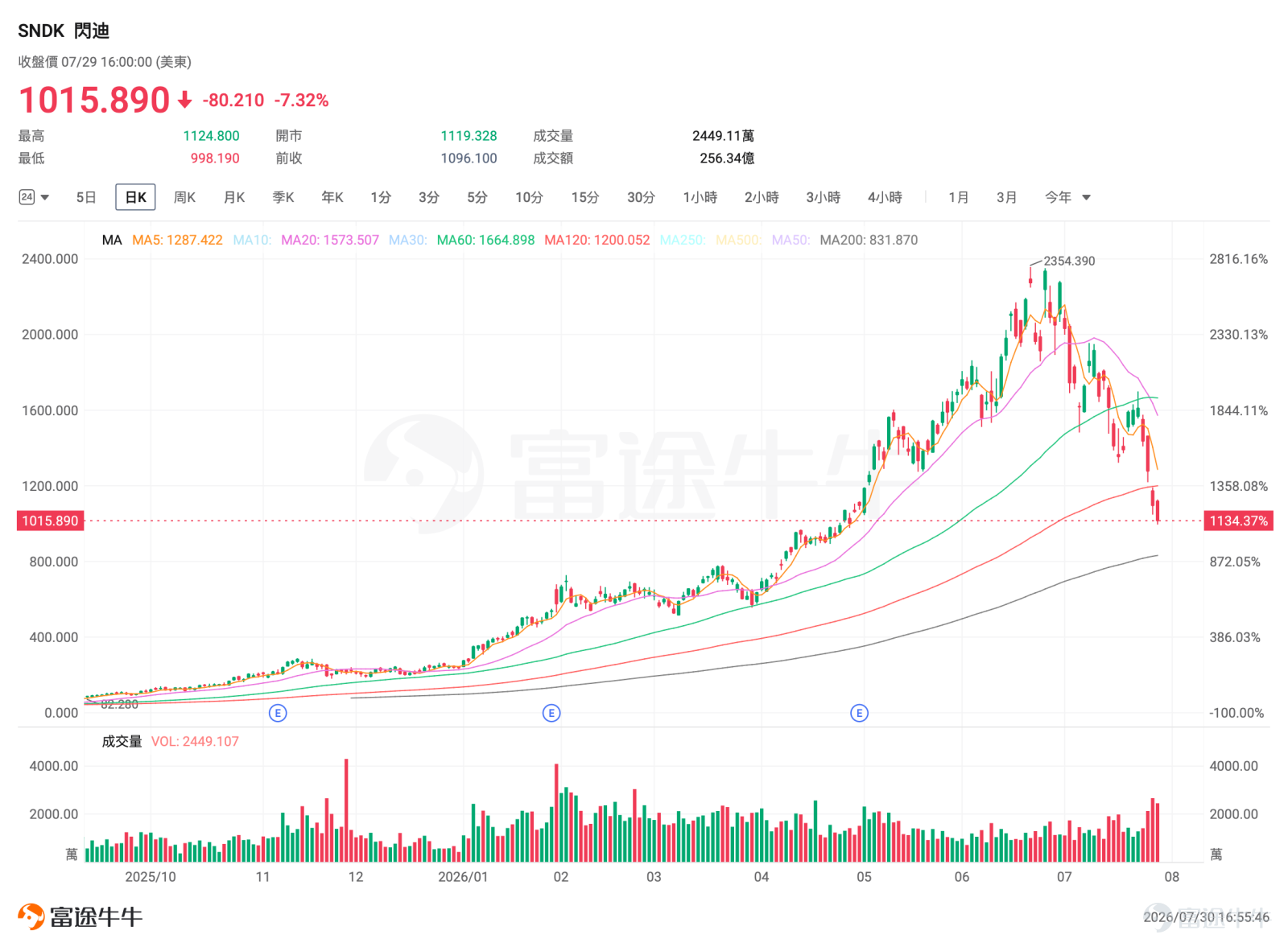
$SanDisk (SNDK.US)$ The stock closed down 7.32% on the previous trading day (July 29) at $1,015.89, briefly dipping as low as $998.19 intraday. Trading volume reached an exceptionally high 25.634 billion shares, with a turnover rate of 16.31%, reflecting sustained panic-driven selling pressure. The stock has tumbled 57% cumulatively since its all-time high of $2,354.39 on June 22.

SanDisk is currently in an accelerating downtrend phase.The stock price has already been cut in half from its all-time high. The 200-day moving average now stands as the sole remaining long-term support barrier. Previously, the 20-day moving average crossed below the 50-day moving average, forming a death cross, and a head-and-shoulders top pattern has confirmed a breakdown. The RSI remains deep in oversold territory, yet this persistent oversold condition has failed to trigger a meaningful rebound, reflecting market caution ahead of the August 5 earnings report. The psychological support at the round $1,000 level is under scrutiny, especially after it was briefly breached to $998.19 yesterday, casting doubt on the validity of this support level.
The core driver behind this sharp sell-off is a systemic wave of selling across the semiconductor sector.According to multiple media reports, the semiconductor sector is currently experiencing its largest capital outflow since the pandemic began—with retail investors recording net selling for nine consecutive trading days, and AI-related memory stocks facing concentrated sell-offs.
‘Record-breaking profits alongside plunging share prices’ has become the central contradiction in today’s memory chip sector.Key variables to monitor going forward include: whether SanDisk’s Q4 fiscal results (corresponding to Q2 2026) can meet high-growth expectations, the trend in spot prices for memory chips, and whether there are clear signs of an actual slowdown in AI-related capital expenditures.
For detailed analysis, click >>Five Key Truths Behind the 'De-leveraged' Plunge in Semiconductor and Memory Sectors and What to Watch Next
3. Options Premium Collection Strategy
1. Cash Secured Put
Sell 1 contract of $SanDisk (SNDK.US)$ 260807 705P, estimated required margin (for reference only): $70,500

Opportunity Rationale:
The current panic selling in the semiconductor sector has created a window for premium-selling strategies under high volatility, $SanDisk (SNDK.US)$ The option's implied volatility is as high as 140.14%, sitting at the 95.63rd percentile historically, indicating that option prices are extremely inflated. The premium received from selling puts is at a historically rare high.
The $705 strike price offers nearly a 30% margin of safety relative to the current price. If the stock stabilizes or rebounds, the seller can collect the premium as yield on idle capital; if the price continues to decline and assignment occurs near the strike, it effectively allows entry into the position at a discounted price. This strategy suits investors who have sufficient cash to cover potential assignment and are willing to take a long position at the strike price.
2. Covered Call

Opportunity Rationale:
For investors already holding 100 shares $SanDisk (SNDK.US)$ of the underlying stock, there is currently no clear sign of stabilization amid the ongoing short-term selloff in the semiconductor sector, yet selling outright would mean forfeiting the chance to benefit from potential upside surprises in earnings reports. By selling calls now, investors can capitalize on the extremely high implied volatility of 140.14% to collect substantial premiums, effectively lowering their cost basis and partially hedging against further near-term downside risk.
If the stock rebounds and gets called away at this strike, it locks in profits near a short-term target price; if the stock continues to consolidate sideways, the premium provides cash flow compensation for the position. Investors can evaluate the risk-reward profiles of different strike-expiry combinations by referencing real-time option chain quotes and margin requirements.
IV. Risk Management Advisory
Although seller strategies have a high win rate, investors must still implement proper risk management:
– Position management is everything.: The biggest risk for option sellers lies in black swan events. It is recommended that margin allocated to any single underlying should not exceed 20% of total capital. Never sell options beyond your capacity to absorb losses just for the sake of collecting higher premiums.
– Covered Call and Timely Rolling: When a covered call becomes deeply in-the-money (i.e., the stock price far exceeds the strike price), if you remain bullish on the underlying stock, you should decisively 'roll' the position—buy to close the current option and simultaneously sell a longer-dated call with a higher strike price—to avoid having your shares called away at an unattractive price.
– Cash-secured put options: Beware of 'left-tail risk': For cash-secured puts, if the stock price crashes due to fundamental deterioration (rather than a normal pullback), don’t hold on stubbornly. In such cases, exit with a stop-loss or roll the position down to buy time while waiting for volatility to normalize.
Make good use of the Options Seller Hub to understand income strategies for selling options and earnOption premiums!

Options Risk Disclosure
An option is a contract that gives the holder the right—but not the obligation—to buy or sell an underlying asset at a predetermined price on or before a specified date. Option prices are influenced by multiple factors, including the current price of the underlying asset, the strike price, time to expiration, and implied volatility. Implied volatility reflects the market's expectation of future volatility over the life of the option and is derived by back-solving from the Black-Scholes option pricing model. It is commonly viewed as an indicator of market sentiment. When investors anticipate higher volatility, they may be willing to pay more for options to hedge their risk, leading to higher implied volatility. Traders and investors use implied volatility to assess the attractiveness of option prices, identify potential mispricings, and manage risk exposure.
Disclaimer
This content does not constitute an offer, solicitation, recommendation, advice, opinion, or any guarantee regarding any securities, financial products, or instruments. The risk of loss in trading options can be substantial. In certain circumstances, your losses may exceed the initial margin deposit. Even if you place contingent orders, such as 'stop-loss' or 'limit' orders, there is no guarantee they will prevent losses. Market conditions may render such orders unexecutable. You may be required to deposit additional margin on short notice. If you fail to meet the required margin within the specified timeframe, your open positions may be liquidated. Nevertheless, you remain fully responsible for any resulting deficit in your account. Therefore, prior to trading options, you should thoroughly study and understand options and carefully consider whether such trading aligns with your financial situation and investment objectives. If you trade options, you should become familiar with the procedures for exercising options and handling expiration, as well as your rights and obligations upon exercise or expiration. Options trading involves substantial risk and is not suitable for all investors. Investors should carefully read 'Characteristics and Risks of Standardized Options' before engaging in any options trading strategy.
Risk Disclaimer: The above content only represents the author's view. It does not represent any position or investment advice of Futu. Futu makes no representation or warranty.Read more


Comment (1)
to post a comment
34
14